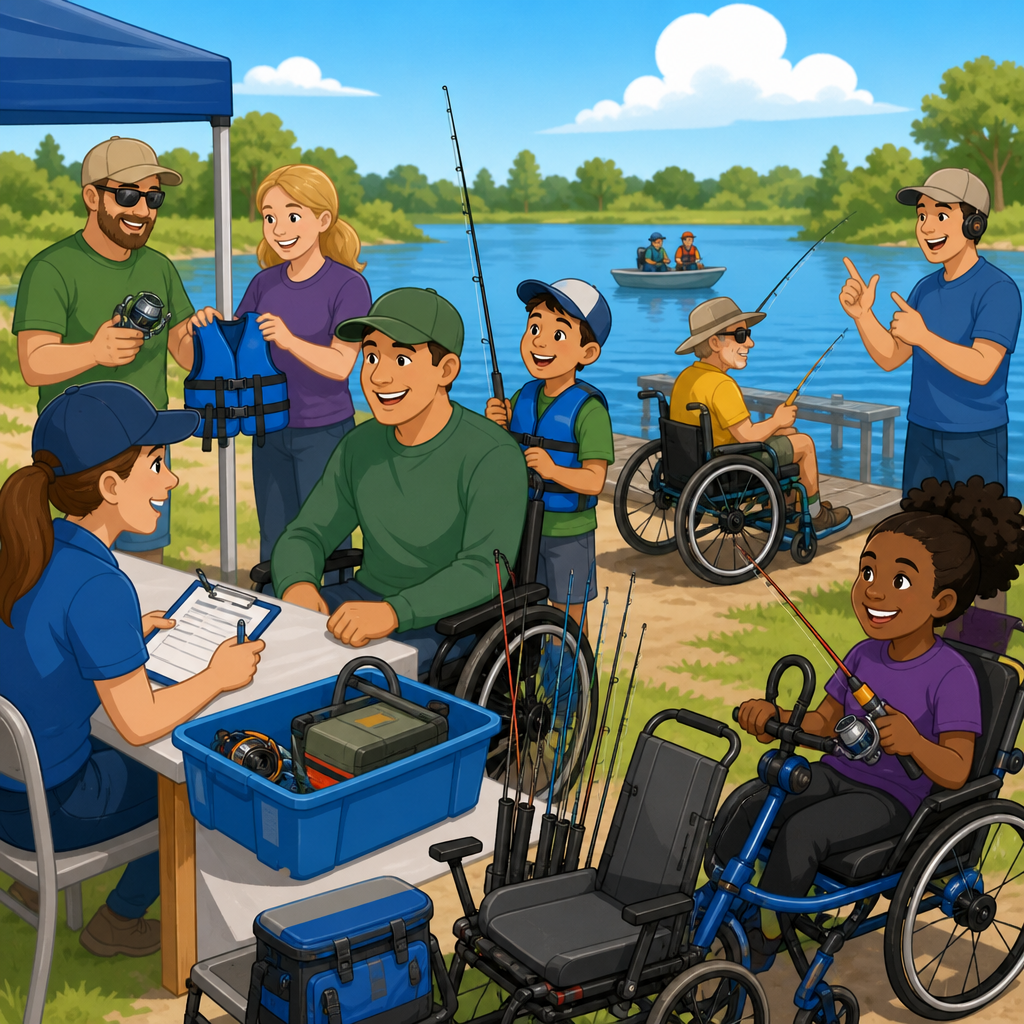
Adaptive fishing events make angling possible for people with disabilities by combining accessible registration, equipment loans, and communication access into one coordinated participant experience. In parks, recreation, and adaptive sports programs, these events are more than community outings; they are operational models that show how inclusion works on the ground. When an agency gets the intake form right, matches people to suitable gear, and plans clear communication before, during, and after the event, participation rises and safety improves.
In practice, adaptive fishing means modifying the environment, equipment, instruction, and staffing so anglers with mobility, sensory, cognitive, developmental, or health-related disabilities can fish with dignity and as much independence as possible. Registration is the system for collecting needs and preferences without creating barriers. Equipment loans are the process for providing rods, reels, mounts, seating, transfer supports, life jackets, and other tools that participants may not own. Communication access covers everything from plain-language emails and captioned videos to interpreters, tactile maps, visual schedules, and on-site announcements that everyone can understand.
I have seen events succeed or fail based on these basics rather than on fish stocking, weather, or sponsorship logos. A beautiful lakefront means little if a family cannot finish the online form, if a wheelchair user arrives and finds only standard folding chairs, or if safety instructions are shouted once over a noisy crowd with no captions or interpreter. By contrast, modest community ponds often deliver outstanding experiences when staff use accessible forms, pre-fit loaner gear, and communication plans tailored to participants. That is why this topic matters across the full parks, recreation, and adaptive sports landscape.
As a hub article for industry-specific guides, this page maps the core decisions agencies, nonprofits, camp operators, therapeutic recreation teams, and event partners must make. It explains how to build an inclusive event lifecycle, from outreach and registration through check-in, fishing support, emergency procedures, and follow-up. It also highlights where this subtopic connects to adjacent needs such as ADA route planning, volunteer training, waterfront risk management, adaptive equipment maintenance, and equitable program evaluation. If you are creating or improving adaptive fishing events, start with the systems here, because access is operational, not aspirational.
Registration systems that reduce barriers before arrival
Registration is the first access point, and it often determines whether a participant ever reaches the shoreline. The best systems collect only necessary information, explain why each question matters, and offer multiple ways to register. At minimum, programs should provide a mobile-friendly web form, phone registration, and an email contact for accommodation requests. Many municipal parks departments use platforms such as ActiveNet, RecTrac, or CivicRec; each can work if the form design is simple, screen-reader compatible, and free from unnecessary timeouts or image-based fields that confuse assistive technology.
A strong adaptive fishing registration form asks practical questions in plain language. Instead of a broad prompt such as “Describe disability,” ask what support will help participation: transfer assistance, low-sensory check-in, seating with back support, adaptive reel preference, interpreter, captioning, large print, medication timing, dietary needs, or space for a support person. This shifts the process from medical disclosure to functional planning. It also aligns with how experienced recreation staff actually allocate resources. I have found completion rates increase when forms estimate the time required, save progress, and clearly separate required fields from optional fields.
Capacity management is another essential registration function. Adaptive events usually have tighter staffing ratios and finite gear inventories, so open enrollment without controls can create unsafe conditions. Use reservation windows, waitlists, and equipment-specific inventory limits. For example, if you have four rod holders for power wheelchair users and two left-hand adaptive spinning reels, those items should be reserved within the registration workflow, not improvised at check-in. Confirmation emails should restate what was requested, what will be provided, arrival directions, parking details, restroom information, weather policies, and a direct phone number for day-of-event support.
Privacy and dignity matter. Store participant information securely, limit staff access to need-to-know details, and avoid public check-in conversations about diagnosis. A good script is simple: “We have your accessibility requests and your equipment is ready at Station B.” If a program serves minors or adults with guardians, consent forms should distinguish emergency authorization, photo release, transportation arrangements, and loaned-equipment responsibility. This creates smoother operations and reduces the risk of asking families to repeat sensitive information multiple times.
Equipment loans that turn interest into participation
Equipment loans are often the difference between an inclusive invitation and a usable program. Fishing requires a chain of components: rod, reel, line, terminal tackle, bait, seating or positioning support, and often a dock or shoreline adaptation. If even one link fails, the participant may watch rather than fish. Effective loan programs therefore start with task analysis. Staff should break fishing into stages such as gripping, casting, line control, hook setting, reeling, fish handling, and release. Then they can match adaptations to the task that is difficult, instead of making assumptions based on diagnosis alone.
Common loan items include one-handed rod holders, forearm cuffs, push-button or lever-activated casting aids, spincast reels for beginners, electric reels for limited endurance, high-contrast bobbers for low vision, tactile strike indicators, quiet fidgets for waiting periods, and weighted rod rests that stabilize gear on docks. For mobility needs, provide transfer benches, beach wheelchairs where terrain requires them, adjustable-height tables for baiting and tackle setup, and PFDs in varied cuts and sizes. For some participants, the most important adaptation is not the rod at all but supportive seating that reduces fatigue and trunk instability.
Loan inventories should be labeled, logged, inspected, and cleaned like any other safety-critical equipment. A basic asset system can be managed in Airtable, Smartsheet, or a parks inventory module, but it must track maintenance dates, missing parts, line replacement, battery status for powered devices, and sanitation procedures for shared contact surfaces. Staff should test every setup before participants arrive. I have repeatedly seen preventable failures caused by frayed line, mismatched reel orientation, dead batteries, or mounts that fit one dock rail but not another. Reliability builds trust faster than any promotional campaign.
| Equipment category | Access need addressed | Typical loan example | Operational note |
|---|---|---|---|
| Rod and reel adaptation | Limited grip, reach, or endurance | Rod holder with spincast reel | Pre-rig and label by handedness |
| Positioning support | Postural stability or transfer needs | Adjustable chair with arm support | Check surface stability at shoreline |
| Sensory access tool | Low vision or sensory regulation | High-contrast float or tactile marker | Keep backup sets at each station |
| Communication support | Hearing, speech, or cognitive access | Laminated visual instruction cards | Use the same icons in pre-event emails |
Equipment loans also need clear participant education. A five-minute fitting session can prevent an hour of frustration. Show how to lock a rod holder, where to rest hands, what the reel resistance feels like, and how to signal for help. Written and pictorial instructions should travel with the gear so volunteers can reinforce the same method. If possible, photograph common setups and create a quick-reference binder. Standardization matters when volunteers change from event to event.
Communication access across outreach, instruction, and safety
Communication access is not a single accommodation; it is a layered system that begins before registration and continues through follow-up. Promotional materials should use plain language, readable fonts, descriptive alt text, and concrete descriptions of the site. Tell people whether the route is paved, whether the dock has edge protection, how far parking is from check-in, whether bait handling is optional, and whether quiet space is available. Vague language such as “fully accessible” is unhelpful because participants define access differently. Specificity allows informed decision-making.
Before the event, send information in more than one format. A text email may work for some participants, while others benefit from a captioned orientation video, a printable social narrative, or a large-print checklist. For Deaf participants, reserve qualified interpreters early and share agenda materials in advance. For blind or low-vision participants, describe landmarks and tactile cues, not just visual signs. For participants with intellectual or developmental disabilities, a visual schedule showing arrival, check-in, safety briefing, fishing time, snack break, awards, and departure reduces uncertainty and behavior escalation.
On site, use redundant communication channels. Important instructions should be spoken, displayed visually, available in writing, and repeated at the fishing station. This is especially important for water safety rules, hook handling, and emergency procedures. Staff radios help operations, but participant-facing communication should include portable whiteboards, picture cards, printed maps, and consistent iconography. In noisy environments, speech alone is unreliable. I have learned that a simple laminated card set explaining cast, wait, reel, stop, fish on, and need help can transform participation for many anglers, including children, nonspeaking participants, and multilingual families.
Communication access also affects dignity and enjoyment. Announce catches in ways that participants choose, ask before offering physical help, and avoid talking to companions instead of to the angler. If a participant uses AAC, leave time for responses. If someone has sensory sensitivities, identify quieter bank locations and reduce sudden microphone announcements nearby. The most successful events train every volunteer in these basics rather than assigning communication access to one specialist. Inclusion works best when the whole team shares the practice.
Site design, staffing, and risk management for adaptive events
Adaptive fishing events succeed when site design, staffing, and risk management are planned together. Start with the route from parking to water. Measure slope, cross-slope, surface firmness, transition lips, gate widths, and turning radius at key points. Confirm accessible restrooms are unlocked and stocked. Check whether docks have stable guardrails, toe clearance for seated anglers, and enough width for passing. If the permanent site has barriers, temporary solutions may help, but they do not replace careful review. A portable mat can improve traction; it cannot solve a steep grade that exhausts participants before they reach the water.
Staffing models should reflect support intensity, not just attendance. A common mistake is counting volunteers without assigning roles. At minimum, designate a registration lead, access coordinator, equipment manager, shoreline safety lead, floating troubleshooters, and a family liaison. Ratios vary by participant profile, but one-to-one support may be necessary for new anglers with high physical assistance needs or complex communication needs. Cross-train staff so absences do not collapse the system. Every role needs a checklist covering setup, participant flow, emergency response, and teardown.
Risk management in adaptive waterfront programs must be specific. Review drowning prevention, weather evacuation, medication storage, allergy exposure from bait, hook injury protocols, seizure response, and transfer safety. Follow local waterfront regulations, parks rules, and insurer requirements, and document how accommodations intersect with emergency procedures. For example, if a participant uses a power wheelchair on a dock, staff should know the turning plan, evacuation route, and who can assist without damaging the chair or blocking egress. Practice these scenarios before the event. Tabletop drills reveal gaps that enthusiasm can hide.
Program quality improves when organizers evaluate outcomes beyond attendance. Track no-show rates, accommodation fulfillment, equipment utilization, incident reports, participant satisfaction, and return registration. Ask whether anglers felt independent, respected, and safe. Those metrics tell you more than the total number of fish caught. They also guide future hub topics across parks, recreation, and adaptive sports, including volunteer training standards, accessible outdoor marketing, funding strategies for specialized gear, and maintenance planning for inclusive waterfront infrastructure.
Building a connected hub for parks, recreation, and adaptive sports
As a sub-pillar hub, adaptive fishing connects operationally to many related subjects. Registration workflows link to broader inclusive intake practices across camps, leagues, and aquatics. Equipment loans connect to procurement, storage, sanitation, and capital budgeting for adaptive sports programs. Communication access overlaps with accessible websites, multilingual outreach, interpretation services, and emergency notification systems. Site planning connects to trails, boat launches, piers, parking, and restroom design. In other words, adaptive fishing is both a standalone program area and a practical entry point for improving inclusion across an entire agency.
This hub should guide readers to deeper resources on adaptive angling equipment selection, ADA-informed site audits, volunteer and counselor training, therapeutic recreation documentation, grant funding, and waterfront emergency action plans. It should also connect to family-facing content such as what to expect at an adaptive event, how to request accommodations, and how equipment loan policies work. Agencies that structure content this way create stronger internal linking signals, but more importantly, they help staff and families find answers quickly. Good information architecture mirrors good event design: clear paths, useful labels, and no dead ends.
The practical lesson is straightforward. Inclusive fishing does not start at the water’s edge. It starts when a participant first hears about the event and decides whether the program seems welcoming, understandable, and workable. If registration is accessible, equipment is ready, and communication is clear, more people can focus on the reasons they came: time outdoors, skill building, social connection, and the simple thrill of feeling a fish pull on the line. Review your current process, identify the first barrier families encounter, and improve that step next.
Frequently Asked Questions
What information should an adaptive fishing event registration form collect?
An effective registration form should gather more than basic contact details. It should also collect the practical information event staff need to create a safe, comfortable, and inclusive fishing experience. That usually includes emergency contacts, mobility needs, sensory considerations, communication preferences, transfer assistance needs, support person attendance, transportation questions, and any medical or behavioral information the participant wants organizers to know in advance. If equipment loans are available, the form should also ask about experience level, preferred fishing method, hand strength, seated or standing use, and whether the participant needs adaptive rods, reel modifications, rod holders, accessible seating, or other supports.
Strong intake forms are written in plain language and avoid vague questions. Instead of asking participants to “describe accommodations,” it is often better to provide clear prompts and checklists with room for additional details. This makes the form easier to complete and gives organizers more usable information. It also helps staff identify where follow-up may be needed before the event. The goal is not to over-collect personal data, but to gather enough specific information to match each participant with the right location setup, equipment, staffing support, and communication plan.
Registration should also be accessible in multiple formats whenever possible. Online forms should be screen-reader friendly, mobile compatible, and simple to navigate. Some participants may need phone registration, paper forms, language assistance, or support completing the process. When agencies treat registration as the first stage of inclusion rather than a paperwork step, they reduce confusion, prevent day-of barriers, and set the event up for success.
How do equipment loan programs support inclusion at adaptive fishing events?
Equipment loan programs are one of the most important access tools in adaptive fishing because they remove both cost barriers and fit barriers. Many participants do not own fishing gear, and even those who do may not have equipment that works well with their physical, sensory, or communication needs. A well-run loan program allows organizers to match rods, reels, tackle, seating, and adaptive accessories to the participant instead of expecting the participant to adapt to standard equipment.
That matching process can make a major difference in independence and enjoyment. For example, some anglers may do best with lightweight rods, push-button reels, one-handed adaptations, forearm supports, non-slip grips, or rod holders mounted to wheelchairs or chairs. Others may need stable shoreline seating, transfer-friendly benches, or simplified tackle setups that reduce dexterity demands. Participants with visual impairments may benefit from tactile orientation, consistent gear placement, and verbal cueing, while some neurodivergent anglers may benefit from familiar routines, quieter stations, or streamlined equipment choices that reduce overload.
Good equipment loan systems also depend on inventory planning and staff training. Organizers should know what gear they have, what condition it is in, how it is cleaned and maintained, and which items are best suited to different needs. Staff and volunteers should understand how to offer options respectfully without making assumptions. When equipment loans are organized well, they do more than provide fishing gear. They create access, improve confidence, and help participants spend more time fishing and less time struggling with equipment that was never designed for them.
Why is communication access so important before, during, and after an adaptive fishing event?
Communication access is essential because inclusion depends on participants being able to receive information, ask questions, make choices, and understand what to expect at every stage of the event. Before the event, communication access helps people decide whether to attend and how to prepare. That may include providing schedules, maps, parking instructions, weather policies, equipment details, accessibility features, and contact information in clear, usable formats. Some participants may need large print, plain language, translated materials, captioned videos, text-based communication, or direct phone follow-up to feel ready to participate.
During the event, communication access becomes even more important because safety, instruction, and participant comfort depend on it. Organizers may need to use visual supports, interpreters, assistive listening systems, communication boards, step-by-step demonstrations, or quieter one-on-one instruction. Staff should know how to get a participant’s attention respectfully, how to check understanding without rushing, and how to adjust teaching methods in real time. Clear communication also supports consent and autonomy by ensuring participants can express preferences about equipment, assistance, breaks, and activity pacing.
After the event, accessible communication remains valuable for follow-up, feedback, and retention. Participants may need accessible surveys, photos with descriptions, future event notices, or individualized follow-up about gear, licensing, or next-step programs. Agencies that invest in communication access build trust and improve repeat participation. In practical terms, that means fewer misunderstandings, stronger safety outcomes, and a more participant-centered program from start to finish.
How can organizers coordinate registration, equipment, and communication access into one smooth participant experience?
The most effective adaptive fishing events do not treat registration, equipment loans, and communication access as separate tasks. They connect them into one coordinated workflow. Registration gathers the information. Staff review that information early. Equipment is assigned based on actual participant needs. Communication plans are set before arrival. Volunteers receive role-specific guidance. The site is prepared with access routes, seating, signage, and backup options. When these systems are linked, participants experience the event as organized, welcoming, and responsive rather than improvised.
One practical way to do this is to use a pre-event planning process that includes participant profiles or access summaries. These should be limited to relevant operational details, such as mobility setup, gear needs, communication preferences, allergy alerts, support person involvement, and transfer considerations. Staff can then use that information to stage equipment in advance, assign appropriate volunteers, and confirm that everyone understands how to communicate with the participant. This reduces delays at check-in and helps avoid the common problem of solving preventable access issues at the shoreline.
Coordination also requires flexibility. Needs may change due to weather, fatigue, transportation delays, or a participant discovering that a planned setup is not the best fit. Strong events build in backup equipment, alternate communication methods, and on-site decision-making authority so staff can make adjustments quickly. In other words, smooth participant experience does not happen by chance. It comes from operational planning that respects individual needs while keeping the whole event running reliably.
What are the best practices for making adaptive fishing events safe, welcoming, and sustainable over time?
Best practices begin with planning for access as a core program function, not an added feature. That means selecting accessible fishing sites, reviewing paths of travel, confirming restroom access, checking parking and drop-off logistics, preparing shade and rest areas, and identifying emergency procedures that work for participants with a range of disabilities. It also means training staff and volunteers in disability etiquette, equipment use, communication methods, lifting and transfer boundaries, and when to ask before assisting. Safety improves when everyone understands their role and when support is offered in a respectful, consistent way.
Welcoming events also pay attention to participant dignity and independence. Organizers should use person-centered language, offer choices, and avoid assuming what someone can or cannot do. Check-in should be calm and clearly marked. Instructions should be easy to follow. Equipment should be ready. Volunteers should be introduced and supervised. Family members and support persons should be included appropriately without speaking over the participant. Small operational details like these shape whether people feel truly included or simply accommodated.
For long-term sustainability, agencies should document what worked, what equipment was used, where bottlenecks happened, and what participants requested for future events. Inventory should be maintained, replacement needs tracked, and partnerships built with parks departments, adaptive sports groups, disability organizations, and local fishing communities. Feedback should be collected in accessible formats and used to improve future programming. Over time, this approach turns one successful outing into a repeatable model for inclusive recreation, showing how thoughtful registration, equipment loans, and communication access can expand participation in a durable way.


