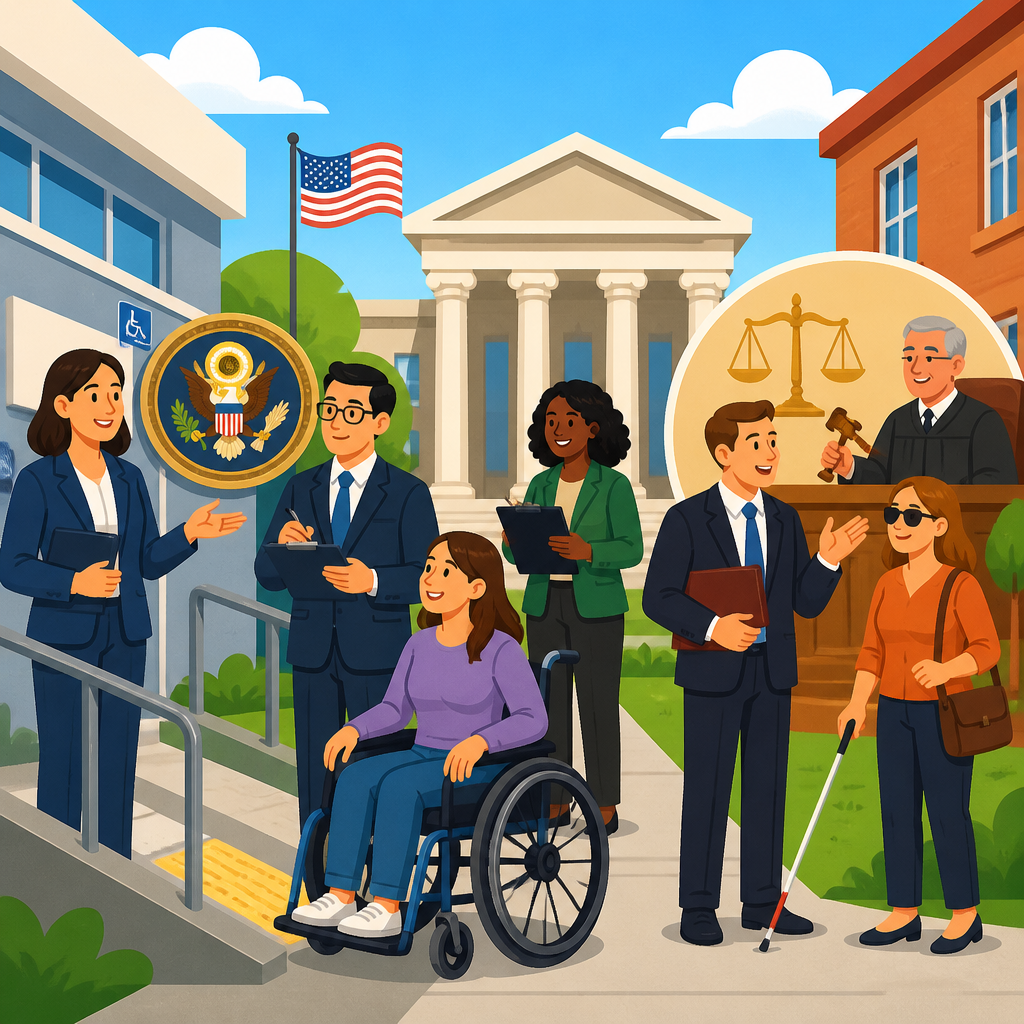
Title II of the Americans with Disabilities Act governs how state and local governments serve people with disabilities, and complaints under this part of the law usually arise when a public entity denies equal access to programs, services, or activities. In practice, Title II reaches far beyond ramps and parking spaces. It applies to public schools, police departments, courts, parks, public hospitals, voting systems, transit agencies, licensing boards, county websites, and city recreation programs. If a town offers a service to the public, Title II is usually in play.
For readers exploring ADA Titles Explained, this hub focuses on Title II: Public Entities and the ways enforcement actually happens. The three main paths are Department of Justice enforcement, enforcement by other federal agencies that fund or regulate public programs, and private lawsuits brought by individuals or organizations. Understanding those paths matters because rights are only meaningful when people know how to assert them, and public entities reduce risk when they understand where investigations begin, what records matter, and what remedies are realistic.
Key terms shape every Title II complaint. A public entity includes any state or local government, any department or agency of that government, and certain instrumentalities such as public transit authorities. Discrimination can include outright exclusion, unnecessary eligibility criteria, inaccessible facilities, ineffective communication, failure to make reasonable modifications to policies, and failure to provide services in the most integrated setting appropriate. Program access is the core standard for existing facilities: not every old building must be rebuilt, but the program as a whole must be accessible. For new construction and alterations, technical accessibility standards apply more strictly.
After working through Title II matters, I have seen the same confusion repeatedly: many people assume the only option is to sue, while many public agencies assume a complaint is only about buildings. Neither view is correct. A complaint may begin with a denied sign language interpreter at a city hearing, an inaccessible online water-bill portal, a courthouse that lacks wayfinding for blind visitors, or a police response plan that ignores communication needs during an arrest. The enforcement landscape is broad, procedural, and often document-driven.
What Title II Requires from Public Entities
Title II requires qualified individuals with disabilities to have an equal opportunity to benefit from public services, programs, and activities. The legal framework comes from the ADA statute, Department of Justice regulations at 28 C.F.R. Part 35, and the 2010 ADA Standards for Accessible Design where physical accessibility standards apply. Public entities must make reasonable modifications to policies, practices, and procedures when necessary to avoid discrimination, unless the change would fundamentally alter the program. They also must furnish appropriate auxiliary aids and services when needed for effective communication, unless doing so would create an undue financial or administrative burden or a fundamental alteration.
Examples make the duty concrete. A county court may need to provide real-time captioning for a litigant who is deaf. A city recreation department may need to modify a rigid registration deadline when a disability-related barrier prevented timely filing. A police department may need to adjust field practices when interacting with a person with autism or a person who is deaf, so long as safety is maintained. A public college operated by a state system may need accessible course materials, captioned video content, and digital platforms that work with screen readers. In each case, the analysis turns on equal access, necessity, and the actual operation of the public program.
Title II also incorporates, in part, the nondiscrimination standards of Section 504 of the Rehabilitation Act for entities receiving federal financial assistance. That overlap matters because many complaints can be framed under both laws, and federal agencies often investigate under both. Public entities with fifty or more employees must designate at least one ADA coordinator and adopt grievance procedures. They should also complete a self-evaluation and, where structural changes are needed, maintain a transition plan. Those documents are not mere formalities. In investigations, they often reveal whether the entity took compliance seriously or ignored predictable barriers.
How DOJ Enforcement Works
The Department of Justice is the primary federal enforcer of Title II across state and local government. A person can submit an ADA complaint to DOJ, and DOJ has discretion to investigate, seek voluntary compliance, issue findings, negotiate settlement agreements, or file a civil action in federal court. DOJ does not investigate every complaint. It tends to prioritize matters involving systemic barriers, significant public impact, repeated violations, law enforcement, institutionalization risk, voting access, or novel issues that need national guidance.
In a typical DOJ investigation, the agency requests policies, training materials, accessibility audits, contracts, complaint logs, website information, and communications related to the alleged barrier. Interviews with complainants, staff, contractors, and leadership often follow. Site inspections may occur for courthouses, schools, sidewalks, detention facilities, polling places, or parks. For digital accessibility complaints, investigators may review procurement practices, platform architecture, testing results, and whether the agency has adopted standards such as WCAG in its internal processes. The question is not only whether a barrier exists, but whether the entity has systems to prevent recurrence.
When DOJ finds problems, resolution usually happens through a settlement agreement or consent decree. These documents commonly require policy revisions, staff training, architectural remediation, web accessibility work, compensatory relief for identified individuals, reporting obligations, and deadlines measured in months or years. In my experience, the reporting requirements are what public entities underestimate most. DOJ often expects named personnel, measurable deliverables, retained records, and periodic certification of compliance. A vague promise to do better is never enough.
DOJ can seek broad remedies. Those may include injunctive relief, compensatory damages for aggrieved persons in appropriate cases, and civil penalties in some enforcement contexts. The larger practical consequence, however, is operational. A DOJ matter can force a city or county to inventory every program, retrain frontline staff, revisit contracts, and fund long-delayed accessibility work. Because of that, agencies should treat early complaints as compliance warnings, not public-relations problems.
Agency Enforcement Beyond DOJ
DOJ is not the only enforcement actor. Many federal agencies enforce disability rights in public programs through Section 504, agency-specific regulations, and referral relationships with DOJ. The U.S. Department of Education’s Office for Civil Rights handles complaints involving public schools, colleges, and education programs. The Department of Health and Human Services Office for Civil Rights addresses state and local health programs, public hospitals, Medicaid administration, and human services. The Department of Transportation addresses transit systems and transportation funding recipients. The Department of Housing and Urban Development may become relevant when public housing or local housing programs are involved.
Agency enforcement matters because the same inaccessible program may be vulnerable on multiple fronts. A school district that fails to provide effective communication to parents who are deaf may face OCR scrutiny. A city bus system with stop announcements that are inconsistent or a paratransit eligibility process that applies improper criteria may draw transportation oversight. A county health department with inaccessible patient intake kiosks, unreadable PDFs, or no interpreter process may face an HHS investigation. These agencies often know the underlying program rules deeply, which makes their investigations especially detailed.
| Enforcement path | Typical target | Common issues | Likely outcome |
|---|---|---|---|
| DOJ Title II complaint | State or local government broadly | Systemic access barriers, law enforcement, courts, websites, facilities | Settlement agreement, consent decree, monitoring, corrective action |
| Education agency complaint | Public schools and colleges | Auxiliary aids, digital access, program exclusion, policies | Resolution agreement, training, service changes, record review |
| Health or human services complaint | Public hospitals, clinics, Medicaid agencies | Interpreter access, forms, equipment, communication failures | Corrective action plan, compliance monitoring, policy revisions |
| Private lawsuit | Specific public entity defendant | Immediate injunctive relief, damages where available through related claims | Court order, settlement, fees, ongoing obligations |
Federal funding can intensify the stakes. Agencies that receive grants or reimbursements must often certify compliance, maintain grievance channels, and cooperate with investigations. In some cases, persistent noncompliance can place funding at risk, although negotiated corrective action is more common than abrupt termination. For public entities, that means Title II complaints should be assessed alongside procurement, records retention, grant management, and enterprise risk, not isolated within facilities or legal departments.
Private Lawsuits Under Title II
Private lawsuits are the third major enforcement path, and they are often the fastest way to force action when access barriers are ongoing. Individuals, advocacy groups, and in some circumstances classes of plaintiffs may sue public entities in federal court for violations of Title II. The most common remedies are declaratory and injunctive relief, meaning a court order requiring the public entity to change policies, provide access, or remove barriers. Attorney’s fees are available to prevailing parties, which strongly influences litigation strategy and settlement leverage.
Damages under Title II are more limited and depend on the legal theory and the facts. Courts generally require proof of intentional discrimination to award compensatory damages, and many courts analyze that through a deliberate indifference standard in effective-communication and accommodation cases. That means a public entity knew that harm to a federally protected right was substantially likely and failed to act. A one-off mistake may not meet that threshold; repeated notice, ignored requests, absent policies, or staff refusals often do. Punitive damages are not available under the ADA.
Private lawsuits commonly involve courts, jails, policing, education, public meetings, sidewalks, elections, and websites. Consider a deaf parent repeatedly denied interpreters for school disciplinary meetings, or a wheelchair user unable to access a county clerk’s office that handles licenses and records. Another frequent scenario is digital exclusion: online tax filing, utility payment, permit application, or emergency alert systems that are incompatible with screen readers or keyboard navigation. Because public services have moved online quickly, digital Title II claims have grown significantly, especially where an inaccessible portal is the primary way to obtain the service.
Litigation is not always the first step. Strong plaintiff-side cases often begin with written notice, documentation of requests, preserved screenshots, witness statements, and medical or service-related records that establish need and impact. On the defense side, public entities do best when they can show a functioning accommodation process, trained decision-makers, prompt interactive responses, and contemporaneous records explaining what was offered and why. In court, credibility often turns on the paper trail.
Common Complaint Categories and High-Risk Areas
The most common Title II complaints cluster around a handful of issues. Effective communication remains a leading category, including sign language interpreters, CART, accessible documents, plain-language alternatives, and communication support during emergencies or law-enforcement encounters. Physical access is still central, especially route barriers, inaccessible service counters, restrooms, witness stands, holding cells, curb ramps, and recreation amenities. Digital accessibility is now a major source of exposure because public entities rely on websites, mobile apps, PDF forms, kiosks, and third-party platforms for essential services.
Policy barriers are equally important and often easier to fix than construction defects. No-pet rules that fail to account for service animals, rigid attendance or scheduling policies, inaccessible public-comment procedures, or blanket requirements for in-person appearances can all violate Title II if reasonable modifications are refused. Emergency management is another high-risk area. Evacuation plans, shelter intake, alert systems, and continuity-of-operations protocols must account for mobility, sensory, cognitive, and psychiatric disabilities. Disasters expose whether accessibility planning was integrated or ignored.
Law enforcement and courts deserve special attention because the consequences of failure are severe. Arrest procedures, interrogation settings, courtroom communication access, and diversion programs can all trigger Title II obligations. The Supreme Court confirmed in Tennessee v. Lane that access to courts is a core concern under Title II. Olmstead v. L.C. remains the defining case on unjustified segregation, establishing that public services must be delivered in the most integrated setting appropriate when reasonable and clinically suitable. Those principles continue to shape complaints involving institutionalization risk and community-based services.
How Public Entities Should Respond to a Title II Complaint
A public entity that receives a complaint should move quickly, preserve records, and separate issue-spotting from defensiveness. First, identify the program, service, or activity at issue and whether immediate access can be provided while the complaint is reviewed. Second, collect policies, communications, training records, contracts, maintenance logs, digital testing reports, and prior complaints touching the same barrier. Third, determine whether the issue involves effective communication, reasonable modification, architectural access, web accessibility, or integrated services, because each category raises different standards and defenses.
Next, involve the ADA coordinator, legal counsel, program leadership, and information technology or facilities staff as needed. A good response addresses both the individual problem and the systemic cause. If a website form is inaccessible, fix the user issue immediately and examine procurement standards, content publishing workflows, and vendor obligations. If an interpreter was not provided, review scheduling procedures, staff authority, after-hours protocols, and documentation practices. The objective is not to create a paper defense after the fact. It is to demonstrate competent compliance and prevent repetition.
From years of reviewing investigations, the entities that resolve complaints best are the ones that already maintain self-evaluations, transition plans, grievance procedures, and regular training. They know who decides modification requests. They test websites before launch. They budget for accessibility rather than treating it as an emergency expense. They also understand limits honestly. Fundamental alteration and undue burden defenses exist, but they require a real analysis by appropriate officials and, where possible, an alternative that still provides access.
Title II complaints are the enforcement engine behind equal access in state and local government, and every public entity should expect scrutiny across physical spaces, digital systems, policies, and frontline interactions. DOJ enforcement can reshape an entire agency. Education, health, transportation, and housing regulators can investigate through their own authority and funding relationships. Private lawsuits can force rapid injunctive relief and expose weak documentation, inconsistent training, and inaccessible design choices. The common thread is simple: if a public service is not meaningfully accessible, the legal risk is real.
For readers using this page as a hub within ADA Titles Explained, the central takeaway is that Title II is program-wide, operational, and deeply practical. Compliance depends on accessible design, effective communication, reasonable modifications, integrated service delivery, and disciplined recordkeeping. Complaints succeed or fail on facts, timelines, and whether the public entity can show informed, prompt, and lawful decision-making. Whether you are evaluating a courthouse, transit system, school district, police department, or city website, the same question applies: can a qualified person with a disability use the service with equal dignity and effectiveness?
Use this hub as the starting point for deeper review of Title II: Public Entities issues, then assess your own policies, facilities, contracts, and digital tools before a complaint arrives. Early audits, staff training, and documented correction plans cost far less than a federal investigation or private lawsuit, and they do more than reduce liability. They make public services work for the people they are supposed to serve.
Frequently Asked Questions
What is a Title II ADA complaint, and what kinds of barriers can lead to one?
A Title II ADA complaint is a claim that a state or local government, or one of its departments, agencies, or instrumentalities, failed to provide a person with a disability equal access to a public program, service, or activity. Many people associate disability law only with wheelchair ramps, parking spaces, or physical entry into buildings, but Title II is much broader than that. It covers the full range of how public entities interact with the public, including communication, policies, procedures, digital access, transportation, law enforcement, education, voting, licensing, recreation, and participation in court or administrative proceedings.
Common examples include a county website that cannot be used with screen readers, a public school that fails to provide effective communication for a parent who is deaf, a city recreation program that excludes a child with a disability without an individualized assessment, a courthouse that does not provide reasonable modifications needed for participation, or a police department that mishandles an encounter because it does not appropriately accommodate a person’s disability. It can also involve inaccessible transit systems, public hospital communication failures, inaccessible voting equipment, or rigid policies that screen out disabled individuals unnecessarily.
At its core, a Title II complaint usually argues that a public entity denied meaningful access. Depending on the facts, that denial may stem from architectural barriers, inaccessible technology, failure to provide auxiliary aids and services, refusal to make reasonable modifications in policies or practices, discriminatory eligibility criteria, or unequal treatment by staff. The legal question is not simply whether the government offered something in theory, but whether people with disabilities could actually use and benefit from it in practice on an equal basis.
Who enforces Title II, and when does the Department of Justice get involved?
Title II is enforced through several overlapping channels. The U.S. Department of Justice plays a central role because it has broad authority to investigate complaints, issue regulations, conduct compliance reviews, negotiate settlement agreements, and file civil enforcement actions. In addition, depending on the subject matter, other federal agencies may have enforcement responsibilities over the public entities they fund or oversee. For example, transportation-related issues may involve the Department of Transportation, while education-related issues may also draw review from the Department of Education’s Office for Civil Rights. This means a single accessibility problem can sometimes trigger more than one enforcement path.
The DOJ often becomes involved when an individual or organization files an administrative complaint, when a matter reflects a pattern or practice of discrimination, or when the issue is significant enough to warrant systemic review. The department may investigate barriers affecting many people, such as inaccessible municipal websites, failures in jail or policing practices, courthouse access problems, or citywide recreation exclusions. In some cases, the DOJ seeks voluntary compliance through technical assistance and negotiated reforms. In others, it enters formal settlement agreements that require training, policy changes, accessibility upgrades, reporting, monitoring, and deadlines for correction.
DOJ involvement does not guarantee immediate action in every case, and the department has discretion in deciding which matters to investigate or litigate. Even so, a DOJ complaint can be valuable because it creates a federal record, may prompt communication with the public entity, and can place pressure on a government body to address the issue before litigation becomes necessary. In larger or more systemic cases, DOJ enforcement can lead to changes that benefit not just one complainant, but an entire community of residents, students, riders, voters, patients, or court users with disabilities.
Do you have to file with the DOJ or another agency before bringing a private Title II lawsuit?
In many Title II cases, a person does not have to file an administrative complaint with the DOJ before filing a private lawsuit in court. That is an important practical point, because some individuals assume they must exhaust every agency process first. In reality, whether an administrative filing is required depends on the type of claim and the legal framework involved, and many ADA Title II claims can proceed directly in court without waiting for the government to act. Still, administrative complaints can be useful even when they are not mandatory.
Filing with an agency may help create documentation, clarify the public entity’s position, and sometimes produce a faster or less adversarial resolution. A school district, court system, transit agency, or municipal department may fix a barrier once the complaint is formally raised. On the other hand, agency review can take time, and individuals facing urgent access barriers may decide that direct litigation is the more effective route, especially if the problem is ongoing and interfering with education, health care, public participation, or access to justice.
Because procedural rules can vary based on the facts, related statutes, the jurisdiction, and the remedies being sought, it is wise to evaluate strategy carefully. A private plaintiff may seek injunctive relief to force changes in policy or accessibility, and in some situations may also pursue attorneys’ fees if successful. The key takeaway is that a DOJ complaint and a private lawsuit are not always either-or choices. They can be separate tools, and sometimes both are used as part of a broader enforcement strategy to stop discrimination and secure long-term compliance.
What remedies are available in a Title II enforcement action or private lawsuit?
The most common remedies in Title II matters are forward-looking changes designed to remove barriers and prevent future discrimination. That can include requiring a public entity to modify policies, provide auxiliary aids and services, improve staff training, make facilities accessible, redesign websites or digital platforms, change eligibility criteria, adopt grievance procedures, or create individualized accommodation processes. In many cases, the primary goal is not simply compensation for a past wrong, but meaningful access going forward.
When the DOJ or another agency resolves a complaint, the result is often a settlement agreement, consent decree, or other compliance arrangement that spells out exactly what the public entity must do and by when. These agreements may require audits, public notices, ADA coordinators, complaint tracking, regular reporting, and outside monitoring. In private litigation, courts can issue injunctions ordering public entities to stop discriminatory practices and take corrective action. That can be especially important where the barrier affects repeated access, such as court participation, school involvement, voting, public meetings, transit use, or ongoing access to online government services.
Depending on the legal theory and the jurisdiction, damages may also be available in some cases, particularly where a plaintiff can show intentional discrimination or deliberate indifference. However, the availability and scope of monetary relief can be more legally complex than the right to seek injunctive relief. As a result, successful Title II cases often focus heavily on proving denial of access and obtaining concrete structural or policy reforms. From a practical standpoint, the strongest cases typically combine a clear factual record with a specific, realistic request for what equal access should look like.
What should someone do if they believe a state or local government violated Title II?
The first step is to document the problem carefully and specifically. That means identifying the public entity involved, the program or service at issue, the date and location of the incident, the barrier encountered, and how the barrier affected access. Save emails, letters, screenshots, denial notices, application materials, medical or accommodation-related communications, witness information, and any photographs or recordings that help show what happened. If the issue involves a website or digital tool, preserve screenshots, URLs, dates, error messages, and details about the assistive technology used. Specific evidence is often what turns a frustrating experience into a persuasive legal claim.
It is also often helpful to notify the public entity and request a correction or reasonable modification in writing. Many public entities have ADA coordinators, grievance procedures, or departmental complaint channels. A direct request can sometimes solve the issue quickly, and if it does not, the written record may later show that the entity was aware of the barrier and failed to act. If the matter is serious, urgent, repeated, or systemic, the individual may also consider filing an administrative complaint with the DOJ or another appropriate agency, especially where broader oversight could be useful.
Finally, if access remains blocked or the legal issues are significant, consulting an attorney experienced in disability rights or public entity litigation can be a smart next step. A lawyer can help assess deadlines, identify the best forum, determine what remedies may be available, and decide whether to pursue negotiation, an agency complaint, or a private lawsuit. Title II cases are often strongest when they are approached strategically, with a clear explanation of the disability-related barrier, the public service involved, the accommodation or modification needed, and the practical solution that would provide equal access.


