Fishing pier edge protection and accessible rail openings are core design elements that determine whether a public fishing facility is safe, usable, and compliant for people with disabilities. In the ADA accessibility standards, fishing piers and platforms fall within recreation facilities, a category that also includes boating facilities, golf courses, swimming pools, miniature golf, and sports areas. I have worked with accessibility reviews for waterfront projects, and fishing structures are among the most misunderstood because designers often focus on views, wave forces, and corrosion while treating reach ranges, guard conditions, and wheelchair fishing access as secondary issues. That is a mistake. The width of a curb, the height of a guard opening, and the spacing of structural members directly affect whether someone can fish independently, move along the perimeter safely, and use the facility with equal convenience.
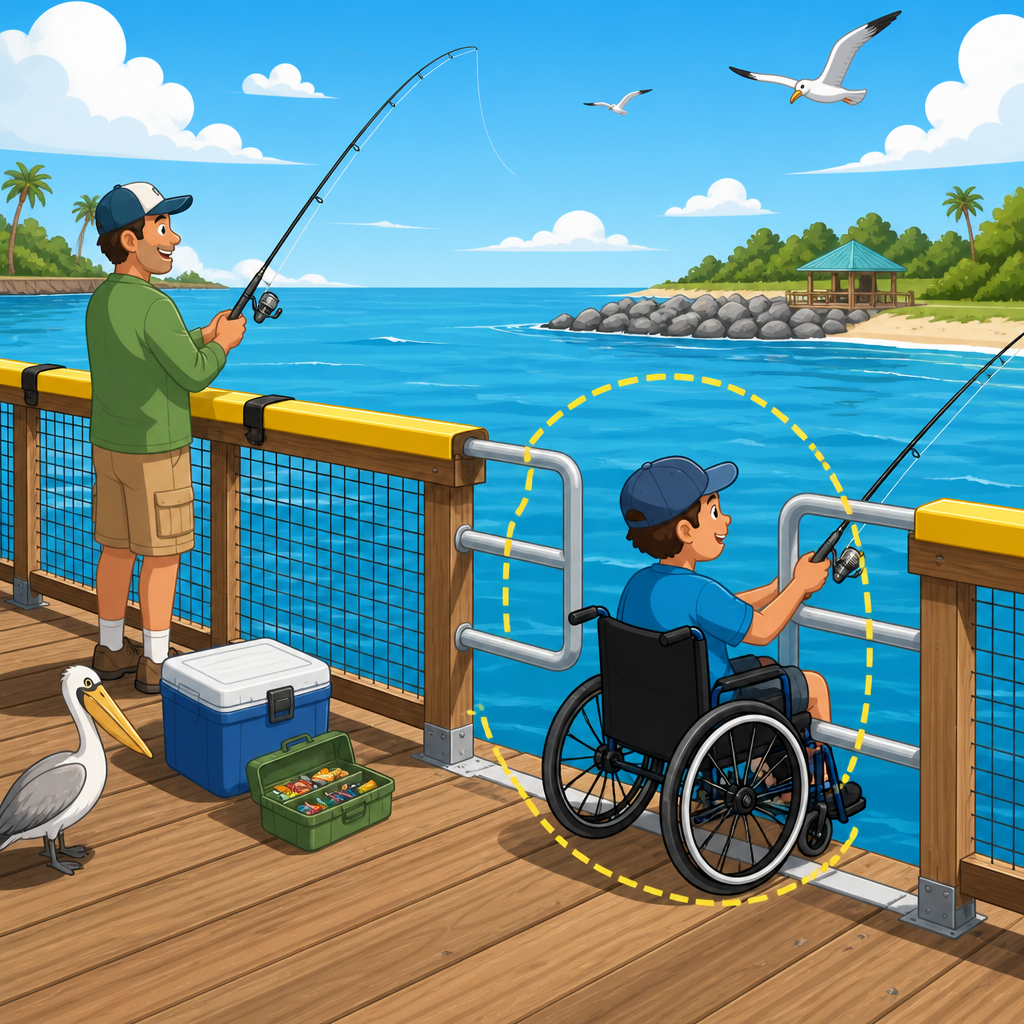
Two terms matter immediately. Edge protection is the curb, barrier, wall, or structural feature at the deck edge that prevents a wheelchair caster from rolling off the platform. Accessible rail openings are the lowered or configured guard sections that let a seated user cast a line and retrieve fish through the railing while preserving safety. These elements are not optional extras added after engineering is complete. They are integral to the fishing pier layout, just like pile spacing, live load assumptions, decking selection, and gangway transitions. When they are omitted early, retrofits become expensive and often awkward.
This topic matters because fishing is one of the most popular outdoor recreation activities in the United States, and public piers are often built with taxpayer funds. A facility that technically reaches the water but blocks independent use at the rail does not deliver meaningful access. Accessibility here is also practical risk management. Clear edge protection reduces wheel incidents. Thoughtful rail openings reduce unsafe reaching and improvised positioning. Good detailing also helps operators maintain the facility, inspect corrosion, and replace parts without undermining compliance. As a hub within recreation and sports facilities, this article explains the rules, the reasoning behind them, and how fishing piers connect to the broader ADA accessibility standards landscape.
Where fishing piers fit within recreation and sports facility accessibility
Fishing piers and platforms are addressed within the accessibility standards for recreation facilities because they present use conditions that differ from ordinary pedestrian routes. Users do not simply pass through; they stop, turn, set down gear, cast, and maneuver near edges for long periods. That changes how clear space, turning space, rail height, and edge protection should be understood. In practice, fishing access is not just about arriving at the deck. The accessible route must connect site arrival points, parking, toilets where provided, and the pier entrance. If a gangway, bridge, or transition plate is part of that route, slope, cross slope, opening width, and surface stability all become part of the compliance picture.
This is why fishing pier guidance belongs in the same family as boating facilities and other recreation areas. The standards recognize that specialized recreation uses require specific design responses. A ballfield route is not a pier route. A pool lift issue is not a rail opening issue. Yet all of them share a common principle: the accessible experience must allow a person with a disability to participate in the primary activity, not merely observe it. For a fishing pier, the primary activity is fishing from the perimeter, with an adequate line of sight, reach over the edge, and room to position mobility devices without hazard.
As a sub-pillar hub, this page also points to the wider recreation and sports facility framework. When teams review a waterfront park, they should not isolate the pier from companion elements. Picnic areas, viewing scopes, boat launch interfaces, accessible seating near event lawns, and route connections to restrooms all affect overall usability. In real projects, I often see compliance fragmented among civil, structural, and landscape disciplines. The best results come when one coordinated matrix lists every recreation element, the governing technical criteria, and the responsible consultant, so no feature falls between scopes.
What edge protection means on a fishing pier and why it is required
Edge protection on a fishing pier is intended to prevent wheelchairs from slipping or rolling off the deck edge. The common solution is a curb or barrier placed along the open side at the deck surface. The requirement exists because fishing activity naturally draws users toward the perimeter, sometimes while handling gear, bait, coolers, or children. A small front caster can drop off an unprotected edge quickly, especially on timber planks with gaps, wet composite surfaces, or decks that slope slightly for drainage. Once that wheel drops, the chair can pivot and create a serious fall hazard.
The practical rule designers rely on is simple: provide a protective element at the edge so a wheelchair tire or caster encounters a barrier before leaving the deck. That barrier must be continuous where needed and should not be interrupted by decorative posts, drainage cuts, or hardware projections that undermine the protective function. On working drawings, I tell teams to dimension the edge protection clearly and show it in section, not only in elevation. Many field errors happen because contractors understand the railing but miss the curb profile at the walking surface.
Material choice matters. Cast-in-place concrete curbs perform well on fixed piers. Marine-grade aluminum kick plates can work on lightweight structures where dead load matters. Pressure-treated timber curbs are common but require close attention to splitting, fastener corrosion, and replacement cycles. In tidal zones, edge protection should be detailed so debris does not collect and accelerate rot or create trip points. Maintenance staff need a straightforward way to inspect connections. If the protective element loosens, it can become a snag for wheels rather than a safeguard.
Edge protection also interacts with drainage and cleaning. Water must move off the deck without creating openings large enough to negate the barrier. Designers sometimes notch curbs aggressively, then discover that caster containment has been compromised. The better approach is to coordinate scuppers, slot drains, or deck gaps away from the accessible fishing edge, or to use engineered details that preserve both runoff and wheel safety. A safe pier edge is never accidental; it is the result of deliberate dimensional control.
How accessible rail openings work and what users need from them
Accessible rail openings are sections of guard or railing designed so a person using a wheelchair can fish over or through the barrier. Standard guard heights that work for fall protection often block casting and line retrieval from a seated position. Lowered or configured openings solve that problem by giving the user a usable fishing edge while preserving the required safety characteristics of the overall guard system. In plain terms, a person should be able to approach the rail, position knees and footrests comfortably, hold a rod, and manage the line without stretching dangerously or colliding with intermediate rails.
On successful projects, these openings are distributed rather than isolated. One designated spot at the far end of a long pier does not create meaningful choice or social inclusion. People fish where conditions are best based on current, shade, species behavior, and crowding. A good layout places accessible fishing positions at intervals and in locations that correspond to real fishing patterns. Corners, widened nodes, and zones near cleaning stations or benches may all deserve consideration, provided circulation remains clear.
The opening itself should be coordinated with clear floor space. This is where many plans fail. A lowered rail section may appear compliant in elevation, yet a bench, tackle cabinet, or diagonal brace blocks the wheelchair approach. The user then has the view of the water but not functional use of the opening. I have found that full-scale mockups are valuable on signature waterfront jobs because they reveal how rod movement, elbow room, wheel positioning, and companion standing space actually work together.
| Design issue | Common mistake | Better practice |
|---|---|---|
| Rail opening location | Only one accessible spot, poorly placed | Distribute openings where fishing conditions and circulation both work |
| Wheel approach | Braces or furniture block forward access | Keep clear floor space aligned with the opening |
| Edge protection | Drainage cuts interrupt the curb | Detail runoff without breaking wheel containment |
| Guard design | Safe height but unusable for seated casting | Use configured sections that balance fishing use and fall protection |
| Maintenance | Mixed metals corrode at connections | Select marine-compatible materials and inspect regularly |
Key technical considerations for compliance, safety, and long-term durability
Compliance does not end with adding a curb and lowering part of a rail. Fishing piers demand coordination among accessibility rules, building code guard requirements, structural loading, and marine durability. The International Building Code and referenced standards affect guard strength, opening limitations in many occupancies, and walking surface conditions. At the same time, accessibility standards govern the usability of the route and the fishing positions. Teams should never assume that satisfying one document automatically satisfies the other. The correct approach is layered review, with conflicts resolved early through code analysis and authority consultation.
Surface quality is especially important. A compliant route to the fishing area must be stable, firm, and slip resistant in practice, not just in product literature. On timber decks, excessive cupping, differential board movement, or oversized gaps can interfere with wheel travel and cane use. On metal grating, opening size and direction matter. On composite boards, thermal movement and algae buildup affect performance. I advise owners to specify maintenance protocols alongside design details, because marine environments punish neglected surfaces quickly.
Reach and maneuvering are equally critical. Anglers bring tackle carts, buckets, and coolers. Companion use is common, and children often cluster near active fishing spots. A technically compliant turning circle that is constantly obstructed does not deliver real access. Designers should preserve wider passing areas and avoid pinch points near widened rail openings. Lighting also deserves attention for dawn and evening use, but fixtures must not intrude into circulation or create glare off the water that obscures edge perception.
Durability choices influence accessibility over time. Stainless steel grades, aluminum alloys, protective coatings, and connection details should be selected for the salinity and exposure level of the site. If rails corrode and are replaced piecemeal, accessible openings are often the first feature lost because maintenance crews default to standard sections. The fix is a clear asset management record: shop drawings, as-builts, replacement specifications, and inspection checklists that identify every accessible fishing station as a protected feature of the facility.
Common design mistakes on fishing piers and how to avoid them
The most common mistake is treating accessibility as a final detailing exercise after structural geometry is fixed. By then, pile locations, framing depths, and railing modules may leave no clean way to provide usable openings or continuous edge protection. The result is awkward custom fabrication, reduced fishing positions, or noncompliant field improvisation. Accessibility should be established during concept design with plan diagrams showing where people will actually fish, wait, pass, and turn.
A second mistake is overvaluing symmetry. Designers often want evenly spaced railing bays, but accessible use may demand asymmetrical modules, wider clear spaces, or localized deck widening. There is nothing wrong with that. Functional performance should lead aesthetics, especially on public recreation structures. Another frequent issue is placing accessible openings where hooks, lines, or sinkers are likely to cross a main circulation path. That creates conflict between anglers and passersby. Shift the route, widen the node, or reorient the opening so the casting zone is safer.
Retrofit projects bring their own problems. Existing piers may have low structural capacity, narrow widths, or historic character concerns. In those cases, not every desired improvement is easy, but many meaningful changes are still possible: selective widening at key bays, replacement of inaccessible guard segments, upgraded transitions at the shore connection, improved lighting, and resurfacing that smooths travel. The goal is not cosmetic compliance language. The goal is measurable improvement in independent use.
Operations mistakes matter too. I have seen accessible rail openings occupied permanently by trash barrels, hose reels, and fish-cleaning tables because staff were not trained on their purpose. Signage and maintenance training should identify these areas clearly, but signs must support use rather than stigmatize it. The best facilities manage this quietly through layout, staff procedures, and routine inspection, so the accessible fishing positions remain open, attractive, and fully integrated into the pier experience.
How this hub connects to the broader ADA accessibility standards for recreation facilities
Fishing pier edge protection and accessible rail openings make the most sense when viewed as part of a complete recreation accessibility strategy. The same planning discipline used here should extend to boating facilities, beach access routes, golf course passage, swimming pool entry, exercise areas, and spectator amenities at sports sites. Each facility type has technical requirements shaped by the activity, but the underlying obligation is consistent: people with disabilities must be able to participate in the recreation itself through routes, clear spaces, operational features, and safe use conditions designed from the start.
For project teams building out an ADA accessibility standards library, this hub should sit beside detailed pages on accessible routes, gangways, toilet rooms, parking, assembly areas, play areas, boating slips, and pool entries. Internal cross-referencing is not just useful for readers; it reflects how projects are actually reviewed. A fishing pier may trigger questions about route slope, door hardware at support buildings, accessible picnic tables nearby, and wayfinding from parking. Treating these as connected topics produces better compliance outcomes than checking each in isolation.
The main benefit of getting fishing pier design right is straightforward: people can reach the water, fish safely, and participate with dignity alongside everyone else. Edge protection prevents roll-off hazards. Accessible rail openings turn access into actual use. Coordinated detailing preserves both safety and durability in harsh marine conditions. If you manage, design, review, or maintain recreation facilities, use this hub as your starting point, then map every related element in the site against the applicable accessibility standards before the next project moves past schematic design.
Frequently Asked Questions
What is edge protection on a fishing pier, and why is it so important?
Edge protection is the safety feature installed along the open sides of a fishing pier or platform to reduce the risk of mobility devices, canes, crutches, walkers, strollers, and even feet slipping or rolling off the edge. On a public fishing facility, this detail is not optional in any practical sense. It is one of the most important elements for user safety because piers sit directly over water, often have changing weather conditions, and may become slick from spray, rain, bait, or fish cleaning activity. A small design oversight at the edge can create a very serious hazard.
From an accessibility standpoint, edge protection matters because many users approach the perimeter to fish, cast, observe the water, or move around other visitors. A person using a wheelchair, scooter, or walker needs confidence that the deck edge will help prevent an accidental roll-off. Likewise, a person with low vision may rely on a detectable barrier condition near the perimeter. Good edge protection supports both independent use and overall public safety, while helping the facility function as intended for a broad range of users.
In real projects, edge protection must be considered together with railing design, structural framing, surface drainage, and fishing access. It is not just a code checkbox. The best pier designs balance safety with usability, making sure visitors can fish comfortably without creating dangerous openings or unprotected drop-offs. That is why edge protection is a core design issue rather than a minor accessory.
How do accessible rail openings work on fishing piers and platforms?
Accessible rail openings are intentional lowered or modified sections in the guard or railing system that allow people seated in wheelchairs or scooters, as well as children or others with limited reach, to fish and view the water more effectively. A standard full-height rail may provide safety, but it can also block access for someone who needs a lower viewing and casting position. Accessible rail openings are designed to solve that problem while still maintaining the protective function of the barrier system.
These openings must be planned carefully. The goal is not simply to remove part of the rail. Instead, the designer typically creates a section that allows approach and use from a seated position while preserving user safety at the perimeter. The width, height, location, and number of these accessible fishing positions all affect whether the facility is actually usable. If the opening is too high, too narrow, or obstructed by framing, toe boards, benches, or rod holders, the space may technically exist but fail in real-world use.
Location also matters. Accessible rail openings should be distributed where people can meaningfully fish, not clustered in awkward or undesirable spots. They should connect to an accessible route, provide adequate maneuvering space, and avoid conflicts with gates, utilities, lighting poles, or concentrated pedestrian traffic. In practice, the most successful fishing pier layouts treat accessible rail openings as primary use features integrated into the experience, not afterthoughts added late in design.
Are fishing piers covered by ADA accessibility standards, and what does that mean for design?
Yes. Fishing piers and platforms are addressed within the ADA accessibility standards as part of recreation facilities. That is significant because it places fishing structures in the same broader accessibility framework as other specialized public-use environments such as boating facilities, golf courses, swimming pools, miniature golf, and sports areas. The standards recognize that recreation spaces still need to be accessible, even when the site conditions, structure types, and user activities are more complex than those in a typical building.
For design teams, this means accessibility cannot be limited to the route from the parking lot to the entrance. It extends into the functional use of the pier itself. The accessible route, the deck geometry, edge protection, guard conditions, rail openings, clear space, surface stability, and circulation all need to work together. Compliance is not just about getting someone onto the structure. It is about enabling meaningful participation in the activity of fishing.
In accessibility reviews, this is where many projects run into trouble. A pier may look accessible at first glance because it has a ramp and a wide deck, but if the railings are unusable from a seated position or the edge conditions create safety risks, the facility may fall short of the intended standard. ADA-related design for fishing structures is therefore both technical and practical. The best approach is to evaluate the pier as a complete user experience, especially for people with disabilities who are there to fish, not merely to reach the platform.
What are the most common design mistakes with pier railings, openings, and edge conditions?
One of the most common mistakes is treating accessible fishing access and edge protection as separate issues when they should be coordinated from the start. Designers may provide a guardrail that satisfies general safety expectations but fails to include usable fishing positions for people seated in wheelchairs. On the other hand, they may create lowered rail openings that improve access but leave unsafe edge conditions, awkward transitions, or insufficient protection at the perimeter. Either imbalance can create serious problems.
Another frequent issue is poor detailing. For example, an opening may be technically present but blocked by horizontal members, heavy trim, structural braces, or utility boxes that interfere with casting and sight lines. In some cases, the opening is placed where users cannot comfortably approach because benches, trash receptacles, fish-cleaning stations, or crowding narrow the clear floor space. Designers also sometimes overlook how users turn, align, and fish from a seated position, which can make the opening frustrating or ineffective.
Surface and maintenance issues are also common. A pier may have a compliant layout on paper, but if the decking becomes uneven, slick, ponded, or obstructed by equipment, usability declines fast. Similarly, edge protection details that trap debris or create trip points can become hazards over time. The lesson from many waterfront reviews is simple: successful pier accessibility requires precise dimensions, thoughtful placement, and durable detailing. The concept has to work both on opening day and after years of exposure, heavy use, and maintenance cycles.
How can a fishing pier be both safe and welcoming for people with disabilities?
A well-designed fishing pier becomes both safe and welcoming when accessibility is built into the overall experience rather than isolated to a few minimum features. That starts with an accessible route to and along the pier, but it also includes comfortable fishing positions, reliable edge protection, practical rail openings, stable surfaces, and enough room for people to move, pause, cast, and socialize. A facility that feels easy to use encourages longer visits and broader participation from people of all ages and abilities.
Safety and accessibility should reinforce each other. Edge protection helps prevent accidents for everyone, while accessible rail openings allow more users to fish effectively. Good lighting, intuitive circulation, clear sight lines, and durable materials also contribute to a stronger user experience. On busier public piers, providing accessible fishing locations in more than one area can reduce conflicts and give users options based on sun, wind, water conditions, or crowd levels. That kind of planning makes the facility feel genuinely public, not selectively usable.
Perhaps most importantly, a welcoming pier is one that acknowledges real-world use. People arrive with tackle, coolers, mobility devices, family members, and varying levels of fishing experience. They need enough space and the right protective features to use the structure with confidence. When edge protection and accessible rail openings are designed thoughtfully, the result is not just better compliance. It is a safer, more inclusive waterfront space where more people can fish independently and enjoy the setting with dignity.