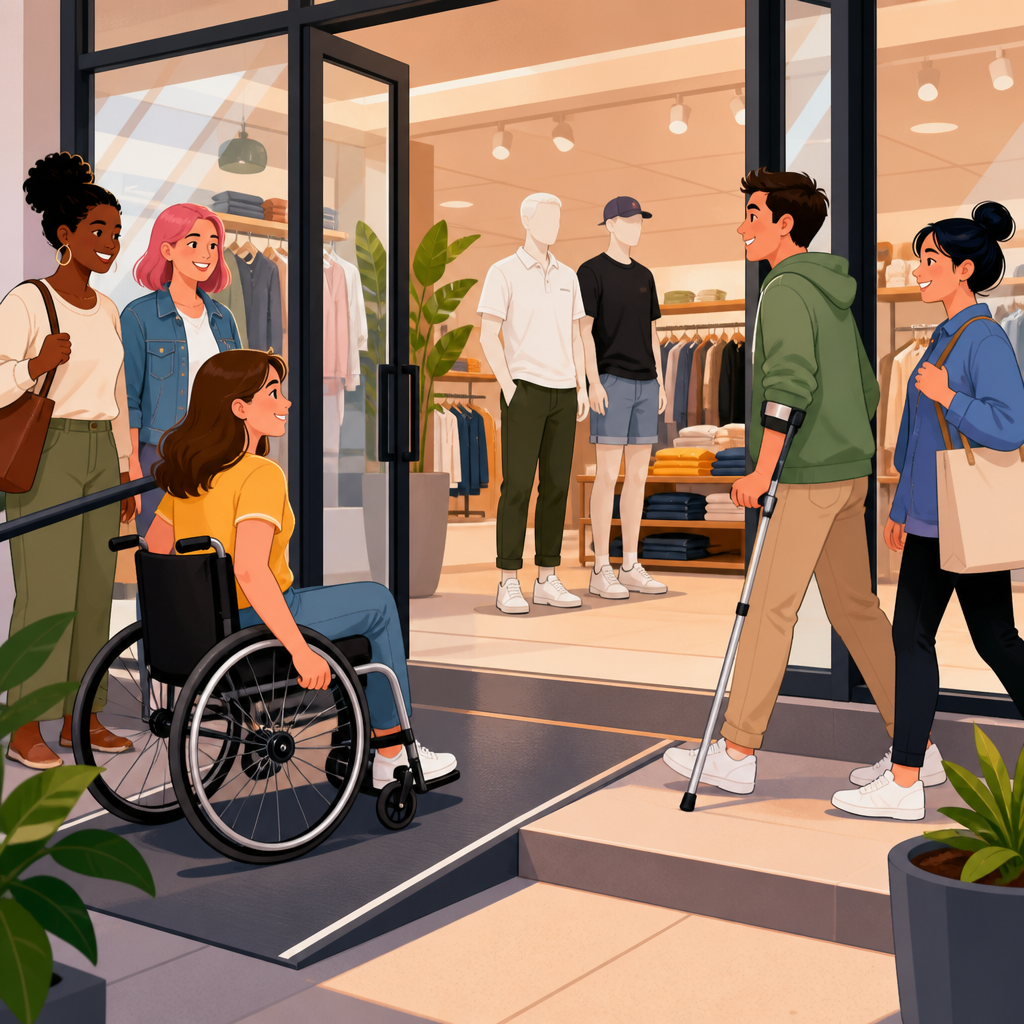
Equal Rights Center v. Abercrombie & Fitch became a defining case for accessible retail design because it translated broad disability access principles into concrete store planning rules. The dispute centered on whether a major clothing retailer’s preferred store format excluded disabled shoppers through features such as steps at entrances, inaccessible routes, narrow pathways, and sales-floor layouts that elevated brand image over equal access. For retailers, architects, property managers, and compliance teams, the case matters far beyond one chain. It shows how the Americans with Disabilities Act applies not only to dramatic barriers like missing ramps, but also to everyday design decisions that shape whether customers can independently enter, browse, try products, and complete purchases.
In practical terms, accessible retail design means creating stores that people with disabilities can use in a manner comparable to other customers. Under Title III of the ADA, places of public accommodation, including retail stores, must remove barriers where readily achievable in existing facilities and must follow accessibility standards in new construction and alterations. Those standards draw heavily from the ADA Accessibility Guidelines and the 2010 ADA Standards for Accessible Design. Equal Rights Center v. Abercrombie is especially important within the broader landscape of influential ADA cases in employment and public access because it demonstrates how advocacy groups, class-based claims, and injunctive settlements can reshape national business practices. I have seen compliance teams focus narrowly on restroom measurements while missing customer journey barriers on the sales floor; this case corrected that blind spot.
As a hub article under legal cases and precedents, this page connects the retail-access dispute to the larger family of influential ADA cases. Employment cases often examine reasonable accommodation, essential job functions, and interactive process failures under Title I. Public access cases, by contrast, test how businesses, schools, transit systems, websites, and hospitality venues design or modify spaces and policies for equal use. Abercrombie sits firmly in the public access branch, yet the lessons overlap with employment compliance: standards must be embedded early, exceptions are costly, and brand preferences never override civil rights duties. Understanding this case helps readers interpret related decisions involving stadium sightlines, website access, service counters, parking, fitting rooms, and program accessibility across sectors.
The result is a useful lens for anyone building a compliance framework. If a retailer asks, “What does equal access look like in a real store?” this case provides the answer: an accessible route from parking and sidewalks, accessible entrances, proper circulation paths, reachable service areas, accessible fitting rooms, and merchandising practices that do not reintroduce barriers after construction is complete. That specificity is why Equal Rights Center v. Abercrombie still matters as both a legal precedent and an operational guide.
What happened in Equal Rights Center v. Abercrombie & Fitch
The Equal Rights Center, a civil rights organization focused on disability and fair housing issues, challenged Abercrombie & Fitch over accessibility barriers in dozens of Hollister and Abercrombie stores. The complaint drew particular attention to the “porch” entrance design used in many Hollister locations. These raised, front-facing entrances often used steps as a signature branding element, while wheelchair users and other disabled customers had to use a side door or a less prominent entrance path. The core legal question was straightforward: can a retailer provide an architecturally impressive primary entrance for nondisabled shoppers while directing disabled patrons to a separate route? Under the ADA, the answer is generally no when equal access can and should be integrated into the main customer experience.
The allegations extended beyond entrances. Plaintiffs challenged inaccessible interior routes, merchandise displays that constricted circulation, and service features that prevented independent use. In retail litigation, details matter. A route that technically exists but is blocked by movable tables, seasonal displays, or dense racks may fail in practice. I have reviewed store audits where a compliant plan set became a noncompliant sales floor after visual merchandising teams tightened clear widths to increase product density. This case highlighted that accessibility is not merely an architectural drawing issue; it is an operations issue, a training issue, and a brand governance issue.
The litigation ended in a significant settlement and consent decree framework requiring changes across a national store portfolio. That outcome is one reason the case is widely cited in discussions of accessible retail design. It proved that advocacy organizations can force large-scale remediation and that uniform prototype design can create nationwide liability when the prototype itself embeds barriers.
Why the case matters in the wider ADA precedent landscape
Equal Rights Center v. Abercrombie belongs in any serious discussion of influential ADA cases in employment and public access because it illustrates how public accommodation claims achieve systemic change. Some ADA cases focus on one plaintiff and one location. This dispute addressed repeated design choices rolled out nationally. That makes it comparable, in practical impact, to other landmark accessibility disputes where a recurring model violated federal standards. For compliance professionals, the message is unmistakable: if a company scales a flawed concept, it scales legal exposure.
The case also complements better-known ADA precedents outside retail. Tennessee v. Lane reinforced access to courts as a fundamental right. PGA Tour, Inc. v. Martin clarified that reasonable modifications may be required even when organizations claim competitive or brand-based justifications. Spector v. Norwegian Cruise Line Ltd. addressed ADA application in a commercial setting with jurisdictional complexity. In the employment realm, US Airways, Inc. v. Barnett explored when accommodations conflict with seniority systems. Each case answers a different question, but Abercrombie answers one that businesses confront daily: must the customer experience itself be designed for equality from the front door inward? Yes.
Its influence also reaches beyond apparel. Grocery chains, electronics stores, hotels with retail components, restaurants with host stands and queuing zones, and mixed-use lifestyle centers all rely on branded environments. The Abercrombie dispute warns that ambiance cannot come at the expense of access. Separate but less equal routes, lowered visibility of accessible entrances, and after-the-fact workarounds are red flags.
Key accessible retail design principles the case brought into focus
The strongest contribution of the case is practical clarity. It turned abstract obligations into a store-by-store checklist. Retailers evaluating exposure should examine the entire customer path, not just isolated measurements.
| Design area | What compliance requires | Common retail failure | Why it creates risk |
|---|---|---|---|
| Entrance | Accessible route to the main entrance or an equivalent integrated entrance | Front steps with side-door access for wheelchair users | Creates segregation and unequal customer experience |
| Circulation | Clear floor space and accessible paths through selling areas | Racks, tables, and displays narrowing aisles | Blocks independent browsing and can defeat planned compliance |
| Service counters | Accessible sales and checkout surfaces | High counters with no lowered portion | Prevents comparable transactions and communication |
| Fitting rooms | Required number of accessible rooms with maneuvering clearance and hardware | Accessible room used as storage or built undersized | Denies core retail service, especially in apparel stores |
| Vertical changes | Ramps, lifts, or same-level access where needed | Raised feature zones accessible only by steps | Excludes customers from merchandise and amenities |
The first principle is integrated access. The ADA strongly disfavors designs that separate disabled customers from the main customer flow when integration is feasible. The second is operational durability. A compliant store on opening day can become inaccessible if staff move fixtures, stack inventory in turning spaces, or lock accessible entrances. The third is equivalence of experience. Access is not just physical entry; it includes dignified participation in browsing, fitting, purchasing, and exiting.
These principles are now standard in good retail accessibility programs. National brands routinely use prototype reviews, third-party ADA surveys, punch-list verification, and periodic operational audits because of lessons drawn from cases like this one.
How public access cases differ from employment ADA cases
Because this article serves as a hub for influential ADA cases in employment and public access, it is important to distinguish the legal frameworks. Employment cases arise under Title I and usually involve qualified individuals with disabilities, reasonable accommodations, medical inquiries, undue hardship, and retaliation. Public access cases like Abercrombie arise mainly under Title III and focus on whether customers can access goods, services, facilities, privileges, advantages, and accommodations offered by a business open to the public.
That distinction affects evidence and remedies. In employment litigation, courts often analyze job descriptions, performance standards, leave records, and communication between employer and employee. In public access cases, the record may center on construction drawings, field measurements, photographs, accessible routes, slope calculations, fixture placement, and expert reports comparing conditions against the ADA Standards. The remedies also differ. Title III generally emphasizes injunctive relief, barrier removal, policy changes, and attorneys’ fees rather than damages in private suits under federal law, although state statutes can alter the economics.
Still, the strategic lesson is shared. In both employment and public access, organizations lose when compliance is treated as an exception process instead of a design principle. Employers need accommodation systems built into human resources practices. Retailers need accessibility built into prototype design, leasing, construction administration, and store operations.
Operational lessons for retailers, landlords, and design teams
After working through accessibility disputes, I have found that companies usually fail in one of three places: concept design, field execution, or ongoing operations. Abercrombie is a textbook example of concept design risk. If leadership approves a signature entrance that requires steps to create a theatrical brand reveal, the legal problem is embedded before the first permit set is issued. Fixing that later across dozens of stores is expensive and publicly damaging.
Landlords are not insulated either. Lease allocation of responsibility matters, but both landlords and tenants can face scrutiny depending on control over common areas, storefronts, and alterations. Shopping center owners should review tenant design criteria, storefront approval processes, and accessible path continuity from parking to suite entry. A compliant tenant space does not solve a noncompliant route through the center.
Design teams should treat accessibility as a coordination discipline. Architects must align finished floor elevations, door hardware, counter details, fitting room dimensions, and route widths. Civil engineers must verify parking, curb ramps, and slopes. Contractors must build to tolerance, because small deviations at thresholds or ramps can cause violations. Visual merchandising teams need clear fixture plans and training so temporary campaigns do not block access. The strongest programs assign accountability, conduct pre-opening audits, and require corrective action timelines.
What this case teaches about compliance strategy and future claims
The deeper lesson from Equal Rights Center v. Abercrombie is that accessibility enforcement is cumulative. A single step, a narrow aisle, or a poorly placed display may seem minor in isolation, but repeated across a chain they indicate policy-level disregard. Plaintiffs’ organizations, private counsel, and government enforcers look for patterns. Prototype noncompliance, inaccessible remodel standards, and recurring operational barriers are exactly the kinds of facts that support broad injunctive relief.
Retailers should therefore adopt a prevention strategy. Start with portfolio mapping to identify store vintages, remodel dates, and high-risk prototypes. Review current standards against the 2010 ADA Standards and applicable state requirements, such as California’s accessibility rules, which can be more demanding and often drive litigation volume. Conduct on-site surveys using qualified specialists, not generic checklists alone. Prioritize customer journey barriers first: parking, route, entrance, sales floor circulation, checkout, fitting rooms, and restrooms. Then fix governance failures by updating design manuals, training store teams, and requiring accessibility review for every remodel, fixture reset, and seasonal installation.
For readers exploring the wider field of influential ADA cases in employment and public access, Abercrombie is the retail design anchor. It shows how legal precedent becomes operational doctrine. Equal access must be visible at the front door, measurable on the sales floor, and sustainable in daily practice. Organizations that internalize that lesson reduce legal risk, protect brand credibility, and serve more customers effectively. The practical next step is simple: audit one representative location against the full customer journey, then use the findings to strengthen standards across the portfolio.
Frequently Asked Questions
What was Equal Rights Center v. Abercrombie & Fitch about, and why is it important for accessible retail design?
Equal Rights Center v. Abercrombie & Fitch is widely viewed as a landmark accessibility case because it applied disability access requirements to the real-world design choices of a national retail chain. At the center of the dispute was the allegation that Abercrombie’s preferred store model used architectural features and merchandising layouts that made it harder, and in some cases impossible, for disabled customers to enter, move through, and fully enjoy the shopping experience. The challenged features reportedly included entrance steps, inaccessible routes, narrow circulation paths, and store layouts that emphasized a particular branded look at the expense of equal access.
The case mattered because it moved accessibility beyond abstract legal standards and into specific planning and design decisions that retailers, architects, and landlords make every day. It showed that accessibility is not limited to whether a ramp exists somewhere on the property. Instead, the law looks at whether disabled shoppers are given a genuinely comparable experience, including practical entry, usable interior paths, access to merchandise, and the ability to shop with dignity and independence. In that sense, the case became a powerful reminder that accessible design is a core part of retail operations, not a secondary add-on.
For the industry, the case underscored that brand identity does not override legal obligations under disability access laws. A visually striking storefront, a dramatic entry sequence, or a tightly controlled sales-floor concept may still create legal risk if it excludes people with mobility impairments or other disabilities. The broader lesson is that accessibility must be integrated into concept development, prototype design, tenant improvement work, and ongoing store management from the beginning.
What accessibility problems in retail stores did the case bring into focus?
The case highlighted several recurring barriers that are especially important in retail design. One major issue was the use of steps at entrances or raised entry features that prevented some customers from using the same primary access point as everyone else. When the most visible or branded entrance is inaccessible, disabled shoppers may be forced to use a side door, a secondary route, or an inconvenient alternative. That can create both practical barriers and a sense of unequal treatment.
Another issue involved interior circulation. Retail stores often use fixtures, display tables, promotional racks, and decorative elements to create atmosphere and guide customer movement. But when those elements narrow the pathways too much or interrupt accessible routes, wheelchair users and others with mobility limitations may not be able to move through the store effectively. The result can be partial access rather than meaningful access, especially if certain departments, fitting rooms, cash-wrap areas, or featured merchandise zones are difficult to reach.
The case also brought attention to the tension between aesthetic priorities and compliance obligations. Some retail environments are intentionally designed around a lifestyle image or theatrical presentation. Elevated platforms, crowded floor plans, dim navigation cues, and dramatic architectural elements may support a brand concept, but they can also create exclusion if accessibility is not built into the design. The larger takeaway is that inaccessible retail design often arises not from a single obvious defect, but from a pattern of choices that collectively make shopping more difficult for disabled patrons.
How did this case influence retailers, architects, and property managers?
Equal Rights Center v. Abercrombie & Fitch had a strong practical effect because it signaled that accessibility compliance must be treated as a design, operational, and risk-management priority. For retailers, the case reinforced the need to review prototype store formats, remodel plans, and merchandising strategies with accessibility in mind. National chains in particular learned that repeating the same inaccessible concept across many locations can multiply legal exposure, making it essential to evaluate not just one store but the entire portfolio.
For architects and design teams, the case highlighted the importance of integrating accessibility standards into the earliest stages of planning. That includes evaluating accessible entrances, route continuity, turning space, fixture placement, fitting room design, point-of-sale access, and the relationship between brand expression and code compliance. It also encouraged a more functional approach to accessibility review: not simply asking whether technical requirements appear on paper, but whether customers with disabilities can actually use the space in a normal, independent way.
Property managers and landlords were affected as well because accessibility problems in retail settings can involve shared responsibilities. Depending on the lease structure and the nature of the barrier, obligations may be divided among tenants, owners, and common-area operators. This case helped emphasize the need for clear lease provisions, coordinated construction oversight, and periodic site inspections. In practice, it pushed the industry toward more disciplined accessibility audits, better documentation, and closer collaboration between legal, facilities, design, and operations teams.
What does the case teach about balancing brand image with ADA accessibility requirements?
One of the most enduring lessons of the case is that strong branding and accessible design are not mutually exclusive, but accessibility cannot be sacrificed in favor of a preferred look. Retailers often invest heavily in signature storefronts, curated customer journeys, dramatic product presentations, and tightly controlled visual standards. Those features may be central to the brand, but if they create barriers for disabled shoppers, they can conflict with ADA obligations and related accessibility requirements.
The case makes clear that the law evaluates the customer experience, not just the retailer’s design intent. A company may believe that steps, narrow paths, or elevated display zones enhance the atmosphere of the store, but if those elements deny equal access, the aesthetic rationale will not excuse the barrier. Accessible design has to be part of the brand execution itself. That means designing beautiful entrances without excluding wheelchair users, maintaining clear and usable circulation paths while still achieving a desired layout, and ensuring that high-impact displays do not block access to merchandise or services.
In practical terms, the best approach is to treat accessibility as a design parameter rather than a constraint that appears at the end of the process. Skilled retail designers can create distinctive environments that also support inclusive shopping. The case helped reshape industry thinking by showing that accessibility is not only a legal requirement, but also a measure of whether a retail brand delivers on fairness, welcome, and customer experience for all visitors.
What should retailers do today to avoid the kinds of accessibility issues raised in Equal Rights Center v. Abercrombie & Fitch?
Retailers should begin with a comprehensive accessibility review of both existing stores and new design concepts. That review should examine entrances, routes from parking and public sidewalks, door hardware, floor transitions, aisle widths, fitting rooms, service counters, restrooms where provided, and access to all key merchandise and sales areas. It is especially important to look at how temporary or operational choices affect compliance, since even a well-designed store can become inaccessible if racks, signage, promotional bins, or seasonal displays are placed in the wrong locations.
Next, companies should evaluate their prototype standards and brand manuals. If a chain uses repeatable design elements across multiple locations, accessibility should be embedded into those standards from the outset. That includes fixture spacing, cash-wrap design, queue layouts, feature displays, and storefront treatments. Retailers should also train store planners, visual merchandising teams, construction managers, and field staff so that accessibility is maintained after opening day and not eroded by day-to-day operations.
Finally, retailers should adopt an ongoing compliance strategy rather than a one-time checklist approach. Regular audits, prompt barrier remediation, consultation with accessibility professionals, and coordination with legal counsel can significantly reduce risk. Just as important, companies should approach accessibility as part of customer service and brand integrity. The core lesson from Equal Rights Center v. Abercrombie & Fitch is that accessible retail design is not merely about avoiding lawsuits. It is about ensuring that every shopper can enter, navigate, and participate in the retail experience on equal terms.


