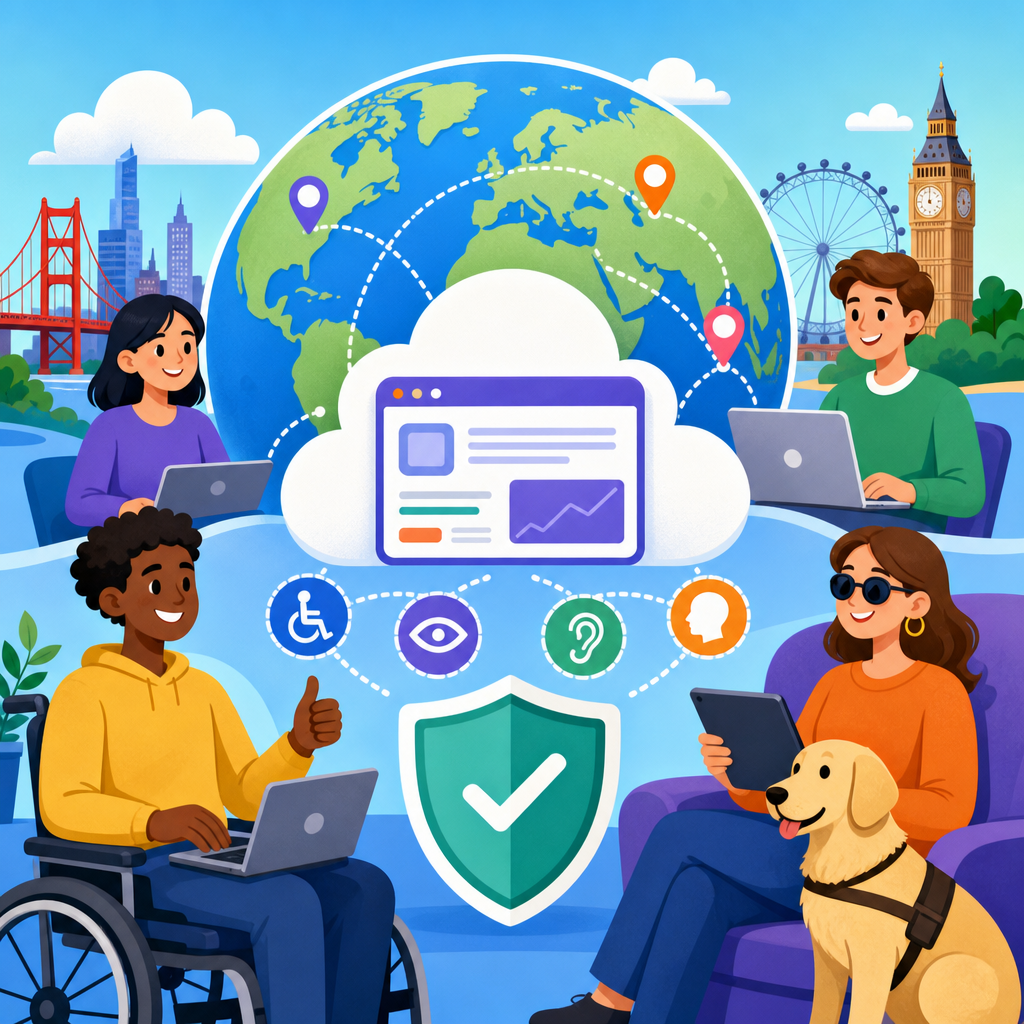
Cross-border SaaS vendors are reshaping accessibility compliance by moving software delivery, data handling, and customer support across jurisdictions that apply different disability rights laws, technical standards, and enforcement models. In practical terms, a software-as-a-service vendor may be headquartered in the United States, host infrastructure in Germany, sell to public agencies in Canada, and support users in Australia. That operating model creates opportunity, but it also multiplies compliance obligations. Accessibility compliance means designing, developing, procuring, and maintaining digital products so people with disabilities can use them effectively, often measured against standards such as WCAG 2.1 or WCAG 2.2, and reinforced by statutes including the ADA, the European Accessibility Act, Section 508, the Accessibility for Ontarians with Disabilities Act, and similar laws worldwide.
I have worked with procurement teams and product leaders that assumed accessibility was a local legal issue handled by a website overlay, a VPAT, or a single audit before launch. In cross-border SaaS, that assumption fails quickly. A vendor serving multiple markets must manage accessibility as an operational discipline: product requirements, engineering practices, design systems, procurement responses, customer contracts, remediation workflows, and evidence collection all need alignment. The reason this matters now is simple. Governments are tightening digital accessibility expectations, enterprise buyers are standardizing due diligence, and AI-powered interfaces are expanding how users interact with software. The future of global accessibility and disability rights will be shaped not only by lawmakers and advocates, but also by the SaaS companies whose products mediate work, education, health, banking, commerce, and public services every day.
This article serves as a hub for the international perspective on that future. It explains what cross-border SaaS vendors mean for accessibility compliance, where global rules are converging, where they still diverge, and how organizations can prepare for a regulatory environment that increasingly treats inaccessible software as both a civil rights barrier and a procurement risk. It also frames the wider direction of disability rights globally: stronger enforcement, broader coverage, clearer technical expectations, and greater attention to usability beyond checklist conformance.
Why Cross-Border SaaS Changes the Accessibility Risk Model
Traditional software compliance was often tied to a specific deployment and customer. SaaS changes that because the same codebase can affect thousands of organizations in dozens of countries at once. If an inaccessible component is released into a shared platform, the defect can trigger simultaneous legal, contractual, and reputational exposure across markets. A keyboard trap in a scheduling workflow, missing form labels in a payroll product, or inaccessible document export in a learning platform can become a global issue overnight.
Cross-border delivery also complicates responsibility. Customers may assume the vendor owns accessibility because the product is centrally controlled. Vendors may assume customers own configuration and content accessibility. In reality, liability often depends on the feature, the contract, and the local law. For example, a collaboration platform may be responsible for accessible navigation, focus order, captions support, and screen reader compatibility, while the customer remains responsible for uploading accessible PDFs or writing meaningful alt text in user-generated content. The future of global accessibility and disability rights will continue to push for this division of responsibilities to be documented more clearly, especially in regulated sectors and public procurement.
Another major shift is procurement scrutiny. Large buyers now request VPATs based on the ITI template, accessibility roadmaps, audit summaries, and remediation timelines before purchase. Public-sector entities in the United States, European Union, and Canada routinely evaluate accessibility during supplier selection. I have seen deals slow down not because a product lacked every accessibility feature, but because the vendor could not explain testing scope, issue severity, exception handling, or ownership of fixes. Cross-border SaaS vendors therefore need repeatable evidence, not one-off claims.
The Legal Landscape: Convergence Around Rights, Divergence in Details
Digital accessibility law is becoming more global, but it is not uniform. The convergence point is the principle that people with disabilities must have equal access to digital services. The divergence lies in scope, enforcement, timelines, and technical references. In the United States, the ADA has been applied to digital services through case law and regulatory interpretation, while Section 508 governs federal procurement and references technical standards aligned with WCAG. In the European Union, the Web Accessibility Directive covers public-sector websites and apps, and the European Accessibility Act expands obligations for many private-sector digital products and services. Canada combines federal requirements under the Accessible Canada Act with provincial regimes such as AODA. Australia applies disability discrimination law with guidance that strongly points to WCAG conformance.
For cross-border SaaS vendors, the practical answer to “Which standard should we follow?” is usually WCAG 2.1 AA today, with a strong migration path to WCAG 2.2 AA because procurement teams and enforcement bodies increasingly expect it. That said, conformance to WCAG alone does not guarantee legal compliance. Laws may require accessibility statements, feedback mechanisms, training records, procurement assurances, or specific remediation processes. The future of global accessibility and disability rights is likely to include more direct references to harmonized technical standards, but local procedural duties will remain important.
| Jurisdiction | Key law or framework | Who is commonly affected | Practical impact on SaaS vendors |
|---|---|---|---|
| United States | ADA, Section 508 | Private businesses, federal suppliers | Litigation risk, procurement reviews, VPAT expectations |
| European Union | Web Accessibility Directive, European Accessibility Act | Public sector, many private digital services and products | Broader market-wide obligations and stronger documentation needs |
| Canada | Accessible Canada Act, AODA | Federal entities, provincially regulated organizations, suppliers | Policy, training, procurement, and customer accommodation expectations |
| Australia | Disability Discrimination Act and guidance | Public and private digital service providers | Complaint-driven exposure and WCAG-based remediation pressure |
The pattern is clear. Rights-based obligations are spreading, technical expectations are clustering around WCAG, and enforcement is moving beyond public institutions into mainstream commerce. SaaS vendors that sell internationally should plan for the strictest common denominator rather than treating each country as an exception.
Accessibility Compliance in the SaaS Stack: Product, Content, and Configuration
Accessibility failures in SaaS usually fall into three layers. First is product accessibility: code, components, workflows, APIs, and native or web interfaces under the vendor’s control. Second is content accessibility: documents, media, templates, knowledge base articles, and user-generated content. Third is configuration accessibility: settings, branding choices, workflow builders, and embedded integrations that customers control inside the platform. A robust compliance program identifies which party owns each layer and how issues will be prevented or fixed.
Product accessibility starts with engineering discipline. Semantic markup, correct ARIA usage, keyboard operability, visible focus indicators, error identification, color contrast, reflow behavior, and compatibility with assistive technologies are baseline requirements. In mature teams, these are embedded in design systems and quality gates. For example, if a date picker component is inaccessible, every product team using that shared component inherits the defect. Rebuilding the component once at the system level is more effective than issuing customer-specific workarounds.
Content accessibility is often overlooked in global compliance conversations, yet it is where many customer complaints originate. Training modules without captions, support articles with poor heading structure, invoices exported as image-based PDFs, and dashboards that rely only on color can all block users. Cross-border SaaS vendors must also think about localization. A product can be accessible in English and less usable in German, Arabic, or Japanese if translated strings break button labels, reading order, line spacing, or screen reader announcements. International accessibility is not only about laws; it is also about language, culture, and assistive technology behavior across markets.
Configuration accessibility is where contracts matter. If customers can build forms, automate workflows, or create branded portals, the vendor should provide accessible defaults, validation rules, guidance, and admin controls. I have seen platforms reduce risk substantially by preventing low-contrast theme selections, prompting for alt text, enforcing field labels, and supplying accessible email templates. These product choices turn accessibility from an optional afterthought into an expected part of everyday administration.
Proof, Procurement, and the Growing Demand for Evidence
Global buyers increasingly ask not “Do you support accessibility?” but “What proof can you provide?” The minimum evidence package for a serious cross-border SaaS vendor now includes a current VPAT or equivalent conformance report, audit methodology, scope boundaries, known issues, target remediation dates, and a public accessibility statement. Sophisticated buyers may also request sample test scripts, screen reader coverage, keyboard-only findings, mobile accessibility results, and details about ongoing monitoring.
Evidence quality matters more than marketing language. A VPAT that marks broad support without noting exceptions often raises concern. A stronger document explains partial support, identifies affected workflows, and pairs those disclosures with remediation plans. Procurement officers and accessibility leads know that no complex platform is perfect. What they want is transparency, competence, and momentum. In my experience, vendors gain trust faster by acknowledging a modal dialog focus issue and giving a release target than by claiming universal compliance and being contradicted in a demo.
The future of global accessibility and disability rights will intensify this evidence trend. As private enforcement, class actions, and procurement standards grow, buyers will expect accessibility to be managed like security or privacy: policy-backed, tested, documented, and continuously improved. That means vendors need governance. Someone must own standards selection, audit cadence, defect prioritization, customer communications, and contract language. Accessibility cannot sit solely with legal, design, or support.
Emerging Trends Shaping the Future of Global Accessibility and Disability Rights
Several forces are defining the next phase. First is the shift from static websites to complex software ecosystems. Accessibility law is increasingly concerned with full task completion, not just page-level compliance. If a user can sign in but cannot complete checkout, approve expenses, join a telehealth appointment, or submit a job application, the service is not effectively accessible. This is pushing regulators and courts toward usability-centered analysis.
Second is stronger regional enforcement. The European Accessibility Act is especially significant because it broadens accessibility obligations across consumer-facing digital services and products in a large economic bloc. Even vendors outside Europe will feel the effect when they sell into EU markets through direct contracts, resellers, or embedded services. Similar pressure appears elsewhere through procurement rules, human rights frameworks, and strategic litigation.
Third is the rise of AI interfaces. AI can help with captions, alt text suggestions, plain-language support, and automated testing triage, but it does not solve accessibility on its own. Generative summaries may hallucinate labels, automated image descriptions can miss context, and AI chat interfaces can create new barriers if they rely on unlabeled controls, streaming updates that are not announced properly, or inaccessible authentication steps. The lesson is clear: AI is an assistive layer, not a substitute for standards-based accessible product design.
Fourth is the growing recognition of disability as a market, workforce, and innovation issue, not only a compliance issue. The World Health Organization and the World Bank have long estimated that more than one billion people live with some form of disability globally. In enterprise software, accessible design improves outcomes for far more users than those who formally identify as disabled. Keyboard support helps power users. Captions help multilingual teams. Clear error messages help everyone. This broader value case reinforces why global disability rights will continue moving into mainstream product strategy.
What Cross-Border SaaS Vendors Should Do Now
The most effective path is to operationalize accessibility across the product lifecycle. Start by adopting a single global baseline, typically WCAG 2.2 AA for new work, while mapping local legal duties in major markets. Build an accessibility requirements library for design, engineering, QA, procurement, support, and customer success. Test with both automated tools and manual methods using screen readers such as NVDA, JAWS, and VoiceOver, because automation alone catches only a portion of defects. Maintain a risk register and prioritize blockers in critical user journeys first.
Next, define ownership clearly. Product teams should own code-level fixes, design systems should own reusable components, documentation teams should own content standards, and legal or compliance teams should coordinate statements and contract terms. Create customer-facing guidance that explains shared responsibility for templates, uploaded content, and configuration. If your platform supports third-party integrations, evaluate those touchpoints too; an accessible core product can still fail users when embedded widgets, payment processors, or identity providers break keyboard or screen reader access.
Finally, treat accessibility as a continuous international capability. Monitor regulatory changes in the United States, EU, Canada, the UK, Australia, and other target markets. Update audits after major releases. Train staff annually. Involve disabled users in usability testing. Publish progress. When teams do this consistently, accessibility stops being a reactive legal scramble and becomes a durable part of product quality and market readiness.
Cross-border SaaS vendors sit at the center of the future of global accessibility and disability rights because their products now mediate essential participation in work, school, government, healthcare, and commerce across borders. The central lesson is straightforward: international accessibility compliance is not one law, one document, or one test. It is a system of legal awareness, technical standards, evidence, governance, and user-centered design. Vendors that understand this can scale more confidently, respond to procurement demands faster, and reduce the risk of excluding users in any market.
The strongest global programs share the same traits. They follow harmonized technical standards, document exceptions honestly, assign ownership across teams, localize with accessibility in mind, and verify real usability with assistive technologies. They also recognize tradeoffs. Full remediation takes time, legacy architecture can slow progress, and local legal nuances still matter. But those constraints are manageable when accessibility is embedded early and reviewed continuously.
For organizations building or buying SaaS internationally, the benefit is clear: better accessibility compliance creates better software, stronger customer trust, and wider market access. Use this hub as your starting point for the international perspective on accessibility. Review your vendor requirements, audit your highest-risk workflows, and make accessibility a standing part of global product strategy.
Frequently Asked Questions
1. What is a cross-border SaaS vendor, and why does it matter for accessibility compliance?
A cross-border SaaS vendor is a software provider that operates across multiple countries at the same time. That can mean the company is incorporated in one country, hosts its platform or backups in another, contracts with customers in several others, and delivers technical support from yet another region. In accessibility terms, this matters because legal obligations do not always follow a single, simple rule. Instead, accessibility compliance may be shaped by where the vendor is based, where the customer is located, where the product is used, what type of customer is buying it, and which laws apply to the transaction.
For example, a SaaS company might be subject to U.S. accessibility expectations through disability rights laws and procurement rules, while also needing to satisfy Canadian public-sector accessibility requirements, European accessibility standards, and local consumer protection rules in other markets. Even when the functional accessibility goals are similar, the legal language, enforcement mechanisms, documentation expectations, and technical references can vary. One jurisdiction may emphasize non-discrimination, another may focus on public procurement, and another may require conformance with a specific version of WCAG or another technical benchmark.
That complexity matters because accessibility is not just a design issue. It affects product development, contract negotiations, security architecture, customer onboarding, support operations, localization, and vendor risk management. A cross-border SaaS vendor cannot assume that meeting one country’s baseline automatically resolves obligations everywhere else. The practical takeaway is that international delivery expands the compliance footprint. Accessibility must be managed as a multi-jurisdiction governance issue, not treated as a one-time checklist item attached to a single release.
2. Which accessibility laws or standards typically affect cross-border SaaS vendors?
There is no single global accessibility law that governs all SaaS platforms, so cross-border vendors usually deal with a layered compliance environment. In the United States, accessibility obligations may arise from the Americans with Disabilities Act, Section 504, Section 508, state-level requirements, and procurement expectations tied to public-sector customers. In Canada, vendors may encounter federal and provincial frameworks, including accessibility laws that shape public procurement and service delivery. In the European context, vendors often need to consider the European Accessibility Act, national implementations, public-sector website and app rules, and technical standards such as EN 301 549. Australia and other jurisdictions may also apply disability discrimination law, procurement standards, and guidance tied to digital accessibility.
On the technical side, the Web Content Accessibility Guidelines, or WCAG, are the most common reference point across jurisdictions. Even where the law does not explicitly say “WCAG,” contracts, procurement documents, internal policies, and industry practice often use WCAG 2.1 or WCAG 2.2 as the working standard. That said, the required conformance level, scope, and interpretation may differ. Some frameworks concentrate on websites and mobile apps, while others may extend to software interfaces, documents, customer communications, support channels, or electronic procurement systems.
What cross-border vendors need to understand is that legal compliance and technical conformance are related but not identical. A product can aim for WCAG conformance and still face legal risk if accessibility barriers persist in onboarding, authentication, customer service, or third-party integrations. Likewise, a vendor may meet a particular contractual standard but still need broader process controls to respond to disability-related complaints or regulatory inquiries. The strongest approach is to map all relevant jurisdictions, identify the standards and legal triggers in each one, and maintain a compliance program that can adapt as laws and guidance evolve.
3. How do multiple jurisdictions increase accessibility risk for SaaS providers and their customers?
Multiple jurisdictions increase accessibility risk because they create overlapping obligations with different thresholds, terminology, timelines, and enforcement pathways. A vendor may be fully familiar with domestic rules but less prepared for international customer expectations around procurement disclosures, accessibility statements, audit rights, remediation commitments, or language localization. The risk is not only that the software itself may contain barriers, but that the vendor’s overall service model may fail to meet legal or contractual requirements in one or more markets.
One major risk area is inconsistent standard application. A company might build toward WCAG 2.1 AA internally, while a customer contract references a newer version, a local technical standard, or a broader accessibility framework that includes documentation, PDFs, training materials, and support channels. Another risk area is decentralization. Engineering may sit in one country, infrastructure in another, customer success in a third, and subcontracted support in a fourth. Without centralized governance, accessibility responsibilities can fall through the cracks, especially when bug prioritization, content publishing, and assistive technology testing are handled by different teams under different policies.
There is also an enforcement and reputation dimension. Public agencies, universities, enterprise buyers, and regulated organizations increasingly ask for VPATs or equivalent accessibility documentation, testing evidence, remediation plans, and contractual warranties. If the vendor cannot provide reliable answers across regions, deals may stall or be lost. Complaints can also emerge from end users, advocacy groups, procurement reviews, or regulatory channels. For customers, relying on a noncompliant vendor creates downstream risk because inaccessible software can interfere with their own legal duties to employees, students, citizens, or consumers. In short, cross-border operations do not just multiply market opportunities; they multiply the points where accessibility failure can become a legal, commercial, or operational problem.
4. What should organizations evaluate before buying software from a cross-border SaaS vendor?
Organizations should start by evaluating whether the vendor has a mature, repeatable accessibility program rather than only a marketing claim. A credible vendor should be able to explain which standards it targets, how frequently it tests, who performs the testing, what assistive technologies are included, and how issues are prioritized and fixed. Buyers should request current accessibility documentation such as a VPAT or equivalent conformance report, but they should not stop there. It is equally important to ask for supporting detail on testing methodology, known limitations, roadmap commitments, and whether the document reflects the actual version being purchased.
Because the vendor operates across borders, procurement teams should also examine contract structure and jurisdictional fit. That includes asking which legal entity is signing the agreement, where data is hosted, which subcontractors are involved, what law governs the contract, and whether the vendor will commit to accessibility obligations that align with the buyer’s own regulatory environment. Public-sector and highly regulated buyers often need specific language around remediation timelines, notice obligations, audit cooperation, alternative access measures, and termination rights if accessibility defects are not addressed. Those terms should be negotiated up front, not left for later dispute.
Support and operations deserve close attention as well. Buyers should confirm whether customer support channels themselves are accessible, whether training content and documentation are usable by people with disabilities, whether localized versions maintain the same accessibility quality, and how the vendor handles accessibility in integrations, updates, and custom configurations. Strong due diligence looks beyond the interface and examines the full service lifecycle. The best buying decision comes from treating accessibility as a vendor governance issue, a product quality issue, and a legal risk issue all at once.
5. How can cross-border SaaS vendors build a stronger accessibility compliance strategy?
The most effective strategy begins with governance. Cross-border vendors need a clearly assigned accessibility owner or leadership function that coordinates legal, product, engineering, procurement, support, and sales teams. Accessibility should be embedded into product development life cycles, design systems, QA processes, release management, and third-party vendor oversight. That means setting a baseline technical standard, documenting how compliance is measured, maintaining issue-tracking workflows for accessibility defects, and creating escalation paths when customer requirements differ by region.
Vendors should also build a jurisdiction-aware compliance framework. In practice, that means identifying the countries and customer segments they serve, mapping applicable disability rights laws and technical standards, and translating those obligations into operational controls. A vendor may decide to design globally to a high common denominator, such as a current WCAG AA target supported by broader software accessibility practices, while also maintaining region-specific contract language, statements, and procurement responses. Legal review should be ongoing, especially as accessibility rules change and new digital accessibility requirements come into force in key markets.
Just as important, vendors need evidence. Accessibility claims should be backed by structured testing, documented remediation, executive reporting, and transparent customer communication. Regular audits, both automated and manual, should include real user flows and assistive technology checks. Teams that produce documents, videos, help content, and support communications should be trained so accessibility extends beyond the core application. Finally, vendors should view accessibility as part of international market readiness rather than as a reactive compliance cost. A mature accessibility program improves procurement success, reduces dispute risk, supports product quality, and makes cross-border growth more sustainable over time.