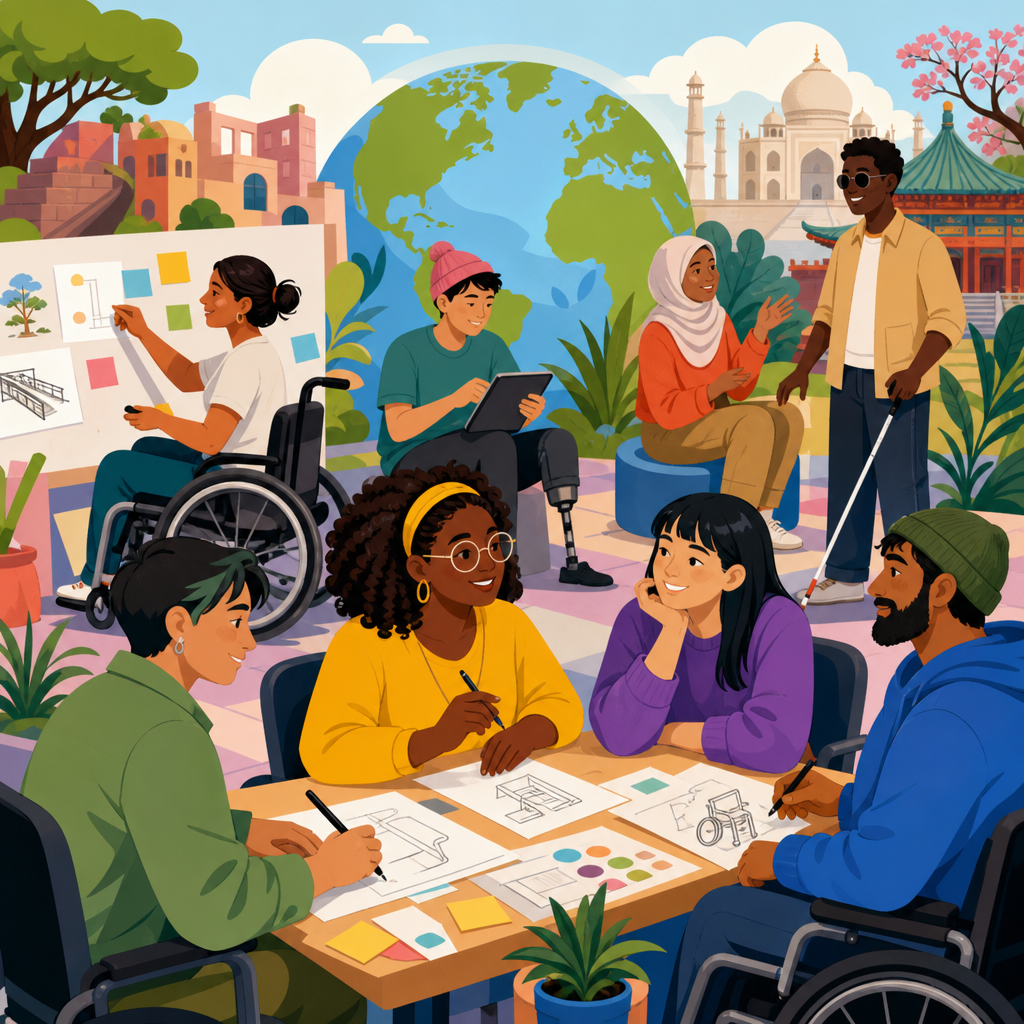
Disability-led design practices are reshaping accessibility by moving disabled people from the margins of consultation to the center of strategy, research, and decision-making. In practical terms, disability-led design means products, services, spaces, and policies are conceived, tested, and refined with disabled people directing priorities rather than merely reacting to finished ideas. That distinction matters because accessibility failures usually begin upstream: a brief ignores cognitive load, a procurement team omits captioning, a transit planner assumes stairs are acceptable, or a software roadmap treats screen reader support as a later patch. I have worked on accessibility programs where late fixes cost multiples of the original feature budget, while early participation by disabled researchers prevented expensive redesigns altogether.
This international perspective matters because accessibility is not one universal checklist applied identically across cultures, legal systems, languages, and infrastructures. A tactile paving standard in Japan interacts with dense rail systems and disciplined wayfinding; disability justice organizing in the United States often addresses race, income, and policing alongside access; Nordic public service design tends to connect digital inclusion with welfare delivery; and community-based rehabilitation models in parts of Africa and South Asia may prioritize low-cost, locally repairable solutions over premium assistive technology. Around the world, the most effective disability-led design practices share a core principle: disabled people define what independence, dignity, and usability actually look like in context.
As a hub for international innovations and strategies in accessibility, this article maps the major patterns practitioners need to understand. It covers leadership models, public space, digital products, education, employment, procurement, and policy, while highlighting examples that show how disability-led design works on the ground. It also clarifies a common misconception: innovation in accessibility is not limited to wealthy countries or high-tech products. Some of the most durable advances come from disabled communities adapting transport systems, voting processes, housing, communication methods, and service delivery under real constraints. Studying those examples gives organizations a clearer path to designing access that is usable, scalable, and accountable.
What disability-led design looks like in practice
Disability-led design begins with governance, not aesthetics. If disabled people are only invited to usability tests at the end of a project, the work is still designer-led with disability consultation attached. In a disability-led model, disabled founders, researchers, product managers, architects, teachers, policy advisers, and community organizers set the agenda from the outset. They define success metrics, identify exclusion risks, and decide which tradeoffs are acceptable. In my experience, this changes meeting dynamics immediately. Teams stop asking, “How can we make this accessible enough?” and start asking, “What conditions enable equitable use for different bodies and minds?”
Several practices distinguish mature disability-led programs. First, they compensate disabled contributors as experts rather than extracting lived experience for free. Second, they recruit across impairment types, languages, and socioeconomic backgrounds, because one wheelchair user or one blind tester cannot represent all disability perspectives. Third, they document decisions and connect them to standards such as the Web Content Accessibility Guidelines, ISO 21801 on cognitive accessibility, universal design principles, and national building codes. Fourth, they build feedback loops after launch, since access can degrade when content, software versions, staffing, or physical maintenance changes. A ramp blocked by deliveries is as unusable as a website broken by an update.
Internationally, this practice appears in different forms. Some organizations are run entirely by disabled leadership. Others use formal advisory boards with decision rights, participatory action research, co-design labs, or procurement rules requiring disabled user involvement. What unites them is control over priorities. That control is the difference between symbolic inclusion and structural accessibility.
Global innovations in public space and mobility
Public infrastructure reveals whether accessibility was genuinely designed in or politically appended later. Japan is frequently cited for tactile paving, audio guidance, accessible rail stations, and detailed wayfinding systems. The yellow truncated domes and bars now seen worldwide originated there in the 1960s through the work of Seiichi Miyake and later became integral to navigation in busy transit settings. The lesson is not simply “install tactile paving.” It is that blind and low-vision mobility must be considered as a system involving curb cuts, train-platform warnings, station announcements, elevator placement, signage contrast, and staff procedures.
European cities offer a different set of examples. In cities such as Oslo, Copenhagen, and Barcelona, accessible urban design increasingly links transportation, digital ticketing, street furniture, and public services. Low-floor buses, step-free metro access, audible crossings, and accessible journey planning apps are strongest where disability groups influence both transport agencies and municipal design standards. London’s transport network, while still uneven, shows how published accessibility maps, turn-up-and-go assistance, and station-by-station data can support independent travel better than generic claims that a network is “accessible.”
Innovation also comes from lower-resource contexts. In India, disability advocates have pushed for more inclusive railway booking systems, better station access, and implementation of rights legislation, while local entrepreneurs and organizations have developed affordable mobility devices and navigation tools. In Kenya and Uganda, community organizations have worked on safer street crossings, school access, and mobility training where formal infrastructure is incomplete. In Brazil, preparations for major international events accelerated some accessible transit and venue upgrades, but disability-led groups also exposed where legacy planning fell short after media attention faded.
| Region | Practice | Why it matters | Key lesson |
|---|---|---|---|
| Japan | Tactile paving integrated with rail navigation | Supports independent orientation for blind travelers | Access works best as a coordinated system |
| Nordic countries | Step-free transit and accessible public service design | Connects mobility with daily civic participation | Accessibility should span physical and digital touchpoints |
| United Kingdom | Published station data and travel assistance programs | Improves trip planning and reduces uncertainty | Transparent information is itself an access feature |
| India | Rights-based advocacy plus affordable mobility innovation | Expands access under infrastructure constraints | Policy and frugal design can advance together |
| Africa community projects | Locally led school and street accessibility efforts | Addresses practical barriers beyond flagship projects | Small interventions can have high daily impact |
The broad takeaway is clear: disability-led mobility design succeeds when governments measure actual journeys, not isolated features. A compliant curb ramp does little if the next block has no crossing signal, or if a transit app is incompatible with screen readers. The strongest international models treat independence, safety, and predictability as design requirements.
Digital accessibility beyond compliance checklists
Digital products often expose the gap between compliance culture and usability culture. Around the world, disability-led teams are pushing organizations to go beyond minimum conformance and build experiences that work in real use: banking flows that can be completed with a screen reader, telehealth platforms that support captions and keyboard navigation, e-commerce checkouts that do not time out during cognitive processing, and education portals that function on low bandwidth with assistive technology. In projects I have reviewed, the most common failure is not a lack of good intentions but a fragmented workflow in which designers, developers, procurement officers, and content teams each assume accessibility belongs to someone else.
The United States, Canada, the United Kingdom, Australia, and the European Union have all advanced digital accessibility through a mix of litigation, standards adoption, procurement rules, and public sector requirements. Yet some of the most interesting international innovation now comes from multilingual, mobile-first environments. For example, disability-led organizations in India and Southeast Asia often test how accessible apps perform on lower-cost Android devices, older operating systems, intermittent networks, and regional language interfaces. That matters because a product that works only on the latest flagship phone is not broadly accessible, even if it passes an automated scan.
Disability-led digital practice usually includes manual testing with screen readers such as NVDA, JAWS, VoiceOver, and TalkBack; keyboard-only navigation; caption and transcript review; plain-language content design; error prevention; and cognitive accessibility checks. It also emphasizes accessibility in design systems so reusable components, from modal dialogs to form fields, are built correctly once and deployed consistently. This is one reason large organizations increasingly treat accessibility as a product quality issue alongside security and performance. When disabled experts are embedded in design operations, defects are caught earlier, documentation improves, and teams learn patterns that scale.
There are tradeoffs. Retrofitting legacy software, document-heavy intranets, or third-party platforms can be slow and expensive. Automated tools such as axe, WAVE, Lighthouse, and Accessibility Insights help, but they do not replace user testing. Internationally, the best strategy is consistent: combine standards-based engineering with lived-experience validation, then maintain accessibility through governance rather than one-time audits.
Education, employment, and service delivery strategies
Accessibility innovation is not only about products and buildings; it is also about how institutions deliver opportunity. Disability-led education strategies around the world increasingly focus on inclusive learning design instead of ad hoc accommodations alone. In higher education, this means captioned lectures, accessible learning management systems, flexible assessment formats, readable PDFs, and faculty training in universal design for learning. In primary and secondary schools, it can mean tactile materials, augmentative and alternative communication support, classroom acoustics, and disability-inclusive teacher preparation. Countries differ in resources, but the principle is shared: access should be routine, not negotiated repeatedly by each student.
Employment offers another important lens. In Germany and parts of Scandinavia, stronger social partnership models and vocational systems have supported structured approaches to workplace accommodation, although outcomes remain uneven. In the United States and United Kingdom, remote work expanded possibilities for many disabled professionals, but also revealed barriers in inaccessible collaboration software and surveillance-heavy management tools. Disability-led employers and employee resource groups have pushed for clearer accommodation processes, accessible procurement, inclusive hiring interviews, and promotion criteria that do not punish workers for using flexible schedules or assistive technology.
Service delivery is where international accessibility strategy becomes concrete for the public. Consider healthcare. A hospital can have a written accessibility policy and still fail if appointment systems are inaccessible, interpreters are unavailable, exam tables are not adjustable, or clinicians do not know how to communicate with autistic patients or deaf patients. Disability-led reforms in healthcare frequently prioritize end-to-end journeys: booking, arrival, consent, examination, follow-up, and records access. Similar thinking applies to elections, courts, emergency management, and social protection programs. An accessible entrance means little if the information desk has no hearing loop, forms are unreadable, or staff are not trained.
These sectors demonstrate a central truth: accessibility is operational. The best disability-led strategies align policy, staffing, technology, training, and budgeting so inclusion survives beyond pilot programs.
Policy, procurement, and the future of international accessibility
Lasting accessibility usually follows power, and power often sits in law, procurement, and budget control. The United Nations Convention on the Rights of Persons with Disabilities established a global rights framework that many national reforms now build upon, particularly around participation, independent living, education, employment, and information access. However, ratification alone does not create accessible systems. Implementation depends on enforcement, technical capacity, and disabled people having a formal role in monitoring outcomes.
Procurement is one of the strongest levers available to governments, universities, and large companies. When contracts require accessible digital products, captioned media, interoperable assistive technology support, and testing with disabled users, markets change. I have seen vendors improve roadmaps quickly once accessibility affected renewal terms or eligibility to bid. Public procurement rules in the European Union, Section 508 requirements in the United States federal context, and comparable standards elsewhere show that buying decisions can normalize accessibility far faster than awareness campaigns alone.
Looking ahead, disability-led design will shape emerging areas including artificial intelligence, smart cities, robotics, and climate resilience. AI captioning and image description can expand access, but only when accuracy, bias, language coverage, and human review are addressed. Smart city systems can improve navigation and service coordination, yet they also risk excluding people if kiosks are inaccessible or sensor-based decisions ignore disability realities. Climate emergencies add urgency: evacuation alerts, shelters, backup power for assistive devices, and accessible recovery services must be planned with disabled communities before disasters occur, not after.
The most effective international strategy is to treat disabled people as leaders, not edge cases. Organizations building their accessibility hub pages, design programs, or policy roadmaps should map user journeys, fund participatory research, require accessibility in procurement, publish measurable targets, and maintain accountability after launch. Disability-led design practices from around the world prove that inclusion is not a charitable add-on or regional trend. It is a disciplined method for creating services and environments that more people can actually use. Start by auditing one journey, inviting disabled experts into decision-making authority, and turning accessibility from promise into practice.
Frequently Asked Questions
What is disability-led design, and how is it different from traditional accessible design?
Disability-led design is an approach in which disabled people shape the direction of a project from the start, rather than being asked to comment on decisions that have already been made. In traditional accessible design, organizations often create a product, service, building, policy, or digital experience first and then add accommodations later if barriers are discovered. That process can improve compliance, but it frequently leaves the original assumptions untouched. Disability-led design changes the sequence and the power structure. Disabled people help define the problem, set priorities, guide research, influence tradeoffs, and evaluate whether the outcome actually works in real life.
This difference matters because many accessibility problems do not begin at the testing stage. They begin much earlier, when a design brief ignores cognitive load, when timelines leave no room for iterative feedback, when budget decisions treat access as optional, or when success metrics focus only on speed, aesthetics, or cost. A disability-led process addresses those upstream failures by making lived experience part of strategy and governance, not just part of review. Around the world, this has led to better results in public services, technology, transportation, education, and civic design because the people most affected by barriers are involved in identifying what those barriers actually are and how they should be solved.
Why are disability-led design practices gaining attention around the world?
Disability-led design is gaining global attention because organizations are recognizing that accessibility cannot be reliably achieved through after-the-fact fixes alone. In many countries, disability advocates, researchers, designers, and entrepreneurs have shown that when disabled people lead, outcomes are often more practical, more inclusive, and more resilient. This shift is happening across sectors. Governments are rethinking public service delivery, universities are revising research methods, companies are improving product development, and cultural institutions are reworking how audiences engage with physical and digital spaces.
Another reason for the growing interest is that disability-led design produces benefits far beyond a single user group. Features that emerge from disabled leadership often improve clarity, flexibility, safety, and usability for everyone. For example, clearer information architecture helps people with cognitive disabilities, but it also helps users under stress, in unfamiliar environments, or using a second language. Captions support Deaf and hard-of-hearing audiences, while also helping people in noisy settings or quiet shared spaces. Globally, disability-led practices are being taken more seriously because they reveal that good access is not a niche enhancement. It is a core design quality that improves participation, trust, and long-term effectiveness.
How do disability-led design practices work in practice across different countries and cultures?
In practice, disability-led design does not look identical everywhere, because local laws, social attitudes, infrastructure, language, and community structures all shape how design work happens. What remains consistent is leadership by disabled people and a commitment to decision-making that reflects lived experience. In one country, that may mean disabled researchers directing fieldwork on transportation access. In another, it may mean Deaf-led teams shaping communication standards for public health information. Elsewhere, it may involve disabled architects, service designers, or policy advocates setting design criteria for schools, housing, voting systems, or digital platforms.
Effective disability-led design usually includes several common elements: paid participation, accessible research methods, diverse representation across disability communities, iterative testing, and shared authority over final decisions. It also requires attention to cultural context. Disability is not understood the same way in every region, and barriers may be intensified by poverty, geography, colonial histories, conflict, or gaps in public infrastructure. Strong disability-led work accounts for those realities rather than importing a one-size-fits-all model. The most credible examples from around the world tend to come from partnerships where disabled people are not symbolic participants, but recognized experts whose insights shape everything from problem definition to implementation and evaluation.
What are the biggest benefits of putting disabled people at the center of strategy and decision-making?
One of the biggest benefits is that disability-led design helps organizations identify hidden assumptions before those assumptions become expensive barriers. When disabled people help lead strategy, teams are more likely to ask better questions early: Who is excluded by this workflow? What happens when someone cannot see, hear, process, remember, travel, or respond in conventional ways? Is this service understandable during stress or fatigue? Does this space work for people with fluctuating conditions? Those questions improve the quality of planning, reduce rework, and lead to more realistic definitions of success.
There are also broader organizational benefits. Disability-led design can improve trust with users, strengthen compliance efforts, support innovation, and create better long-term outcomes because it shifts accessibility from a reactive task to a core operating principle. It often leads to more adaptable systems, clearer communication, and more inclusive hiring and procurement practices. Just as importantly, it addresses the ethical issue of who gets to influence environments that affect daily life. When disabled people are centered in decision-making, access is no longer treated as charity or exception management. It becomes a matter of expertise, equity, and better design judgment.
How can organizations adopt disability-led design practices in a meaningful way?
Organizations can begin by changing who has influence at the earliest stages of planning. That means involving disabled people before briefs are finalized, research questions are set, budgets are assigned, or prototypes are built. A meaningful approach goes beyond consultation sessions or usability tests. It includes hiring disabled staff in leadership, research, design, and governance roles; compensating community contributors fairly; and ensuring that disabled participants can shape priorities instead of simply reacting to options created by others. If the only role disabled people play is feedback at the end, the process is not truly disability-led.
To make the shift credible, organizations should also build access into their operating systems. This includes accessible meetings, flexible communication formats, plain language documentation, inclusive procurement standards, and timelines that allow for iteration. Teams should seek disability expertise that reflects a range of experiences, including physical, sensory, cognitive, neurodivergent, chronic illness, and mental health perspectives, while recognizing that no single person can represent an entire community. The most successful organizations treat disability-led design as an ongoing practice of shared authority, accountability, and learning. That approach not only improves accessibility outcomes, but also leads to stronger products, services, spaces, and policies that work better in the real world.