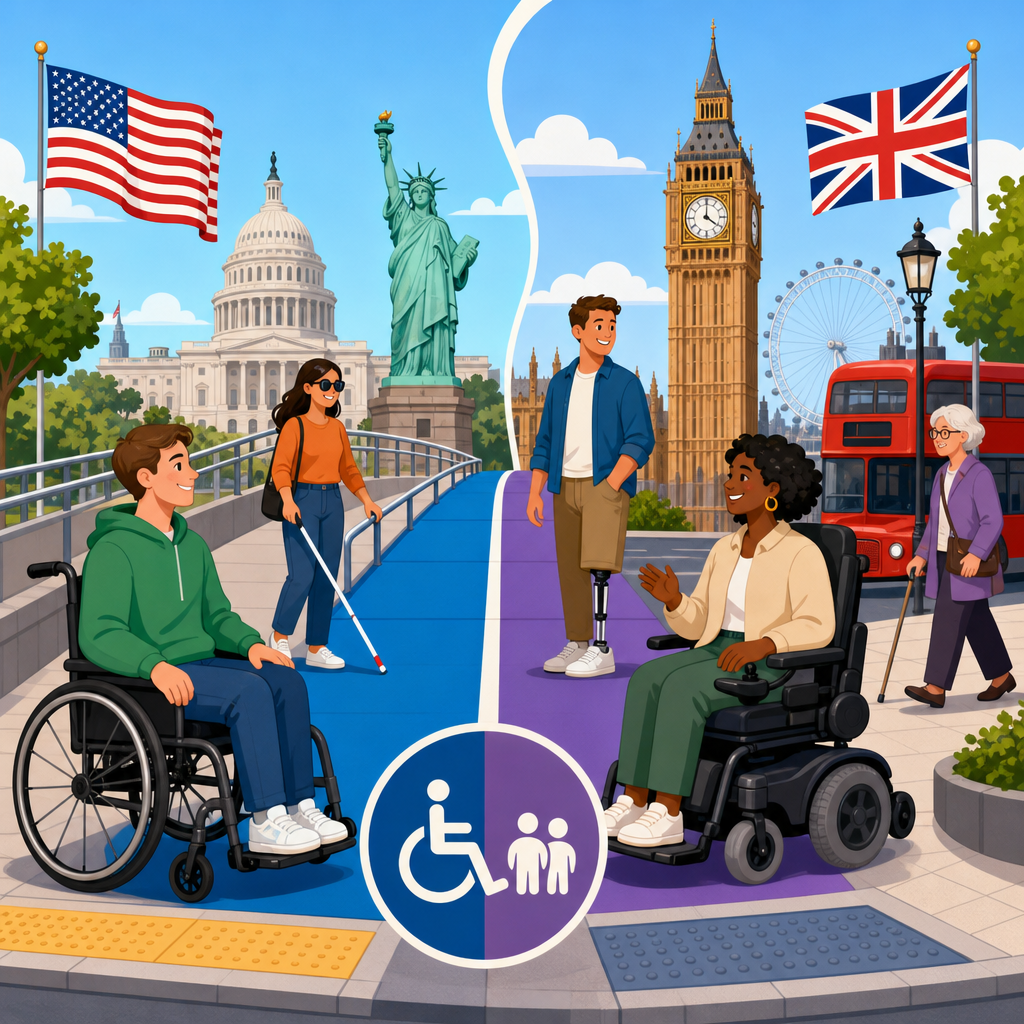
The Americans with Disabilities Act and the UK Equality Act are often grouped together as landmark disability rights laws, yet they differ in structure, scope, enforcement, and day-to-day accessibility obligations in ways that matter for employers, schools, landlords, digital teams, and multinational brands. Accessibility, in this context, means designing physical spaces, services, communications, and technology so disabled people can use them with safety, dignity, and independence. Disability rights law is broader than ramps and lifts: it covers hiring, customer service, housing, education, transport, websites, apps, and the policies that shape whether people are included or excluded. I have worked with teams translating accessibility requirements across jurisdictions, and the biggest mistake I see is assuming the US and UK systems use the same legal logic. They do not. The ADA is a civil rights statute with separate titles governing different sectors, while the Equality Act 2010 consolidates anti-discrimination law across protected characteristics, including disability, into one framework. That distinction affects how organizations assess risk, write policies, budget for remediation, and respond to complaints. This article serves as a hub for global views on disability rights by explaining where the two laws align, where they diverge, and what those differences reveal about accessibility policy in English-speaking democracies.
Different legal foundations and definitions of disability
The ADA, enacted in 1990 and amended by the ADA Amendments Act of 2008, prohibits discrimination against qualified individuals with disabilities in employment, public services, public accommodations, telecommunications, and other areas. Its architecture is segmented: Title I addresses employment, Title II covers state and local government services, and Title III governs private businesses open to the public. The UK Equality Act 2010 merged prior legislation, including the Disability Discrimination Act, into a single anti-discrimination regime. That consolidated structure makes the Equality Act easier to cite at a high level, but not necessarily simpler in application.
Both laws define disability broadly, yet they use different tests. Under the ADA, a person has a disability if they have a physical or mental impairment that substantially limits one or more major life activities, have a record of such an impairment, or are regarded as having one. The ADA Amendments Act instructed courts to interpret coverage expansively and clarified that mitigating measures, such as medication or prosthetics, generally should not be used to deny coverage. Under the Equality Act, a person is disabled if they have a physical or mental impairment with a substantial and long-term adverse effect on their ability to carry out normal day-to-day activities. Long-term usually means at least twelve months, likely to last twelve months, or recurring.
In practice, the US approach places heavy emphasis on major life activities and broad coverage, while the UK test focuses more explicitly on long-term effect and ordinary daily function. That difference can change case strategy. A fluctuating condition may still qualify in both countries, but UK analysis often spends more time on duration and recurring impact. For international businesses, legal intake forms, occupational health processes, and accommodation requests should never rely on one shared definition.
Reasonable accommodation versus reasonable adjustments
The central operational difference between the two systems is how they frame the duty to remove barriers. In the United States, employers must provide reasonable accommodations to qualified employees or applicants unless doing so would create an undue hardship. Public entities and many businesses also have obligations to ensure access, but the terminology and standards vary by title. In the United Kingdom, employers, education providers, service providers, and others may have a duty to make reasonable adjustments when disabled people would otherwise be placed at a substantial disadvantage.
The UK concept of reasonable adjustments is broader and more anticipatory in many settings. For service providers especially, the duty is not only reactive after a person complains; it is a continuing obligation to think ahead about barriers that disabled people generally may face. That can include changing policies, providing auxiliary aids, or altering physical features where reasonable alternatives are needed. In the US, ADA compliance often becomes organized around individual accommodation requests plus technical facility standards. In the UK, I routinely see stronger emphasis on systemic review of customer journeys and institutional practices before a complaint arises.
Examples make the distinction clearer. A US employer may respond to an employee with migraines by approving remote work two days a week, adjusting lighting, and permitting schedule flexibility after an interactive process. A UK employer may reach a similar result, but the analysis will be framed as reasonable adjustments to avoid substantial disadvantage. A cinema chain in the UK may schedule regular captioned screenings and hearing loops as part of an anticipatory service duty, while a US operator may focus more on specific auxiliary aid rules and litigation risk under public accommodation requirements.
Where each law applies in daily life
The ADA and Equality Act both reach employment and services, but they map public and private activity differently. The ADA applies to employers with fifteen or more employees under Title I, state and local government services under Title II, and places of public accommodation under Title III. Title III covers categories such as hotels, restaurants, theaters, retail stores, banks, museums, parks, private schools, and gyms. Religious organizations are generally exempt from Title III, and private clubs may also be exempt.
The Equality Act applies across employment, education, housing-related functions, associations, transport, and service provision, with disability as one protected characteristic among others such as age, race, sex, and religion or belief. The UK framework is not divided into titles like the ADA, so practitioners often analyze disputes through prohibited conduct, duties owed, and sector-specific schedules or regulations. Public sector bodies also face the Public Sector Equality Duty, which requires due regard to eliminating discrimination, advancing equality of opportunity, and fostering good relations. The ADA has no direct equivalent phrased in those terms.
That matters because UK public bodies are expected to embed equality considerations into decision-making, procurement, and policy design, not just respond to individual claims. In the US, a city transit authority may focus on ADA paratransit requirements, stop announcements, station accessibility, and program access. In the UK, a council will often need to document how equality impacts were considered when changing transport routes, closing facilities, or digitizing services. The rights overlap, but the administrative discipline around public decision-making is different.
Enforcement, litigation, and remedies
Enforcement is another major point of divergence. In the United States, the Equal Employment Opportunity Commission enforces ADA employment provisions, while the Department of Justice enforces Titles II and III in many contexts. Private plaintiffs can also sue. ADA litigation has produced extensive case law, especially around website accessibility, public accommodations, service animals, and employment accommodations. Title III generally allows injunctive relief and attorneys’ fees in private actions, but not federal damages for private plaintiffs, although some state laws add damages.
In the United Kingdom, disability discrimination claims are typically brought in Employment Tribunals for workplace matters or County Court or Sheriff Court for services and other claims, depending on jurisdiction and issue. The Equality and Human Rights Commission has enforcement powers and can issue guidance, conduct investigations, and support strategic litigation. Remedies can include compensation for financial loss and injury to feelings, declarations, and recommendations in some contexts. The injury to feelings element, often guided by the Vento bands in employment cases, gives UK claims a remedial character that differs from many ADA private suits.
From a compliance perspective, this changes incentives. In the US, businesses often prioritize technical audits, demand letters, settlement posture, and class-action exposure. In the UK, organizations still face legal risk, but they are also pushed by tribunal culture, public sector scrutiny, and broader equality governance. Neither system is automatically tougher in every case; they simply generate different pressure points.
Digital accessibility and web compliance
Digital accessibility is where many international teams feel the gap most sharply. The ADA does not include a detailed statutory checklist for websites, yet US courts and the Department of Justice have repeatedly treated inaccessible websites and apps as potential barriers under the ADA, particularly when connected to goods, services, or programs. The Web Content Accessibility Guidelines, usually WCAG 2.1 AA and increasingly WCAG 2.2 AA, function as the practical benchmark even though the ADA itself does not codify them in one universal rule for all private websites.
In the UK, website accessibility is shaped by the Equality Act and, for public sector bodies, the Public Sector Bodies Accessibility Regulations 2018, which more directly require accessibility statements and conformance expectations aligned with WCAG. That means a UK government agency usually has clearer published obligations than a comparable US private business. Private UK businesses still face Equality Act exposure if digital services create substantial disadvantage, but the legal pathway is less dominated by the specific litigation patterns seen in the US.
| Issue | ADA approach | UK Equality Act approach |
|---|---|---|
| Core structure | Separate titles by sector | Single consolidated anti-discrimination statute |
| Employment duty | Reasonable accommodation unless undue hardship | Reasonable adjustments to avoid substantial disadvantage |
| Service access | Public accommodation rules, technical standards, auxiliary aids | Anticipatory reasonable adjustments for service users |
| Public bodies | Title II program access obligations | Equality Act duties plus Public Sector Equality Duty |
| Web accessibility | Case law and DOJ interpretation often use WCAG | Equality Act plus specific public sector accessibility regulations |
| Private remedies | Often injunctions under Title III, damages vary by context | Compensation may include injury to feelings |
If you run a global website, the safest operational approach is not to optimize separately for minimum legal thresholds. Use WCAG 2.2 AA, test with screen readers such as NVDA, JAWS, and VoiceOver, include keyboard-only navigation reviews, and build accessibility into procurement and release cycles. That standard will support compliance conversations in both jurisdictions and reduce costly retrofits.
What these differences mean for global disability rights strategy
Looking at the ADA and the Equality Act together reveals a wider global pattern in disability rights. Countries may share the same moral goal of inclusion while using different legal mechanisms to get there. The United States often relies on sector-specific civil rights enforcement, technical standards like the ADA Standards for Accessible Design, and a strong litigation culture. The United Kingdom uses a consolidated equality model, a more explicit anticipatory adjustments duty in service contexts, and additional public law expectations for state bodies. Both systems have also been influenced by the UN Convention on the Rights of Persons with Disabilities, especially in how policymakers discuss participation, autonomy, and barrier removal.
For multinational organizations, the practical lesson is clear: build one high accessibility baseline, then localize legal processes. Maintain a centralized accessibility policy, but adapt definitions of disability, complaint channels, and assessment templates by country. Train managers not to wait for perfect medical wording before discussing support. Audit customer-facing journeys, not just building dimensions. Review recruitment platforms, PDFs, video captioning, call center scripts, and emergency procedures. In my experience, the organizations that perform best are those that treat accessibility as governance, design, and service quality, not only as legal defense.
This hub on global views on disability rights starts with the ADA and the Equality Act because they are influential reference points for international teams. Their differences show why accessibility cannot be copied from one market to another with a find-and-replace policy. Understand the legal foundation, plan for anticipatory barrier removal, and use recognized standards in digital and physical environments. If your organization operates across borders, audit your current practices against both frameworks and make accessibility a standing part of how you design, hire, communicate, and serve.
Frequently Asked Questions
1. What is the main difference between the ADA and the UK Equality Act when it comes to accessibility?
The biggest difference is that the Americans with Disabilities Act (ADA) is a US civil rights law built around several separate titles that regulate different areas of public life, while the UK Equality Act 2010 is a broader anti-discrimination statute that brings many equality protections into one framework. In practical terms, both laws aim to prevent disabled people from being excluded, but they organize duties differently and use somewhat different legal concepts to get there.
Under the ADA, accessibility duties are spread across specific areas such as employment, state and local government services, and places of public accommodation. The law is closely tied to technical standards in many physical access settings, especially through the ADA Standards for Accessible Design. That means US organizations often think in terms of whether a building feature, route, restroom, counter, or entrance meets a defined accessibility requirement. The ADA also plays a major role in digital accessibility discussions, even though the statute itself was written before the modern web became central to daily life.
By contrast, the UK Equality Act focuses heavily on discrimination, disadvantage, and the duty to make reasonable adjustments. Rather than being structured mainly around detailed architectural rules in a single statute, it asks whether a disabled person has been put at a substantial disadvantage and whether the organization took reasonable steps to remove or reduce that disadvantage. Accessibility under the Equality Act therefore often turns on context: the person’s needs, the barrier involved, the resources of the organization, and what changes would be practical and proportionate.
So if you want the short version, the ADA often feels more category-based and standards-driven in operation, while the Equality Act often feels more principles-based and adjustment-focused. For employers, schools, landlords, service providers, and multinational brands, that difference matters because compliance is not just about having the same intent in both countries. The legal tests, documentation, risk points, and enforcement expectations can be quite different even when the goal of inclusion is shared.
2. How do the two laws define disability, and why does that affect accessibility duties?
Both laws protect people with disabilities, but they do not define disability in exactly the same way, and that can affect who is covered and when duties are triggered. Under the ADA, disability is generally defined as a physical or mental impairment that substantially limits one or more major life activities, a record of such an impairment, or being regarded as having such an impairment. US law, especially after the ADA Amendments Act, is intended to be interpreted broadly, so the coverage question is not supposed to be read too narrowly.
In the UK, the Equality Act typically defines disability as a physical or mental impairment that has a substantial and long-term adverse effect on a person’s ability to carry out normal day-to-day activities. The phrase “long-term” is especially important in UK analysis, because the impact usually must have lasted, or be likely to last, at least 12 months. That means the UK framework sometimes places more explicit emphasis on duration than US discussions do.
Why does this matter for accessibility? Because legal protection often begins with whether the individual is covered. In employment, education, housing, customer service, or digital access disputes, the scope of the disability definition can shape whether an organization had a duty to act. If a person is clearly covered under one law but the analysis is less straightforward under the other, the organization may face different legal obligations in different jurisdictions.
This also matters for policy drafting. A multinational employer or service provider should not assume that a single internal definition of disability will perfectly match both legal systems. Many organizations choose to adopt a more inclusive operational approach than the bare minimum legal threshold, because it reduces inconsistency and improves user experience. From an accessibility perspective, that is often the wisest path: design processes that remove barriers early, rather than relying on narrow arguments about whether someone qualifies for protection after a problem has already occurred.
3. What is the difference between “reasonable accommodation” under the ADA and “reasonable adjustments” under the Equality Act?
These ideas are closely related, but they are not identical in wording, application, or legal culture. Under the ADA, the phrase most often used in employment is “reasonable accommodation.” This refers to changes or modifications that enable a qualified individual with a disability to apply for a job, perform essential job functions, or enjoy equal benefits and privileges of employment. Examples include modified schedules, assistive technology, accessible workstations, interpreters, or adjustments to workplace policies. Employers must provide accommodation unless doing so would create an undue hardship, which generally means significant difficulty or expense in light of the employer’s circumstances.
Under the UK Equality Act, the duty is usually framed as making “reasonable adjustments.” This duty can apply in employment, education, and the provision of services, and it is often described in broader, more anticipatory terms than many US organizations are used to. In the UK, the duty may involve changing a provision, criterion, or practice, altering a physical feature, or providing an auxiliary aid. The key question is whether a disabled person has been placed at a substantial disadvantage and what reasonable steps could have been taken to avoid that disadvantage.
A major practical difference is that the UK duty is often understood as requiring organizations to think ahead about barriers that disabled people as a group may face, especially in service delivery and public-facing environments. In the US, many accommodation discussions are still highly individualized, particularly in employment. That does not mean the ADA lacks broader accessibility obligations; it certainly has them. But the legal workflow and organizational mindset can differ. ADA compliance may often start with a request and an interactive process in employment, while the Equality Act may more strongly encourage organizations to identify and remove foreseeable barriers before a person has to ask.
For digital teams, facilities managers, HR departments, and customer service leaders, the takeaway is simple: do not treat these phrases as interchangeable labels. They reflect different legal traditions and can lead to different compliance strategies. A strong cross-border accessibility program should include both individualized support processes and proactive barrier removal, so the organization is prepared under either framework.
4. Do the ADA and the Equality Act apply differently to websites, apps, and other digital services?
Yes, and this is one of the most important areas for modern organizations. In the United States, the ADA is frequently used to challenge inaccessible websites, mobile apps, online forms, digital documents, and other technology, especially where they are connected to public-facing goods and services. However, the legal landscape has developed through agency guidance, court decisions, and settlements more than through one single, comprehensive statutory section dedicated specifically to websites. As a result, US organizations often face a degree of uncertainty about scope, especially depending on industry and jurisdiction, even though the overall direction is clear: inaccessible digital services can create serious ADA risk.
In the UK, digital accessibility issues are generally analyzed through the Equality Act’s anti-discrimination framework and the duty to make reasonable adjustments, along with additional public sector rules where applicable. The core question is often whether the inaccessible website, app, portal, or communication method places disabled users at a substantial disadvantage and whether reasonable steps were taken to prevent that. This can cover issues such as keyboard navigation, screen reader compatibility, captioning, color contrast, form labeling, timing controls, accessible PDFs, and alternatives for users who cannot access standard digital channels.
In both countries, organizations commonly use the Web Content Accessibility Guidelines (WCAG) as the practical benchmark for digital accessibility, even though WCAG itself is not always written directly into every legal provision. That is why a business operating in both markets should not focus only on whether a law explicitly names a technical standard. The smarter question is whether disabled users can actually access the content, complete tasks, understand information, and use support channels independently.
For multinational brands, digital compliance should be treated as an ongoing governance issue, not a one-time project. Build accessibility into design systems, procurement, content workflows, QA testing, vendor contracts, and remediation timelines. That approach helps reduce risk under both the ADA and the Equality Act, because both laws are fundamentally concerned with whether disabled people are being denied equal access in real-world use, not just whether a company has a policy statement on paper.
5. How are the ADA and the Equality Act enforced, and what should organizations do to stay compliant across both?
Enforcement differs significantly, and that difference shapes how organizations should manage risk. In the United States, the ADA can be enforced through federal agencies such as the Equal Employment Opportunity Commission in employment matters and the Department of Justice in certain public access matters, as well as through private lawsuits. Depending on the context, claims may involve investigations, negotiated settlements, injunctive relief, civil penalties, attorneys’ fees, and mandatory changes to facilities, policies, or digital systems. Because ADA litigation is active in many sectors, businesses often view accessibility through a litigation-prevention lens as well as a compliance lens.
In the UK, Equality Act enforcement can also involve court or tribunal claims, but the mechanisms and legal culture are different. Employment claims often go to employment tribunals, while service-related and other discrimination claims may proceed through the courts. The Equality and Human Rights Commission also has enforcement and strategic powers in certain circumstances. Rather than looking exactly like the US model of ADA complaint and settlement activity, UK enforcement often centers more directly on discrimination analysis, reasonableness, disadvantage