Japan regulates public access and assistance dogs through a national legal framework that combines disability rights, animal training standards, and duties for businesses and public facilities. In practice, the core rules come from the Act on Assistance Dogs for Physically Disabled Persons, supported by broader disability policy and local implementation guidance. For travelers, residents, employers, and service providers, understanding how Japan regulates public access and assistance dogs matters because the country recognizes several working dog categories, sets certification requirements, and expects institutions to admit qualified dogs in daily life.
In Japan, the phrase assistance dogs usually refers to three legally defined types: guide dogs for people with visual impairments, service dogs for people with physical disabilities, and hearing dogs for people with hearing impairments. This is narrower than usage in some other countries, where emotional support animals, psychiatric service dogs, or owner-trained dogs may fall into overlapping discussions. Japan’s system is more formal. It relies on designated training organizations, assessment procedures, identifiable markings, and documentation that confirm a dog’s status. That structure gives businesses clearer signals, but it also means access rights are tied closely to official recognition rather than broad self-identification.
From my work reviewing public access policies across jurisdictions, Japan stands out for pairing access rights with a highly controlled qualification process. The result is not a free-form model. It is a regulated access model designed to reduce disputes at doors, on trains, in hospitals, and in workplaces. The tradeoff is important: stronger standardization can improve public confidence, yet narrower definitions may leave some disabled people outside the legal categories. As a hub article within Global Views on Disability Rights, this page explains the legal foundation, who qualifies, where dogs must be admitted, what businesses can ask, how enforcement works, and why Japan’s approach differs from systems in the United States, Europe, and other parts of Asia.
Japan’s legal framework for assistance dogs
The central statute is the Act on Assistance Dogs for Physically Disabled Persons, enacted in 2002 and later expanded in stages. Its purpose is straightforward: support the independence and social participation of people with physical disabilities by ensuring they can be accompanied by trained assistance dogs. The law works alongside Japan’s wider disability framework, including the Basic Act for Persons with Disabilities and the Act for Eliminating Discrimination against Persons with Disabilities. Together, these measures reinforce a principle that disabled people should be able to access public life on equal terms, while the assistance dog law supplies the operational details.
The law does not create a general right for any supportive animal to enter any place. Instead, it defines specific dog roles, requires those dogs to be trained for concrete tasks, and links public access to certification. Ministries and local governments issue guidance to help businesses understand their obligations. In real terms, that means a hotel, restaurant, clinic, retailer, or municipal office is not expected to judge a dog subjectively. It is expected to recognize a properly certified assistance dog and admit the handler except in limited circumstances tied to health, safety, or facility-specific operational constraints.
One reason this framework is often cited in comparative disability policy is that it addresses a common business concern directly: certainty. Countries with looser definitions often produce frontline confusion because staff are unsure which animals are protected and what questions are lawful. Japan reduces that uncertainty by building access around designated categories and recognizable proof. That is especially useful in dense urban settings like Tokyo or Osaka, where businesses handle large visitor volumes and quick entrance decisions are routine.
Which dogs are legally recognized
Japan legally recognizes guide dogs, service dogs, and hearing dogs. Guide dogs assist people with visual impairments by navigating obstacles, locating entrances, stopping at curbs, and supporting safe travel in crowded public environments. Service dogs assist people with physical disabilities by retrieving dropped items, opening and closing doors, helping with balance-related tasks, operating switches, or summoning help. Hearing dogs alert handlers to doorbells, alarms, calling voices, timers, and other important sounds. These are task-trained working dogs, not companion animals.
The phrase physically disabled persons in the title of the law can be misleading to international readers. Guide dogs and hearing dogs are clearly included, but the statute is not drafted as a catchall for all disability-related animal assistance. People expecting the broadest possible disability access regime may be surprised that Japan’s legal design remains category-specific. Psychiatric service dogs are not recognized in the same established way under this statute, and emotional support animals do not receive equivalent public access protection. That limitation is one of the most significant points for foreign visitors planning travel in Japan.
Because the categories are precise, training is precise as well. A guide dog must demonstrate safe navigation behavior under distraction. A service dog must perform practical mobility or daily living tasks reliably. A hearing dog must alert consistently to specified sounds and respond appropriately in public settings. Japan’s policy logic is that access rights should rest on demonstrated functionality. That focus on tasks mirrors international best practice in working dog standards, even though the legal scope is narrower than in some other countries.
Certification, identification, and handler responsibilities
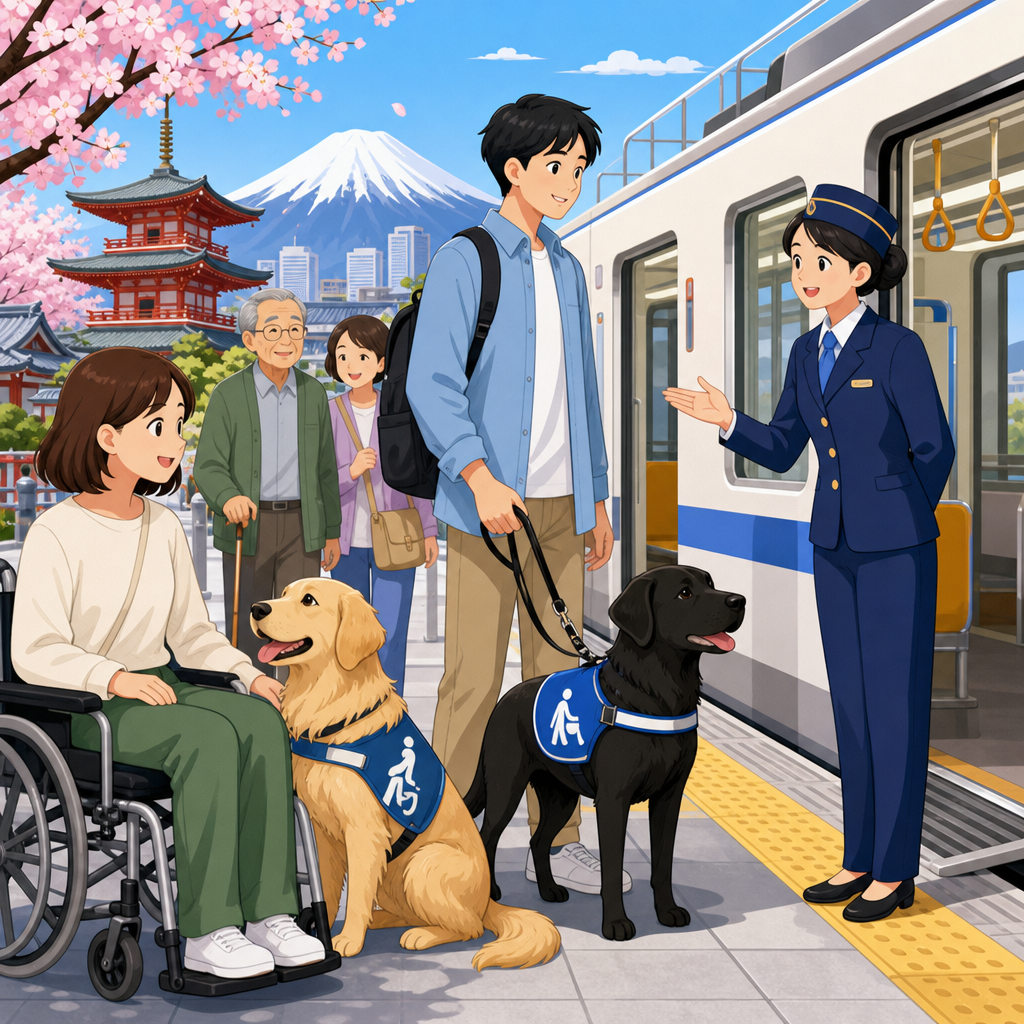
Public access in Japan depends heavily on certification. Assistance dogs are trained by designated organizations and assessed against established standards. Once qualified, the dog and handler receive documentation showing the animal’s legal status. The dog also wears a sign or marker identifying it as an assistance dog. This visible identification is a practical feature of the Japanese model. It gives transport staff, shop employees, and reception personnel an immediate compliance cue and lowers the chance of conflict at entry points.
Handlers also have responsibilities. They must keep the dog under control, maintain hygiene, and carry the required certificate. The dog must be healthy, vaccinated as required, and suitable for public settings. In my experience analyzing access disputes, this two-sided structure is one reason Japan’s rules are easier to operationalize than rights-only systems. Businesses are not simply told to admit a dog; they are assured that certified assistance dogs have passed training and that handlers must manage them appropriately. That assurance builds trust in restaurants, medical facilities, and shared transportation.
| Category | Main function | Access basis | Typical identification |
|---|---|---|---|
| Guide dog | Navigation for visual impairment | Certified task-trained dog under the law | Harness and official assistance dog marker |
| Service dog | Physical task assistance | Certified task-trained dog under the law | Vest or marker plus handler documentation |
| Hearing dog | Alerts to important sounds | Certified task-trained dog under the law | Official marker and handler documentation |
For foreign handlers, the key issue is equivalency. A dog recognized abroad is not automatically treated as legally qualified in Japan if it does not fit Japanese categories or lacks documentation that local institutions can verify. That does not mean access is impossible, but it does mean advance planning is essential. Airlines, hotels, and event venues often need notice, translated records, or direct coordination before travel dates.
Where public access applies in daily life
Japan’s assistance dog rules are designed to cover the spaces that shape ordinary participation in society. Public transportation is a major example. Certified dogs should be admitted on trains, buses, taxis, and many domestic travel services because mobility is a prerequisite for employment, education, healthcare, and community life. Hospitals and clinics are another critical setting. While medical institutions may manage infection-control procedures and movement within specialized treatment areas, the baseline expectation is inclusion, not exclusion. Government offices, schools, workplaces, hotels, retail stores, and restaurants are also part of the access landscape.
The business duty is especially important. Amendments and related disability discrimination measures strengthened expectations that private businesses, not only public bodies, accept assistance dogs. That shift matters because many access barriers happen in commercial spaces rather than in government buildings. A person denied entry to a café, barber, supermarket, or office tower experiences a direct restriction on participation. Japan’s legal model recognizes that equality requires ordinary access, not merely symbolic rights in formal institutions.
Real-world compliance still varies. Large national rail operators and major hotel chains usually have established procedures and staff training. Small businesses may be less familiar, particularly in regions with fewer assistance dog users. That gap is common internationally. The most effective organizations use simple internal scripts: confirm the dog is an assistance dog, avoid intrusive questioning, identify any operational issue narrowly, and proceed with admission. Clear signage and frontline training reduce mistakes far more effectively than ad hoc judgment at the door.
Limits, refusals, and common misunderstandings
Japan does not treat access as unlimited in every imaginable setting. Like other countries, it allows practical restrictions where there are legitimate health, safety, or operational reasons. Sterile hospital zones, food preparation areas not open to the public, and certain controlled environments may require adjusted arrangements. The legal test is not personal discomfort, assumptions about dogs, or generalized hygiene concerns. It is whether a specific restriction is objectively justified. A restaurant dining area, for example, is not the same as a commercial kitchen. Staff often confuse those spaces, but the distinction matters legally.
Another misunderstanding involves pet policies. A no-pets rule does not override assistance dog access because an assistance dog is not treated as a pet for access purposes. Businesses also should not impose blanket segregation, such as forcing a handler to sit only in one corner of a café or use a separate entrance without necessity. Reasonable management is allowed; discriminatory exclusion is not. If another customer is afraid of dogs or has an allergy, the preferred response is usually to separate parties where feasible rather than eject the disabled handler.
Foreign visitors most often encounter confusion over terminology. Someone may describe a psychiatric service dog in English and assume the concept transfers directly. In Japan, staff may be looking for one of the three legal categories and the related marker or certificate. That mismatch is not simply linguistic. It reflects a different regulatory model. Travelers who understand that difference can plan better by contacting carriers and venues early, carrying Japanese-language documents, and avoiding assumptions based on home-country law.
How Japan compares with other disability rights approaches
Japan’s model is best understood as structured inclusion. By contrast, the United States relies on the Americans with Disabilities Act, which protects access for service dogs trained to perform tasks for a person with a disability and generally limits staff to two narrow questions when the disability or task is not obvious. The U.S. system is broader in covered disabilities, including psychiatric disabilities, and does not require national certification. That flexibility can expand access, but it can also produce fraud concerns and inconsistent frontline enforcement.
Many European countries sit somewhere between these models, often combining accreditation traditions with accessibility duties under national law. Japan is more centralized than some systems and more category-bound than others. Its strength is clarity. Its weakness is that clarity comes from exclusion as well as definition. If a disabled person’s needs fall outside the recognized categories, the law may offer less direct protection for dog access than they would receive elsewhere.
For anyone studying global views on disability rights, that comparison is the key lesson. Disability access policy always balances autonomy, verification, administrative simplicity, public confidence, and inclusion. Japan prioritizes standardization and predictability. Other jurisdictions prioritize self-declaration and broader anti-discrimination principles. Neither choice is consequence-free. The practical question is which model produces the highest real-world participation with the fewest unnecessary disputes. Japan’s answer is to regulate assistance dogs tightly so access rights are easier to recognize and enforce in everyday public life.
What this means for businesses, institutions, and travelers
Businesses in Japan should train staff to recognize certified assistance dogs, understand the three legal categories, and avoid refusing entry based on pet rules or customer preference alone. Institutions should keep procedures short and consistent: welcome the handler, verify identification only as necessary, and solve seating or routing issues without isolating the person. Travelers and residents who use assistance dogs should carry documentation, confirm transport and lodging arrangements in advance, and prepare for occasional education at the point of access.
The broader lesson is that good disability rights implementation depends on more than passing a law. It requires recognizable standards, public awareness, and routine compliance in ordinary places. Japan offers a valuable case study because it turns a civil participation issue into an operational system that businesses can follow. If you are exploring international disability access rules, use Japan as a benchmark for how legal definitions, certification, and public accommodation duties work together—and review the related articles in this International Perspective hub to compare how other countries regulate assistance animals and public access.
Frequently Asked Questions
1. What law governs assistance dogs and public access in Japan?
Japan’s main legal framework for assistance dogs is the Act on Assistance Dogs for Physically Disabled Persons. This law sets the foundation for how guide dogs, service dogs, and hearing dogs are recognized, trained, certified, and admitted into public spaces. In practical terms, it is the central rule that determines when an assistance dog must be accepted by public facilities, transportation providers, workplaces, and many businesses. The law is not just about animals entering buildings; it is part of a broader disability rights approach that supports independent living, mobility, and equal participation in society.
The law works alongside wider disability policy in Japan, including anti-discrimination principles and local administrative guidance. That means the national statute provides the core legal rights and obligations, while ministries, municipalities, and operators often issue practical instructions on implementation. For example, a business may look not only to the statute itself, but also to local notices on signage, staff training, hygiene handling, and customer communication. This layered system is important because it explains why enforcement in Japan can involve both formal legal duties and administrative expectations.
It is also important to understand that Japan’s framework is relatively structured and category-based. Rather than using a broad, informal idea of any “support animal,” the law focuses on recognized assistance dogs that meet defined standards. This gives businesses and the public a clear legal reference point, but it also means access rights usually depend on whether the dog falls within the recognized legal categories and has completed the required certification process.
2. Which types of assistance dogs are legally recognized in Japan?
Japan legally recognizes three main categories of assistance dogs under its national framework: guide dogs for people with visual impairments, hearing dogs for people with hearing impairments, and service dogs for people with physical disabilities. These categories are specifically tied to functional tasks that help the handler navigate daily life, communicate environmental alerts, or perform practical physical support. The emphasis is on trained working dogs that assist with disability-related needs in a direct and reliable way.
This is a key point for anyone comparing Japan’s rules with those in other countries. In some jurisdictions, the term “service animal” may be used more broadly, and emotional support animals may be discussed in similar conversations. In Japan, however, the legal framework is narrower and more formal. Public access rights are generally tied to dogs that fall within the recognized statutory categories and that have been trained and certified according to the legal system. That makes documentation, identification, and recognized status more important than in countries where staff may rely primarily on verbal confirmation.
For travelers and businesses, the practical takeaway is straightforward: not every assistance-related animal will automatically receive the same legal treatment in Japan. If a dog is not a guide dog, hearing dog, or service dog as defined under the Japanese framework, access questions can become more complicated. That is why advance preparation, clear proof of status, and direct communication with airlines, hotels, employers, and venues are especially valuable when planning to rely on an assistance dog in Japan.
3. Where must assistance dogs be allowed in Japan?
Under Japan’s assistance dog framework, certified assistance dogs are generally entitled to accompany their handlers into a wide range of public and quasi-public settings. This includes public transportation, government offices, hospitals, schools, workplaces, shops, restaurants, hotels, and other facilities that serve the public. The basic principle is that a person with a qualifying disability should not be excluded from everyday social participation simply because they use a trained assistance dog.
In practice, duties can vary depending on the type of facility and the entity operating it. Public institutions and many business operators are expected to admit certified assistance dogs and avoid unnecessary refusal. Employers also have responsibilities in workplace settings, particularly where allowing the dog is necessary for the employee’s ability to work effectively and safely. Healthcare and hospitality environments sometimes raise operational concerns about hygiene, space, or customer reactions, but those concerns do not automatically justify exclusion. Instead, operators are generally expected to accommodate the assistance dog while managing the environment appropriately.
That said, implementation still matters. Staff may ask to confirm that the dog is an officially recognized assistance dog, especially if they are unfamiliar with the law. Businesses often rely on visible indicators, certificates, or identification materials to distinguish certified assistance dogs from pets. For that reason, handlers should be prepared for occasional questions even though the law supports access. The overall rule is inclusion, but smooth entry often depends on the combination of legal rights, proper certification, and staff awareness at the point of service.
4. Do assistance dogs in Japan need training and certification?
Yes. Training and certification are central to Japan’s regulatory model. The legal system is designed around the idea that assistance dogs receiving public access rights must meet established behavioral, health, and task-performance standards. This helps protect both the rights of disabled handlers and the confidence of businesses and the public. A certified assistance dog is expected to be under control, perform disability-related tasks reliably, behave appropriately in public, and meet health management requirements.
The certification process is important because it serves as the legal bridge between the dog’s role and the handler’s access rights. Japan’s framework does not generally treat self-declared status as enough. Instead, recognized training and evaluation help show that the dog is genuinely prepared for public environments such as trains, restaurants, hospitals, offices, and lodging facilities. This formal structure also helps reduce disputes over safety, hygiene, or misrepresentation.
For handlers, the practical implication is that documentation matters. Carrying the relevant identification or certification materials can make interactions with facility staff much easier. For businesses, certification provides a lawful basis for understanding when an animal falls within the protected assistance dog framework. In short, Japan regulates access not only by granting rights, but also by requiring that those rights rest on a verified training and certification system that supports trust, public order, and accessibility.
5. What should travelers, employers, and businesses know about complying with Japan’s assistance dog rules?
Travelers should know that preparation is essential. Even though Japan has a national legal framework supporting assistance dogs, real-world access can depend on advance coordination, especially for international visitors. Airlines, rail operators, hotels, event venues, and landlords may each have their own procedures for confirming the dog’s status, health records, and recognized function. Because Japan places significant weight on official recognition and certification, foreign travelers should check carefully whether their dog’s documentation will be accepted as equivalent or whether additional arrangements are needed before arrival.
Employers should understand that assistance dog access is not only a customer-service issue but also a workplace accommodation issue. If an employee uses a legally recognized assistance dog, the employer should approach the situation as part of its broader disability inclusion responsibilities. That may involve allowing the dog in work areas, training supervisors and coworkers, reviewing emergency procedures, and addressing practical matters such as layout, rest breaks, or client-facing interactions. The goal is not merely technical compliance, but creating a workplace where the employee can participate on equal terms.
Businesses and public-facing service providers should focus on staff education and consistent procedures. Frontline employees need to know that certified assistance dogs are not pets and generally cannot be refused simply because of a no-pets policy. They should also understand how to respond professionally if they need to confirm identification or if another customer raises objections. A well-run compliance approach usually includes internal guidance, respectful communication scripts, and a basic understanding of the governing law. In Japan, many access problems arise not from the absence of rules, but from uncertainty at the point of contact. Businesses that train their teams well are far less likely to create legal risk or inconvenience disabled customers.
Across all groups, the broad lesson is the same: Japan regulates assistance dogs through a structured legal system that combines access rights, recognized dog categories, training standards, and implementation duties. Knowing the framework in advance makes travel smoother, employment more inclusive, and customer service more lawful and respectful.