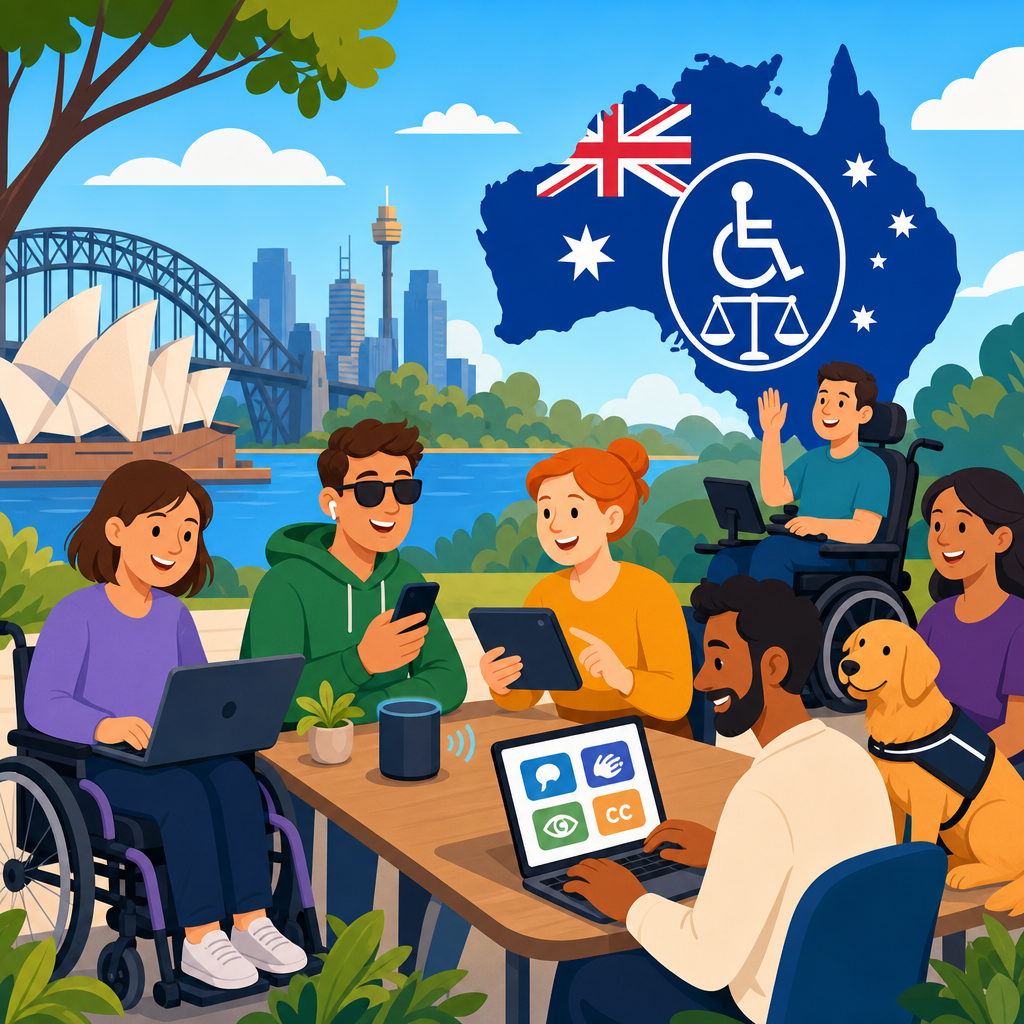
Australia, the ADA, and disability rights in digital services sit at the intersection of law, design, procurement, and everyday participation. The title may sound unusual because the Americans with Disabilities Act is a United States statute, while Australia has its own legal framework, yet organizations routinely compare them when building websites, apps, portals, kiosks, and online customer journeys used across borders. In practice, that comparison matters because digital services are now essential infrastructure for work, education, health care, banking, transport, and government. If a booking form cannot be completed with a keyboard, a PDF cannot be read by a screen reader, or a video lacks captions, access is denied as surely as if a staircase blocked a building entrance. In this international perspective hub, I will map how Australia approaches digital disability rights, how that approach aligns with and differs from the ADA, and what global teams should do to reduce legal risk while delivering genuinely usable services.
Disability rights in digital services means the legal and practical requirement to make websites, mobile apps, software interfaces, documents, and self-service technologies accessible to people with disability. That includes people who are blind or have low vision, Deaf or hard of hearing users, people with mobility impairments, neurodivergent users, and people with cognitive, speech, or psychosocial disabilities. The most widely used technical benchmark is the Web Content Accessibility Guidelines, usually WCAG 2.1 or 2.2, organized around content being perceivable, operable, understandable, and robust. Those standards do not replace law, but courts, regulators, procurement teams, and accessibility auditors use them as the practical yardstick. Australia’s debate is especially important because it reflects a broader global shift: disability rights are increasingly applied to digital services through anti-discrimination law, public sector rules, consumer expectations, and international human rights principles.
How Australia regulates digital accessibility
In Australia, the central statute is the Disability Discrimination Act 1992, commonly called the DDA. It prohibits discrimination on the ground of disability in areas including the provision of goods, services, facilities, education, employment, accommodation, and access to premises. Digital services fall within that services framework. A website, online application portal, payment journey, telehealth system, or digital learning environment can therefore become the subject of a disability discrimination complaint if inaccessible design prevents equal participation. The Australian Human Rights Commission has long treated web accessibility as part of this obligation, and its guidance has consistently pointed organizations toward recognized standards such as WCAG.
The landmark Australian case most practitioners cite is Maguire v Sydney Organising Committee for the Olympic Games. In that matter, a blind complainant challenged the inaccessibility of the Sydney Olympics website. The decision, delivered in 2000, became globally influential because it confirmed that web content was not outside disability law simply because it was new technology. I still see this case referenced in procurement policies and remediation roadmaps because its lesson remains current: digital barriers are legal barriers when they stop people using a service on equal terms. The case also showed that accessibility cannot be bolted on after launch. When core architecture, navigation, and document workflows are inaccessible, remediation is slower and more expensive.
Australian public sector practice adds another layer. The Digital Transformation Agency and state governments have typically required conformance with WCAG for government websites and online services, often at Level AA. That matters beyond government itself because vendors building for the public sector are expected to produce accessible design systems, components, forms, and content patterns from the outset. Universities, banks, insurers, retailers, and health providers often mirror those requirements because they face similar complaints risk and serve broad populations. The result is a mixed but clear compliance environment: the DDA supplies the legal prohibition on discrimination, while WCAG provides the technical benchmark most organizations use to demonstrate that they took reasonable steps.
Where the ADA fits into the comparison
The ADA is not an Australian law, but it shapes the global discussion because many multinational organizations operate one digital estate across the United States, Australia, Europe, and Asia-Pacific. Title II of the ADA covers state and local government services, and Title III applies to places of public accommodation and commercial facilities. In recent years, US enforcement and litigation have made it plain that websites and mobile apps are within scope when they act as gateways to goods and services. The Department of Justice has repeatedly taken the position that inaccessible digital services can violate the ADA, and US courts have often relied on WCAG as the practical standard, even when the statute itself does not spell out technical criteria line by line.
For Australian teams, the comparison is useful in three ways. First, it highlights that anti-discrimination law can reach digital services even without a web-specific act. Second, it shows how litigation pressure can accelerate internal accessibility programs. Third, it demonstrates that accessibility must cover entire user journeys, not isolated pages. In one audit program I worked on, a retailer had alt text on home page banners but failed at account creation, checkout error handling, and coupon application. Under both Australian and US analysis, that would be a service-access problem, not a cosmetic issue. The practical takeaway is simple: organizations should map accessibility across browsing, registration, purchase, support, and post-sale account management.
Global disability rights beyond Australia and the United States
Australia and the ADA sit within a broader international framework. The United Nations Convention on the Rights of Persons with Disabilities, or CRPD, is the key human rights instrument. Australia ratified it in 2008, and many countries use it to guide legislation, policy, and public procurement. Article 9 addresses accessibility, including information and communications technologies. While the CRPD is not a technical manual, it establishes the principle that digital participation is part of equal participation in society. That principle has influenced legal reforms and official guidance worldwide.
Other jurisdictions show the same trajectory with different legal machinery. The European Accessibility Act sets accessibility requirements for specified products and services, including e-commerce and banking interfaces in many contexts. The EU Web Accessibility Directive requires public sector websites and mobile apps to meet accessibility standards and publish accessibility statements. Canada’s Accessible Canada Act has pushed federal institutions and regulated sectors toward structured accessibility planning. The United Kingdom applies the Equality Act 2010 alongside Public Sector Bodies Accessibility Regulations. New Zealand relies on the Human Rights Act and strong government standards. The shared pattern is unmistakable: disability rights in digital services are moving from best practice to expected baseline, enforced through a mix of equality law, procurement rules, sector regulation, and complaint mechanisms.
| Jurisdiction | Main legal driver | Digital accessibility effect |
|---|---|---|
| Australia | Disability Discrimination Act 1992 | Inaccessible digital services can amount to unlawful discrimination; WCAG commonly used |
| United States | ADA Titles II and III | Websites and apps increasingly treated as covered services; strong litigation pressure |
| European Union | EAA and Web Accessibility Directive | Public sector and many private digital services face explicit accessibility requirements |
| Canada | Accessible Canada Act | Planning, reporting, and barrier removal obligations in federal contexts |
| United Kingdom | Equality Act 2010 and accessibility regulations | Anti-discrimination duties plus public sector technical compliance expectations |
What accessible digital services require in practice
Accessible digital services are built, tested, and maintained so that disabled users can complete the same tasks with comparable independence, privacy, and reliability. That starts with semantic structure in code, text alternatives for meaningful images, sufficient color contrast, resizable text, visible focus states, and complete keyboard access. It extends to captions for video, transcripts for audio, labels and instructions for forms, predictable navigation, error identification, and compatibility with assistive technologies such as screen readers, speech recognition, magnifiers, and switch devices. On mobile, accessibility also includes touch target size, orientation support, and platform-native accessibility APIs on iOS and Android.
The most common failure pattern is not a missing checkbox on an audit sheet; it is a broken task. Consider an online government grant application. A blind user may reach the form, but if the date picker is not announced properly, required fields are unclear, error messages are not linked to inputs, and uploaded attachments are inaccessible scanned PDFs, the service is functionally unavailable. The same is true for a banking app that times out without warning, a telehealth platform that captions only clinician speech but not patient speech during recorded consultations, or a university learning portal where quizzes cannot be navigated by keyboard. Compliance and usability converge at the task level. If people cannot complete the task, the service is not accessible.
Risk, enforcement, and the business case
Organizations often ask whether digital accessibility is mainly a legal issue or a customer experience issue. The answer is both. In Australia, complaints can be brought under the DDA, leading to conciliation, reputational damage, remediation costs, and sometimes broader policy changes. In the United States, serial litigation and demand letters have pushed many brands into settlement agreements with monitoring and deadlines. In Europe and the United Kingdom, public bodies face scrutiny through mandated statements, monitoring, and procurement requirements. Legal exposure is real, but the operational cost of inaccessible services is just as tangible: failed transactions, support calls, abandoned applications, duplicate service channels, and exclusion from public tenders.
The business case is strongest when tied to measurable service performance. When teams improve form labels, validation, focus management, and content clarity, completion rates usually rise for everyone, not only disabled users. Captions help Deaf users, but they also help commuters in noisy environments and non-native language speakers. Plain language reduces cognitive load and customer error. Responsive layouts and keyboard support often improve efficiency for power users. In my experience, the fastest way to secure executive support is to pair accessibility findings with conversion data, call-center volumes, or complaint trends. Accessibility becomes hard to dismiss when it is shown to reduce friction across the entire customer journey.
How global teams should build a durable accessibility program
A durable program does not begin with a one-time audit and end with a badge in the footer. It begins with governance. Assign executive ownership, define an accessibility policy, adopt WCAG 2.2 AA as the minimum target unless a stricter rule applies, and set procurement requirements for vendors, platforms, and content agencies. Require accessibility acceptance criteria in design briefs, user stories, and definition of done. Integrate automated testing tools such as axe, WAVE, or Lighthouse, but do not rely on automation alone; automated tools typically catch only a portion of issues. Manual keyboard testing, screen reader testing with NVDA, JAWS, and VoiceOver, and usability testing with disabled participants are indispensable.
Training is equally important. Designers need to understand color contrast, focus order, and error prevention. Developers need semantic markup, ARIA discipline, and component behavior knowledge. Content teams need heading structure, link purpose, plain language, and accessible document practices in Word, PowerPoint, and PDF. Product owners need to scope accessibility from discovery through release. If the organization serves multiple countries, create a baseline global standard and then map local legal overlays. That approach prevents fragmentation. One design system, one testing method, and one remediation workflow can support compliance in Australia while also addressing ADA exposure, European requirements, and wider global expectations.
Conclusion
Australia, the ADA, and disability rights in digital services belong in the same conversation because digital access is now a core civil rights issue worldwide. Australia’s DDA shows that anti-discrimination law can apply powerfully to websites, apps, documents, and online transactions. The ADA demonstrates how sustained enforcement pressure can reshape digital practice at scale. Global developments, from the CRPD to European and Commonwealth rules, confirm the broader direction: accessible digital services are no longer optional enhancements. They are a legal, operational, and ethical baseline for participation in modern life.
For organizations building this international perspective into strategy, the lesson is straightforward. Use WCAG as the technical foundation, test complete user journeys, include disabled users in research, and treat accessibility as an ongoing product quality function rather than a late compliance exercise. If this page is your hub for global views on disability rights, the next step is to map each target market, identify the governing accessibility obligations, and prioritize remediation where users face the highest barriers. Start with your most important digital service, test it with real assistive technology, and fix the tasks people cannot complete today.
Frequently Asked Questions
1. Why does an article about Australia discuss the ADA when the ADA is a United States law?
It comes up because digital services rarely stay inside one legal or geographic boundary. A business may be headquartered in Australia, serve customers in the United States, use software vendors from Europe, and operate websites, apps, booking systems, customer portals, and self-service tools that are available globally. In that environment, the Americans with Disabilities Act, or ADA, becomes part of the conversation even when an organization is primarily focused on Australian compliance. The ADA is a US civil rights law, while Australia has its own legal structure, most notably the Disability Discrimination Act 1992 and related accessibility expectations across government and commercial settings. Even so, teams often compare the two because they are solving the same practical problem: making sure people with disability can access and use digital services on equal terms.
The comparison is especially common in procurement, policy writing, risk management, and platform design. A multinational organization may ask whether a website meets expectations under the ADA, Australian disability discrimination law, and recognized technical standards such as the Web Content Accessibility Guidelines, or WCAG. Although the statutes are different, the operational questions are similar: Can a blind user complete a purchase with a screen reader? Can a Deaf user access video content with captions? Can a person with limited dexterity navigate a form without relying on precise mouse movements? Can a person with cognitive disability understand the process and recover from errors? Those are not abstract legal questions; they are everyday participation issues tied to employment, education, banking, transport, healthcare, retail, and government services.
So the title may sound unusual at first, but the overlap is real. Discussing the ADA alongside Australia’s framework helps readers understand cross-border obligations, compare enforcement trends, and build digital services that are resilient, inclusive, and usable in more than one market. In practice, many organizations do not want separate “US accessibility” and “Australia accessibility” systems. They want one mature accessibility approach that reduces legal exposure, improves customer experience, and supports equitable access everywhere they operate.
2. What Australian laws and standards matter most for digital accessibility and disability rights?
In Australia, the central legal reference point is the Disability Discrimination Act 1992, often called the DDA. The DDA prohibits discrimination on the basis of disability in key areas of public life, including the provision of goods, services, facilities, education, employment, accommodation, and access to premises. While the statute was drafted before today’s digital ecosystem fully emerged, its principles apply to modern digital services because websites, apps, online forms, portals, and digital customer journeys are now standard ways that organizations deliver services to the public. If an inaccessible digital system prevents a person with disability from accessing a service on equal terms, that can raise serious discrimination concerns.
Australia also has important policy and standards frameworks that shape expectations, especially in government and public sector contexts. WCAG is the most widely recognized technical benchmark for web accessibility and is often used as the practical measure of whether a digital service is accessible. Government procurement rules, internal digital service standards, and accessibility policies frequently refer to WCAG conformance, commonly at Level AA. Even where a private organization is not explicitly required by a statute to certify against WCAG, the guidelines are still highly relevant because they provide a clear and internationally recognized framework for accessible design and testing.
There are also broader human rights and administrative considerations. Public sector bodies may face stronger expectations because digital accessibility is closely tied to equal participation, fair service delivery, and accountable decision-making. In addition, sector-specific requirements may matter. For example, education providers, financial service businesses, healthcare organizations, transport operators, and employers may each face distinct accessibility pressures based on how essential their digital channels are to daily life. The practical takeaway is that compliance in Australia is not just about having a policy statement. It is about making sure digital services actually work for people with disability across the full user journey, from discovery and login through forms, transactions, customer support, and ongoing account access.
3. Is complying with WCAG enough to satisfy legal obligations under the ADA or Australian disability law?
WCAG is extremely important, but it is best understood as a technical standard rather than a complete legal shield. In both the United States and Australia, organizations often rely on WCAG as the leading benchmark for digital accessibility because it translates accessibility principles into concrete design and development requirements. It covers issues like text alternatives for images, keyboard access, color contrast, heading structure, focus visibility, form labels, error identification, and compatibility with assistive technologies. If a site or app meaningfully conforms to WCAG, that is usually strong evidence that an organization is taking accessibility seriously.
However, legal compliance and technical conformance are not identical. A digital service can pass many automated and manual WCAG checks and still create barriers in real-world use. For example, a process may technically satisfy certain criteria but remain confusing, inconsistent, or unusable for people with cognitive disability. A kiosk may be partially accessible on paper but impossible to use independently in a noisy or crowded environment. A customer support path may exist, yet force disabled users into slower or less private alternatives than everyone else. Laws such as the ADA and Australia’s DDA are ultimately concerned with equal access, non-discrimination, and practical usability, not just checklist performance.
That is why mature organizations combine WCAG conformance with user-centered accessibility governance. They test with assistive technologies, include disabled users in research, review end-to-end journeys, train staff, address procurement risks, and fix issues through a documented remediation process. They also consider mobile applications, PDFs, emails, video, authentication, third-party integrations, and service support channels, not just public webpages. In short, WCAG is the foundation, but the legal and ethical goal is broader: ensuring that people with disability can independently, effectively, and with dignity use the service in the same essential way as others.
4. What kinds of digital services are most likely to create disability rights risks for organizations operating in Australia or across borders?
The highest-risk services are usually the ones people rely on for essential participation and the ones that control access to important opportunities, benefits, or transactions. That includes websites with account creation, checkout, booking, and payment flows; mobile apps used for banking, healthcare, transport, insurance, and utilities; online learning platforms; job application systems; customer self-service portals; government forms; telehealth systems; and in-person digital tools such as kiosks, ticketing terminals, and check-in screens. When a digital barrier blocks access to one of these services, the impact is not minor inconvenience. It can mean exclusion from employment, education, medical care, public information, financial services, or day-to-day independence.
Common risk points include inaccessible authentication methods, time-limited sessions, unlabeled form fields, poor screen reader support, missing captions, drag-and-drop interactions with no keyboard alternative, low contrast interfaces, and error messages that are vague or not programmatically associated with fields. PDF-heavy workflows are another frequent problem, particularly when critical forms, statements, policies, or notices are published in inaccessible formats. Third-party software presents a major risk as well. An organization may believe its own website is accessible, but if the payment gateway, chatbot, recruitment platform, identity verification tool, or appointment booking system is not accessible, the overall service still fails users.
Cross-border operations add complexity because one inaccessible product can trigger complaints in multiple jurisdictions, especially when services are publicly available online. Risk also grows when accessibility is treated as a one-time launch task instead of an ongoing operational discipline. Content updates, redesigns, code releases, and vendor changes can all introduce new barriers. The most effective way to reduce disability rights risk is to view accessibility as part of service quality and governance: build it into procurement, product requirements, design systems, quality assurance, content publishing, incident response, and executive oversight. That approach protects users and also gives organizations a much stronger position if questions about compliance arise.
5. How should organizations approach accessibility if they want to meet expectations in Australia while also accounting for the ADA and other international norms?
The smartest approach is to build one strong accessibility program that works across jurisdictions rather than trying to create separate compliance silos for each country. Start by adopting a clear accessibility standard, typically WCAG 2.1 or 2.2 Level AA depending on the organization’s policy baseline and contractual commitments. Then apply that standard consistently across websites, mobile apps, authenticated portals, documents, video content, and digital transactions. This should be backed by governance, not just aspiration: assign ownership, define review processes, set release criteria, track defects, and establish a realistic remediation roadmap for legacy systems.
Procurement is one of the most important pieces. Many accessibility failures enter the organization through third-party platforms, templates, plugins, software-as-a-service products, and outsourced development. Contracts should require accessibility evidence, testing cooperation, remediation commitments, and ongoing support. Internally, teams need training across roles, including designers, developers, testers, content authors, legal teams, procurement staff, product managers, and customer service personnel. Accessibility is not just a coding issue. Decisions about structure, language, media, workflows, and support channels all affect whether a service is usable by people with disability.
It is also important to combine technical testing with lived-experience input. Automated tools catch only part of the problem. Manual audits,