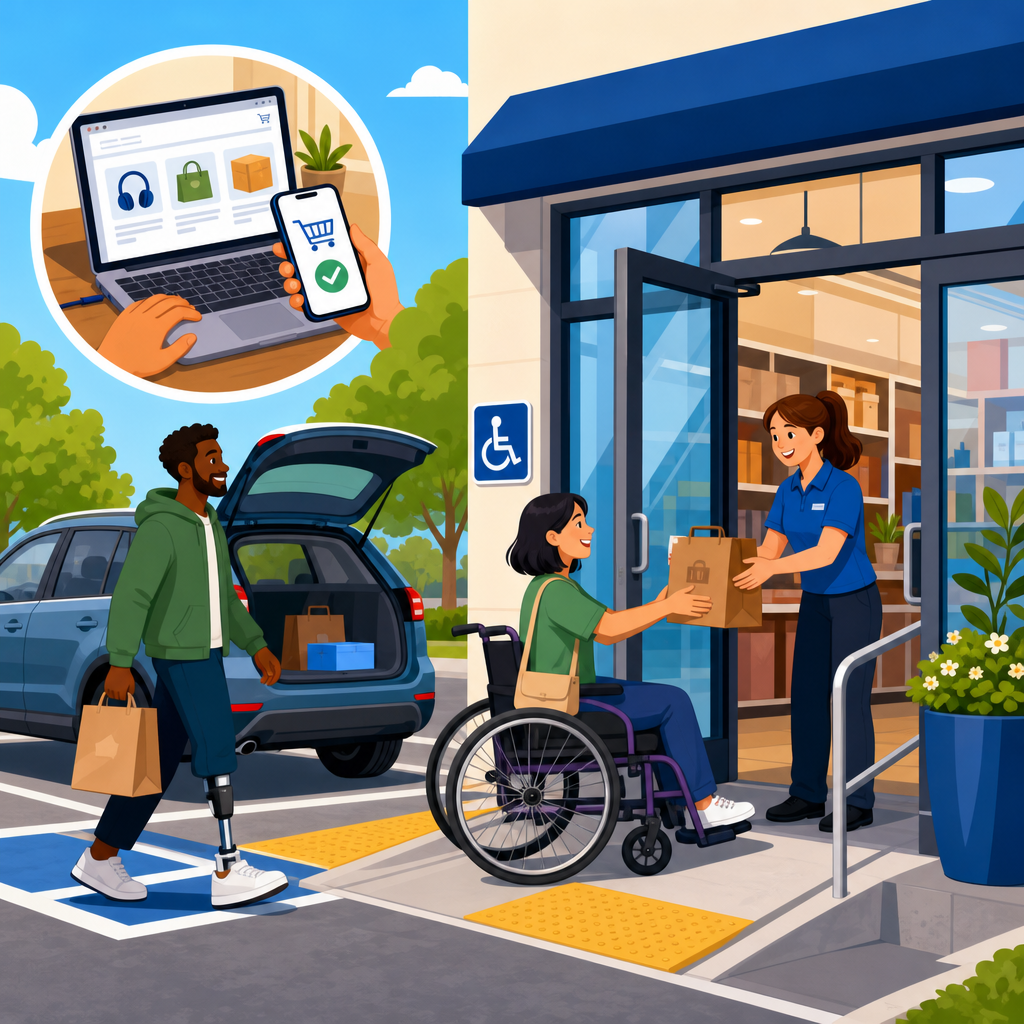
Accessible buy online pick up in store processes under the ADA are no longer a niche compliance concern for large chains. They are a core retail and e-commerce requirement that affects conversion, customer loyalty, operational efficiency, and legal risk for every merchant offering pickup. Buy online pick up in store, often shortened to BOPIS, lets a shopper complete product selection, payment, and order confirmation online, then collect the item at a physical location. Accessibility means people with disabilities can complete each step with substantially equivalent ease, privacy, independence, and timeliness. The ADA, or Americans with Disabilities Act, requires equal access to goods and services offered by places of public accommodation, and modern retail increasingly delivers those goods and services through a blend of websites, apps, parking lots, service counters, curbside zones, kiosks, and staff-assisted handoff points.
I have worked with retailers mapping pickup journeys from product page to trunk delivery, and the pattern is consistent: teams often fix only the website checkout while the actual pickup experience remains full of barriers. A blind shopper may be able to place an order with a screen reader yet arrive to find no accessible signage, no reliable way to announce arrival, and no trained associate who understands how to complete the handoff. A customer with limited dexterity may get stuck on a countdown timer, a vehicle description form, or an app flow that cannot be completed by voice control. A shopper who is deaf may miss text updates designed only as voice calls. Accessibility for BOPIS is therefore not a single web issue or a single store issue. It is a service design issue spanning digital interfaces, physical spaces, and employee processes.
This hub article explains what accessible BOPIS looks like in retail and e-commerce, why the ADA applies, which friction points most often create exclusion, and how merchants can build a pickup process that works in practice. It also serves as the central guide for related topics in this industry segment, including accessible product discovery, checkout and payment, curbside pickup operations, store signage, mobile app accessibility, third-party platform risk, and staff training. If a retailer wants a realistic standard, the answer is simple: every customer should be able to browse, buy, travel to the store, identify the pickup location, communicate arrival, verify identity, receive the order, and resolve problems without unnecessary barriers or extra dependence on another person.
Why ADA accessibility matters for retail pickup services
For retail and e-commerce businesses, BOPIS is now a mainstream fulfillment model. Major chains expanded pickup rapidly after 2020, and midmarket merchants followed because pickup reduces shipping cost, speeds delivery, and creates upsell opportunities when customers enter the store. That business value creates legal and operational exposure when the service is not accessible. The ADA predates mobile commerce, but its core principle is durable: when a business opens its goods and services to the public, it must provide equal access. Courts and settlement activity have made clear that websites, apps, and integrated store services can fall within that obligation, especially when they are tightly connected to physical retail locations.
In practice, retailers should treat the Web Content Accessibility Guidelines, currently WCAG 2.1 or 2.2 Level AA, as the baseline for websites and apps, even though the ADA itself does not list a technical checklist in its text. For the physical side, accessible parking, routes, counters, signage placement, and policies matter just as much. The Department of Justice has repeatedly emphasized effective communication and equal access, and that principle applies directly to pickup notifications, arrival instructions, and customer service alternatives. A pickup process that works only for customers who can see small signs, stand in a long line, hear a phone prompt, or tap a precise mobile control is not equal access.
The commercial reason matters too. The disability market is large, and barriers in pickup journeys create abandoned carts, failed orders, social complaints, and support costs. When I audit retail pickup flows, accessibility fixes almost always improve general usability. Clear instructions reduce missed pickups. Better wayfinding lowers associate interruptions. Multiple contact options reduce no-show confusion. Simpler confirmation screens reduce address and timing errors for everyone. Accessibility under the ADA is therefore both a civil rights responsibility and a measurable retail performance improvement.
Where BOPIS journeys commonly fail
The most common failures appear at the seams between digital and physical steps. Product pages may not announce stock status correctly to assistive technology, so a customer cannot tell whether pickup is available at a chosen store. Store selectors often rely on unlabeled map pins, infinite scroll results, or modals that trap keyboard focus. Time-slot schedulers can be unreadable by screen readers or impossible to operate without a mouse. Some checkout systems force session timeouts without warning, disrupting shoppers with cognitive disabilities or anyone using alternative input methods. Others require CAPTCHAs that are inaccessible or demand account creation before purchase.
After checkout, the next breakdown usually appears in communications. Retailers may send pickup instructions only in image-based emails, only through app push notifications, or only by automated phone call. Arrival workflows are another weak point. Some merchants assume every customer will tap “I’m here” in the app, but accessible service needs alternatives such as text, phone, and staff assistance that are clearly described and equally effective. At the store, inaccessible curbside signage, lack of an accessible route from parking to pickup, high service counters, poor lighting, background noise, and inconsistent employee procedures can make a valid order effectively impossible to collect.
Returns, substitutions, and out-of-stock exceptions are especially risky. If the chosen item is unavailable, can the customer review alternatives with a screen reader? If age verification or ID checks are required, is the process respectful and flexible without compromising policy? If someone cannot enter the store due to mobility limitations, can staff complete the handoff at the curb in a documented way? Accessible BOPIS depends on solving these edge cases because real retail service is defined by exceptions, not by the happy path shown in a wireframe.
Building an accessible pickup journey end to end
An accessible BOPIS process should be designed as one continuous service. Start with product discovery. Inventory availability must be exposed as text, not color alone, and pickup eligibility should be announced consistently on product detail pages. Store selection should support keyboard navigation, visible focus states, properly labeled form controls, and a list view that does not depend on a visual map. If location permission is denied, manual entry must remain easy. The customer should understand store hours, cutoff times, preparation windows, and any curbside instructions before paying.
Checkout must support error prevention and recovery. Use semantic form fields, programmatic labels, plain-language validation messages, and accessible payment components. If a session expires, warn users in advance and let them extend time. Confirmation pages and emails should state exactly what happens next: when the order will be ready, where to go, what signage to look for, how to announce arrival, what identification is needed, and what alternatives exist if the app or phone fails. This information should appear in text, not only in diagrams or icons. For mobile apps, ensure support for VoiceOver, TalkBack, dynamic type, color contrast, reduced motion settings, and landscape orientation where feasible.
Store operations then need the same rigor. Pickup spaces should connect to an accessible route. Signage should be readable, placed consistently, and not rely only on QR codes. If QR codes are used, provide the phone number and text number in plain print. Counters should include an accessible service position. Doorbells, kiosks, or check-in tablets need tactilely discoverable placement and accessible software. Most importantly, associates need a script and escalation path. They should know how to assist without making assumptions, how to communicate with customers who are deaf or blind, and how to handle service animals, companion support, and alternative verification methods.
| Journey stage | Common barrier | Accessible practice | Retail example |
|---|---|---|---|
| Product page | Pickup availability shown by color only | Expose stock and pickup status in text with live updates | “Ready for pickup today at Oak Street” announced to screen readers |
| Store selection | Map-only selector with unlabeled pins | Provide searchable list view, labeled controls, keyboard support | Customer enters ZIP code and chooses a store from results list |
| Checkout | Timed session expires without warning | Provide timeout alert and option to extend time | Banner appears with two extra minutes and saved cart state |
| Arrival | App-only “I’m here” notification | Offer text, phone, and staffed alternatives with clear instructions | Sign lists SMS number and service desk extension |
| Handoff | High counter and unclear verification process | Accessible counter position and flexible ID confirmation procedure | Associate confirms order number verbally at lower service point |
Digital standards, testing methods, and governance
Retail teams need repeatable standards, not one-time remediation. For websites and apps, WCAG Level AA is the practical benchmark because it addresses perceivable, operable, understandable, and robust interactions that directly affect BOPIS tasks. That means meaningful alternative text, heading structure, focus order, error identification, sufficient color contrast, touch target sizing, and compatibility with screen readers and speech input. Native app teams should also follow Apple Human Interface Guidelines and Android accessibility guidance because platform conventions affect discoverability and usability.
Testing must include automated scanning and human evaluation. Automated tools such as Axe, WAVE, Lighthouse, and Accessibility Insights can quickly flag missing labels, contrast problems, and structural errors, but they cannot judge whether pickup instructions make sense or whether a curbside flow is usable in the real world. Manual testing with keyboard-only navigation, NVDA, JAWS, VoiceOver, and TalkBack is essential. So is testing with zoom, reduced motion, and speech control. I also recommend in-store journey testing: place a real order, arrive during peak hours, follow the signage, and document every dependency. Many serious barriers appear only when software, staffing, and physical layout intersect.
Governance closes the gap between project launch and ongoing compliance. Merchants should assign clear ownership across e-commerce, store operations, facilities, legal, customer care, and training. Accessibility acceptance criteria belong in design briefs, sprint definitions of done, procurement requirements, and QA checklists. Third-party components deserve special attention. Store locator plugins, scheduling widgets, payment wallets, chatbot overlays, and SMS vendors often create the very barriers customers encounter. Contracts should require conformance, remediation timelines, and audit cooperation. Internal linking within the retailer’s knowledge base should direct teams from this hub topic to detailed guidance on app accessibility, curbside operations, store design, and accessible customer support.
Operational realities, staff training, and future-proofing
Even strong digital compliance fails without trained people. Associates are the last mile of BOPIS accessibility, and they need concise, practical instruction. Training should cover respectful communication, sighted guide basics, how to read key information aloud when requested, how to exchange written notes with deaf customers, and how to avoid separating a customer from a mobility device or service animal. Staff also need authority to solve problems. If the designated curbside bay is blocked, if the customer cannot use the app, or if weather makes pickup unsafe, there should be a documented fallback rather than improvisation.
Metrics help retailers improve. Track pickup abandonment, support contacts, failed arrival notifications, average handoff time, and complaints tied to accessibility barriers. Review them by store and by channel because process drift is common. Customer feedback forms should themselves be accessible and should ask targeted questions about pickup instructions, signage, communication options, and staff assistance. Periodic mystery shopping with disabled testers produces better insight than generic satisfaction surveys because it reveals whether the intended process works under normal store pressure.
Looking ahead, accessible BOPIS will increasingly involve AI search, conversational commerce, digital wallets, and geolocation automation. Those tools can help if they reduce steps and clarify information, but they can also create new barriers when they remove visible controls or hide critical details behind voice-only prompts. The durable strategy is to preserve user choice, provide redundant communication channels, and document every pickup requirement in plain language. Retail and e-commerce leaders who treat accessibility as service design, not legal cleanup, build a more resilient operation. Review your full pickup journey now, fix the weak seams first, and use this hub as the starting point for every related guide in your retail accessibility program.
Frequently Asked Questions
What does an accessible buy online pick up in store process mean under the ADA?
An accessible buy online pick up in store process means the entire customer journey can be used by people with disabilities without unnecessary barriers. Under the ADA, that does not stop at the store entrance or parking lot. It applies to the real-world experience of ordering online, choosing a pickup location, paying, receiving pickup instructions, arriving at the store, communicating with staff, and completing the handoff. If any part of that sequence breaks down for a customer with a disability, the process may not be meaningfully accessible even if the website or storefront appears compliant in isolation.
In practice, accessibility for BOPIS includes digital accessibility and operational accessibility working together. The website or app should support screen readers, keyboard navigation, clear labels, error identification, sufficient color contrast, accessible calendars and location selectors, and easy-to-understand instructions. Pickup communications should be available in formats customers can access, including emails, texts, and notifications that are readable by assistive technology. The physical pickup step should also be usable, with accessible routes, clear signage, staff procedures that do not depend on hearing, speech, or prolonged standing, and practical alternatives when a standard pickup counter or curbside workflow does not work for the customer.
The key legal and business point is that accessibility is not just a technical checklist. It is about equal access to the service. A merchant offering BOPIS should be asking whether a blind customer, a customer with low vision, a deaf or hard of hearing customer, a customer with limited dexterity, a customer with a mobility disability, or a customer with cognitive disabilities can complete the same task with roughly the same convenience, independence, and dignity as other shoppers.
Why is ADA accessibility important for BOPIS beyond legal compliance?
ADA accessibility matters for BOPIS because pickup is now a core retail channel, not a side feature. When merchants make pickup accessible, they reduce friction at exactly the point where customers are deciding whether to complete a purchase. A shopper who cannot select a store, cannot activate a pickup button with a keyboard, cannot understand the arrival instructions, or cannot physically complete the pickup is far more likely to abandon the order and switch to a competitor. Accessibility directly affects conversion rates, repeat business, and customer trust.
There are also significant operational benefits. Accessible systems tend to be clearer, more consistent, and easier for everyone to use. Better form design reduces checkout errors. Clearer pickup instructions reduce customer confusion and support calls. More flexible pickup procedures help staff solve problems faster on site. In many organizations, the same improvements that help customers with disabilities also improve the experience for older adults, temporary injury cases, multilingual users, and customers dealing with glare, noise, time pressure, or mobile device limitations.
Legal risk remains an important factor as well. Retailers increasingly face scrutiny when digital services and physical processes are disconnected from accessibility obligations. A merchant may have an accessible website homepage but still create barriers in the pickup workflow that lead to complaints or claims. Treating BOPIS accessibility as part of customer experience strategy rather than a narrow compliance exercise is usually the smarter approach. It protects the brand, broadens the customer base, and helps ensure that a highly visible retail service is usable by the people it is meant to serve.
Which parts of the online ordering and pickup process most often create accessibility barriers?
The most common barriers appear in the exact steps that make BOPIS convenient for most shoppers. Store locator tools are a major trouble spot when they rely on maps without text alternatives, inaccessible modal windows, or filters that are difficult to use with a keyboard or screen reader. Inventory availability and pickup eligibility can also be confusing if status messages are not announced properly to assistive technology or if color alone is used to communicate whether an item is available for pickup.
Checkout and scheduling are another frequent source of problems. Many merchants use time-slot pickers, address validators, account sign-in prompts, or payment flows that are not fully accessible. CAPTCHAs, timeout warnings, unlabeled fields, and error messages that do not clearly explain what needs to be fixed can stop a customer from finishing the order. If pickup instructions are sent only through inaccessible emails, image-based messages, or app notifications that are not compatible with assistive tools, the problem continues even after the sale is technically complete.
The physical handoff can create just as many barriers. Examples include requiring customers to wait in a line without seating, using pickup counters that are hard to reach, expecting verbal confirmation in a noisy environment, posting unclear signage, or requiring app-based “I’m here” check-ins that are difficult to use. Curbside pickup can also become inaccessible if there is no reliable way for a customer to communicate arrival without using a smartphone in a specific way, or if staff are not trained to provide alternative assistance. The most effective way to identify these barriers is to test the process from beginning to end, not just screen by screen.
How can retailers make their BOPIS process more accessible in practical terms?
Retailers should start by treating BOPIS as one connected service journey. That means reviewing the website or app, order confirmation messages, customer support channels, parking and entry routes, pickup signage, and staff procedures together. On the digital side, merchants should follow recognized accessibility best practices, including semantic page structure, descriptive form labels, keyboard operability, focus visibility, meaningful button names, accessible error handling, and compatibility with screen readers and mobile assistive technologies. Every critical action, from selecting pickup to confirming arrival, should be tested without relying on a mouse, gesture precision, or visual-only cues.
Operational design is just as important. Stores should provide clear and accessible pickup instructions before the customer arrives, including where to go, how to check in, what identification is needed, and what alternatives are available if the standard process is not usable. Pickup areas should have accessible routes, readable signage, and staff who understand how to assist respectfully and effectively. Retailers should also offer more than one communication method, such as text, phone, email, and in-person assistance, so customers are not forced into a single inaccessible channel.
Training and testing are what turn policy into real accessibility. Staff need scripts and flexibility for situations involving service animals, communication differences, mobility limitations, and alternative verification methods. Teams should conduct usability testing with people with disabilities and review analytics for abandonment points in the BOPIS funnel. Accessibility feedback should be easy to submit, and issues should route to teams that can fix both technical and store-level problems. The best results usually come when accessibility is built into design, development, merchandising, and store operations rather than left to a last-minute legal review.
Does ADA compliance for BOPIS apply only to large retailers, or should smaller merchants pay attention too?
Smaller merchants should absolutely pay attention. Accessibility in buy online pick up in store is not just a concern for national chains with sophisticated omnichannel systems. Any merchant that offers online ordering tied to in-store pickup is creating a blended digital and physical customer experience. If that experience excludes or disadvantages people with disabilities, the business can lose sales, damage customer relationships, and increase exposure to complaints and legal scrutiny regardless of company size.
For smaller retailers, the good news is that accessibility improvements do not always require enterprise-level budgets. Many high-impact changes are straightforward: use accessible website templates, make forms and buttons properly labeled, simplify pickup instructions, ensure staff know how to offer alternatives, and confirm that the pickup location itself is easy to identify and use. A smaller operation may even have an advantage because it can often adjust procedures faster, train teams more directly, and personalize support in ways that larger organizations struggle to do consistently.
The important mindset is that accessible BOPIS is part of serving customers well. It helps local stores compete, supports customer loyalty, and reduces preventable friction. As online-to-offline retail continues to grow, customers increasingly expect pickup to be reliable and usable for everyone. Businesses that address accessibility early are usually in a stronger position than those that wait until a complaint, lost customer, or operational failure forces the issue.