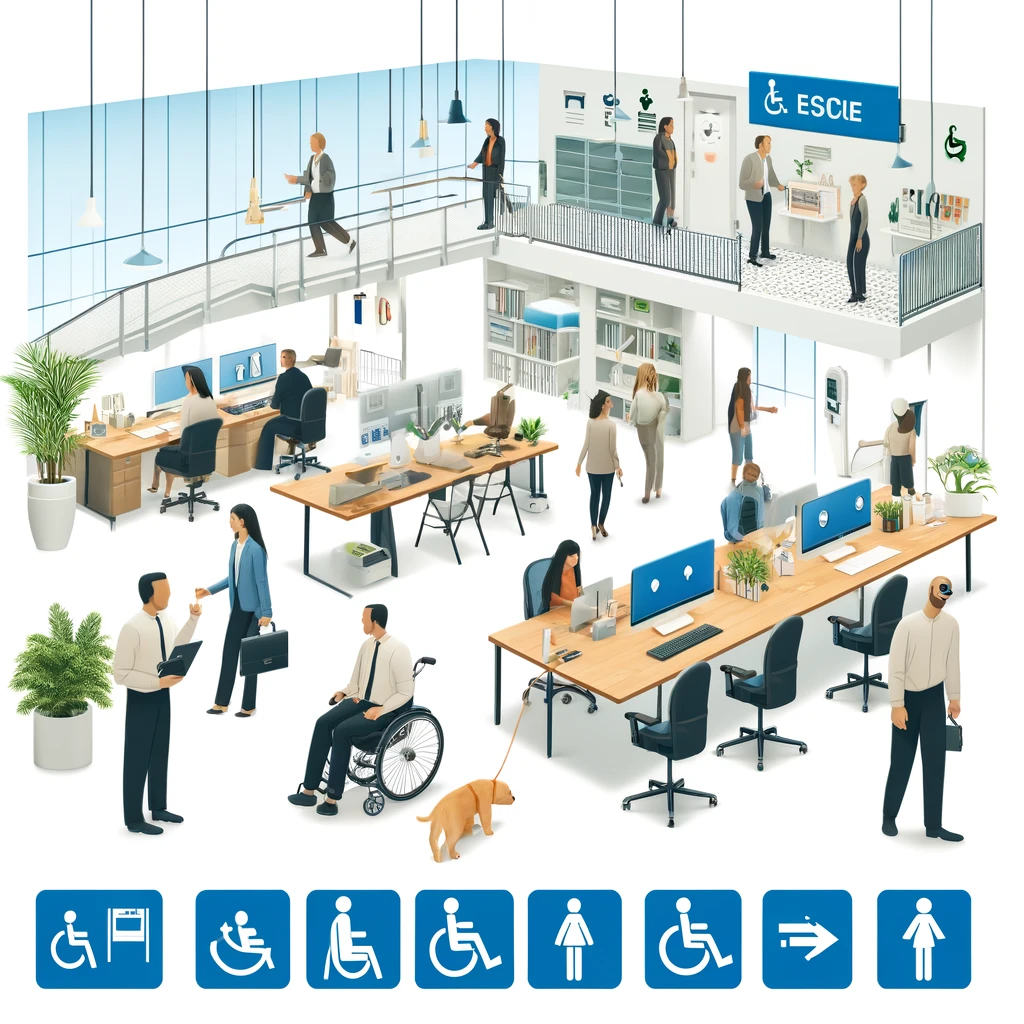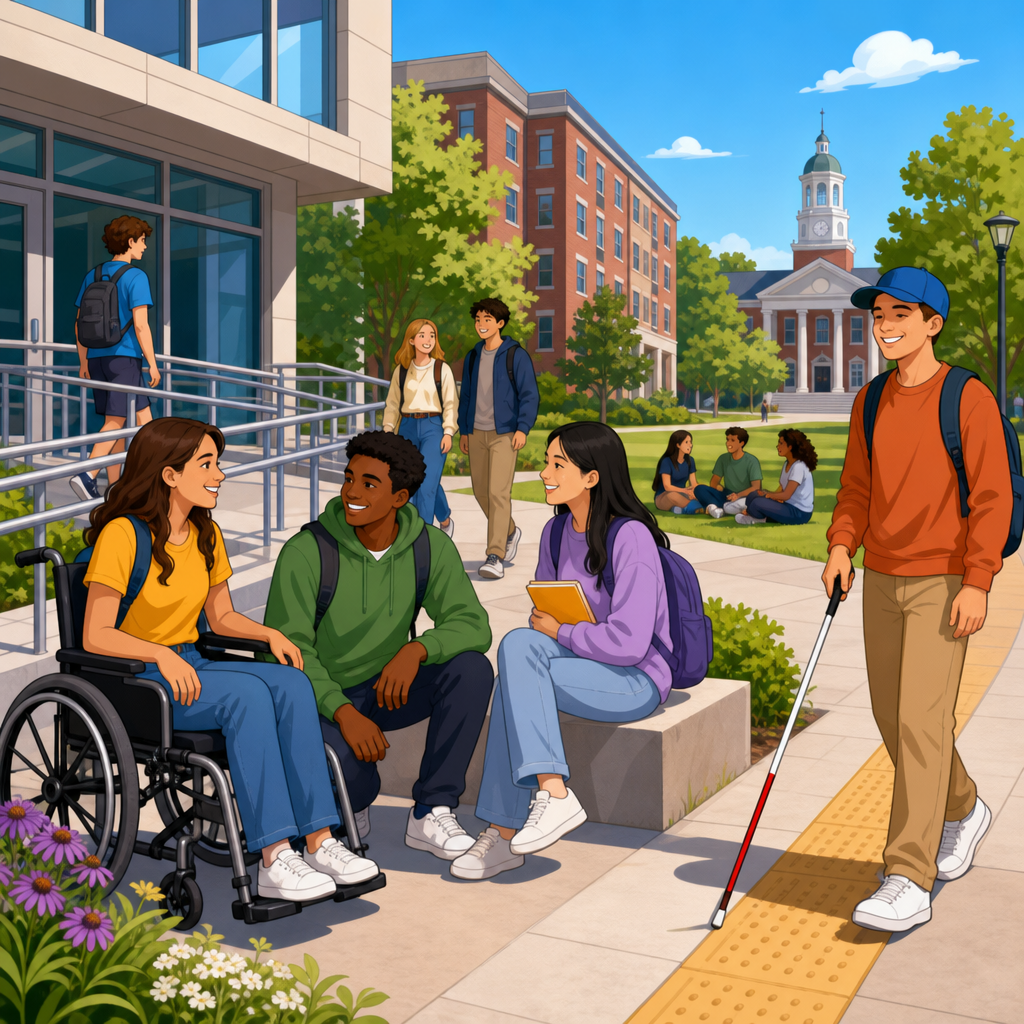
ADA compliance for campuses, dorms, and student life programs is the practical work of making higher education accessible across classrooms, housing, events, transportation, digital systems, and everyday campus interactions. In this sector, compliance is not limited to ramps or reserved parking. It includes academic adjustments, effective communication, accessible procurement, emergency planning, housing policies, recreation, and the systems student affairs teams use to deliver services. When colleges and universities get this right, students with disabilities can participate in campus life on equal terms. When they get it wrong, barriers appear in admissions, move-in, dining, club activities, counseling, athletics, and graduation pathways.
The legal foundation is broad and interconnected. Public institutions are generally covered by Title II of the Americans with Disabilities Act, while private institutions that qualify as places of public accommodation are typically covered by Title III. Section 504 of the Rehabilitation Act applies to programs receiving federal financial assistance, which includes most colleges and universities. Housing, employment, transportation, and telecommunications rules may also apply depending on the service involved. In practice, campus leaders cannot treat accessibility as a narrow facilities issue. It is an operational requirement that touches student life, procurement, technology, risk management, human resources, and governance.
I have worked with institutions that believed they were compliant because they had an accommodation office and a few accessible residence hall rooms. That assumption rarely survives a real audit. The barriers usually sit in the handoffs: inaccessible event registration forms, residence life policies that overlook service animals, orientation videos without captions, maintenance processes that leave power door operators broken for weeks, or student conduct procedures that fail to provide auxiliary aids. Accessibility succeeds when institutions build repeatable systems, assign ownership, and measure outcomes rather than relying on goodwill or case-by-case fixes.
This hub article covers sector-specific ADA compliance for campuses, dorms, and student life programs from an implementation perspective. It explains what compliance means in higher education, where the most common risks appear, and how institutions can structure governance, audits, remediation, training, and documentation. It also connects physical accessibility with digital accessibility and program access, because students experience the campus as one ecosystem. If a housing portal is inaccessible, an accessible room inventory alone does not solve the problem. If a student center entrance meets technical standards but event communications are unreadable by screen readers, participation is still unequal. The goal is full and effective access across the student journey.
What ADA compliance means in higher education settings
On a campus, ADA compliance means qualified students, employees, and visitors with disabilities must have an equal opportunity to access programs, services, and activities. Equal opportunity does not always mean identical treatment. It means institutions must remove unnecessary barriers and provide reasonable modifications, auxiliary aids, and accessible features unless doing so would fundamentally alter the program or create an undue burden under the applicable standard. For older campuses, program access can sometimes be achieved without making every building fully accessible, but the overall program still must be accessible when viewed in its entirety. New construction and alterations are a different matter and must follow applicable design standards much more strictly.
Student life programs expand the compliance picture. Orientation, student conduct, clubs, counseling, campus employment, recreation, intramurals, dining plans, Greek life activities, leadership programs, and study abroad all create access obligations. A disability services office cannot carry these duties alone. Residence life professionals need procedures for housing accommodations and emergency evacuation. Event teams need captioning, sign language interpreter workflows, and accessible seating plans. Procurement staff need accessibility language in software and furniture contracts. Transportation managers need accessible shuttle operations. Campus police need communication protocols for Deaf and neurodivergent community members. Each function affects whether students can participate meaningfully.
Institutions that perform well treat accessibility as enterprise compliance. They maintain policies, designate accountable leaders, perform periodic self-evaluations, prioritize remediation by risk and impact, and document decisions carefully. They also distinguish between disability accommodation and universal design. Accommodation responds to individual need. Universal design reduces the number of barriers everyone encounters by default, such as captioning all videos, choosing accessible furniture layouts, or using readable event materials from the start.
Campus facilities, routes, and common areas
Physical accessibility on campus starts with routes, entrances, parking, restrooms, signage, and service counters, but it does not end there. Colleges often occupy historic buildings, sloped sites, and facilities renovated in phases over decades. Those conditions create predictable friction points: inaccessible paths between academic buildings and residence halls, heavy doors without operators, podium-only classrooms, labs with fixed-height benches, older restrooms with inadequate turning space, and assembly venues with poor wheelchair seating distribution. An accessible route is only useful if it connects the places students actually need to go without unreasonable detours.
I have seen institutions discover that a technically compliant entrance was functionally unusable because snow storage blocked the access aisle each winter. Another campus installed lifts in an auditorium but failed to train event staff on operation, leaving students waiting for help at every performance. These are not minor defects. They undermine reliability, and reliability is central to equal access. Routine inspection, preventive maintenance, and seasonal planning matter as much as initial design review.
Facilities teams should assess exterior routes, residence hall entrances, classroom furniture, service desks, recreation spaces, dining areas, laundry rooms, mail centers, and emergency egress features. They should also verify wayfinding. Students should not need insider knowledge to locate an accessible entrance or restroom. Clear directional signage and accurate campus maps reduce frustration and missed services. For alterations and new construction, institutions should use the 2010 ADA Standards for Accessible Design, relevant building code provisions such as ICC A117.1 where adopted, and state accessibility requirements that may be more stringent.
Dorms, housing assignments, and residential life operations
Dorm compliance is one of the most sensitive parts of campus accessibility because housing is both a service and a home. Students need accessible bedrooms and bathrooms, but they also need equitable access to the residential experience: roommate matching, meal plans, social programming, study lounges, package pickup, laundry, and overnight guest policies. Problems often arise when housing offices treat accessible rooms as inventory exceptions rather than core supply that must be protected and managed carefully.
Best practice starts with accurate room inventories and functional classifications. Institutions should know which rooms have roll-in showers, visual alarms, lowered features, clear maneuvering space, proximity to elevators, or quiet locations relevant to disability-related needs. Housing portals must allow students to request accommodations accessibly, upload documentation securely, and receive timely decisions. Reservation practices should avoid assigning accessible rooms to students without related needs unless there is a clear release protocol and a plan to recover capacity. Maintenance response times for elevators, automatic doors, and accessible fixtures should be tracked separately because delays can effectively displace a resident.
Residential life staff also need scripts and training for disability-related interactions. Service animals, emotional support animals, personal care attendants, dietary needs, and evacuation plans all require coordinated handling. FERPA and privacy considerations matter, but confidentiality cannot become an excuse for poor planning. Resident assistants should know how to refer concerns without demanding medical details, and professional staff should document interactive processes consistently. In enforcement actions involving higher education housing, recurring themes include delayed accommodations, inaccessible common spaces, and policies that look neutral on paper but exclude students in practice.
Student life programs, events, and extracurricular access
Student life is where compliance becomes visible. If a student can attend class but cannot join organizations, use the fitness center, participate in leadership retreats, or understand event announcements, the institution is not delivering equal opportunity. Events need an accessibility workflow that begins at planning, not after complaints. Registration forms should ask what accommodations are needed, promotional materials should state how to request them, and timelines should account for interpreter scheduling, captioning, accessible transportation, and seating arrangements. Hybrid events need accessible livestream platforms, live captions where appropriate, and readable shared files.
Recreation and athletics present special operational issues. Intramural sign-ups, locker rooms, pool lifts, adaptive equipment, and spectator access all matter. A campus with an accessible arena entrance but no accessible team travel process still creates exclusion. The same principle applies to clubs and field trips. If student organizations receive funding, use campus facilities, or act as part of institutional programs, accessibility expectations should be built into recognition policies, event manuals, and advisor training.
| Student life area | Common barrier | Practical compliance action |
|---|---|---|
| Orientation | Videos without captions or inaccessible schedules | Caption all media and publish screen-reader-friendly itineraries |
| Campus events | No accommodation request process | Add request language, deadlines, and staff ownership to every event page |
| Recreation | Inaccessible equipment or locker routes | Audit paths, procure adaptive options, and train attendants |
| Student organizations | Off-campus venues with barriers | Require accessible venue selection in funding and approval rules |
| Conduct hearings | No interpreters or alternate formats | Build auxiliary aid procedures into case management workflows |
The simplest rule is that every student-facing program should have an owner who can answer one question clearly: how does a student request access, and what happens next? If no one can answer that, the process is not mature enough.
Digital accessibility, portals, and communication systems
For modern campuses, digital accessibility is inseparable from ADA compliance. Students apply, sign housing contracts, register for orientation, pay deposits, reserve counseling appointments, join campus organizations, request shuttle rides, and receive emergency alerts through software. If those systems are not accessible, barriers appear before a student ever reaches a building. The most common failures involve unlabeled form fields, keyboard traps, poor color contrast, inaccessible PDFs, image-only menus, and videos without captions or transcripts.
Institutions should benchmark against WCAG 2.1 AA at minimum, while monitoring movement toward WCAG 2.2 in procurement and remediation planning. Core systems typically include the LMS, SIS, housing platform, event tools, mobile apps, digital signage content, and public websites. Procurement is a major control point. Contracts should require accessibility conformance statements such as VPATs using the ACR format, testing rights, remediation timelines, and indemnity language appropriate to the institution’s risk posture. A VPAT is not proof of accessibility, but it is a useful due diligence artifact when combined with independent testing.
Communications teams should also standardize accessible content practices: heading structure, alt text, plain language, meaningful link text, accessible social graphics, captioned video, and tagged PDFs only when PDFs are necessary. In my audits, inaccessible event flyers and student affairs microsites are among the most common avoidable barriers because they are produced quickly outside central web governance. Training and templates reduce that problem immediately.
Governance, audits, training, and continuous improvement
Strong compliance programs do not depend on a single coordinator fixing issues after complaints. They use governance. A campus hub for this subtopic should connect policy areas including facilities, housing, transportation, digital systems, procurement, and student programs so leaders see the whole risk landscape. Effective structures usually include an executive sponsor, a cross-functional steering group, departmental owners, issue tracking, and annual reporting. Without this architecture, accessibility work becomes fragmented and inconsistent.
Audits should combine policy review, site inspections, user testing, document sampling, and interviews with frontline staff. OCR resolutions and Department of Justice settlements repeatedly show that documentation matters. Institutions should keep self-evaluations, transition plans where applicable, maintenance logs, accommodation records, procurement reviews, and training attendance records. They should also prioritize based on impact. Fixing inaccessible emergency notifications, housing workflows, and primary routes generally matters more than low-traffic edge cases, though both should enter the roadmap.
Training must be role-specific. Facilities teams need design and maintenance guidance. Student affairs staff need accommodation and communication protocols. Web teams need content and testing standards. Resident assistants need referral pathways and emergency procedures. Procurement officers need contract controls. When I help campuses build maturity, the turning point is usually not a new policy. It is when each department knows exactly what compliance looks like in its daily work and leaders review measurable progress every quarter.
ADA compliance for campuses, dorms, and student life programs works when institutions stop treating accessibility as a side issue and manage it as core infrastructure for education. The most effective campuses align legal duties, operational workflows, and student experience. They audit physical and digital environments together, protect accessible housing inventory, build event accommodation processes, train staff by role, and document decisions carefully. That approach reduces complaints and litigation risk, but more importantly, it removes barriers that interfere with learning, belonging, safety, and independence.
As a hub for sector-specific ADA compliance, this topic should guide readers to deeper resources on residence hall design, digital accessibility standards, transportation, recreation, procurement, and policy implementation. The central lesson is straightforward: access must be reliable across the full student journey, from admissions to move-out. A campus is only as accessible as its weakest handoff. Review your policies, inventory your barriers, assign owners, and start a prioritized remediation plan now.
Frequently Asked Questions
What does ADA compliance actually cover on a college or university campus?
ADA compliance on a campus covers far more than wheelchair ramps, elevators, or accessible parking spaces. In higher education, accessibility touches nearly every part of the student experience, including classrooms, residence halls, dining areas, student unions, libraries, athletic facilities, transportation systems, websites, learning platforms, campus events, and the policies that shape how services are delivered. It also includes academic adjustments, auxiliary aids and services, effective communication for students who are deaf, hard of hearing, blind, low vision, or have other communication-related disabilities, and equal access to student life programs.
In practice, that means colleges and universities must look at both the physical environment and the operational systems behind it. A building may be accessible at the entrance, but barriers can still exist if classrooms are scheduled in inaccessible spaces, housing assignments do not account for disability-related needs, online forms cannot be completed with assistive technology, or campus events fail to provide captioning or accessible seating. ADA compliance also applies to policies involving emotional support animals, meal plan modifications, transportation requests, emergency evacuation procedures, recreation access, and student conduct processes.
For campuses, the real goal is equal opportunity. Students with disabilities should be able to participate in academics, housing, social life, leadership programs, orientation, study abroad preparation, counseling services, and co-curricular activities in a way that is as integrated and independent as possible. Compliance is strongest when institutions move beyond reactive accommodation and build accessibility into planning, procurement, training, and everyday decision-making across departments.
How does ADA compliance apply to dorms and campus housing?
Campus housing is one of the most important and most misunderstood parts of ADA compliance. Accessible housing is not just about whether a dorm has an elevator or an accessible restroom. It involves the full housing process, including how students apply for housing, request disability-related accommodations, receive room assignments, access common areas, use laundry facilities, enter and exit the building, and participate in residential programming. A student’s living environment must support equal access to campus life, not simply provide a technically compliant room.
Common housing accommodations can include accessible routes, roll-in showers, visual alarms, lower counters, automatic door openers, proximity to academic buildings or dining, single-room consideration related to disability, permission for an assistance animal, modifications to no-pet or guest policies, temperature control needs, allergen considerations, and flexibility in housing deadlines when documentation or interactive review is involved. Institutions also need clear, fair procedures for evaluating requests and communicating decisions in a timely manner so students are not left without appropriate housing at move-in.
Residential life teams should also consider accessibility in roommate matching, emergency planning, maintenance response, and community programming. If floor meetings, social events, or required trainings are held in inaccessible locations or without communication access, students may be excluded even if their assigned room is accessible. The most effective housing programs coordinate disability services, facilities, student affairs, housing operations, and risk management so that accessibility is embedded throughout the residential experience rather than handled as an afterthought.
What are student life programs expected to do to remain ADA compliant?
Student life programs are expected to provide students with disabilities an equal opportunity to participate in the full range of co-curricular and social experiences offered on campus. That includes orientation, student organizations, leadership programs, intramural sports, recreation, campus traditions, concerts, volunteer programs, club meetings, late-night programming, and other activities that contribute to belonging and engagement. Compliance in this area requires more than responding to requests one at a time; it calls for accessible planning from the beginning.
For example, event organizers should evaluate whether venues are physically accessible, whether registration forms work with screen readers, whether videos are captioned, whether interpreters or CART services may be needed, whether accessible seating is integrated rather than segregated, and whether transportation to off-campus activities can accommodate students with mobility disabilities. Printed materials, mobile apps, ticketing systems, and waiver forms should also be accessible. When student life staff consistently ask these questions in advance, they reduce barriers and create a more inclusive environment for all participants.
Training is especially important because many student life programs rely on student leaders, resident assistants, club officers, and event coordinators who may not understand accessibility requirements. Campuses that do this well create simple procedures, planning checklists, and support channels so accessibility is part of routine program development. The standard is not perfection in every moment, but a proactive, organized effort to prevent exclusion and respond effectively when accommodations are needed.
How do digital accessibility and effective communication fit into campus ADA compliance?
Digital accessibility and effective communication are central to ADA compliance in higher education because so much of campus life now happens through websites, portals, learning systems, email, mobile apps, and digital documents. A campus can have accessible buildings and still create serious barriers if students cannot register for classes, complete housing forms, access event details, read financial aid information, or use student conduct portals with assistive technology. Accessibility must extend to the digital systems students use every day.
Effective communication means students with disabilities must receive information in ways that are as clear, timely, and usable as information provided to others. Depending on the situation, that may involve captioning, sign language interpreters, accessible PDFs, screen-reader-compatible web content, alternative text for images, Braille or large print materials, or communication support during meetings and disciplinary processes. It also means avoiding inaccessible practices such as scanned image-only documents, videos without captions, forms that cannot be navigated by keyboard, or emergency notices delivered only through inaccessible channels.
Because campuses often use third-party software for housing, dining, counseling, transportation, and student engagement, accessible procurement is a major part of compliance. Institutions should evaluate accessibility before purchasing or renewing technology rather than waiting until students encounter barriers. Strong ADA programs bring together IT, procurement, disability services, communications, student affairs, and academic leadership to create standards, testing processes, remediation timelines, and accountability. When digital access is treated as a campus-wide operational priority, institutions are much better positioned to meet legal expectations and support student success.
What are the biggest ADA compliance risks for campuses, and how can colleges reduce them?
Some of the biggest ADA compliance risks on campuses come from inconsistency, siloed decision-making, and overreliance on informal fixes. A school may have a disability services office, but still face exposure if housing makes separate decisions without coordination, student life plans events without accessibility review, procurement buys inaccessible software, or emergency procedures fail to account for disabled students in residence halls. Complaints often arise not from one obvious barrier, but from repeated breakdowns across multiple systems that make access unreliable or burdensome.
High-risk areas commonly include inaccessible digital platforms, delayed accommodation processes, poorly documented housing decisions, inaccessible events, lack of communication access, transportation gaps, and emergency planning that does not address evacuation, sheltering, or alert systems for students with different disabilities. Another major risk is staff uncertainty. When front-line employees, faculty, student leaders, and administrators do not know their roles, students may be told incorrect information, redirected repeatedly, or required to navigate unnecessary hurdles.
Colleges can reduce these risks by building a coordinated compliance structure. That usually includes clear policies, an ADA or accessibility leadership function, defined responsibilities across departments, regular training, accessible procurement standards, grievance and feedback channels, periodic audits of facilities and digital systems, and reliable documentation of requests and responses. Just as important, institutions should review student-facing processes from start to finish, including admissions, orientation, housing, transportation, recreation, and conduct. The most resilient campuses treat ADA compliance as an ongoing operational responsibility tied to equity, retention, and student experience, not just a legal checklist addressed after a complaint.