Wheelchair spaces and companion seating are among the most visible parts of accessible design because they determine whether people can participate in public life with dignity, safety, and choice. Within ADA Accessibility Standards, Chapter 8 addresses special rooms, spaces, and elements where access must be designed deliberately rather than added as an afterthought. In practice, this chapter affects assembly areas, dressing and fitting rooms, transient lodging, detention and correctional facilities, and courtrooms. I have worked on accessibility reviews for tenant improvements, event venues, and hospitality projects, and Chapter 8 is where otherwise capable teams often make preventable mistakes. They know the general rules for accessible routes and turning space, yet they still misplace wheelchair locations, omit companion seats, or misunderstand what “dispersion” requires in a real seating bowl.
A wheelchair space is a designated location that accommodates a wheelchair user within a fixed or planned setting such as a theater, arena, lecture hall, or courtroom audience area. Companion seating is the adjacent seat intended for a friend, family member, aide, or colleague to sit with the wheelchair user rather than in a separate row or section. These are not courtesy upgrades. They are required design features with dimensional, location, and line-of-sight implications. Chapter 8 matters because it translates civil rights into built outcomes. If a venue offers hundreds or thousands of seats but clusters all accessible positions at the back, on one ticket tier, or beside an obstruction, the space may be technically built yet functionally exclusionary. The standards aim to prevent exactly that result.
This hub article explains the full Chapter 8 landscape while giving special attention to wheelchair spaces and companion seating without guesswork. It defines where the chapter applies, what designers, owners, and operators must check, and how the subtopics connect. It also serves as a launch point for deeper pages on each room type. If you are planning a new facility, renovating an existing one, reviewing drawings, or auditing seating inventory, the central question is simple: can a person with a disability use the space in a manner comparable to everyone else? Chapter 8 answers that question through detailed requirements that deserve to be understood as a system, not as isolated code notes.
How Chapter 8 fits within ADA Accessibility Standards
Chapter 8 covers conditions that are specialized enough to need rules beyond the baseline requirements found elsewhere in the standards. General scoping and technical provisions still matter, including accessible routes, doors, maneuvering clearances, toilet access, signage, protruding objects, and common reach ranges. Chapter 8 builds on those foundations for spaces where user experience depends on layout, privacy, supervision, ticketing, sleeping arrangements, or fixed seating patterns. In project reviews, I treat Chapter 8 as a coordination chapter. It forces architects, interior designers, operators, and often legal or risk teams to align intent early, because errors here are expensive to correct after construction.
The chapter applies most obviously to assembly areas. That term includes theaters, arenas, stadiums, lecture halls, auditoriums, grandstands, and similar spaces with fixed or planned seating for spectators. But it also reaches dressing rooms, fitting rooms, prison and jail housing, hotel rooms with mobility or communication features, and courtrooms with designated participant areas. Each setting raises a different accessibility problem. In a stadium, the issue may be sight lines over standing spectators and equitable seat dispersion. In a fitting room, the issue may be clear floor space, turning room, benches, and mirror placement. In a hotel, the issue may be integrating guest room features so booking works in the real world, not just on a checklist.
The important takeaway is that Chapter 8 is not a niche appendix. It governs some of the most public and legally sensitive parts of a facility. Owners face complaints when accessible seating cannot be purchased at equivalent prices, when a hotel’s “accessible room” lacks usable bathing configuration, or when a courtroom participant cannot reach the witness stand or jury box support spaces. Understanding the chapter at hub level helps teams identify which detailed articles they need next and prevents the common mistake of assuming that one accessible route at the main entrance solves the rest.
Wheelchair spaces in assembly areas: quantity, dispersion, and experience
In assembly areas, wheelchair spaces must be provided in required numbers based on seating capacity, and those spaces must be an integral part of the seating plan. The core idea is equivalency. People who use wheelchairs should have choices in price, viewing angle, and audience experience that are comparable to those available to other patrons. In practice, that means the locations cannot all be on one concourse, one end zone, one premium tier, or one isolated platform. Dispersion is the rule that corrects this. When seating has multiple levels, classes, or price points, accessible locations should be spread accordingly. The standards and associated guidance make clear that a single accessible cluster rarely satisfies a large venue.
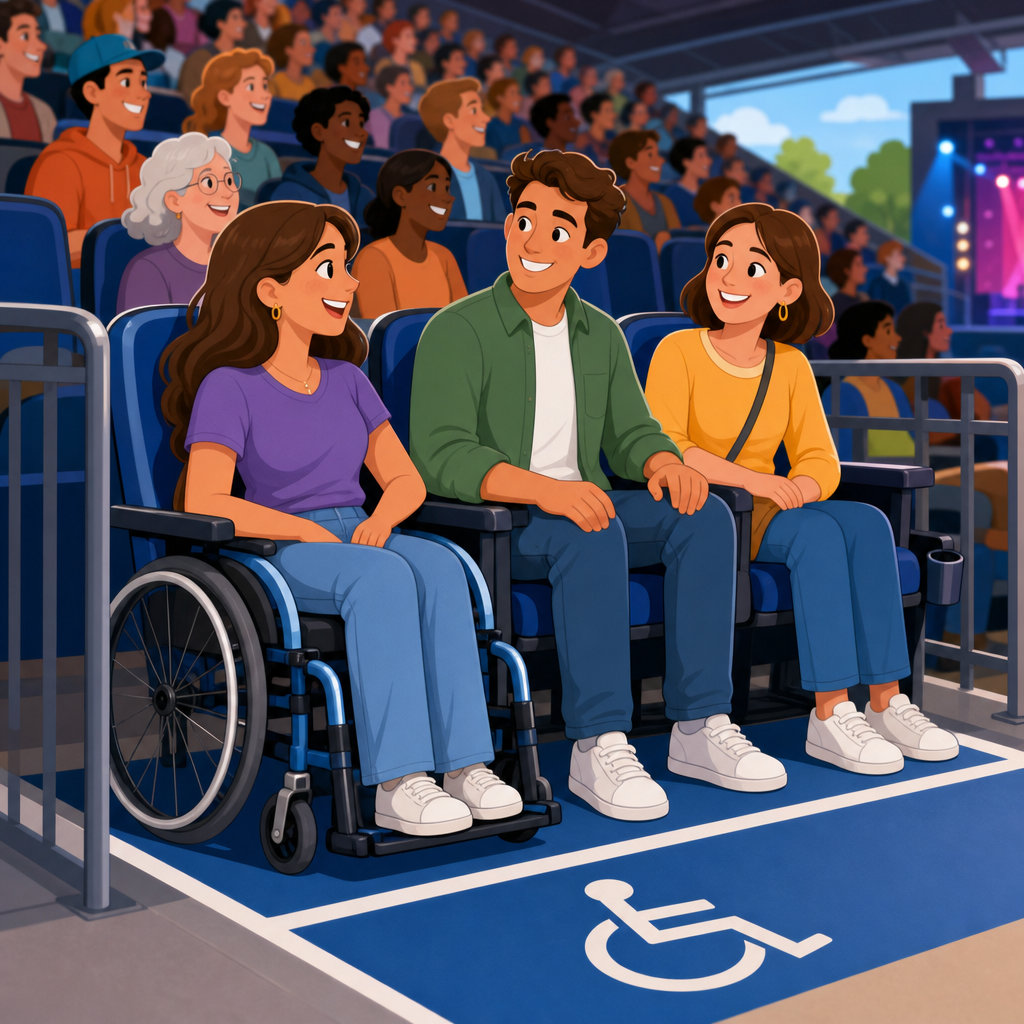
Companion seating is required next to each wheelchair space, and this adjacency matters more than some plans suggest. A companion seat should not be across the aisle, behind a guardrail, or in a removable loose chair position that staff have to improvise later. I have seen venues rely on ushers to “make room,” which fails both predictability and dignity. A wheelchair user should be able to arrive and find the location ready for use without negotiation. Designers should coordinate seat counts, aisle widths, handrails, and ticketing maps so the companion seat is permanently recognized in the layout and in the sales system.
Line of sight is another frequent problem. In stadiums and arenas, accessible seating must provide lines of sight comparable to those for members of the general public. For many venues, that includes seeing over standing spectators, not merely over seated ones. The Department of Justice has enforced this principle repeatedly because a wheelchair location that loses the stage or field whenever the crowd stands is not equivalent access. During design review, I ask teams for section details, not just plan dots. A compliant count on paper can still fail if the vertical geometry leaves the wheelchair user staring at shoulders during critical moments of an event.
| Assembly seating issue | What compliance requires | Common mistake | Better design response |
|---|---|---|---|
| Wheelchair space count | Provide required number based on total seating capacity | Counting temporary overflow areas as permanent spaces | Show every space on permit drawings and in the ticketing inventory |
| Companion seating | Place an adjacent companion seat at each wheelchair space | Locating the companion seat across an aisle or behind the user | Integrate the companion seat directly beside the wheelchair location |
| Dispersion | Distribute locations across viewing angles, levels, and price ranges | Putting all accessible seating on one concourse | Mirror the venue’s overall seating choices as closely as possible |
| Lines of sight | Provide viewing comparable to other spectators, including standing conditions where applicable | Reviewing only plan view without section analysis | Model sight lines in section during schematic design |
Operational practices must support the built design. Ticketing systems need to show wheelchair spaces and companion seats accurately, allow purchase at available price levels, and avoid routing all accessible requests through a phone exception unless that process truly offers equivalent service. Staff training matters too. If venue personnel routinely reseat parties, block accessible routes with portable equipment, or sell companion seats without preserving adjacency options, the user experience breaks down. Good compliance is therefore architectural and operational. The best venues document policies for releasing unsold accessible seats, exchanging tickets, and handling group seating requests without reducing access choice.
Dressing rooms, fitting rooms, and transient lodging
Chapter 8 also addresses spaces where privacy and maneuvering room are essential. In dressing rooms and fitting rooms, accessibility is not just about entering the door. Users need enough clear floor space to move, turn, transfer, use benches, and reach hooks, shelves, and mirrors. On retail projects, I often find one larger fitting room provided near the sales floor, but the bench is undersized, the door swing consumes maneuvering space, or accessories are mounted beyond reach. A truly usable fitting room works as a complete environment. It supports independent clothing changes without requiring staff assistance for basic actions such as hanging garments or checking a mirror.
Transient lodging introduces another set of Chapter 8 obligations. Hotels, motels, inns, and similar facilities must provide accessible guest rooms in required numbers, and some rooms must include communication features for guests who are deaf or hard of hearing. Mobility features may include accessible routes into the room, compliant door clearances, accessible toilet and bathing facilities, and reachable controls. The standards distinguish among room types and bathing options because a room labeled “accessible” can still fail guest expectations if, for example, the tub lacks proper transfer features or the shower configuration does not match what was reserved. Booking systems must accurately identify features so guests can choose rooms that meet actual needs.
The practical lesson across fitting rooms and lodging is that dimensions alone do not guarantee usability. Teams should test layouts with actual furniture, fixture projections, and user pathways. In hotel renovations, one of the most effective steps is to build or digitally model a typical accessible room early, then walk through check-in to bathing to emergency notification. That process reveals conflicts between millwork, beds, drapery pulls, thermostats, luggage benches, and bathroom doors that are easy to miss in isolated detail sheets. Chapter 8 rewards integrated thinking because these rooms are judged by how they function during real use, not by whether a single clearance appears in isolation.
Detention, correctional facilities, and courtrooms
Some of Chapter 8’s most consequential requirements apply to detention and correctional facilities. Accessibility here is often misunderstood because designers assume security concerns override usability. In reality, the standards require accessible cells, toilet and bathing facilities, and common-use spaces in numbers tied to facility type and housing classification. Features must be coordinated with security hardware, clear floor spaces, and circulation paths. During correctional work, the most challenging coordination issues usually involve turning space around bunks or toilets, shower thresholds, and durable grab bar detailing that still supports maintenance and supervision goals. Accessibility in these settings is not optional because people in custody may have temporary or permanent mobility limitations and still retain the right to usable facilities.
Courtrooms present a different but equally important challenge: access must extend beyond the public gallery to participant areas. That can include the witness stand, jury box support areas, judicial bench approaches where required, attorney stations, holding or consultation rooms, and circulation routes used during proceedings. I have reviewed court renovations where the public entrance and spectator seating were accessible, yet a wheelchair user called for jury service could not reach the jury box or related spaces. That is exactly the type of fragmented compliance Chapter 8 is meant to prevent. Access in a courtroom must support full civic participation, not just observation.
Both facility types demonstrate an essential principle for the whole chapter: specialized environments still require equal use, even when supervision, hierarchy, or security influence layout. The standards do allow nuanced application because not every room serves the same function, and some provisions hinge on altered scope or program type. Still, project teams should resist the temptation to treat these occupancies as exceptions first and accessible environments second. The right sequence is the opposite. Start with the user’s required activities, map the accessible path through those activities, and then coordinate security or procedural controls around that path.
How to review Chapter 8 without guesswork
The most reliable way to review Chapter 8 is to follow a four-part method: identify the covered space type, confirm scoping counts, verify technical dimensions and routes, and then test the user experience from arrival to completion of the activity. That last step is where many reviews improve dramatically. For assembly areas, trace parking or transit arrival to ticketing, route choice, seat location, companion placement, concessions, toilet access, and exit. For lodging, trace reservation to check-in, room entry, sleeping area use, bathing, storage, and emergency communication. For courtrooms, trace every role: spectator, juror, witness, attorney, and detainee. Each role reveals different barriers.
Recognized references help remove ambiguity. The 2010 ADA Standards for Accessible Design are the core federal benchmark. For assembly seating, Department of Justice guidance and settlement history provide important interpretation on dispersion, ticketing, and sight lines. ICC A117.1 can also inform coordination where projects align multiple codes, though teams should always confirm which standard governs the legal obligation at issue. Digital review tools such as Bluebeam, Revit-based clash checks, and line-of-sight modeling are useful, but they do not replace a standards-based checklist and narrative reasoning. I rely on both: software for geometry, and manual review for user equivalency.
As this sub-pillar hub, this page should lead you to dedicated articles on assembly areas, accessible hotel rooms, fitting and dressing rooms, detention and correctional accessibility, and courtroom design. Use it as your starting framework. When you review wheelchair spaces and companion seating, remember the broader Chapter 8 lesson: compliance is not a matter of sprinkling accessible features into special rooms. It is about designing each specialized environment so a person with a disability can participate with comparable choice, privacy, safety, and independence. Apply that standard early in planning, verify it carefully in drawings, and revisit it during operations so accessible design performs as intended.
Frequently Asked Questions
What are wheelchair spaces and companion seats, and why do they matter so much in assembly areas?
Wheelchair spaces are designated locations within an assembly area where a person using a wheelchair can remain in their mobility device and still enjoy the event, performance, meeting, or service as part of the general audience. Companion seats are the adjacent or nearby seats intended for friends, family members, aides, or others attending with that person. Together, they are fundamental to accessible design because they do more than satisfy a code requirement. They shape whether people can participate in public life with dignity, independence, and meaningful choice.
In practical terms, these spaces affect the day-to-day experience of stadiums, theaters, lecture halls, arenas, and other venues where people gather. If wheelchair spaces are isolated, placed only in undesirable locations, or separated from companion seating, the result is not real access. People may technically enter the room but still be excluded from the same quality of experience offered to everyone else. ADA design standards address this by requiring wheelchair spaces and companion seating to be intentionally integrated into the seating plan rather than treated as leftovers or emergency accommodations.
This matters because accessible participation is about more than a path to the door. It includes sight lines, choice of ticket price and viewing angle, proximity to amenities, and the ability to sit with others. In well-designed assembly spaces, wheelchair users have options comparable to those available to the general public, and companions can attend without awkward rearrangements or staff improvisation. That is the real goal: predictable, usable access without guesswork.
How should wheelchair spaces be distributed so they provide real choice instead of just meeting the bare minimum?
Distribution is one of the most important concepts in accessible assembly design. A compliant venue is not simply one that includes a certain number of wheelchair spaces somewhere in the room. Those spaces must be dispersed in a way that offers a range of experiences similar to what other spectators can choose from. That means considering different seating sections, elevations, viewing angles, distances from the stage or field, and ticket price categories where applicable.
For example, if every wheelchair space is placed in the back row of a single section, the design may fail to provide equivalent choice even if the quantity appears sufficient. A thoughtful layout places wheelchair spaces in multiple areas so people can choose a location that fits their preferences, budget, and group. In large venues, this often means dispersing accessible seating horizontally and vertically. In smaller rooms, it still means avoiding a one-location-only solution unless the room’s size and configuration make broader dispersion unnecessary.
Companion seating must be considered at the same time. A wheelchair space without a nearby companion seat creates a social barrier, and a companion seat that requires a group to split up defeats the purpose of integrated seating. Designers, owners, and operators should think beyond the drawing set and ask practical questions: Can a wheelchair user attend with a spouse, friend, or aide? Can they choose premium seating or budget seating? Can they access multiple viewing options like other guests? When those questions are answered early in design, the result is a venue that functions smoothly for everyone and avoids expensive fixes later.
Do wheelchair spaces need clear sight lines, and what common design mistakes interfere with the view?
Yes. Wheelchair spaces in assembly areas must provide lines of sight comparable to those for other spectators, including in situations where people in front may stand. This is a critical point because access is not meaningful if a person can enter a venue but cannot actually see the event. In sports arenas, concert halls, theaters, and similar spaces, sight-line design must account for realistic audience behavior rather than idealized seated conditions.
One common mistake is placing wheelchair spaces on a flat floor directly behind standard seating without accounting for how quickly the view disappears when the audience stands. Another is locating accessible positions only at cross aisles or concourses where railings, guard elements, or circulation traffic partially block the view. Designers sometimes also overlook the impact of platform height, row spacing, or the geometry between the wheelchair position and the focal point of the event.
Good design addresses these issues through careful section studies, not assumptions. The wheelchair space should be coordinated with floor elevations, guard placement, and surrounding seating so the user has a genuine viewing opportunity. Companion seats should support that same experience rather than being awkwardly offset or obstructed. Because sight lines are highly technical and can be affected by small dimensional choices, they are an area where early coordination is especially important. Reviewing sight lines during design is far easier than trying to correct them after construction, particularly in fixed seating environments where structural and tiered seating layouts are already in place.
How do wheelchair spaces and companion seating fit into Chapter 8’s broader approach to special rooms and spaces?
Chapter 8 of the ADA Accessibility Standards focuses on areas where accessibility must be designed deliberately because the space serves a specialized function. Assembly areas are one of the clearest examples, but the same design philosophy extends across other specialized environments such as dressing and fitting rooms, transient lodging, and detention and correctional facilities. In each case, the standards recognize that access cannot be achieved by simply providing a general route and hoping the rest works itself out.
Wheelchair spaces and companion seating reflect this broader approach. They are not generic circulation features; they are purpose-built accommodations within a highly specific type of environment. The design must respond to how people actually use the space: attending events, sitting with companions, viewing a performance, moving through seating areas, and choosing among available options. That is exactly the kind of intentionality Chapter 8 is meant to enforce.
This larger context is useful because it helps owners and design teams understand that accessible design is not about isolated technical boxes. It is about making the specialized function of a room usable to people with disabilities in a way that is integrated, predictable, and respectful. Whether the space is a locker room, hotel guest room, courtroom gallery, or arena seating bowl, the underlying question is the same: can a person with a disability use the space in a way that reflects the same purpose and dignity offered to others? Wheelchair spaces and companion seating are among the most visible answers to that question.
What should architects, facility owners, and operators do to avoid guesswork and get wheelchair seating right from the start?
The best approach is to treat accessible seating as a core design decision from the earliest planning stages rather than as a code review item at the end. That begins with understanding the applicable ADA requirements for quantity, dispersion, companion seating, access routes, and sight lines, then integrating those criteria into programming, seating layouts, ticketing strategy, and operational policies. Early coordination among architects, accessibility consultants, venue planners, seating vendors, and ownership can prevent the most common errors.
It is also important to review the user experience, not just the dimensions. A technically sized wheelchair space that is difficult to reach, separated from companions, located in a poor viewing area, or excluded from premium and group seating options may still create serious access problems. Teams should examine plans and sections carefully, model sight lines where appropriate, and ask how a wheelchair user and their companions would actually move through and use the venue. In many cases, the most valuable quality-control step is simply walking through likely scenarios before anything is built or installed.
Operators have a role as well. Even a well-designed room can fail in practice if wheelchair spaces are mismanaged, obstructed, or treated as flexible overflow areas. Ticketing systems should accurately reflect accessible seating inventory, staff should understand how companion seating works, and venue policies should support equivalent access instead of creating unnecessary hurdles. The goal is consistency. People should not have to negotiate for basic accommodations every time they attend an event. When design and operations align, wheelchair spaces and companion seating become what they should be: reliable features of inclusive public life, not exceptions that depend on staff guesswork or last-minute fixes.