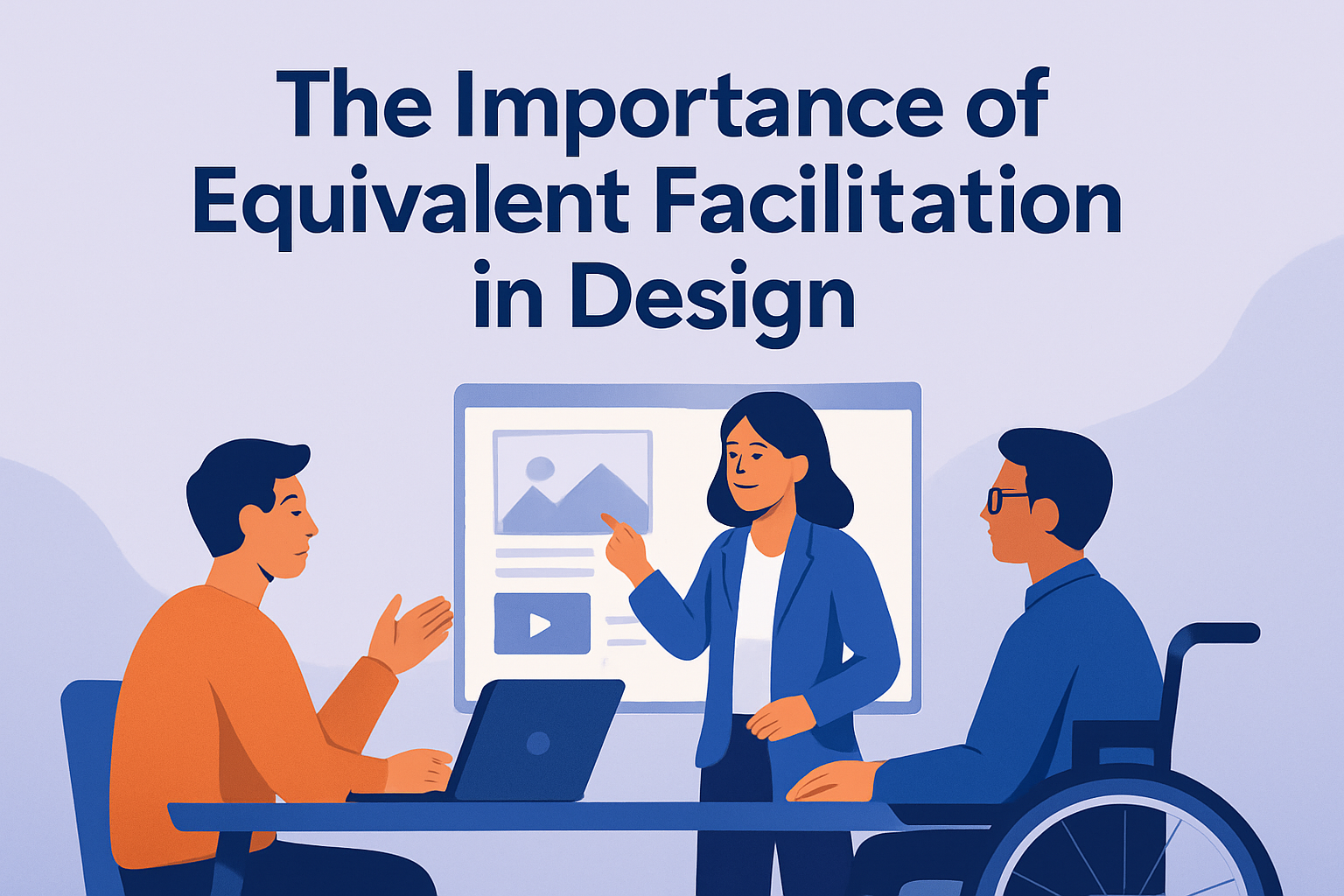
Design is a fundamental part of everything we interact with, from the websites we browse to the buildings we enter. But not all designs serve all people equally, which is where the concept of equivalent facilitation comes into play. Equivalent facilitation is a principle in design that aims to provide equal access and usability to everyone, regardless of their abilities or limitations. It matters because accessibility in design is not just a legal requirement but a moral imperative. Ensuring that designs are inclusive allows everyone, including individuals with disabilities, to engage fully with products, services, and environments.
In today’s society, where inclusivity and equality are valued more than ever, understanding and implementing equivalent facilitation can lead to broader societal integration and acceptance. By focusing on this principle, designers can create solutions that not only meet regulatory standards but also demonstrate empathy and foresight. This article will discuss the various aspects of equivalent facilitation, supported by real-world examples and practical explanations.
What is Equivalent Facilitation?
Equivalent facilitation refers to the concept of creating alternative access solutions when the standard practices do not suffice. It involves designing for accessibility in a way that does not compromise on the quality or effectiveness of the user experience for people with disabilities. According to the Americans with Disabilities Act (ADA), equivalent facilitation permits the use of alternative designs and technologies if they result in the same level of access and usability as the existing standards provide.
An example of equivalent facilitation can be seen in the digital world, where websites are often required to be accessible to individuals who use screen readers. Standard solutions might include adding alternative text to images; however, a more innovative solution could involve using structured data and semantic HTML to offer a richer user experience without images at all. This ensures that all users can extract the same information and fullness of engagement, even if delivered through different methods.
Real-World Example: Accessible Banking Systems
In the banking sector, traditional teller counters are often inaccessible to wheelchair users due to their height. Applying the principle of equivalent facilitation, many banks have incorporated specialized ATMs with adjustable heights and enhanced audio interfaces. These ATMs provide the same services as a human teller, thereby fulfilling the principle of equivalent facilitation.
Additionally, mobile banking apps have become another solution for fostering accessibility. By ensuring apps are designed with accessibility features like voice recognition and text-to-speech capabilities, banks afford users with visual impairments the same services available in physical locations, adapted to the digital landscape.
Equivalent Facilitation in Architecture
Architecture is a field where equivalent facilitation can significantly enhance accessibility. For instance, traditional staircases present challenges for individuals with mobility impairments. While ramps are a standard solution, incorporating vertical lifts or floor-level elevators could serve as equivalent facilitation, offering smoother access without the extensive space that ramps require.
Consider a heritage building where interior modifications like ramps might disrupt historical aesthetics. Here, implementing floor-level elevators with transparent glass can maintain the visual integrity while providing accessibility. This is equivalent facilitation at its best, showing that creative solutions can meet accessibility needs without detracting from the original design intent.
The Role of Technology in Achieving Equivalent Facilitation
Technology has opened up new avenues for implementing equivalent facilitation across various design disciplines. One pertinent example is in the field of education, where traditional learning materials may not be accessible to students with disabilities. The adoption of e-books and audiobooks exemplifies how technology can facilitate equivalent solutions. These alternatives ensure that all students have access to educational content, irrespective of physical or cognitive limitations.
Moreover, virtual reality (VR) and augmented reality (AR) technologies are being explored to enhance learning experiences for those with learning disabilities. By providing immersive, interactive environments, these technologies can offer equivalent educational experiences, tailored to individual needs.
Regulatory Frameworks Supporting Equivalent Facilitation
Globally, regulatory bodies recognize the importance of equivalent facilitation and have embedded it into their legal frameworks. The World Wide Web Consortium (W3C), for example, includes guidelines that encourage designers to use innovative methods to achieve accessibility in ways that may not adhere strictly to traditional standards but still achieve equal access.
In the context of physical spaces, the ADA in the United States provides standards that encourage equivalent facilitation, allowing flexibility in design while maintaining the core objective of accessibility. By supporting alternative solutions through regulation, these frameworks empower designers and architects to develop creative and inclusive solutions.
Addressing Misconceptions About Equivalent Facilitation
A common misconception about equivalent facilitation is that it is merely a workaround for non-compliance with accessibility standards. On the contrary, equivalent facilitation requires careful consideration and rigorous application to ensure that alternate methods provide genuinely equal access. It is not about opting for easier solutions but about finding more fitting, sometimes more innovative solutions that cater to diverse needs.
- Myth: Equivalent facilitation is a compromise on quality.
- Fact: It aims to maintain or elevate the user experience for all individuals.
- Myth: It is more costly than standard compliance.
- Fact: While initial costs may vary, the long-term inclusivity benefits often outweigh the costs.
- Myth: It is only important for compliance.
- Fact: It ensures broader user engagement and satisfaction, independent of regulations.
Combatting these misconceptions requires education and understanding of the true intent and potential of equivalent facilitation in creating equitable environments.
Implementing Equivalent Facilitation in Design Process
Incorporating equivalent facilitation into the design process involves a systematic approach. Design teams need to prioritize user research to understand the diverse needs of all potential users. Including users with disabilities in the design process can provide valuable insights that shape more inclusive and effective design solutions.
For example, when redesigning public transportation systems, transit authorities may involve passengers with reduced mobility in pilot programs. Feedback from these users can then inform the development of more accessible solutions, such as low-floor buses and tactile guiding paths, effectively applying the principle of equivalent facilitation to enhance user experience for all.
Challenges in Applying Equivalent Facilitation
Despite the benefits, implementing equivalent facilitation is not without challenges. One significant challenge is the resistance to change, especially where traditional methods are deeply entrenched. Convincing stakeholders of the necessity and advantages of innovative accessibility solutions requires demonstrating the long-term benefits, both in terms of inclusivity and potentially broader market reach.
Another challenge lies in the difficulty of measuring comparability between traditional and alternative solutions. Designers must ensure that any alternative provides an equal or superior experience, which can be subjectively assessed. Therefore, robust user testing and feedback collection are crucial components of the implementation process.
Practical Applications and Future Directions
The future of design, particularly in smart cities and digital environments, presents promising opportunities for equivalent facilitation. Growing trends in personalized experiences through AI-driven solutions could further enhance individualized accessibility. Designers and technologists must stay abreast of technological advancements to continuously innovate in facilitating equivalent access.
Consider the emerging trend of autonomous vehicles, for instance. By designing these vehicles with voice-controlled interfaces and adjustable features, manufacturers can ensure that they are accessible to users with various disabilities from the outset, rather than as an afterthought.
Conclusion: Taking the Next Steps Towards Equitable Design
In conclusion, the importance of equivalent facilitation in design cannot be overstated. It champions the idea that accessibility should not be an additional feature but an integral part of the design process. By adopting this mindset, designers can create more inclusive environments that observe not only compliance but also human-centric innovation.
The key takeaways to remember are the necessity of equivalent facilitation in promoting inclusivity, the role of creativity and technology in achieving it, and the ongoing need for education and advocacy. As a call to action, designers and organizations should prioritize user-centric design strategies that probe deeper than mere compliance, exploring innovative pathways to ensure everyone can be fully included in all facets of life.
In moving forward, let us embrace the challenges as opportunities to break traditional boundaries and set new standards for accessibility that truly reflect our society’s commitment to equality and inclusion.
Engage with communities, seek continuous feedback, and remain open to new technologies. By doing so, the goal of a universally accessible world becomes not just a vision but a tangible reality.
Frequently Asked Questions
1. What is equivalent facilitation in design, and why is it important?
Equivalent facilitation in design refers to an approach that aims to ensure that all people, regardless of their abilities or disabilities, have equal access and usability when interacting with design elements. This principle is crucial because it recognizes that traditional design standards might not suit everyone. Instead, equivalent facilitation allows for alternative methods that achieve the same level of access, ensuring inclusivity and usability for everyone.
The importance of equivalent facilitation is multi-faceted. On a basic level, it’s about making sure that everyone can use and benefit from the designed environment, whether it’s a website, a piece of software, or a physical structure. It highlights the necessity for designers to think beyond the typical user experience and consider variations in human capabilities. This approach not only broadens the reach of products and services but also aligns with ethical standards by acknowledging that inclusivity is a right, not a privilege.
Moreover, addressing equivalent facilitation helps in meeting legal requirements since many countries have laws and standards mandating accessibility for people with disabilities. Failing to implement such measures can lead to penalties or legal ramifications for businesses and organizations. Therefore, equivalent facilitation isn’t just good practice; it’s often a legal necessity too.
2. How does equivalent facilitation differ from traditional design approaches?
Traditional design approaches often follow a one-size-fits-all guideline, relying on standardized techniques and features intended to cater to a general audience. While these methods can address common needs, they may fall short in providing adequate access to individuals with varying abilities or unique requirements. This is where equivalent facilitation diverges significantly from traditional practices.
Equivalent facilitation is not confined to a single plan or set of guidelines; instead, it advocates for flexibility in design that allows for alternative solutions to achieve comparable outcomes. For instance, while a traditional design might rely on physical tactile buttons for interface control, equivalent facilitation could suggest an alternative like voice command features or color contrast adjustments for better visual accessibility.
Moreover, equivalent facilitation encourages innovation and creativity in problem-solving. Designers are urged to step beyond conventional methods by exploring cutting-edge technologies and user-centered solutions that satisfy diverse needs more effectively. Essentially, it expands the rules to accommodate everyone, thus creating an inclusive design environment that doesn’t just prioritize the average user but champions the diversity of human experience.
3. What are some examples of equivalent facilitation in design practice?
There are numerous instances where equivalent facilitation can be reflected in design practices, tailored to meet the needs of individuals with different abilities. For example:
– **Web Accessibility:** Designing websites with text-to-speech compatibility or implementing keyboard navigation for users who cannot operate a traditional mouse. This ensures that users with visual or motor impairments can access and interact with digital information effectively.
– **Building Accessibility:** Installing ramps alongside stairs for wheelchair accessibility or tactile paving for guiding individuals who are visually impaired. These solutions are key in creating public spaces that are usable by everyone.
– **Software Features:** Incorporating adjustable font sizes and text/background color contrast options for users with visual impairments or difficulties in processing information through standard displays.
– **Product Design:** Developing adaptable tech gadgets that provide haptic feedback or contain voice recognition features helpful to users with hearing impairments or mobility challenges.
These examples showcase equivalent facilitation in action, ensuring that accessibility is never compromised in design, thereby heralding a holistic approach to inclusivity and diversity.
4. What challenges do designers face when implementing equivalent facilitation?
Incorporating equivalent facilitation into design can pose several challenges for designers who need to balance creative innovation, technical feasibility, and cost considerations. One significant challenge is understanding the wide range of disabilities and how these might impact interaction with designs. This requires extensive research, user testing, and stakeholder engagement to ensure that the solutions developed adequately address the diverse needs of potential users.
Additionally, designers often face technological constraints; some designs might require complex implementation or are limited by current technology, complicating efforts to ensure accessibility. Moreover, not all design teams have immediate access to resources or expertise necessary to develop these inclusive solutions, which can hinder the implementation process.
Cost is also another recurring challenge. Expanded testing, comprehensive evaluations, and the development of multiple design solutions can increase project costs. This may deter some organizations from fully integrating equivalent facilitation unless there is clear justification of its value or return on investment.
Despite these hurdles, the commitment to promoting inclusivity in design through equivalent facilitation is crucial. Investing in accessible design ultimately enhances user experience for everyone and opens up opportunities to engage with a broader audience.
5. How can organizations promote awareness and better integration of equivalent facilitation in their designs?
To promote awareness and effectively integrate equivalent facilitation, organizations should begin with educational initiatives aimed at raising understanding of its importance and methods. Training programs for designers and decision-makers should be implemented, focusing on the diverse needs of users and the potential solutions that equivalent facilitation can offer.
Organizations are encouraged to foster a culture of accessibility where inclusive design is prioritized and seen as an integral part of the overall design process, rather than an afterthought. This can involve incorporating accessibility as a core value in company policies and rewarding teams who successfully implement equivalent facilitation. Collaborating with accessibility experts and stakeholders, including individuals with disabilities, can also provide valuable insights and drive motivation for creating meaningful designs.
Moreover, showcasing successful case studies or piloting accessible design projects can further underline the practicality and effectiveness of equivalent facilitation, serving as concrete evidence of its benefits. Organizations should also stay informed on regulatory requirements and advancements in accessibility technologies to remain compliant and forward-thinking in their design strategies.
By advocating for and integrating equivalent facilitation into design processes, organizations not only meet the needs of all users but also enhance their brand reputation and societal impact by fostering a more inclusive world.