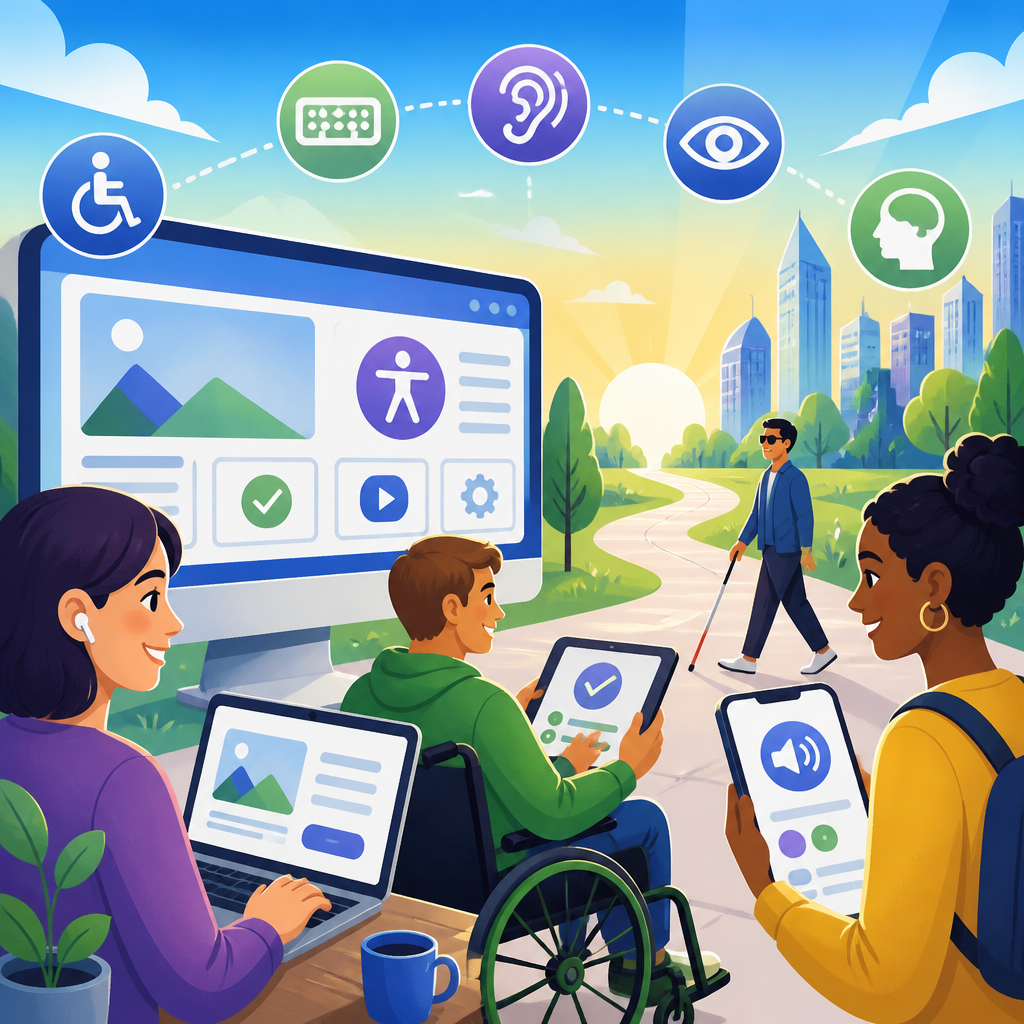
The next five years of ADA web and app compliance will be defined by stricter enforcement, clearer technical expectations, and a broader view of digital accessibility as a product requirement rather than a legal afterthought. In practical terms, ADA compliance for websites and mobile applications means designing, building, and maintaining digital experiences that people with disabilities can use effectively. That includes people who are blind, have low vision, are Deaf or hard of hearing, have mobility limitations, cognitive disabilities, vestibular disorders, speech disabilities, or temporary impairments that affect navigation, reading, input, or comprehension.
Although the Americans with Disabilities Act does not prescribe a single coding standard for every site or app, courts, settlement agreements, and agency guidance have pushed organizations toward recognized technical benchmarks, especially the Web Content Accessibility Guidelines, now commonly applied at Level AA. I have watched this shift move from occasional remediation projects to board-level risk management. Five years ago, many teams still treated accessibility as a one-time audit. Today, the more mature organizations build it into procurement, design systems, QA, release pipelines, and customer support because the legal, operational, and reputational costs of exclusion are measurable.
This matters because digital channels are now primary service channels. Banking, telehealth, education, retail, transportation, government services, and workplace tools all depend on websites, native apps, kiosks, PDFs, and embedded third-party components. When any of those touchpoints fail basic accessibility expectations, users are blocked from buying, learning, applying, scheduling, or participating. Over the next five years, ADA web and app compliance will evolve from reactive lawsuit avoidance into continuous digital governance. The organizations that prepare now will spend less on emergency fixes, serve more customers, and adapt faster as standards, platforms, and enforcement continue to develop.
Regulation and enforcement will become more specific
The strongest near-term trend is a move toward more explicit rules and more predictable enforcement. The Department of Justice has already made clear that the ADA applies to digital experiences offered by covered entities, and recent rulemaking for state and local government under Title II points to a future in which technical conformance expectations are stated more plainly. Private sector organizations under Title III should assume that regulators, plaintiffs, and judges will continue using WCAG 2.1 or newer versions as the practical measuring stick, even when statutes do not cite them line by line.
In my work, the biggest mistake I still see is waiting for a perfect final rule before acting. That approach is risky. Enforcement does not pause because a company wants more certainty, and accessibility claims often focus on very ordinary failures: unlabeled form fields, missing alt text on functional images, keyboard traps, low contrast, inaccessible checkout flows, CAPTCHA barriers, and videos without captions. Plaintiffs do not need exotic defects to build a case. They need evidence that a disabled user could not complete a core task.
Expect the next five years to bring more sector-specific scrutiny. Healthcare portals, higher education platforms, financial services apps, travel booking tools, and e-commerce checkouts are especially exposed because they handle essential transactions. Procurement requirements will also tighten. Enterprise buyers increasingly ask vendors for accessibility conformance reports using the Voluntary Product Accessibility Template, and weak or outdated VPATs will become a larger sales obstacle. Compliance will not be judged only by a homepage scan. Buyers and regulators will look at authenticated experiences, mobile workflows, documents, and support channels.
WCAG conformance will expand from websites to full digital ecosystems
The future of ADA web and app compliance is not about a single public website. It is about the complete digital ecosystem: design systems, native iOS and Android apps, web applications behind login, downloadable documents, chat interfaces, video libraries, maps, payment tools, and third-party integrations. As organizations mature, they stop asking whether the marketing site passes and start asking whether every critical user journey works with screen readers, keyboard-only navigation, zoom, reflow, voice control, captions, and reduced motion settings.
That broader scope matters because users do not experience accessibility in silos. A person might discover a service on a website, create an account in a mobile app, sign a document in a portal, and contact support through chat. If any one step fails, the entire service fails. I have seen teams celebrate a strong audit score on public pages while account onboarding remained impossible in the native app because custom controls were not exposed correctly to VoiceOver or TalkBack. Over the next five years, that disconnect will become less acceptable commercially and legally.
Version changes will also matter. WCAG 2.2 adds requirements that reflect modern interaction patterns, including focus appearance, dragging alternatives, and target size considerations. WCAG 3.0 remains further out, but its development signals a long-term shift toward outcomes and usability. Organizations should not wait for a complete standards reset. The practical move now is to build against current Level AA requirements while tracking emerging criteria that affect forms, touch targets, authentication, and error prevention.
Accessibility operations will replace one-time remediation
The most important operational prediction is that accessibility programs will look more like security or privacy programs. Annual audits alone will not be enough. Teams will need governance, ownership, documentation, and recurring measurement. Mature programs already assign executive sponsorship, define engineering standards, maintain issue severity levels, require accessible design reviews, and test releases before production. Over the next five years, this model will spread because it is the only scalable way to keep pace with frequent deployments.
What does that look like in practice? It starts with policy, then moves into workflow. Product requirements include accessibility acceptance criteria. Designers use component libraries with tested color tokens, focus states, and semantic patterns. Developers run automated checks with tools such as axe, Lighthouse, and Accessibility Insights, then supplement those checks with manual keyboard and screen reader testing. QA validates defects in the same tracking system used for functional bugs. Support teams know how to escalate accessibility barriers quickly. Legal and procurement teams review third-party risk before contracts are signed.
The following table shows how this shift will reshape common compliance practices over the next five years.
| Area | Old approach | Next five years |
|---|---|---|
| Audits | One-time review after launch | Scheduled testing tied to releases and major updates |
| Ownership | Shared vaguely across teams | Named leaders in product, engineering, design, and legal |
| Standards | General ADA references | Documented WCAG-based requirements and design system rules |
| Testing | Mostly automated scans | Automation plus keyboard, screen reader, zoom, and mobile assistive tech testing |
| Vendors | Accessibility reviewed late | VPAT review, contract language, and remediation commitments before purchase |
| Measurement | Pass or fail mindset | Severity tracking, time to remediation, and journey-level usability metrics |
This operationalization changes budgets as well. Spending will move from emergency legal response and broad retrofits toward ongoing staffing, training, and process integration. That is a healthier cost profile. Fixing an inaccessible component inside a design system is cheaper than fixing fifty product surfaces after a demand letter arrives.
Mobile apps, authentication, and emerging interfaces will drive the hardest questions
Web accessibility guidance is relatively mature, but app accessibility remains uneven in many organizations. That gap will narrow because native apps are now central to banking, travel, delivery, healthcare, and workplace access. The technical issues are well known: missing accessibility labels, incorrect role exposure, poor focus order, gesture-only interactions, dynamic type failures, insufficient contrast, and custom controls that do not announce state changes. Apple and Google both provide strong platform guidance, but teams still bypass it when speed pressures dominate.
Authentication will become an especially important compliance topic. Multi-factor authentication, one-time passcodes, timed sessions, and identity verification tools often create barriers for screen reader users, users with cognitive disabilities, and users who cannot perform fine motor interactions quickly. The next five years will bring closer attention to accessible login design, including password managers, passkeys, clear error recovery, and alternatives to puzzle-based or image-based verification. A compliant experience is not one that merely displays a login form. It must let users complete authentication independently.
Emerging interfaces add another layer. AI chat widgets, voice assistants, augmented reality features, and biometric sign-in flows will all need accessibility review. New interaction models do not exempt products from old obligations. If a chatbot becomes the primary support channel, its keyboard behavior, reading order, transcript availability, and timeout handling matter. If a retailer adds AR product previews, users still need equivalent product information and purchasing access without relying on vision-heavy interactions. Innovation will expand compliance scope, not shrink it.
Litigation risk will remain high, but market pressure will matter just as much
Businesses often ask whether lawsuit volume will keep rising. The more useful question is why accessibility risk persists even when organizations know the rules. The answer is that digital products change constantly. New templates, plug-ins, campaigns, and app releases can reintroduce barriers overnight. As long as accessibility is treated as a cleanup project, litigation risk remains durable. Over the next five years, claims will continue because plaintiffs and advocacy groups can still find basic failures across high-traffic consumer properties.
However, legal exposure is only part of the picture. Market pressure is becoming equally significant. Large enterprises increasingly require accessible software from vendors. Public entities are tightening contractor expectations. Investors and boards are paying more attention to disability inclusion as part of governance and brand resilience. Customer expectations are also shifting. People compare digital experiences quickly, and inaccessible flows create abandonment that analytics teams can often see in higher error rates, lower conversion, or support contacts clustered around the same task.
A useful prediction for executives is this: accessibility performance will become a measurable competitive advantage in sectors with complex transactions. If two insurance portals offer similar pricing but one works cleanly with assistive technology and the other does not, the accessible product will win more trust, more completions, and fewer escalations. Compliance therefore should be framed not only as defense, but as service reliability and revenue protection.
The organizations that succeed will invest in people, not just tools
Automated scanners will improve, and AI-assisted testing will become more common, but tools will not solve ADA web and app compliance by themselves. Automated testing typically catches only a portion of WCAG issues. It can identify missing form labels, color contrast failures, empty links, and some structural problems, but it cannot reliably judge whether alt text is meaningful, whether instructions are understandable, whether focus order matches task logic, or whether error messaging actually helps a user recover. Human judgment remains essential.
That is why the best next-five-year strategy is capability building. Train designers on semantics, reading order, and nontext alternatives. Train developers on ARIA usage, native controls, focus management, and assistive technology behavior. Train content teams on headings, link purpose, plain language, captions, and document structure. Train procurement and legal teams on VPAT review and contractual remedies. Most importantly, involve disabled users in research and testing. Nothing replaces direct observation of real users trying to complete real tasks.
As this subtopic hub expands, organizations should also follow connected developments: new case law, federal and state rule updates, WCAG version changes, mobile platform guidance, document accessibility requirements, and procurement best practices. The next five years of ADA web and app compliance will reward steady, structured action over reactive remediation. Start with your highest-impact journeys, adopt clear technical standards, assign ownership, test continuously, and close the gaps that block users today. That work reduces legal risk, strengthens customer trust, and makes every future update easier to ship accessibly.
Frequently Asked Questions
What will ADA web and app compliance look like over the next five years?
Over the next five years, ADA web and app compliance will become more structured, more enforceable, and much harder for organizations to treat as a one-time legal checklist. The biggest shift is that accessibility is moving from a reactive issue to a core product and operational requirement. Businesses, public entities, schools, healthcare organizations, retailers, financial institutions, and software companies will increasingly be expected to build accessible websites and mobile applications from the start rather than patch barriers after complaints arise.
In practice, that means organizations should expect clearer technical benchmarks to guide digital accessibility efforts, with WCAG continuing to serve as the primary reference point for websites and apps. Teams will need to think beyond basic homepage fixes and address full user journeys, including navigation, forms, account creation, checkout, document access, media, customer support tools, and native mobile interactions. Accessibility expectations will also extend further into third-party integrations, embedded tools, and software platforms that affect whether a user can independently complete a task.
Another important trend is that enforcement pressure is likely to increase. Plaintiffs, regulators, and advocacy groups are paying closer attention to whether digital services are usable by people with disabilities, and organizations will need stronger internal processes to demonstrate ongoing compliance efforts. In short, the next five years will reward companies that treat accessibility as part of design quality, engineering discipline, procurement standards, and risk management.
Will legal enforcement of ADA digital accessibility become stricter?
Yes, and that is one of the most important developments organizations should prepare for. While the legal landscape has evolved over time, the broader direction is clear: digital accessibility is no longer viewed as optional when websites and apps are central to how the public accesses goods, services, information, education, employment, and healthcare. Courts, regulators, and state-level authorities are increasingly recognizing that inaccessible digital experiences can function as real barriers for people with disabilities.
Stricter enforcement does not only mean more lawsuits, although litigation will remain a major concern for many organizations. It also means higher expectations from procurement teams, enterprise customers, investors, and partners who want to reduce compliance risk and align with modern accessibility standards. Government-facing contractors and organizations in regulated sectors may face even greater scrutiny, especially if their digital properties support essential public access or mission-critical services.
What makes the next five years different is that organizations will have a harder time arguing that accessibility expectations were unclear. As industry standards mature and accessibility testing becomes more integrated into normal development workflows, failure to address well-known barriers may be viewed less sympathetically. Businesses that adopt documented policies, regular audits, remediation plans, training programs, and accessible development practices will be in a much stronger position than those relying on occasional fixes after receiving a complaint.
Which technical standards will matter most for ADA compliance in websites and mobile apps?
The most important technical reference point will continue to be the Web Content Accessibility Guidelines, commonly known as WCAG. Although the ADA itself does not read like a technical specification for websites and mobile applications, WCAG has become the leading framework used to evaluate whether digital experiences are accessible. Over the next five years, organizations should expect WCAG-based requirements to remain central to accessibility reviews, contracts, remediation projects, and legal discussions.
For websites, that means focusing on fundamentals such as keyboard accessibility, meaningful alt text, sufficient color contrast, clear headings and labels, accessible forms, logical focus order, resizable text, readable content structure, and compatibility with assistive technologies such as screen readers. For mobile apps, accessibility work must also account for platform-specific behaviors, including screen reader support, touch target size, orientation, dynamic text scaling, gesture alternatives, captioning, labeling of controls, and predictable navigation patterns across iOS and Android environments.
Just as important, technical compliance will increasingly be evaluated at the experience level, not just the code-snippet level. A site can have isolated accessible components and still be unusable if critical tasks break down. That is why mature organizations combine automated scanning with manual testing, assistive technology testing, and real-world task validation. The standard that matters most is not simply whether a page passes a scan, but whether a person with a disability can successfully and independently use the digital product as intended.
Why should companies treat accessibility as a product requirement instead of a legal afterthought?
Because that is the only sustainable way to keep up with where digital compliance is heading. When accessibility is treated only as a legal concern, it often gets addressed too late, after design decisions are locked in, code has already shipped, and business teams are under pressure to move quickly. That approach usually leads to expensive retrofits, recurring defects, frustrated users, and greater legal exposure. By contrast, when accessibility is treated as a product requirement, it becomes part of how teams define quality from the beginning.
This shift has practical benefits beyond compliance. Accessible design tends to improve usability, clarity, consistency, and resilience for all users, not just users with disabilities. Clear form labels help everyone. Captions support users in noisy or quiet environments. Strong color contrast improves readability across devices and lighting conditions. Keyboard support helps power users as well as people who cannot use a mouse. Accessibility is often a driver of better product thinking because it forces teams to design for real variation in how people interact with technology.
Over the next five years, the organizations that perform best will be the ones that integrate accessibility into research, design systems, engineering standards, QA processes, content publishing, vendor selection, and release management. In other words, accessibility needs ownership, budget, timelines, acceptance criteria, and accountability just like security, privacy, and performance. Once teams make that operational shift, compliance becomes far more achievable and far less disruptive.
What should organizations do now to prepare for the next five years of ADA web and app compliance?
Organizations should start by taking an honest inventory of their digital ecosystem. That includes public websites, authenticated portals, mobile apps, PDFs, multimedia content, e-commerce flows, customer service tools, and third-party platforms that users rely on to complete essential tasks. Many accessibility risks are not limited to a company’s main website; they often appear in embedded booking tools, payment systems, support widgets, document libraries, or app features that were never fully tested for assistive technology use.
Next, organizations should establish a structured accessibility program rather than relying on ad hoc remediation. A strong program usually includes a baseline audit, prioritization of critical user flows, documented remediation plans, internal accessibility standards, training for designers, developers, QA teams, and content authors, and regular testing before and after release. It is also important to adopt accessible procurement practices so new vendors and tools do not introduce avoidable barriers into the environment.
Finally, companies should recognize that accessibility is ongoing maintenance, not a project with a permanent finish line. Content changes, feature launches, redesigns, framework updates, and vendor changes can all introduce new issues. The best preparation is to build repeatable processes: include accessibility in product requirements, define test cases for key disability scenarios, monitor continuously, and assign clear internal ownership. That approach not only lowers legal risk, but also creates digital experiences that more people can actually use, which is the real point of compliance in the first place.


