Swimming pool lifts are one of the most visible accessibility features in recreation and sports facilities, yet they are also among the most frequently misunderstood. In practice, compliance depends on more than buying a powered chair and bolting it to a pool deck. Location, seat height, clear deck space, water depth, operability, maintenance, and staff readiness all determine whether a lift actually provides safe, independent access for people with mobility disabilities. I have worked with aquatic centers, hotels, therapy pools, and municipal parks where a lift technically existed but failed in daily use because batteries were dead, seats were mounted too high, or the unit was positioned where users could not approach it.
Within ADA accessibility standards, swimming pool lifts sit inside the broader recreation and sports facilities category. That category also covers sloped entries, transfer walls, transfer systems, accessible routes to spectator areas, locker rooms, exercise spaces, spas, and other recreation amenities. A hub article on recreation and sports facilities needs to explain how pool lifts fit into the larger accessibility framework: they are not an isolated equipment purchase but part of a connected accessible experience from parking and entrance to changing rooms, deck circulation, and water entry.
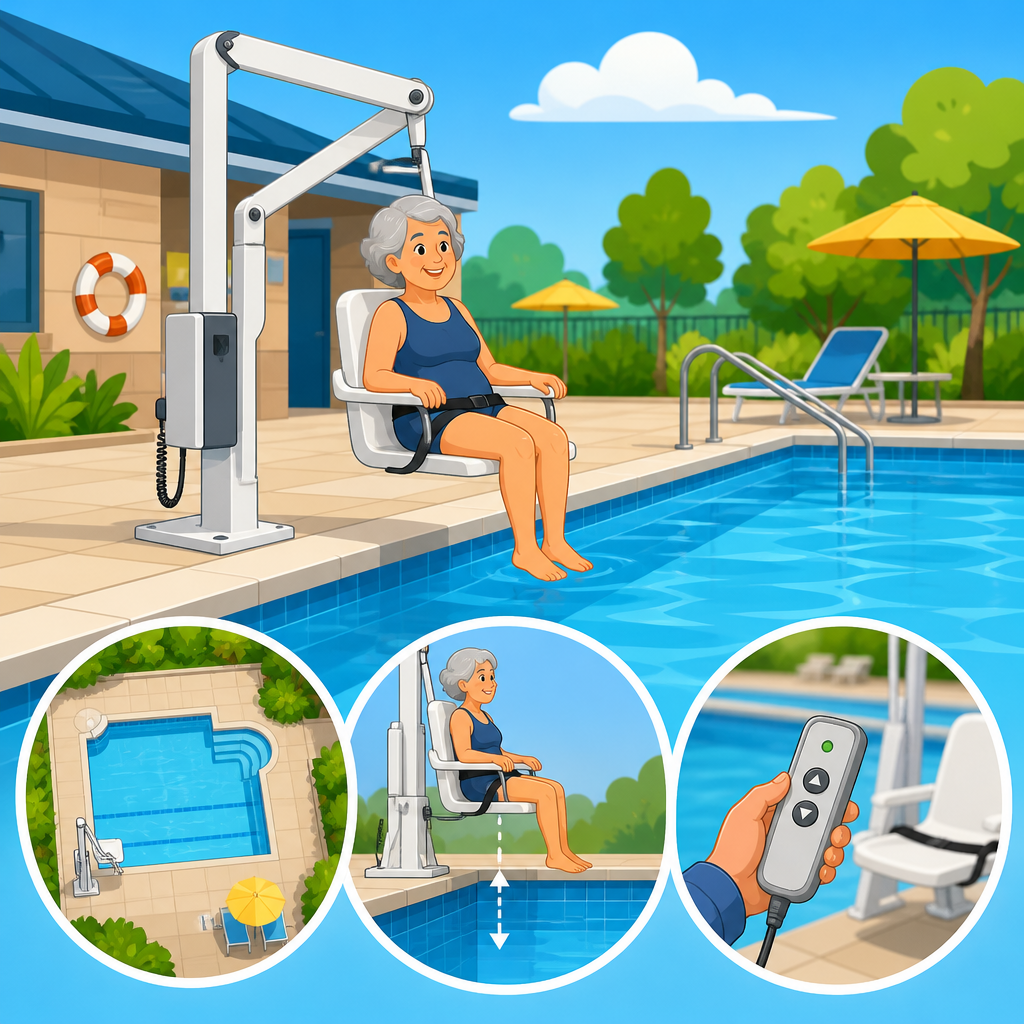
A swimming pool lift is a device designed to transfer a user from the pool deck into and out of the water using a seat, arm supports, footrests, and a powered or assisted lowering mechanism. Seat height refers to the measured distance from the deck to the top of the seat in its raised position, a critical factor because a seat set too high or too low can make lateral transfer difficult or unsafe. Operational readiness means the lift is installed, charged, unlocked, available during pool hours, and usable without barriers. These definitions matter because accessibility law focuses on actual usability, not just appearance. For facility owners, operators, designers, and risk managers, getting these details right reduces legal exposure and improves service for members, guests, patients, athletes, and families.
Where Pool Lifts Fit Within Recreation and Sports Facilities Accessibility
Recreation and sports facilities are judged as systems, not as isolated rooms or products. A pool lift may satisfy one requirement at the water’s edge, but the route leading to it must also be accessible. That includes parking access aisles, entrances, reception counters, locker rooms, toilet rooms, showers, and deck surfaces. In several facility reviews I have conducted, the pool lift itself met dimensional requirements, yet users still faced barriers because the only path to the lift crossed hose bibs, loose deck furniture, or a threshold at the natatorium door. A compliant lift does not cure an inaccessible route.
For aquatic environments, standards distinguish between types of entries and the number required based on pool size and configuration. Large swimming pools generally need two accessible means of entry, with at least one being a pool lift or sloped entry. Smaller pools may be permitted to provide one accessible means of entry. Spas, wading pools, and catch pools have separate provisions. This matters for hub-level planning because facility teams often assume one portable device can serve every vessel on site. In reality, each pool or spa must be evaluated individually, and the correct accessible entry type depends on the specific use, dimensions, and whether the facility is newly constructed, altered, or subject to existing-facility obligations.
As a subtopic within ADA accessibility standards, recreation and sports facilities also involve program access and operational policy. Staff cannot create policies that undermine an otherwise compliant design, such as requiring advance notice before a disabled swimmer may use a lift if other patrons can enter the water freely. The central principle is equal opportunity. In aquatic settings, equal opportunity usually means a person can approach the lift, transfer to the seat, activate it independently where feasible, enter the water safely, and exit without needing extraordinary assistance.
Location Requirements: Why Placement Determines Usability
The best location for a swimming pool lift is the place where a user can approach, transfer, and enter water with the least difficulty. Standards require lifts to be located where the water level does not exceed a specified depth, typically 48 inches in the area served by the lift. That depth limit is not arbitrary. It helps ensure a user can be lowered into water suitable for a controlled entry and exit rather than into a depth that increases instability or dependence on staff. Designers sometimes place a lift where it is least visible for aesthetic reasons, but hidden corners often produce poor deck circulation, reduced supervision, and difficult side transfers.
In hotels, I often see lifts mounted near the deep end because that is where mechanical anchoring is easiest or where deck furniture creates less conflict. That is usually the wrong decision. A better location is commonly along a straight deck edge with sufficient clear space, close to an accessible route, and near a moderate water depth. At municipal pools, placing the lift near the primary accessible path from locker rooms works better than locating it behind lane storage racks. At therapy pools, location should also account for caregiver circulation, transfer assistance when needed, and proximity to handrails without obstructing the required clear deck space.
Permanent versus portable location is another issue. Fixed lifts generally provide more reliable access because they remain in the correct position and are less likely to be removed for events or storage. Portable lifts can be acceptable in some circumstances, but operators must prove they are readily available and can be positioned for immediate use. The practical problem is consistency. When a portable lift is stored in a maintenance room, missing a battery, or blocked by stacked chairs, it is not operationally ready. From both compliance and customer-service standpoints, the correct location is the one where the lift can remain available during all open swim hours.
Seat Height, Transfer Geometry, and User Safety
Seat height is one of the most common technical failures in pool lift installations. The seat needs to be low enough to support a lateral transfer from a mobility device but high enough to work with the lift’s travel path and deck conditions. Standards set a seat height range measured from the deck to the top of the seat surface in the raised position. When installers ignore that range, users can end up facing an awkward uphill transfer or a seat that drops below the level needed for safe positioning. Even a difference of an inch or two can be significant for someone transferring independently.
In field conditions, seat height problems often result from aftermarket replacement seats, shimmed anchoring systems, deck resurfacing, or selecting a lift model intended for a different application. I have seen facilities resurface pool decks and unknowingly raise the finished deck enough to change the transfer relationship. The lift still moved, but the transfer became harder because armrest and seat geometry no longer aligned well with a wheelchair cushion height. This is why post-installation verification matters. Measure the final installed condition, not the manufacturer brochure dimensions alone.
User safety also depends on seat design details beyond height. The seat should provide stable support, armrests should not interfere with transfer, footrests should move clear when needed, and the controls should be operable from the deck and water. A lift can technically lower a person into the pool while still being functionally poor if the user cannot comfortably position their legs, hold a support point, or activate the movement without overreaching. Good transfer geometry is not luxury design; it is the difference between independent access and dependence on staff lifting or repositioning a patron.
Operational Readiness: The Difference Between Installed and Usable
Operational readiness means the pool lift works every day the pool is open, not only on inspection day. Batteries must be charged, waterproof hand controls must be connected and responsive, emergency stop functions should work, and the lift cannot be chained, covered, or disabled in a way that delays access. In enforcement and litigation, one of the most damaging facts for an operator is having a compliant lift that staff cannot activate because the battery is dead or the key is missing. That failure shows a breakdown in management, not a one-time inconvenience.
Readiness also includes staffing practices. Staff should know where the operating manual is, how to perform a pre-use check, how to assist without taking over, and when a lift must be removed from service. In strong facilities, opening procedures include confirming charge level, cycling the lift through a test run, inspecting seat hardware, and clearing the required deck space. In weak facilities, no one owns the process, so the lift becomes a neglected piece of specialty equipment. The pattern is predictable: infrequent testing leads to surprise failures during guest use, which leads to embarrassment, complaints, and avoidable risk.
| Operational issue | Common cause | Practical fix |
|---|---|---|
| Dead battery | Charger not connected after closing | Add nightly charging to written close-out checklist |
| Lift unavailable | Portable unit stored off deck | Assign a fixed in-service location during all open hours |
| Seat too high | Incorrect installation or deck resurfacing | Re-measure installed height and adjust anchoring system |
| Blocked transfer space | Furniture or storage placed beside lift | Mark clear deck zone and train staff to keep it open |
| Controls not usable | Damaged handset or disconnected cable | Inspect before opening and keep replacement parts on site |
New Construction, Alterations, and Existing Facilities
The compliance analysis for swimming pool lifts changes depending on whether the facility is newly constructed, altered, or already existing. New construction is the most demanding category because the expectation is full integration of accessibility features into the original design. In a new natatorium, there is little excuse for poor lift location, inaccessible routes, or inadequate deck clearances because these elements can be coordinated with structural, civil, and architectural plans from the beginning.
Alterations require careful scoping. If a facility renovates the pool deck, modifies the basin, or upgrades associated amenities, accessibility obligations can be triggered or expanded. I have seen projects described as simple finish replacements that actually changed deck elevations, drain slopes, and route continuity around the pool. Once that happens, the lift and its surrounding clearances need fresh review. Teams that treat aquatic accessibility as a late equipment specification often discover conflicts too late, such as anchors landing in expansion joints or deck drains interfering with transfer space.
Existing facilities present the most nuance because barrier removal is judged through a standard of what is readily achievable in many cases, while public entities may analyze program access differently. Even so, existing conditions are not a blanket exemption. Operators should document what access is currently provided, what barriers remain, what modifications are planned, and how users request assistance. In private clubs, older hotels, and apartment communities, I have found that a modest investment in a fixed lift, route improvements, and staff procedures solves most access problems far more effectively than ad hoc assistance policies.
Maintenance, Inspection, and Risk Management in Daily Operations
Reliable pool lift access depends on routine maintenance, documented inspection, and accountability. Manufacturers such as S.R. Smith and Spectrum Aquatics provide model-specific guidance for charging cycles, anchor inspection, actuator checks, and replacement intervals. Operators should follow those instructions while also aligning with broader facility maintenance programs and aquatic risk protocols. A best-practice approach includes daily visual checks, weekly function testing, monthly documented inspections, and immediate removal from service if any structural, electrical, or control issue appears.
Risk management is not only about avoiding incidents; it is about preventing predictable access failures. For example, corrosion can affect hardware in humid natatoriums, especially where chemical balance is poorly controlled. Deck movement can loosen anchors over time. Vinyl straps and padding degrade under ultraviolet exposure at outdoor pools. Water intrusion can damage remote controls and charging connectors. None of these failures are surprising. They are normal operating realities in aquatic environments, which is why maintenance must be scheduled rather than reactive.
Documentation matters because it shows whether the facility manages accessibility with the same seriousness as water chemistry or lifeguard certification. Keep inspection logs, repair records, staff training sign-ins, and manufacturer bulletins together. If a user reports a transfer difficulty, treat that feedback as operational data, not as a complaint to dismiss. The strongest recreation and sports facilities build accessibility into preventive maintenance, capital planning, and front-line customer service. That approach protects users, strengthens compliance, and turns a pool lift from symbolic equipment into dependable access. Audit your recreation spaces now, verify every pool lift in service, and correct the barriers before your next guest finds them first.
Frequently Asked Questions
Where should a swimming pool lift be located to provide real accessibility and support compliance?
A pool lift should be located where a person with a mobility disability can actually approach it, transfer safely, and enter the water without unnecessary obstacles or staff improvisation. In most facilities, that means placing the lift on an accessible route, in a portion of the deck with the required clear space for maneuvering, and in water deep enough for the lift to function as intended. The best location is not simply the first available spot on the deck or the easiest place to anchor the equipment. It should be chosen based on how people truly move through the facility, including wheelchair users, older adults, and patrons who need extra stability during transfers.
In practical terms, the lift should not be blocked by lounge chairs, storage bins, guard stands, movable lane line reels, or seasonal equipment. Users should be able to approach it independently, position their mobility device, and transfer onto the seat without navigating a cluttered or sloped deck area. Facilities also need to consider whether the lift is placed in a location that allows dignified use. If the lift is tucked into an awkward corner, behind equipment, or in an area that is constantly roped off, it may technically exist while functionally denying access.
Location also affects usability in ways that are easy to overlook. For example, if a lift is installed where wave action, current, or recirculation features make boarding unstable, the experience can become unsafe. If it is placed beside a wall feature, ladder, or handrail that interferes with the seat’s travel path, users may not be able to complete the transfer or water entry smoothly. In competitive or multi-use pools, managers should also think about whether programming routinely blocks access to the lift during peak hours. A lift that is physically present but unavailable during lessons, team practice, or lap swim can create serious access problems.
Ultimately, a compliant and effective lift location is one that supports independent use as much as possible and does not rely on ad hoc staff workarounds. The location should be reviewed not just at installation, but during routine accessibility audits, especially if the deck layout, programming, or surrounding equipment changes over time.
Why does pool lift seat height matter so much, and what problems arise when it is not set correctly?
Seat height matters because it directly affects whether a person can transfer onto the lift safely and with a reasonable degree of independence. For many users, the transfer from a wheelchair, mobility scooter, or other device to the lift seat is the most physically demanding part of the entire process. If the seat is too high, it may require an unsafe upward transfer. If it is too low, it can create a difficult downward drop and increase the risk of sliding, loss of balance, or shoulder strain. A lift can appear modern and fully powered, yet still be poorly usable if the seat height is not within an appropriate transfer range.
In the field, seat height problems are common because installers, operators, and purchasing teams often focus on weight capacity, brand, or battery performance while overlooking transfer geometry. Some facilities unintentionally change the effective transfer conditions by adding thick deck coatings, replacing surrounding surfaces, or adjusting the base in ways that alter the height relationship between the seat and the deck. Others assume that because the chair rotates and lowers into the water, the boarding position will automatically work for everyone. It does not. Small differences in height can have a major impact on safety and independence.
An improperly set seat height can also force staff into providing more physical assistance than should be necessary. That creates risk for both the user and the employee, especially in wet environments where lifting and repositioning are difficult. It can also undermine the purpose of providing an accessible means of entry in the first place. The goal is not merely to have a device on site, but to offer a usable transfer opportunity for people with a range of mobility needs.
Facilities should verify seat height as part of commissioning, regular inspections, and any repair or replacement process. Operators should also pay attention to user feedback. If patrons repeatedly say the lift is difficult to board, that is a strong signal that the transfer setup needs review. Seat height is not a minor technical detail; it is one of the core factors that determines whether the lift works in the real world.
What deck space and surrounding conditions are needed for a pool lift to be usable, not just installed?
A pool lift needs more than an anchor point and electrical or battery readiness. It also needs adequate clear deck space around it so users can approach, align, transfer, and depart safely. That clear space must remain genuinely available in day-to-day operations, not just during an inspection or on a floor plan. In many facilities, the biggest accessibility failures happen not because the lift is missing, but because the surrounding deck area is treated as flexible storage or overflow space for programming.
For a lift to be usable, the deck area should be stable, slip-resistant, and free from abrupt changes in level or obstructions that interfere with wheelchair positioning. Patrons need room to maneuver beside the seat, and staff need enough space to assist when assistance is requested. If the lift is hemmed in by planters, guard chairs, tables, teaching platforms, or stacked furniture, a user may not be able to get close enough to transfer safely. Even temporary obstructions can make the feature unusable during the times people need it most.
Facilities should also think beyond dimensions and consider operational realities. Is the deck routinely crowded with spectators during swim meets? Do aquatic fitness classes set equipment around the lift area? Are hoses, covers, or lane lines stored nearby? Is water chemistry residue making the surface slick? These conditions can turn an otherwise compliant installation into a practical barrier. Clear space is only meaningful if staff are trained to preserve it consistently.
Good operational practice includes marking the area if appropriate, incorporating the lift zone into opening and closing checks, and ensuring that all departments understand it is not a staging area for movable equipment. The lift should also be positioned so its movement path into the water remains unobstructed. A usable pool lift depends on the total environment around it, not just the machine itself.
How do water depth, operability, and maintenance affect whether a pool lift is actually ready for use?
Water depth, operability, and maintenance are essential because a lift can only provide access if it works correctly in its installed environment at the moment a patron needs it. Water that is too shallow or otherwise incompatible with the lift’s design can affect safe submersion and user transfer into the pool. Even if the lift has been installed in a generally appropriate location, changing pool configurations, movable floors, bulkheads, or operational setups can alter the conditions enough to interfere with proper function.
Operability is equally important. A compliant lift should be capable of being used when needed, and staff should not have to scramble to find a charger, a key, a missing handset, or a supervisor who knows how to turn it on. In many facilities, lifts become functionally unavailable because batteries are not charged, waterproof controls are misplaced, emergency stop functions are not understood, or protective covers are locked in a way that delays access. These are not minor inconveniences. They can mean that a patron is effectively denied equal access despite the facility having purchased the equipment.
Maintenance is where many organizations either protect accessibility or quietly lose it. Pool environments are hard on equipment. Corrosion, battery degradation, worn seat belts, damaged armrests, loose anchors, control failures, and rotation issues are all common over time. Regular visual checks are not enough by themselves. Facilities need documented inspection and maintenance routines that follow manufacturer guidance and address the realities of heavy public use. If something is malfunctioning, repairs should be treated with urgency rather than deferred as a low-priority equipment issue.
Operational readiness means the lift is installed in suitable water depth, assembled correctly, charged or powered, tested, unobstructed, and available during facility hours. It also means staff know how to respond if a component fails while preserving user safety and dignity. The strongest programs treat the lift like other critical life-safety and access equipment: something to be checked proactively, not discovered broken at the moment of use.
What does staff readiness look like for swimming pool lifts, and why is it so important to accessibility?
Staff readiness means employees understand not only how the lift works, but also how to keep it available, how to communicate respectfully with patrons, and how to support use without creating unnecessary dependence. This is crucial because even a well-installed, fully functional lift can become inaccessible if staff are unsure how to operate it, do not know where the controls are, leave the battery uncharged, or mistakenly tell patrons that the lift is only available with advance notice. Accessibility is not achieved by equipment alone; it depends heavily on day-to-day human practices.
Well-prepared staff should know the lift’s basic operating sequence, charging protocol, safety features, emergency procedures, transfer considerations, and inspection expectations. They should also understand the surrounding accessibility requirements, such as keeping the clear deck space open and ensuring the lift is not blocked by program equipment. Front desk staff, managers, lifeguards, maintenance personnel, and aquatic instructors all play a role. If only one person on one shift knows how the lift works, the facility does not have meaningful operational readiness.
Equally important is communication. Staff