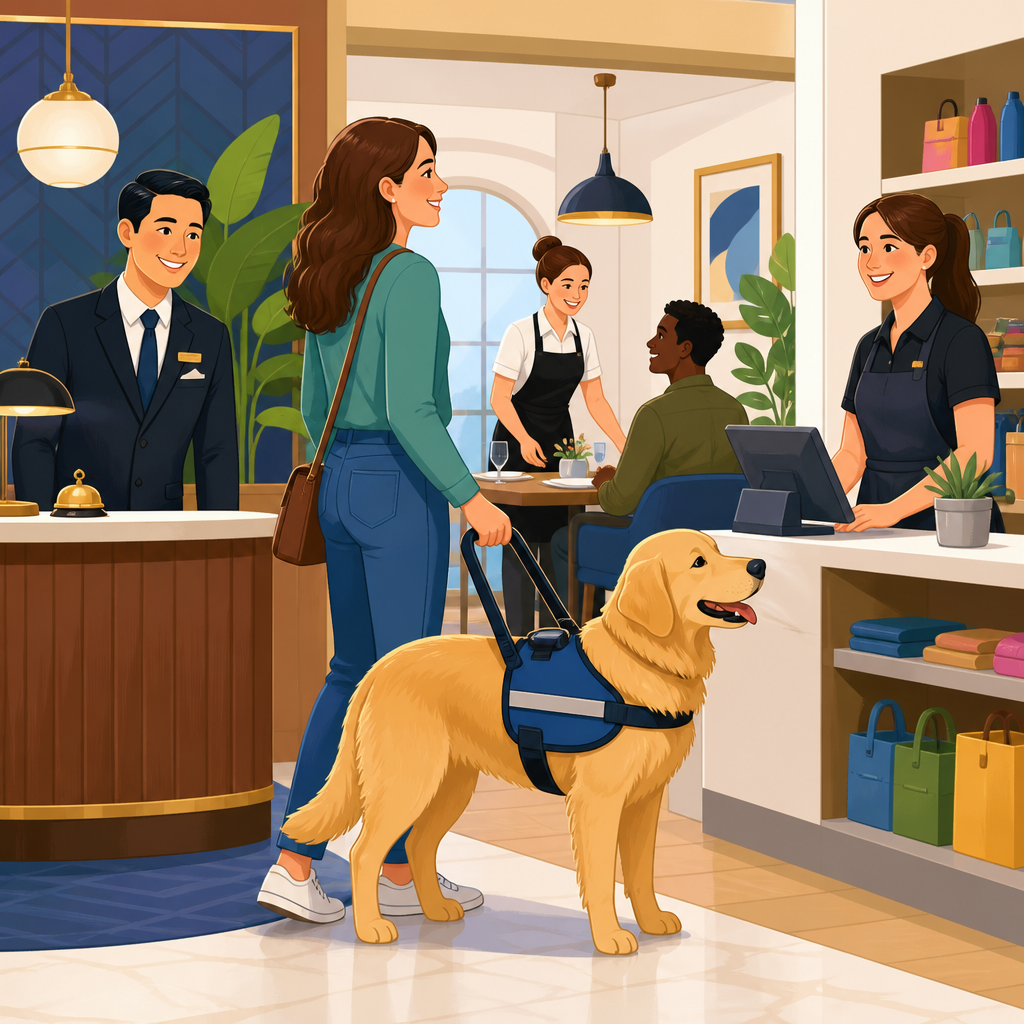
Service animal resources for hotels, restaurants, and stores are essential because frontline staff make legal, safety, and customer-service decisions every day, often in seconds, and mistakes can expose a business to complaints, lost revenue, and preventable conflict. In this context, a service animal is generally a dog individually trained to do work or perform tasks for a person with a disability, while support, comfort, or therapy animals serve different roles and are governed by different rules. I have helped hospitality and retail teams build policies, train staff, and respond to incidents, and the same pattern appears across properties, dining rooms, and sales floors: confusion starts when employees rely on assumptions instead of defined procedures. Specialized ADA resources and support matter because the core federal rules are short, but real operations are not. A bell desk needs guidance on check-in, housekeeping, and relief areas. A restaurant needs scripts for hosts, servers, and managers. A store needs practical direction for carts, fitting rooms, and de-escalation. This hub article brings those needs together and explains the standards, tools, and training elements businesses should use to stay compliant while serving guests respectfully.
At a practical level, specialized ADA resources and support means policy templates, staff training, incident documentation, signage guidance, state-law cross-checks, and role-based answers to common questions. The ADA sets the baseline for public accommodations, including lodging, food service, and retail, but implementation requires more than posting a rule in a handbook. Teams need examples, approved language, escalation paths, and a reliable place to verify edge cases. They also need to know what the law does not require. Staff do not need to identify a customer’s disability, demand certification, or separate a guest from the public areas because another customer is uncomfortable. They do need to understand when a service animal can be excluded, such as when it is out of control and the handler does not take effective action, or when the animal is not housebroken. When those distinctions are taught clearly, businesses reduce friction and create a more consistent experience. As the hub for this subtopic, this guide covers the governing standards, the most useful operational resources, and the support structure every hotel, restaurant, and store should put in place.
Core ADA rules every business must understand
The Americans with Disabilities Act is the starting point for service animal policy in hotels, restaurants, and stores because these businesses are public accommodations under Title III. The U.S. Department of Justice guidance is clear on the central definition: a service animal is a dog trained to perform tasks directly related to a person’s disability. In limited cases, miniature horses may also need to be assessed under separate factors such as size, weight, and whether the facility can accommodate them safely. Emotional support animals are not service animals under the ADA, even when a customer describes substantial comfort or medical benefit. That distinction matters because many disputes begin when staff treat all animals as equivalent or reject all animal-related requests without analysis.
Employees should know the two permitted questions when the need for the animal is not obvious: first, is the dog a service animal required because of a disability; second, what work or task has the dog been trained to perform. Those questions are narrow by design. Staff may not request documentation, require the animal to demonstrate its task, or ask about the person’s diagnosis. Businesses also cannot charge pet fees or isolate the handler from other customers, although they may charge for actual damage if they would charge other customers for the same damage. The ADA also does not require a service animal to wear a vest, badge, or harness, though many handlers use them. In my experience, this single point is one of the most common causes of improper denial at entry points.
Exclusion is permitted only in specific circumstances, and staff training should use that exact framing. A service animal may be removed if it is out of control and the handler does not take effective action, or if the animal is not housebroken. Allergies and fear of dogs are not valid reasons to exclude a service animal, though managers may need to separate parties where possible. Direct threat analysis must be based on actual behavior, not stereotypes about breed or size. These standards sound straightforward, but in operating environments with noise, crowding, food, cleaning chemicals, and multiple departments, the details can unravel quickly unless the business has reliable resources and escalation procedures.
Resources hotels need for lodging operations
Hotels face the broadest set of service animal touchpoints because a stay crosses reservations, arrival, room assignment, housekeeping, maintenance, food outlets, and security. A strong lodging resource package starts with a written policy aligned to Department of Justice guidance and brand standards, then breaks that policy into department-specific procedures. Reservation agents should avoid screening questions that exceed the ADA. Front desk teams should know the approved check-in script, the process for noting a service animal without flagging the guest improperly, and the rule against pet fees. Housekeeping should understand room-entry etiquette when a dog is present, how to coordinate service with the guest, and when to elevate sanitation or damage issues. Security should be trained on behavior-based intervention rather than appearance-based assumptions.
Relief area planning is one of the most useful specialized resources for hotels because it turns an abstract duty into a practical guest amenity. Full-service and resort properties should identify an accessible outdoor relief area, publish directions internally, and prepare backup options for urban properties with limited exterior space. Managers should also know how to handle breakfast buffets, lounges, pools, fitness centers, and shuttle operations. For example, a service animal is generally allowed in public dining areas, but local health rules do not override the ADA on that point. Pools are different: the animal does not enter the water if doing so would fundamentally alter operations or create a safety issue, but the handler still needs access to deck areas where customers are normally allowed. Good hotel resources address these distinctions in plain language and tie them to real incidents.
Incident documentation is another hotel priority. I recommend a simple event form that captures date, location, observed behavior, staff actions, guest statements, and follow-up, without recording unnecessary medical information. If a dog barked repeatedly in a corridor, lunged at another guest, or was left unattended in a room in violation of hotel policy, the record should describe facts, not labels. This protects both the guest and the property if a complaint later reaches corporate, a franchisor, counsel, or a disability-rights agency. Hotels also benefit from quick-reference cards at the desk and a short refresher module during onboarding because turnover in guest-facing roles is usually high.
Resources restaurants need for dining rooms and food service
Restaurants often encounter service animal questions at the host stand, where time pressure is high and staff experience is mixed. The most effective restaurant resources are short, specific, and built around scripts. Hosts need to know when they may ask the two permitted questions, how to respond if another diner objects, and why local food codes do not justify refusing a trained service dog in dining areas open to customers. Servers should know not to pet, feed, or distract the animal, and managers should know when behavior crosses the line into lawful removal. A dog quietly positioned under a table is almost never the problem; problems arise when staff react to the mere presence of the animal rather than conduct.
Food service operations also need seating and workflow guidance. Narrow aisles, patio entrances, self-service beverage stations, and buffet lines can create congestion. The answer is not to seat the handler separately by default. Instead, the team should offer the same range of available seating while considering safe passage and space for the dog to remain under control. Quick-service restaurants need similar support for order counters, pickup lanes, and queue management. In one rollout I supported, a simple manager card reduced conflicts because it gave supervisors approved language for common objections, including “other customers are allergic,” “health code says no animals,” and “show me the papers.”
| Business type | Common pressure point | Recommended resource | Key compliance note |
|---|---|---|---|
| Hotel | Check-in and room assignment | Front desk script and relief area map | No pet fee; no documentation demand |
| Restaurant | Host stand and customer objections | Manager card with approved responses | Dining area access is generally required |
| Store | Entrance screening and floor incidents | Door policy and escalation checklist | Behavior, not appearance, drives decisions |
Restaurants should also prepare for sanitation concerns without turning them into disability inquiries. If an accident occurs, the business may address cleanup through ordinary health and safety procedures and may lawfully remove an animal that is not housebroken. What it should not do is announce a blanket ban, humiliate the guest, or discuss the person’s disability in front of others. The best support materials include side work guidance for cleanup, manager escalation contacts, and post-incident review so teams learn from difficult shifts instead of repeating the same mistakes.
Resources stores need for retail floors and customer interactions
Stores need specialized ADA resources because retail environments are decentralized. A single shift may involve greeters, sales associates, fitting room attendants, cashiers, loss-prevention staff, and supervisors, and each role sees only part of the customer journey. The foundation is a clear entrance policy that tells employees what they may ask, what they may not ask, and when to call a manager. Retail teams often overfocus on gear such as vests or tags, but the legal test is task training and behavior, not appearance. A small boutique and a big-box chain face different floor plans, yet both benefit from the same support structure: concise scripts, manager checklists, and standardized incident notes.
Fitting rooms, shopping carts, and product protection are the recurring retail issues. Service animals generally accompany the handler where customers are normally allowed, including fitting room corridors and checkout lanes. Staff should not insist that the dog wait with another employee or outside the fitting area. At the same time, stores may maintain neutral safety rules, such as keeping aisles clear and protecting food-preparation zones in stores that include grocery or café components, so long as those rules are applied consistently and do not single out disability access. If merchandise is damaged or the animal behaves aggressively, staff should document specific facts and involve management immediately.
Large retailers should add service animal guidance to loss-prevention training. I have seen situations where a well-meaning associate challenged a customer repeatedly, then security escalated the encounter based on incomplete information. That is avoidable. A store resource center should include a one-page legal summary, examples of lawful and unlawful questions, de-escalation language, and a path for reviewing complaints. Chains with online training platforms can reinforce these points through short scenario modules tied to actual store layouts. Independent retailers can achieve the same effect with laminated reference sheets and monthly team discussions.
Building a specialized support system that actually works
The most useful hub resources do not stop at legal summaries; they connect policy to operations, accountability, and updates. Start with a master policy reviewed by counsel or a qualified compliance advisor, then build role-based procedures for reservations, hosts, cashiers, managers, housekeeping, security, and maintenance. Add training that uses scenarios drawn from the business itself: a guest leaves a dog alone in a hotel room, a diner objects to nearby seating, a shopper’s dog blocks an aisle, or an employee asks for paperwork because the dog has no vest. Scenario training creates retention because employees remember the decision path, not just the rule.
Next, establish support channels. Staff should know who to call on shift, where the policy lives, and how to document incidents. Multiunit operators should maintain a state-law reference because federal rules set the floor, while state or local rules may add penalties, posting requirements, or definitions related to service-animal misrepresentation. Accessibility consultants, hospitality associations, restaurant associations, retail trade groups, and disability-rights organizations can all provide practical materials, but those materials must be curated into one internal source of truth. Review the package at least annually and after any serious complaint. The benefit is consistency: customers receive respectful access, managers make faster decisions, and the business reduces legal and reputational risk. If you oversee hotels, restaurants, or stores, audit your current service animal resources this week and close the gaps before the next frontline decision tests them.
Frequently Asked Questions
What is the difference between a service animal and an emotional support, comfort, or therapy animal?
A service animal is generally a dog that has been individually trained to do work or perform specific tasks for a person with a disability. Those tasks must be directly related to the person’s disability, such as guiding someone who is blind, alerting a person who is deaf, pulling a wheelchair, reminding a person to take medication, interrupting self-harming behavior, or responding to a seizure. By contrast, emotional support, comfort, and therapy animals may provide important benefits, but they are not treated the same way under public-access rules because their primary role is to provide comfort or companionship rather than perform individually trained disability-related tasks.
For hotels, restaurants, and stores, this distinction matters because staff often need to decide quickly whether an animal must be allowed into areas open to the public. In many public accommodations, a trained service dog accompanying a person with a disability is generally permitted, while emotional support or comfort animals may not have the same access rights. Therapy animals usually work in clinical, educational, or volunteer settings and are not automatically granted the same public-access status either. Staff should be trained to avoid assumptions based on breed, vest, paperwork, or appearance alone. A small, quiet dog without any identifying gear may still be a legitimate service animal, while an animal wearing an official-looking vest may not qualify.
The safest operational approach is to train employees on the functional definition: focus on whether the dog is individually trained to perform disability-related work or tasks, not on labels customers use casually. Clear training helps reduce confrontation, improves customer service, and lowers the risk of mishandling access decisions.
What can hotel, restaurant, and retail staff legally ask when it is not obvious that a dog is a service animal?
When the need for the animal is not obvious, staff should generally keep the interaction short, respectful, and limited to two core questions: whether the dog is required because of a disability, and what work or task the dog has been trained to perform. These questions help frontline employees verify access appropriately without crossing into personal medical territory. Staff should ask in a calm, neutral tone and avoid making the customer feel challenged or embarrassed.
Just as important is knowing what staff should not ask. Employees generally should not demand medical documentation, ask the person to disclose the nature of the disability, require a special ID card, insist on proof of certification, or request that the dog demonstrate its task. Many legitimate service animals do not carry paperwork, and there is no universal federal registration that determines access. Businesses that rely on internet certificates, badges, or unofficial registries may still make the wrong decision and expose themselves to complaints.
For practical operations, managers should give employees a simple script they can use consistently. For example: “Welcome. If it’s not obvious, I’m allowed to ask whether the dog is required because of a disability and what task it has been trained to perform.” This keeps the conversation professional and reduces the chance that an employee improvises in a way that sounds accusatory. Consistency is especially important in busy environments, where quick judgment calls can lead to uneven treatment, frustrated customers, and escalation.
Can a business ever ask a service animal to leave, and if so, under what circumstances?
Yes. A business may generally ask that a service animal be removed if the animal is out of control and the handler does not take effective action to control it, or if the animal is not housebroken. Examples may include repeated barking that is not related to a trained task, lunging at customers, running freely through the premises, jumping on tables or merchandise, or soiling indoor areas. The key point is that the decision should be based on the animal’s actual behavior, not on fear, stereotypes, breed assumptions, or the fact that another customer is uncomfortable around dogs.
Even when removal is justified, the business should still offer the person with a disability the opportunity to obtain goods or services without the animal present, when feasible. For example, a store might continue assisting the customer, a restaurant might offer takeout, or a hotel might work through available accommodations while addressing the behavior issue. The goal is not to deny service to the person, but to address a specific, legitimate problem involving the animal’s conduct.
Businesses should also understand what usually does not justify exclusion. Allergies, generalized fear of dogs, or assumptions that animals are unsanitary are not, by themselves, enough to deny access. In food-service settings especially, staff sometimes mistakenly believe health codes automatically prohibit service animals in dining areas open to the public. In general, service animals are still allowed in those customer areas. Clear written policies and scenario-based training help staff separate real exclusion grounds from common misconceptions.
Are service animals allowed in all areas of a hotel, restaurant, or store?
Service animals are generally allowed in areas where the public is normally permitted to go. In a hotel, that may include the lobby, hallways, guest rooms, elevators, and other public or guest-access spaces. In a restaurant, that usually includes dining areas and paths used by customers. In a store, that generally means sales floors, fitting-room access where applicable, checkout areas, and other customer-facing spaces. The basic rule is that a person with a disability using a service animal should typically have access to the same public areas available to other customers.
That does not mean every part of the property must be open to the animal. Areas not open to the public, such as certain kitchens, food-preparation zones, secure employee-only workspaces, or locations where there is a legitimate safety restriction, may be treated differently. Businesses should be careful, however, not to overstate restricted zones. A customer dining area is not the same as a commercial food-prep area, and a blanket “no animals” rule should not be applied without understanding the service-animal exception.
Hotels should also train teams on issues that frequently cause confusion, including pet fees, cleaning charges, and room assignments. A service animal is not treated like a pet, so standard pet fees generally should not be imposed simply because the guest has a service animal. At the same time, if a guest is responsible for actual damage caused by the animal, a hotel may generally charge for damage the same way it would charge any guest for damage they cause. Assigning guests with service animals only to “pet-friendly” rooms is also a common error unless that assignment is voluntary. Operationally, the best practice is to integrate service-animal guidance into front-desk, host-stand, and floor-staff training so employees know what access looks like in real situations.
What should a business include in a service animal policy and staff training program?
An effective service animal policy should be simple enough for frontline staff to follow under pressure, but detailed enough to guide managers through harder situations. At a minimum, it should define what a service animal is in practical terms, explain the limited questions staff may ask, describe when an animal may legally be excluded based on behavior, clarify that documentation is not required, and distinguish service animals from emotional support, comfort, or therapy animals. It should also explain where service animals are generally permitted within the business and identify any truly restricted areas based on safety or operational necessity.
Training should go beyond policy language and include realistic examples. Employees should practice how to respond if a customer arrives with a dog in a shopping cart, if another guest complains about allergies, if the dog barks once versus continuously, or if a handler is upset about being questioned. Managers should know how to de-escalate, document incidents, and correct staff mistakes quickly. A short script library is especially helpful because it gives employees confident, respectful phrasing instead of forcing them to improvise. This protects both the customer experience and the business.
Businesses should also review their policy regularly, especially if they operate across multiple locations or states, because additional state or local rules may apply. Signage, onboarding materials, complaint procedures, and escalation paths should all align with the written policy. When teams understand the rules and the reasons behind them, they make faster, fairer decisions. That reduces conflict at the point of service, supports accessibility, and helps the business avoid preventable legal and reputational problems.


