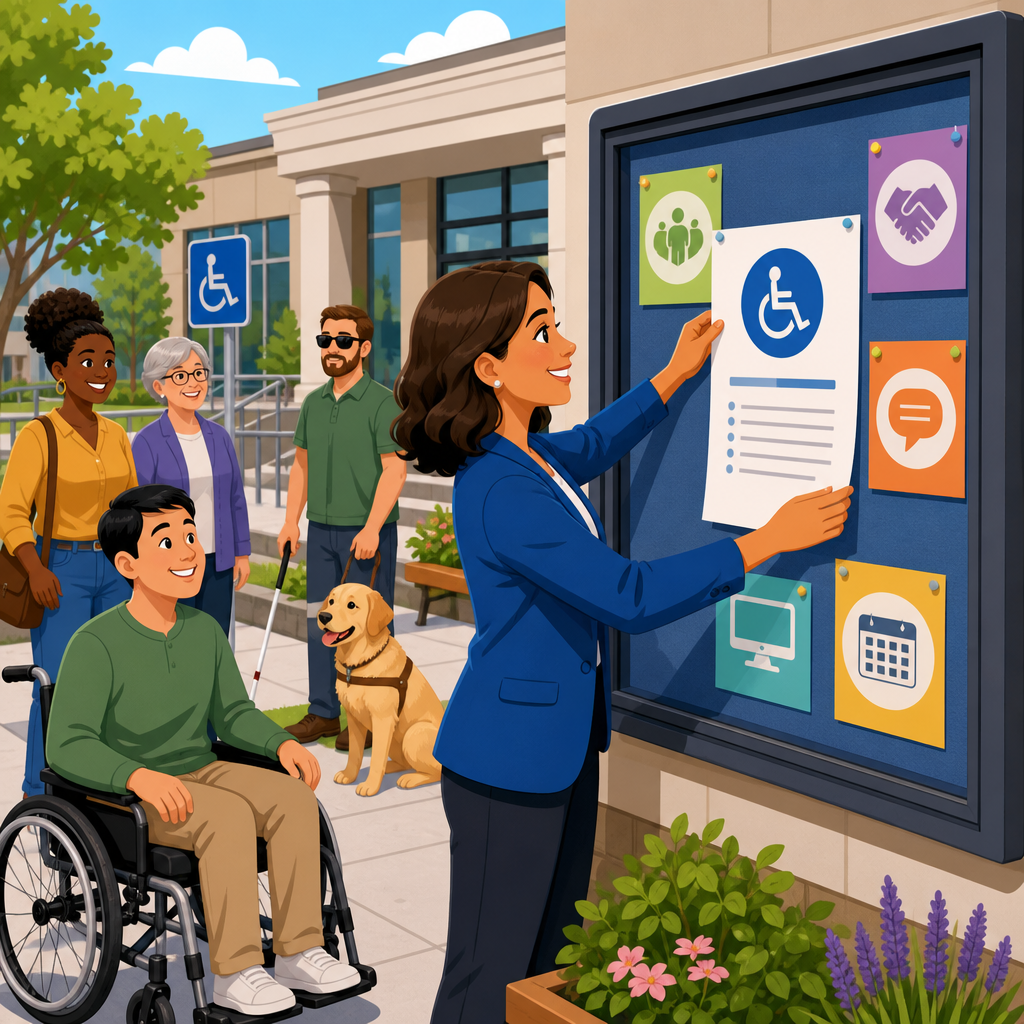
Public notice requirements under Title II are one of the most overlooked parts of ADA compliance, yet they are often the first thing I review when assessing whether a public entity has built a functioning accessibility program. Title II of the Americans with Disabilities Act applies to state and local governments, and it requires those entities to make services, programs, and activities accessible to people with disabilities. For an ADA Coordinator, the public notice is not a formality. It is the public-facing statement that tells residents, employees, vendors, parents, students, and visitors what rights exist, how to request assistance, and where to bring concerns. When the notice is missing, outdated, or buried, the rest of the compliance structure usually shows similar weaknesses.
Under 28 C.F.R. § 35.106, a public entity with fifty or more employees must adopt and publish grievance procedures and must disseminate enough information to applicants, participants, beneficiaries, and other interested persons to inform them of the protections against discrimination assured by Title II. That requirement works alongside two related duties that ADA Coordinators manage regularly: designation of at least one responsible employee under § 35.107, and self-evaluation and transition planning under § 35.105 and § 35.150. In practice, these duties are connected. The notice identifies the coordinator, explains how to request auxiliary aids and services or reasonable modifications, links people to grievance procedures, and supports implementation of transition plans by making accessibility commitments visible and actionable.
This matters because public notice is where legal compliance meets everyday operations. A city resident may need a sign language interpreter for a zoning hearing. A parent may need school board materials in an accessible electronic format. A job applicant may need extra time on a written civil service exam because of a disability. If the entity does not publish clear instructions, people are forced to guess, and delay itself can become discrimination. Strong notice language reduces that risk. It also improves consistency across departments, builds trust, and creates internal accountability. As the hub page for ADA Coordinators and transition plans, this article explains what should be published, how it connects to broader implementation work, and how to structure the notice so it actually supports compliance.
What Title II public notice must include
A Title II public notice should answer five basic questions directly: who is protected, what programs and services are covered, who the ADA Coordinator is, how to request accommodations, and how to file a grievance. The regulation does not prescribe one exact script, but the Department of Justice expects clear communication that informs the public of ADA protections. The best notices are short enough to be understood quickly and detailed enough to be useful. In my audits, the most effective notices are published in a full version on the website, a shorter version on forms and announcements, and tailored versions attached to meetings, events, employment materials, and procurement documents.
At minimum, the notice should state that the public entity does not discriminate on the basis of disability in admission to, access to, participation in, or treatment in its services, programs, or activities. It should identify the ADA Coordinator by title and provide current contact information, including phone, email, mailing address, and telecommunications access where applicable. It should explain how to request auxiliary aids and services, such as interpreters, captioning, alternate formats, assistive listening devices, or accessible digital documents. It should also explain how to request reasonable modifications to policies, practices, or procedures. Finally, it should link or point to the grievance procedure, including timelines and submission methods.
Coverage should be broad. A common mistake is publishing a notice that focuses only on employment or only on physical access. Title II is wider than that. It covers public meetings, recreation programs, emergency communications, libraries, police interactions, court services, online forms, transit, utility billing, permitting, elections, and contracted services delivered on the entity’s behalf. If the notice is vague, staff may wrongly assume accessibility duties apply only in city hall or only when a wheelchair ramp is involved. Precise wording prevents that confusion and gives the coordinator a stronger foundation for training and enforcement.
Where and how an ADA Coordinator should publish the notice
Publishing means more than posting one PDF on an obscure webpage. The notice must be disseminated to applicants, participants, beneficiaries, and other interested persons. That standard requires multiple channels because people interact with public entities in different ways. A municipality should place the full notice on its main accessibility page, link it from high-traffic service pages, and include it in online and printed application materials. School districts should place it on district websites, student and parent handbooks, board meeting notices, special education resources, employment postings, and event announcements. Transit agencies should include accessibility and complaint information on rider pages, schedules, station signage, and paratransit materials.
Accessibility of the notice itself is critical. I regularly see agencies publish a scan-only PDF that screen reader users cannot navigate. That undermines the purpose of the notice. Web content should conform to recognized accessibility standards such as WCAG 2.1 Level AA, which most settlement agreements and state digital accessibility policies use as the operational benchmark. Notices should be available in HTML, not just PDF, and forms linked from the notice should also be accessible. Telephone numbers should be active and monitored. Email inboxes should be owned by roles rather than individuals whenever possible, such as ada@agency.gov, so requests are not lost when staff turnover occurs.
Dissemination should also reflect language access and communication needs. If the entity commonly provides vital information in Spanish or other prevalent languages under its language access practices, the ADA notice should follow that pattern. Printed versions should be available at reception desks, libraries, community centers, transit hubs, and program offices. Public meeting agendas should include a short accommodation statement with a deadline and contact method, but the language should also clarify that last-minute requests will be considered whenever possible. Residents should not have to understand disability law to figure out how to participate in government.
How the notice connects to grievance procedures, self-evaluation, and transition plans
The public notice is one component of a larger Title II system, and it works best when integrated with the coordinator’s core documents. The grievance procedure gives people a formal way to raise disability discrimination concerns. The self-evaluation identifies barriers in policies, communications, programs, digital services, and facilities. The transition plan focuses on structural changes needed to achieve program access, especially where physical barriers exist in facilities and rights-of-way. A notice that does not point to these related tools leaves the public with rights in theory but no clear path to action.
In implementation, I treat the notice as the front door and the transition plan as the map behind it. If a city knows from its self-evaluation that several parks lack accessible routes and picnic tables, the notice should tell residents how to request accommodations for current events while long-term capital work is underway. If a courthouse has hearing rooms with inconsistent assistive listening coverage, the notice should explain how to request devices in advance and whom to contact if equipment fails. If online permit forms are being remediated, the notice should identify an accessible alternative process that is equally effective and timely. This is how a compliant notice supports program access during the gap between identifying barriers and fully removing them.
Strong integration also improves recordkeeping. Requests and grievances reveal patterns: repeated complaints about inaccessible PDFs, frequent interpreter requests at one location, or mobility barriers in a specific recreation facility. Those patterns should feed back into self-evaluation updates, capital planning, procurement standards, and staff training. The coordinator who uses notice-driven data well can prioritize transition plan projects more intelligently and justify budget requests with documented demand rather than assumptions.
Core elements every public entity should publish
The most effective ADA coordinator pages publish a structured set of materials rather than a single generic statement. The exact package varies by entity size and services, but the following set covers what most state and local governments need to make Title II compliance understandable and operational.
| Published item | Purpose | What it should contain |
|---|---|---|
| ADA nondiscrimination notice | Explains rights and coverage | Statement of nondiscrimination, covered programs, coordinator contact details |
| Accommodation request information | Enables access before a problem occurs | How to request interpreters, captioning, alternate formats, policy modifications, deadlines, emergency options |
| Grievance procedure | Provides formal complaint path | Submission methods, timelines, review steps, appeal route, anti-retaliation statement |
| ADA Coordinator page | Centralizes implementation contacts | Role description, office hours, response expectations, related links |
| Self-evaluation summary | Shows ongoing compliance work | Scope reviewed, barriers identified, policy updates, digital and program findings |
| Transition plan or accessibility plan summary | Shows structural barrier removal priorities | Facilities covered, barriers, methods, timelines, responsible departments, public input process |
Publishing summaries is often the practical choice even when the underlying documents are long. For example, a county may maintain a 200-page transition plan with building inventories, curb ramp data, and cost estimates. The public-facing page should still provide a clear summary, a downloadable full plan, and a simple explanation of what has been completed, what is underway, and how people can comment. This approach serves both transparency and usability.
Common mistakes that weaken compliance
The most common failure is treating the notice as static legal boilerplate. Contact information changes, websites migrate, forms break, and program structures shift. If the notice still names a retired employee or a disconnected number, it creates immediate risk. Another frequent problem is separating accessibility information by silo. Human resources may publish an employment accommodation statement, parks may post event language, and IT may host a digital accessibility page, but none of them may connect to a central Title II notice. From a resident’s perspective, that fragmentation is confusing and discouraging.
Entities also weaken compliance when they rely on narrow deadlines or burdensome forms. It is reasonable to request advance notice for interpreters or alternate formats because scheduling matters, but a policy that refuses all requests submitted fewer than seventy-two hours before a meeting is risky. Title II requires reasonable modifications and effective communication, not administrative convenience as the final rule. Staff should be trained to evaluate late requests, offer alternative methods when ideal services are unavailable, and document the steps taken. The notice should reflect that practical flexibility.
Another mistake is ignoring digital accessibility in the notice package. If the page describing how to request an accessible document is itself inaccessible, the agency has created a barrier at the point of entry. I have seen complaint forms without labels, PDFs without tags, videos without captions, and maps with no text alternatives. These are not minor technical issues. They prevent people from understanding rights and participating in services. A well-run coordinator program tests notice pages with keyboard navigation, screen readers, color contrast tools, and plain-language review before publication.
Building a durable hub for ADA coordinators and transition plans
Because this topic sits at the center of compliance and implementation, the best hub pages do more than restate the law. They organize the entire accessibility program. A durable hub should link users to the nondiscrimination notice, grievance procedure, accommodation request process, meeting accessibility information, digital accessibility resources, emergency communication practices, procurement requirements, self-evaluation summaries, and transition plans. It should also explain, in plain terms, the difference between immediate program access obligations and longer-term structural changes. That distinction helps the public understand why a service must still be made accessible today even when a building modification is scheduled for next fiscal year.
For coordinators, the hub creates internal discipline. Departments know where official language lives, which forms to use, and how the public will be routed. That consistency matters during audits, investigations, and litigation. It also improves continuity when staff changes occur. A city that centralizes templates for meeting notices, event registration forms, and complaint handling can maintain compliance more reliably than one that leaves each department to invent its own process.
The practical standard is simple: publish enough information that a person with a disability can understand their rights, request what they need, and escalate a concern without guesswork. When that standard is met, public notice becomes more than a regulatory requirement. It becomes an operational tool that supports equal access across every service the entity provides.
Title II public notice requirements are foundational because they turn accessibility obligations into visible, usable instructions for the public and staff. An ADA Coordinator should publish a clear nondiscrimination notice, current coordinator contact information, accommodation request procedures, grievance procedures, and accessible summaries of self-evaluation and transition plan work. Those materials should appear in multiple formats and locations, be accessible themselves, and connect directly to day-to-day services such as meetings, programs, employment, websites, and facilities.
The main benefit of doing this well is not just lower legal risk. It is better service delivery. Clear notices help residents participate, help employees respond consistently, and help leadership see where barriers remain. They also create the feedback loop that makes transition plans meaningful rather than static reports. If you manage ADA compliance, review your public notice today, test every link and form, and make your hub page the reliable front door your community needs.
Frequently Asked Questions
What does Title II require a public entity to publish in its ADA public notice?
Under Title II, a public entity should publish a clear public notice explaining that it does not discriminate on the basis of disability and that it provides equal access to its services, programs, and activities. At a practical level, the notice should tell the public that auxiliary aids and services are available when needed for effective communication, that reasonable modifications may be available to policies and procedures when required to avoid disability-based discrimination, and that complaints can be filed through the entity’s grievance process if someone believes access was denied.
A strong notice should also identify the ADA Coordinator by title, and usually by name, office, mailing address, phone number, email address, and any accessible contact methods such as relay information. If the entity has adopted a grievance procedure, the notice should explain where that procedure can be found and how to use it. In other words, the notice should answer the basic questions a member of the public may have: What are my rights, who do I contact, and what should I do if I need an accommodation or want to report a problem?
Although the regulation itself does not prescribe one exact script for every agency, the notice should be specific enough to be useful and broad enough to cover all programs, services, and activities. The best public notices avoid vague language. Instead of simply saying the entity “supports accessibility,” they communicate concrete rights and contact pathways. That is what makes the notice more than a symbolic statement. It becomes an operating tool for compliance and public trust.
Who is required to post an ADA public notice under Title II?
Title II applies to state and local governments and to their departments, agencies, and other instrumentalities. That means cities, counties, public school districts, public colleges, police departments, courts, libraries, transit agencies, parks departments, public health offices, and similar governmental bodies are all potentially covered. If the entity provides services, programs, or activities to the public, Title II accessibility obligations are already in play, and the public notice requirement is one of the foundational administrative steps in demonstrating compliance.
As a rule, public entities that employ 50 or more people have additional administrative obligations under Title II, including designating at least one responsible employee to coordinate ADA compliance and adopting grievance procedures. In practice, those are the organizations most commonly expected to maintain a formal, visible ADA public notice that includes ADA Coordinator information and complaint procedures. But smaller public entities should not assume that accessibility communication is optional. Even where the administrative framework is less formal, the entity still has nondiscrimination and access obligations.
For an ADA Coordinator, the safest and most effective approach is to treat public notice as essential regardless of organizational size. If members of the public do not know their rights, do not know how to request accommodations, or do not know whom to contact, the entity has created an avoidable barrier. A published notice helps close that gap and signals that accessibility is built into operations rather than handled only when a problem escalates.
Where should an ADA public notice be published so it is actually effective?
The short answer is that the notice should be published anywhere the public is likely to look for information about the entity’s services. At a minimum, that usually includes the organization’s website in a location that is easy to find, such as a dedicated ADA or accessibility page linked from the main navigation or footer. The notice should not be buried in a policy archive or posted only as a hard-to-read PDF. If someone needs an accommodation for a meeting, court appearance, permit appointment, class, recreation program, or public hearing, they should be able to find the information quickly and independently.
Effective publication usually also means posting the notice in physical locations. Common examples include city halls, administrative offices, service counters, libraries, recreation centers, transit facilities, and any place where members of the public interact with staff or access programs. Public entities should also consider including notice language in program materials, event announcements, employment-related public materials where relevant, intake forms, and communications for major public meetings. If the entity serves a multilingual community, translated versions may also be appropriate to make the notice meaningfully available.
Just as important, the notice itself must be accessible. Web postings should be compatible with screen readers, keyboard navigation, and other assistive technology. Printed versions should be available in alternative formats upon request, and staff should know how to provide them. A beautifully worded notice does very little if it is hidden, inaccessible, or placed where only insiders can find it. The goal is practical access, not technical publication alone.
What is the difference between an ADA public notice and an ADA grievance procedure?
This is a common point of confusion. The ADA public notice and the ADA grievance procedure are related, but they are not the same thing. The public notice is the outward-facing statement that tells people about their rights under Title II, the entity’s commitment to nondiscrimination, the availability of accommodations and effective communication, and how to contact the ADA Coordinator or file a complaint. It is the public-facing roadmap.
The grievance procedure, by contrast, is the internal and external complaint process the entity adopts for prompt and equitable resolution of disability-related complaints. It typically explains where a complaint should be submitted, what information should be included, what timelines apply, who reviews the complaint, how a response will be issued, and whether there is an appeal path. The grievance procedure gives structure to complaint handling; the public notice tells people that the process exists and how to reach it.
An ADA Coordinator should make sure these two documents work together. The public notice should direct readers to the grievance procedure without forcing them to hunt for it. The grievance procedure should be written clearly enough that a member of the public can understand it without legal assistance. When these pieces are aligned, the entity is much better positioned to receive concerns early, respond consistently, and show that accessibility issues are being managed through an established process rather than improvised case by case.
How often should an ADA Coordinator review and update the public notice?
The public notice should be reviewed regularly and updated whenever key information changes. As a baseline, an annual review is a smart governance practice. That review should confirm that the ADA Coordinator’s contact information is current, the grievance procedure link still works, accessibility request instructions are accurate, and the language still reflects how the entity actually handles accommodation requests and disability-related complaints. If the notice lists a staff member who has left, references an outdated phone number, or points to a missing form, the public may be effectively cut off from access even though the notice technically exists.
Updates should also be triggered by operational changes. If the entity reorganizes departments, adopts a new accessibility request process, changes its website structure, opens new facilities, launches new public-facing programs, or receives repeated questions showing that the notice is unclear, the notice should be revised. Public notices should evolve with the entity’s accessibility program. A stale notice is often a sign that compliance is being treated as static paperwork rather than an active responsibility.
From an ADA Coordinator’s perspective, reviewing the public notice is one of the simplest and highest-value maintenance tasks in the compliance program. It is often the first thing an auditor, consultant, advocate, or plaintiff-side attorney will look for because it reveals whether the entity has put basic administrative infrastructure in place. A current, visible, and accurate notice does not prove full compliance by itself, but it strongly suggests the organization understands its obligations and has created a functional doorway for the public to request access and raise concerns.