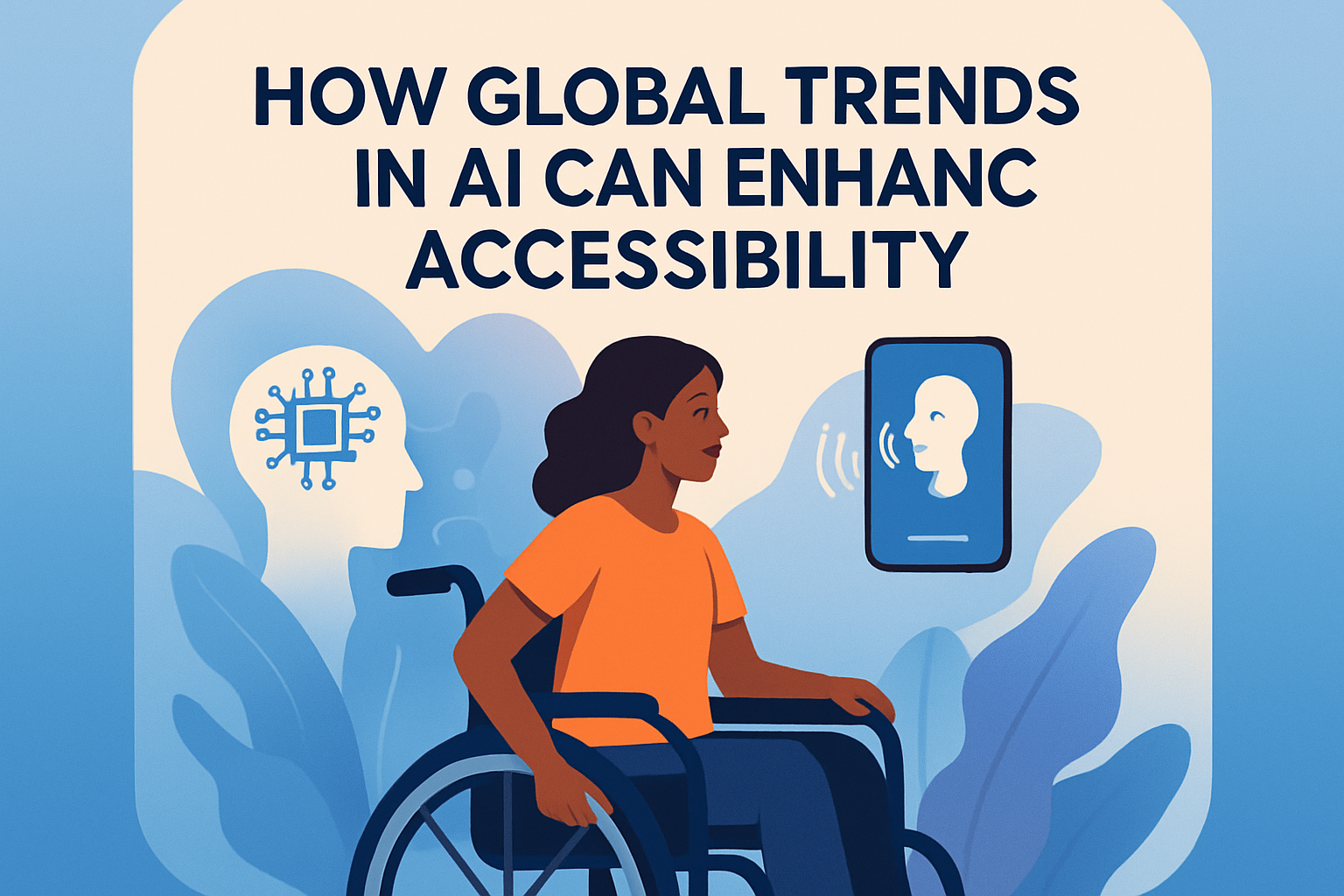
In today’s rapidly advancing digital age, Artificial Intelligence (AI) has positioned itself as a key enabler in overcoming various challenges across multiple sectors. A fundamental arena where AI is making a significant impact is in enhancing accessibility for individuals around the globe. But what do we mean when we talk about accessibility? At its core, accessibility refers to the design of products, devices, services, or environments so that people with disabilities can use them without difficulty. It encompasses a wide range of practices and standards aimed at ensuring equal access and opportunities for all, especially those with differing abilities. As we delve deeper into the subject, it is crucial to understand why this matters. There is an intrinsic need to foster an inclusive society where everyone, irrespective of their physical or mental limitations, can navigate everyday life with the same ease as anyone else. AI technologies pave the way in achieving this noteworthy objective. From aiding visually impaired individuals in gaining a better understanding of their surroundings to breaking down communication barriers for those with hearing difficulties, the promise of AI in accessibility goes beyond simple automation—it is about reshaping lives and communities for the better.
AI-Powered Assistive Technologies
One of the most pronounced impacts of AI in accessibility is through AI-powered assistive technologies. These solutions are designed to aid individuals with disabilities in performing tasks that would otherwise be challenging or impossible due to their condition. A prime example of this is the development of AI-driven speech recognition software. Technologies like Google’s Live Transcribe and Microsoft’s Azure Cognitive Services offer real-time transcriptions, making communication smoother for the hearing impaired by converting spoken language into text.
This innovative approach can drastically improve the quality of life for hearing-impaired individuals by facilitating better access to education, professional interactions, and social communications. For instance, a student in a lecture can follow along with accurate, real-time captions, ensuring they don’t miss out on crucial information. Likewise, in a work meeting, an employee with hearing difficulties can actively participate without the pressure of trying to lip-read or miss out on the conversation details.
Visual Assistance and AI
Visually impaired individuals face a different set of challenges, and AI is stepping in to address these as well. Computer vision, a subset of AI, plays a critical role in developing tools that can interpret and describe the world for those who cannot see. For example, advanced applications such as Seeing AI by Microsoft use the camera of a smartphone to identify objects, read text aloud, and even describe the emotions on people’s faces.
These AI applications are a game-changer in everyday tasks that sighted individuals often take for granted. Whether it’s reading labels in a supermarket, navigating unfamiliar spaces, or recognizing friends and family members, AI visual assistance provides unparalleled support. Real-world usage shows incredible stories, such as a visually impaired person using such an app to independently manage their grocery shopping—choosing items based on nutritional information they would otherwise rely on others to provide.
AI in Cognitive Accessibility
AI’s role stretches beyond physical disabilities to encompass cognitive and neurological diversity. AI tools are increasingly being designed to assist individuals with cognitive impairments, including autism and dyslexia. For instance, AI-driven personalized learning platforms can adapt content difficulty levels and presentation modes based on user interaction patterns, thereby facilitating more effective learning experiences tailored to cognitive abilities.
These personalized platforms help accommodate varying needs by removing artificial barriers in learning environments. For a student with dyslexia, this could mean the use of a font designed for dyslexia, auditory content instead of written instructions, or exercises presented in a sequence tailored to their specific learning pace. Such customization ensures an equitable educational platform where learning is accessible to all students regardless of their individual challenges.
AI and Mobility Enhancements
Mobility is another critical area where AI is making significant advancements in accessibility. AI-driven innovations are transforming the lives of individuals with mobility impairments by providing better integration and ease of use within their daily lives. Self-driving cars, powered by sophisticated algorithms and sensors, hold great promise in restoring independence to those who are unable to drive.
The potential for these applications is immense. A practical scenario could involve an AI-driven wheelchair equipped with navigational guidance. Such a device could automatically avoid obstacles and find the most efficient route within a building, empowering users to move about freely without needing assistance. This level of autonomy contributes to reintegrating individuals into society and empowers them to partake in activities that were previously out of reach.
AI in Smart Home Accessibility
Smart home technology, infused with AI, is becoming an essential aspect of creating accessible living spaces. Devices like smart speakers, thermostats, and lighting systems can be controlled via voice commands, empowering individuals with limited mobility or dexterity to manage their environment efficiently.
| Smart Device | Functionality | Accessibility Benefit |
|---|---|---|
| Smart Speaker | Voice-activated controls and virtual assistant | Hands-free interaction, easy access to information |
| Smart Thermostat | Automated climate control | Regulates temperature without manual adjustment |
| Smart Lighting | Remote and automated lighting management | Simple control for those with mobility constraints |
A visually impaired user, for instance, can ask their smart speaker to orchestrate their schedule or adjust their home settings without needing to locate and manipulate physical controls. The seamless interaction made possible by AI-driven smart devices not only enhances convenience but also contributes to a sense of autonomy and safety for users.
Overcoming Communication Barriers with AI
Communication is another major domain where AI has the potential to eliminate barriers. AI-driven translation apps are now capable of translating spoken or written content into multiple languages, effectively bridging the gap in communication for individuals from different linguistic backgrounds.
Consider someone who is both deaf and communicates through American Sign Language (ASL); face-to-face communication in a different language can be a significant hurdle. AI-based applications can analyze sign language gestures and translate them into spoken or written language, thereby facilitating smooth communication. This opens up more opportunities for community involvement and employment that would have been challenging due to communication barriers.
AI and Mental Health Support
The role of AI in mental health support is another burgeoning field where accessibility considerations are taking center stage. AI-driven chatbots and virtual therapists are increasingly used to provide mental health support to those unable to access traditional services. These platforms are designed to recognize patterns of distress and offer tailored guidance or intervention.
These tools hold particular value for individuals in remote areas or those with mobility restrictions who may find it challenging to visit a therapist’s office. They also work as a supplement to traditional therapy, offering users real-time assistance and an accessible mode of immediate support in times of need.
Key Takeaways
In summary, the integration of AI into everyday technologies is pioneering new possibilities in accessibility for people with disabilities worldwide. From powering assistive devices that translate languages and read visual cues, to smart homes that respond to voice commands, and vehicles that navigate autonomously, AI is revolutionizing how differently-abled individuals interact with the world. The rise of adaptive and personalized technologies ensures that no one is left behind due to physical, cognitive, or communication barriers. As we continue to advance, it is crucial for stakeholders—be it technology developers, policymakers, or community advocates—to prioritize inclusivity and accessibility in AI developments. By doing so, we not only enhance the quality of life for millions but also create an environment where every individual has the opportunity to thrive. To engage with this transformation, consider advocating for inclusive AI developments in your community or supporting initiatives that promote technological accessibility. Together, we can ensure that the promise of AI translates into real-world benefits for each and every member of our society.
Frequently Asked Questions
1. What is meant by ‘accessibility’ in the context of AI and why is it important?
Accessibility, particularly in the domain of AI, refers to the creation and design of products, services, and environments that enable individuals with disabilities to use them easily and effectively. The significance of accessibility in AI cannot be understated as it plays a vital role in bridging gaps for people who encounter barriers due to physical, sensory, or cognitive impairments. When AI technologies are developed with accessibility in mind, they provide equal opportunities for everyone, fostering inclusivity and diversity in our digital society.
Addressing accessibility ensures that innovations in AI do not inadvertently marginalize those with disabilities, allowing them to harness the full potential of these technologies. Whether it’s through voice-activated assistants that help people with limited mobility, screen readers for the visually impaired, or AI-driven transcription services for the hearing impaired, accessibility-driven AI solutions ensure that technology acts as an enabler rather than a barrier.
2. What global trends in AI are currently enhancing accessibility?
There are several major global trends in AI that are positively impacting accessibility. One significant trend is the advancement in natural language processing (NLP), which allows for more intuitive communication between humans and machines through voice, text, or other formats. This has led to developments in digital assistants and sophisticated text-to-speech and speech-to-text systems that benefit those with visual or auditory impairments.
Additionally, machine learning and computer vision technologies are being used to develop applications that can interpret and describe visual information for individuals with visual impairments. AI systems can now recognize and narrate the content of images and videos, providing a more inclusive visual experience.
Moreover, AI-powered predictive text and autocorrect functionalities help individuals with cognitive or motor impairments to communicate more efficiently by reducing the physical effort required for typing and enhancing accuracy.
3. How can AI help in making digital content more accessible?
AI can significantly enhance the accessibility of digital content through various methods. For one, AI-driven tools can automatically generate accurate captions and subtitles for video content, making it accessible to people who are deaf or hard of hearing. These tools leverage speech recognition and natural language processing to ensure that the generated text corresponds accurately with the spoken content.
Additionally, content optimization through AI involves analyzing and simplifying complex text, making it more readable and understandable for those with cognitive disabilities or language barriers. Machine learning models can summarize large text bodies and provide user-friendly versions without losing the essential message.
Furthermore, screen reader software powered by AI assists individuals who are visually impaired by converting on-screen text into synthesized speech. This enables them to navigate applications and websites more effectively.
4. What role do AI-powered assistive technologies play in real-world scenarios?
AI-powered assistive technologies play a critical role in providing practical support to individuals with disabilities in various aspects of their lives. In education, AI tools are deployed to support inclusive learning environments, where students with disabilities can access educational materials through tailored learning platforms that adapt content delivery to their individual needs.
In the workplace, AI-driven software applications facilitate more efficient communication and collaboration. For instance, real-time transcription services allow for seamless integration into meetings, helping employees who are deaf or hard of hearing to participate actively without barriers.
In transportation, AI-based apps provide real-time information and navigation assistance for those with mobility impairments, enhancing their independence and mobility in both urban and rural environments.
5. What are some potential challenges and ethical considerations in using AI to enhance accessibility?
While the deployment of AI in enhancing accessibility holds immense potential, it also comes with inherent challenges and ethical considerations. One primary challenge is ensuring the accuracy and reliability of AI tools, especially when dealing with sensitive applications that directly impact individuals’ lives. Erroneous or biased AI systems can exacerbate existing inequalities rather than alleviate them.
Privacy concerns also emerge, given that AI systems often require access to comprehensive personal data to provide personalized assistance. It’s essential to ensure rigorous data protection and user consent policies to safeguard privacy rights.
Moreover, there is the ethical responsibility to involve individuals with disabilities in the development process, ensuring that AI solutions are designed with their explicit input and needs in mind. This participatory approach helps avoid potential biases and results in more effective and empathetic accessibility solutions.