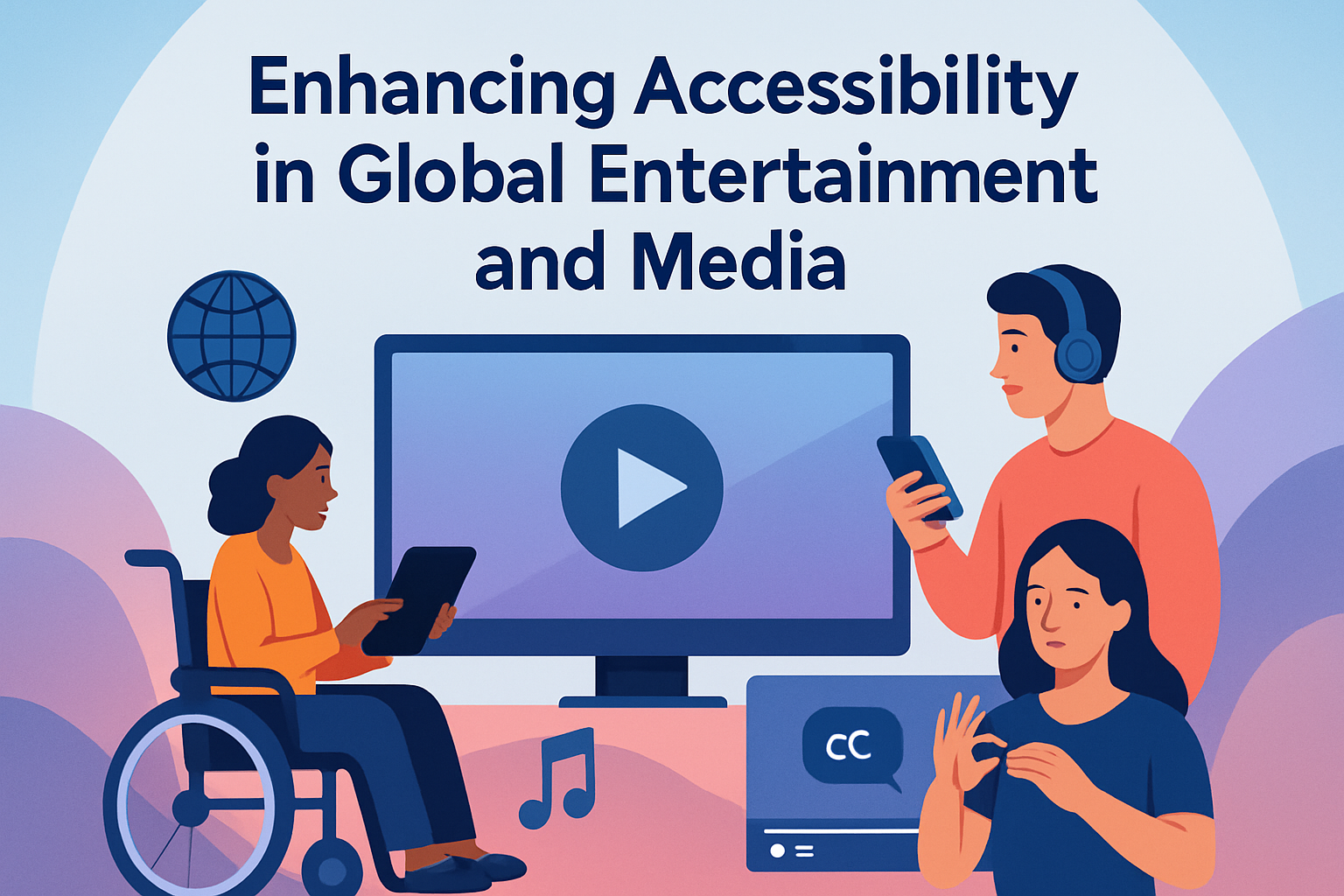
Accessibility in global entertainment and media is a critical consideration in the 21st century, impacting the lives of millions worldwide. Defined as the inclusive practice of ensuring content is accessible to all, including individuals with disabilities and those from varying cultural and linguistic backgrounds, accessibility ensures that every individual has the opportunity to engage with media content without facing unnecessary barriers. Understanding its significance is paramount as media and entertainment drive cultural discourse, shape public opinion, and influence societal norms. Accessibility enhances inclusiveness, promotes diversity, and ensures a level playing field where everyone can participate and benefit. It is not only a moral obligation but also a strategic advantage in a hyperconnected, multicultural world. By enhancing accessibility, creators, producers, and network operators open up new markets, foster innovation, and ensure compliance with legal standards, ultimately leading to a more equitable, socially responsible industry. This article delves into how accessibility can be improved across global entertainment and media sectors, exploring the methods and technologies that can drive this change.
Universal Design and Its Role in Media Accessibility
The concept of universal design plays an integral role in enhancing accessibility within the media and entertainment industry. Universal design refers to the process of creating products and environments to be usable by all people, to the greatest extent possible, without the need for adaptation or specialized design. This approach is essential in media as it ensures content is accessible from the onset, ultimately making the consumption experience seamless for all audience members.
For instance, consider the case of the BBC. The organization has integrated universal design principles within its broadcasting service to ensure inclusivity. By implementing features such as adaptable text sizes, high-contrast modes, and screen reader compatibility, BBC platforms are tailored to meet diverse user needs without requiring individuals to seek out alternative solutions. These efforts not only improve user accessibility but also enhance the overall viewing experience, making content engaging and interactive for everyone.
Subtitles, Captions, and Audio Descriptions
Subtitles, captions, and audio descriptions are key components of accessibility in visual media, making content available to audiences who are deaf, hard of hearing, blind, or visually impaired. Subtitles provide text translations of spoken language in different languages, while captions offer a textual representation of all audio elements including music and sound effects. Audio descriptions provide additional narration that describes visual elements not discernable through sound alone.
A real-world example of effective use of captions and audio descriptions is found in the streaming giant Netflix. Netflix extensively employs both features, catering to a broad audience with diverse needs. By providing English subtitles for non-native speakers, captions for those who are deaf or hard of hearing, and audio descriptions for individuals with visual impairments on a majority of its content, Netflix not only aligns with accessibility requirements but also broadens its reach.
Technological Innovations in Accessibility
Technological advancements have significantly propelled the efforts to enhance accessibility in media. From artificial intelligence (AI) to machine learning, technologies facilitate the automatic generation, adaptation, and translation of content to ensure accessibility and inclusivity.
A notable innovation is IBM’s Watson Captioning, which uses AI to automate the captioning process, thereby addressing one of the critical challenges in timely content delivery. This technology can rapidly generate accurate captions, translating spoken words in real time into text, thus aiding broadcasters and content creators in meeting legal and audience demands. Technological tools like Watson Captioning not only streamline operational processes but also ensure that accessibility becomes an integral part of the content production cycle.
Multi-Language Support and Cultural Adaptation
Ensuring that content is linguistically accessible involves providing multi-language support and culturally adaptive content. This extends beyond basic translations to encompassing cultural nuances, idioms, and context that resonate with different demographic groups. This kind of thoughtful adaptation broadens the accessibility lens, ensuring media resonates deeply across various cultural contexts.
Disney’s approach to multi-language support exemplifies this practice. By offering movies in various languages and considering localized content strategies, Disney creates a universal appeal while preserving cultural identity. This is seen in their streaming platform, Disney+, which offers films and series in multiple languages alongside culturally relevant adaptations. Such actions not only enhance accessibility but also boost global reach and acceptance.
The Legal Imperative and Compliance Factors
Legal mandates globally require that media and entertainment comply with accessibility standards. Legislation such as the Americans with Disabilities Act (ADA) in the United States and the European Accessibility Act serve as significant catalysts for change, outlining clear guidelines and requirements for media accessibility.
For instance, broadcasters in the EU are obligated to comply with the Web Content Accessibility Guidelines (WCAG), ensuring online video content meets specific accessibility standards. Failing to meet these requirements can lead to litigation and sanctions. Compliance is not solely about adherence but about recognizing the ethical imperative to facilitate inclusivity in media consumption.
| Accessibility Feature | Description | Example Provider |
|---|---|---|
| Subtitles/Closed Captions | Text overlay providing spoken words and sounds | Netflix |
| Audio Descriptions | Narrations for visual content’s non-verbal elements | BBC |
| Cultural Adaptation | Localization of language and content for cultural relevance | Disney+ |
Business Advantages of Enhanced Accessibility
The business case for accessibility in entertainment and media is compelling. Accessible media content opens up new markets, fosters customer loyalty, and enhances brand reputation, all of which can lead to increased revenues. A Deloitte study reveals that companies prioritizing accessibility outperform competitors in market growth and customer satisfaction.
Apple is a case in point. By committing to accessibility as a core company value, Apple has not only launched a range of accessibility-friendly products but also won the loyalty of countless consumers who appreciate its inclusive design philosophy. The built-in accessibility features within iOS devices, such as VoiceOver and Magnifier, exemplify Apple’s dedication to creating accessible products while tapping into market demographics that other companies may overlook.
Challenges and Future Directions in Accessibility
Despite progress, challenges persist in achieving universal accessibility in media and entertainment. These challenges include socio-economic barriers, technological limitations, and resistance to change among industry stakeholders. Furthermore, measuring accessibility and its impact can be complex, necessitating industry collaboration and ongoing research.
Looking to the future, the emphasis should be on leveraging emerging technologies like AI, virtual reality, and augmented reality to create more immersive and accessible experiences. Collaboration among tech companies, content creators, and policy-makers will be key to advancing the agenda of accessibility, ensuring that no audience is left behind.
Conclusion and Call to Action
In conclusion, enhancing accessibility in global entertainment and media is not merely a technical or legal obligation; it is a profound social commitment that enriches lives, fosters inclusivity, and promotes diversity. The key takeaways from this exploration are the importance of universal design, the necessity of leveraging technology, and the strategic advantage of multi-language support. By advocating for accessibility, stakeholders are encouraged to look beyond compliance and toward embracing a broader vision of inclusive engagement.
To continue this momentum, stakeholders in the entertainment and media sectors must prioritize accessibility in all facets of content creation and distribution. By doing so, they will not only meet regulatory requirements but also enrich their offerings, ultimately building stronger connections with audiences worldwide.
Acting now by promoting industry collaboration and technological innovation, investing in accessibility features, and engaging with diverse audiences will ensure that media and entertainment continue to evolve, leaving no one behind and creating a richer, more connected global cultural tapestry.
Your Next Step: Review your current media practices for accessibility and consult with accessibility specialists to identify potential improvements. Together, we can create a more inclusive world where entertainment and media content is treasured by all.
Frequently Asked Questions
1. Why is accessibility in entertainment and media important on a global scale?
Accessibility in global entertainment and media is crucial because it ensures that diverse audiences, including individuals with disabilities and those from various cultural and linguistic backgrounds, have equal opportunities to access and enjoy content. This is especially significant in our interconnected world where entertainment and media shape societies and influence cultural norms. By promoting accessibility, we create an inclusive environment that embraces diversity, fosters understanding, and eliminates unnecessary barriers, allowing everyone to participate in and benefit from the cultural dialogue. Accessibility is not merely a technological or regulatory requirement; it’s a fundamental aspect of corporate social responsibility for media companies seeking to reach a wider audience.
2. What are some common barriers to accessibility in media content?
Various barriers can obstruct individuals from accessing media content. Physical barriers include the lack of closed captions or sign language interpretation for hearing-impaired audiences, and the absence of audio descriptions for visually-impaired viewers. Content that hasn’t been translated or adapted for linguistic minorities presents linguistic barriers. Additionally, certain technologies or platforms might not be user-friendly for individuals with cognitive or motor impairments, adding technological barriers. By identifying and removing such obstacles, entertainment and media industries can ensure their content is inclusive, allowing everyone to enjoy and engage with it without discrimination.
3. How can entertainment and media companies improve accessibility effectively?
To enhance accessibility, companies can adopt a multi-faceted approach. This includes implementing Universal Design principles that focus on creating products and environments that can be used by all people, to the greatest extent possible, without the need for adaptation. Utilizing technologies like real-time captioning, descriptive video services, and content moderation to include diverse languages and dialects can significantly improve accessibility. Training for creators and developers can make them aware of accessibility needs and solutions, ensuring that accessibility is integrated from the beginning of content creation or software development. Regular audience feedback and accessibility audits can also help identify areas for further improvement.
4. Are there any regulations or standards that guide accessibility in media?
Yes, there are various regulations and standards globally that aim to guide and enforce accessibility in media. In the United States, the Americans with Disabilities Act (ADA) mandates that public accommodations, including media services, must be accessible to people with disabilities. Additionally, the Web Content Accessibility Guidelines (WCAG) established by the World Wide Web Consortium (W3C) provide a set of recommendations for making web content more accessible, widely adopted by companies worldwide. In Europe, the European Accessibility Act aims to bring forward common accessibility guidelines across the member states. Adherence to these standards not only helps companies comply with legal requirements but also taps into a broader, often underserved, market.
5. What are the benefits of making media content more accessible?
Enhancing accessibility in media content provides numerous benefits not only to consumers but also to companies and society as a whole. For audiences, it means broader access to information, entertainment, and services, contributing to a more inclusive and equitable society. For businesses, reaching a larger audience base can lead to increased customer loyalty, a better brand reputation, and potentially higher revenue. Moreover, designing with accessibility in mind fosters innovation, as it encourages creative thinking beyond conventional needs. On a societal level, increased accessibility in media can heighten awareness and understanding of diverse needs, promoting inclusivity and empathy across cultures and communities, ultimately contributing to social cohesion and progress.