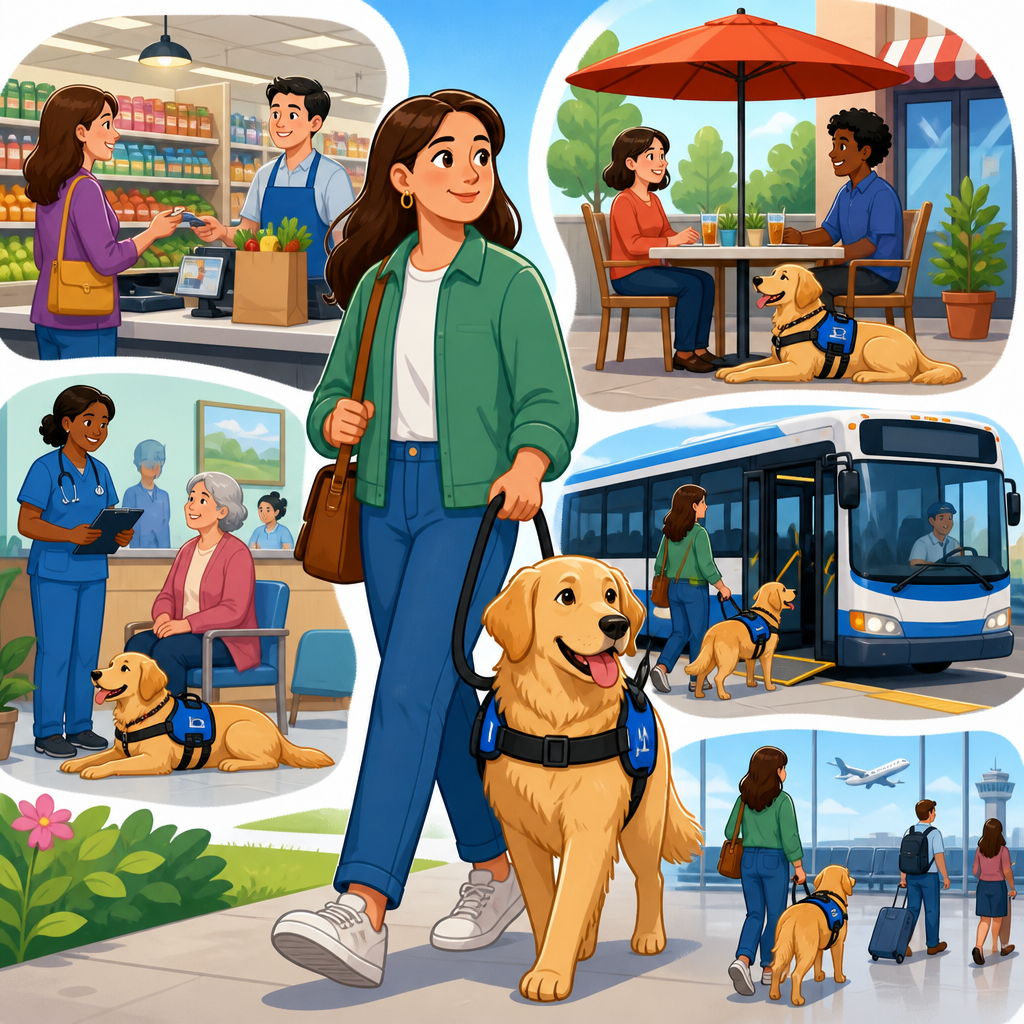
Can you bring a service dog anywhere under the ADA? In most public settings, the answer is yes, but the real rule is narrower and more precise than many businesses, landlords, employers, and even handlers assume. The Americans with Disabilities Act gives people with disabilities the right to be accompanied by a trained service animal in places open to the public, with limited exceptions tied to safety, control, and the nature of the setting. Understanding those boundaries matters because confusion leads to unlawful denials, strained confrontations, and missed accommodations that affect daily life.
In my work reviewing access policies and helping teams respond to disability accommodation requests, I have seen the same problem repeat: people know the phrase “service dog rights,” but not the actual ADA standard. A service animal under the ADA is a dog, and in some cases a miniature horse, that has been individually trained to do work or perform tasks for a person with a disability. Emotional support, comfort, companionship, or crime deterrence alone do not meet that definition. That distinction is the foundation for every access decision.
This hub article explains basic rights under the ADA for service dog handlers and the organizations that serve them. It covers where service dogs are allowed, what staff may ask, when access can legally be limited, and how ADA rights interact with housing, air travel, and employment rules that come from other laws. If you need a practical answer, start here: a trained service dog generally may go into restaurants, hotels, stores, hospitals, schools, government buildings, and most other public accommodations, even where pets are not allowed. The handler does not need to show certification because the ADA does not require a national registry or official ID card.
That said, “anywhere” is not absolute. The ADA protects access, not exemption from all rules. A business may remove a service dog that is out of control and not effectively corrected, or that is not housebroken. Certain restricted areas, such as sterile operating rooms or spaces where the animal’s presence would fundamentally alter the service or create a legitimate safety risk, can also be excluded. Those exceptions are real, but they are narrow, and they must be applied based on facts rather than fear, allergies, assumptions, or generalized no-pet policies.
What the ADA actually protects
The ADA is the primary federal law governing service dog access in public life. Title II applies to state and local government programs, while Title III applies to private businesses and nonprofits that operate places of public accommodation. Together, these rules require covered entities to modify no-pet policies to permit a service animal accompanying a person with a disability. The Department of Justice regulations at 28 C.F.R. sections 35.136 and 36.302(c) are the core operational standards most organizations should know.
The law protects the handler’s right to equal access. That means a person using a service dog must be allowed to enter, move through, and receive goods or services on the same terms as other customers, patients, students, or visitors. Staff cannot isolate the person, seat them in a lesser area, add a cleaning fee simply because a dog is present, or delay service while debating whether the disability looks visible enough. The ADA is designed to remove barriers, not create new gatekeeping rituals.
The protected animal must be trained to perform tasks directly related to the handler’s disability. Common examples include guiding a person who is blind, alerting a person who is deaf, retrieving dropped items, interrupting self-harm behaviors, reminding a handler to take medication, detecting changes associated with seizures, or performing pressure and grounding tasks during psychiatric disability episodes. The key is trained work or tasks. A dog whose presence merely calms someone without specific task training is not a service animal under the ADA.
One point many people miss is that the ADA standard is function based, not paperwork based. There is no federal certificate, no mandatory vest, and no official database that determines access. I regularly advise frontline teams to stop asking for cards bought online because those documents often prove nothing. Compliance turns on the dog’s training and behavior, plus the handler’s disability-related need, not on branded gear or registration websites.
Where a service dog can go in daily life
Under the ADA, a service dog can usually accompany its handler anywhere the public is allowed to go. That includes grocery stores, coffee shops, restaurants, pharmacies, shopping centers, movie theaters, libraries, museums, hotels, taxis, rideshare vehicles operated by covered entities, courthouses, polling places, banks, shelters, and social service offices. It also includes public transit systems such as buses and trains, because transportation providers covered by federal disability rules must permit service animals.
Restaurants are a common flashpoint. Health codes that prohibit pets do not override the ADA. A service dog may enter dining rooms, buffet lines, and waiting areas because the dog is not treated as a pet. The business does not have to provide food, water, or a relief area, but it must allow the team to remain unless one of the specific removal standards applies. I have had managers assume an open kitchen ban extends to every back-of-house threshold; in reality, the question is whether the area is open to the public and whether there is a legitimate safety concern.
Hotels must permit service dogs in guest rooms that are not otherwise pet-friendly, and they cannot charge pet fees because the animal is not a pet. However, they may charge for actual damage if they would charge any guest for the same damage. Hospitals and medical offices generally must allow service dogs in patient rooms, clinics, waiting rooms, and exam spaces. A truly sterile environment, such as certain burn units or operating rooms, may justify exclusion, but broad hospital-wide bans are inconsistent with ADA requirements.
Schools, colleges, and government buildings also fall within ADA coverage, though details may vary by program. A city hall cannot refuse entry based on a no-animals rule. A university library cannot demand proof of certification before access. In practice, most lawful disputes arise not from the building type but from misunderstandings about behavior, documentation, or whether a particular area is genuinely restricted for safety reasons.
What staff may ask and what they may not ask
When the need for a service dog is not obvious, staff may ask only two questions: is the dog required because of a disability, and what work or task has the dog been trained to perform? Those are the only routine gatekeeping questions allowed under the ADA. Staff may not ask the person to disclose a diagnosis, explain medical history, produce training records, demonstrate the task, or show an ID card. This is one of the most important basic rights under the ADA because it protects privacy while giving businesses a practical verification framework.
Handlers should also know what the ADA does not require from them during everyday access. They do not need to register the dog, buy a vest, carry a doctor’s note for public places, or answer intrusive follow-up questions about treatment. Many conflicts can be defused by calmly giving a short, lawful response such as, “Yes, this is my service dog, and he is trained to alert and respond to my medical condition.” That answer satisfies the ADA standard without oversharing sensitive information.
| Situation | Allowed under the ADA | Not allowed under the ADA |
|---|---|---|
| Need for dog is not obvious | Ask whether the dog is required because of a disability | Ask for diagnosis or medical records |
| Need for task clarification | Ask what work or task the dog is trained to perform | Demand a task demonstration |
| Entry screening | Observe whether the dog is under control and housebroken | Require registration, certification, or special ID |
| Fees and seating | Treat the handler like other patrons | Charge pet fees or isolate the person |
From the business side, training staff on this script is essential risk management. A host, cashier, security guard, or receptionist who improvises can easily create a discrimination claim in under a minute. The safest process is simple: ask the two permitted questions when needed, assess behavior, and move on. If a problem develops later, address the behavior, not assumptions about disability.
When access can legally be limited
The ADA does not require a business or government agency to admit every dog in every circumstance. There are several narrow grounds for exclusion. First, the dog must be under the handler’s control. The regulations specifically mention harness, leash, or tether unless those devices interfere with the dog’s work or the handler’s disability prevents their use, in which case voice, signal, or other effective control is acceptable. Persistent barking, lunging, jumping on patrons, or roaming away from the handler can justify removal if the handler does not promptly regain control.
Second, the dog must be housebroken. This standard is straightforward and often overlooked because access disputes tend to focus on paperwork. If an animal urinates or defecates inside a business, exclusion is generally lawful. Third, a service dog may be excluded if its presence would fundamentally alter the nature of the goods or services, or if it poses a direct threat that cannot be mitigated. These terms come from disability law and require individualized assessment, not stereotypes.
A direct threat means a significant risk to health or safety based on actual evidence. For example, a zoo may restrict access to a particular prey-animal exhibit if the presence of a dog would provoke dangerous behavior. A sterile surgical suite may exclude the dog due to infection-control standards grounded in medical necessity. By contrast, generalized concerns about allergies, fear of dogs, cultural discomfort, or “other customers might complain” are not valid reasons to deny access. If a customer has a dog allergy, the business should try to accommodate both parties, such as seating them apart.
Even when a dog is lawfully excluded, the person with a disability must still be offered the opportunity to obtain goods or services without the animal’s presence, if that is feasible. That detail matters. Removal of the dog is not permission to remove the customer.
How ADA rights differ from housing, work, and air travel rules
A major source of confusion is that the ADA is not the only disability law affecting animals. Housing is primarily governed by the Fair Housing Act, and air travel is governed by the Air Carrier Access Act. Employment accommodations arise under Title I of the ADA, which uses a different analysis from public access rules. As a result, the answer to “Can I bring my service dog?” depends on the setting.
In housing, assistance animals can include both service animals and emotional support animals if they are needed because of a disability and the housing provider must make a reasonable accommodation. HUD guidance, not public-accommodation rules, drives that process. In air travel, the Department of Transportation now treats psychiatric service dogs as service animals but no longer requires airlines to recognize emotional support animals as service animals. Airlines may use specific federal forms and behavior standards. Those forms do not carry over to restaurants or stores.
At work, an employee may request permission to bring a service dog as a reasonable accommodation, but the employer can evaluate effectiveness, workplace impact, safety, and alternative accommodations through the interactive process. There is no automatic public-access rule inside every workplace. I often see employers incorrectly apply the two-question public standard to employees, or landlords incorrectly demand ADA-style proof rules. Each setting has its own legal framework, and applying the wrong one creates avoidable disputes.
Practical guidance for handlers and businesses
For handlers, the best protection is preparation. Keep your dog trained for calm public behavior, reliable task performance, toileting on schedule, and neutral responses to crowds, food, carts, children, and other animals. If challenged, answer the two lawful questions clearly and briefly. Document incidents after a denial, including names, times, witnesses, and what was said. If a problem is not resolved on site, a follow-up complaint to management, a state or local civil rights agency, or the U.S. Department of Justice may be appropriate.
For businesses and public entities, policy clarity prevents conflict. Write a short service animal policy aligned with Department of Justice guidance. Train all frontline employees with realistic scenarios, including invisible disabilities and psychiatric service dogs. Do not rely on internet certification cards, breed assumptions, or blanket bans. Focus on behavior, safety, and the exact legal standard. In my experience, organizations that rehearse these moments reduce both complaints and staff anxiety because employees know exactly what to do.
The core takeaway is simple. Under the ADA, a trained service dog can go with its handler into most places open to the public, even when pets are prohibited. The right is broad, but it is not unlimited: the dog must be trained, under control, and housebroken, and truly restricted spaces may be excluded for legitimate reasons. Knowing these basic rights under the ADA helps handlers travel confidently and helps organizations comply without guesswork. If this topic affects your daily life, use this page as your starting point and build your policies, questions, and next steps from the actual law.
Frequently Asked Questions
Can you bring a service dog anywhere under the ADA?
Not literally everywhere. Under the Americans with Disabilities Act, a person with a disability generally has the right to be accompanied by a trained service dog in places open to the public, such as stores, restaurants, hotels, theaters, hospitals, and government buildings. That broad access right is why many people say a service dog can go “anywhere,” but the actual rule is more specific. The ADA covers public accommodations and state and local government services, and within those settings, service dogs are usually allowed to accompany their handlers anywhere members of the public are normally permitted to go.
There are still limited exceptions. A business or public entity may exclude a service dog if the dog is out of control and the handler does not take effective action to control it, or if the dog is not housebroken. In rare cases, a service dog may also be restricted from a particular area if its presence would fundamentally alter the nature of the goods or services being provided or create a legitimate safety problem that cannot be reduced through reasonable modifications. So the best answer is this: in most public places, yes, but not without limits, and not in every imaginable location.
What places are covered by the ADA’s service dog access rules?
The ADA’s service animal rules apply primarily to public accommodations and state and local government entities. Public accommodations include a wide range of private businesses and nonprofit organizations that serve the public, including restaurants, grocery stores, retail shops, medical offices, pharmacies, schools open to the public, gyms, hotels, banks, museums, and transportation terminals. If customers or members of the public are normally allowed inside, a trained service dog usually must be allowed in those same areas with its handler.
The rules also apply to state and local government programs, services, and activities. That means courthouses, public libraries, city offices, public hospitals, and similar facilities generally must permit service dogs. However, the ADA does not govern every legal setting involving animals. Housing is largely addressed under the Fair Housing Act, and employment issues are handled under Title I of the ADA, which uses a reasonable accommodation framework rather than the public-access rules. Airlines are governed primarily by the Air Carrier Access Act, not the ADA. That distinction matters because people often assume one single service dog rule applies everywhere, when in reality access rights depend on the type of setting involved.
Can a business ask for proof, certification, or documentation for a service dog?
In most ADA-covered public settings, no. A business generally may not require special identification cards, certification papers, proof of training, a vest, or registration documents as a condition of entry. The ADA does not require service dogs to be officially certified by a federal registry, and there is no universal government-issued service dog license that handlers must present to gain access to a store or restaurant.
When it is not obvious that the dog is a service animal, staff are usually limited to asking two specific questions: whether the dog is required because of a disability, and what work or task the dog has been trained to perform. They cannot demand details about the person’s disability, require the dog to demonstrate the task, or insist on medical paperwork in ordinary public-access situations. That said, businesses are not powerless. If a dog is behaving in a disruptive, uncontrolled, or unsafe way, the business may address the behavior itself. The ADA protects legitimate service dog access, but it does not prevent businesses from enforcing neutral conduct and safety rules that apply to everyone.
When can a service dog legally be excluded from a public place?
A service dog can be excluded in a few narrow but important circumstances. The two clearest reasons are if the dog is out of control and the handler does not take effective action to control it, or if the dog is not housebroken. For example, repeated barking, lunging, jumping on people, running away from the handler, or relieving itself indoors may justify removal if the handler cannot promptly correct the situation. The key issue is behavior, not labels. Even a legitimate service dog may be removed if it is not under control.
There are also uncommon situations where access to a particular area may be restricted because allowing the dog there would fundamentally alter the nature of the service or create a genuine safety risk. This is not the same as a generalized fear of dogs, speculation about allergies, or a preference for a pet-free environment. Businesses cannot exclude a service dog simply because other customers are uncomfortable or because food is being served. In fact, service dogs are generally allowed in restaurants and buffet lines despite common myths to the contrary. If a dog must be excluded for a valid reason, the business should still offer the handler the opportunity to obtain the goods or services without the animal present, when that is possible.
Do landlords, employers, and “no pets” businesses have to allow service dogs under the same ADA rules?
No, and this is where confusion often arises. A “no pets” policy does not override disability law, but the legal rules differ depending on whether the setting is public access, housing, or employment. For businesses open to the public, the ADA generally requires access for trained service dogs regardless of pet policies. In housing, the Fair Housing Act usually controls, and it may protect both service animals and other assistance animals as reasonable accommodations, even if the animal is not a dog or is not trained to perform tasks in the same way the ADA requires. Housing providers may have a different process for evaluating accommodation requests than a restaurant or store would.
Employment is different again. Under Title I of the ADA, an employee does not have an automatic right to bring a service dog into the workplace under the same public-access standard used for customers. Instead, the issue is typically handled through the reasonable accommodation process, which may involve evaluating the job duties, the work environment, safety concerns, and whether the accommodation would create an undue hardship. So while service dog access is often broad, the legal framework changes depending on where the issue arises. Understanding that difference helps avoid the common mistake of assuming that one ADA rule answers every question about service animals in every setting.