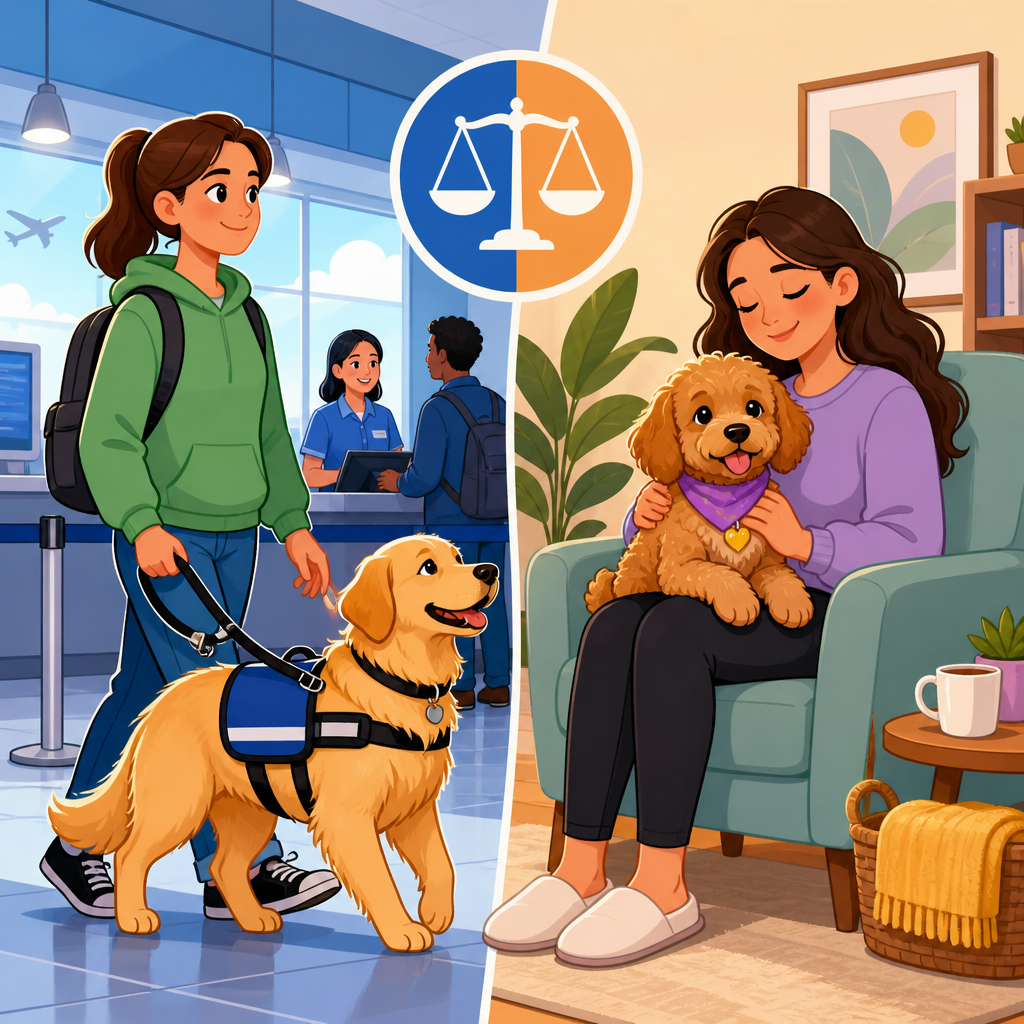
Psychiatric service dogs and emotional support animals are often discussed together, but the legal difference between them determines who can enter restaurants, hotels, stores, clinics, workplaces, and public transit with an animal. Under the Americans with Disabilities Act, access turns on function, not comfort: a service animal is a dog individually trained to do work or perform tasks for a person with a disability, while an emotional support animal provides benefit through presence without task training. That distinction matters because “Service Animals & Mobility Devices” is one of the most misunderstood areas in disability rights, affecting handlers, businesses, healthcare providers, landlords, and the public. I have worked through these issues with accommodation requests, access disputes, and policy reviews, and the same pattern appears repeatedly: people know the terms, but they do not know the thresholds, exceptions, or overlapping laws. A clear hub page is essential because this subtopic extends beyond dogs. It also includes miniature horses in limited cases, wheelchairs and manually powered mobility aids, other power-driven mobility devices such as Segways, golf carts, and seated scooters, and the direct threat and safety rules that govern all of them. This article explains the legal definitions, what questions staff may ask, where access applies, how mobility devices fit into the same framework, and which laws cover housing, transportation, and employment when the ADA is not the whole answer.
What the ADA Means by Service Animal, and Why Training Is the Legal Trigger
The ADA definition is narrow and specific. A service animal is a dog that has been individually trained to do work or perform tasks for an individual with a disability. The disability may be physical, sensory, psychiatric, intellectual, or another mental disability. The key legal trigger is individualized task training linked to the person’s impairment. For psychiatric service dogs, examples include interrupting self-harm behavior, waking a handler from night terrors, reminding a person to take medication, guiding a disoriented person to an exit during a dissociative episode, performing room checks for PTSD, applying deep pressure on cue to reduce escalating panic, or retrieving a phone during a crisis. Those are tasks. By contrast, providing comfort by being present, reducing loneliness, or making a person feel calmer without trained task performance does not meet the ADA standard.
This is why psychiatric service dogs and emotional support animals are not interchangeable in public accommodations. A dog may be immensely helpful and still not qualify as a service animal under federal disability access rules. Businesses often get this wrong by demanding certification, and handlers sometimes get it wrong by assuming any doctor’s note creates public access rights. The ADA does not require registration, ID cards, vests, or certificates. In practice, I have seen online registries create more confusion than clarity because they look official but carry no legal weight. What matters is whether the dog is trained to take a specific action when needed because of the handler’s disability.
The Difference Between Psychiatric Service Dogs and Emotional Support Animals
A psychiatric service dog is a working animal under the ADA. An emotional support animal is not. The practical result is straightforward: psychiatric service dogs generally have public access rights in covered places, and emotional support animals generally do not. The reason is not that one condition is more serious than another. The reason is that one animal performs trained disability-related tasks and the other offers untrained emotional benefit.
Consider two common examples. A veteran with PTSD has a dog trained to create a physical buffer in crowds, interrupt panic behaviors, and lead the handler outside when physiological signs of escalation begin. That dog is performing observable and trained tasks tied to disability management. Now consider a student with anxiety whose cat reduces distress when present in the apartment. The cat may be a valid support animal in housing under fair housing rules, but it is not a service animal for ADA public access. The same person can have a legitimate need and still fall under a different law with a different remedy. That distinction prevents disappointment, conflict at entrances, and bad policy.
The same principle applies to species. The ADA’s service animal rule is generally limited to dogs, with a separate provision requiring reasonable modifications for miniature horses when specific assessment factors are met. Emotional support animals may be other species in some housing situations, but species flexibility does not create public access rights under the ADA.
What Businesses May Ask, What They May Not Ask, and When Exclusion Is Lawful
When the disability is not obvious, staff may ask only two questions: whether the dog is required because of a disability and what work or task the dog has been trained to perform. Staff may not demand medical records, require a special ID card, ask for a demonstration, or inquire about the nature of the person’s disability. Those limits exist because access rights would be meaningless if every errand required disclosure of private health information.
At the same time, access is not unlimited. A service animal can be excluded if it is out of control and the handler does not take effective action to control it, or if the animal is not housebroken. A business may also exclude an animal that poses a direct threat to health or safety based on actual behavior, not stereotypes or generalized fear. Allergies and fear of dogs are usually not valid reasons to deny access, though facilities may need practical separation measures. Food establishments must allow service dogs in public areas even where state or local health codes otherwise restrict animals. However, businesses are not required to provide care, food, or designated relief areas.
These rules matter because many disputes arise from behavior rather than status. A legitimate service dog that barks continuously in a movie theater, lunges at shoppers, or urinates indoors may be removed. Conversely, a calm dog should not be excluded because an employee assumes psychiatric disabilities are less real than mobility impairments. The legal test is function, control, and safety.
How Service Animals and Mobility Devices Fit the Same Rights-and-Protections Framework
This hub article also covers mobility devices because the same access framework often applies: public entities and businesses must make reasonable modifications unless a specific limitation justifies restriction. For mobility aids, the ADA draws a line between wheelchairs and manually powered devices, which must generally be permitted, and other power-driven mobility devices, which require an individualized assessment. That second category includes devices such as golf carts, Segways, all-terrain vehicles, and some seated transporters used because of mobility disabilities.
The assessment for other power-driven mobility devices looks at factors such as the type, size, weight, dimensions, speed, facility design, pedestrian traffic, and whether the device can be operated safely under legitimate safety requirements. In real settings, that means a museum may allow a Segway at controlled speed but prohibit a larger off-road vehicle in narrow historic corridors. A hospital may limit certain devices in sterile zones while still offering alternatives. The principle matches service animal access: no blanket assumptions, but no obligation to ignore genuine safety constraints either.
Mobility devices and service animals also intersect in daily life. A handler may use a power wheelchair and a psychiatric service dog together. A store policy that informally permits one but obstructs the other still creates an access barrier. Good policy treats both as accommodation tools and trains frontline staff to apply defined standards rather than personal judgment.
Where ADA Access Applies, and Where Other Laws Control
The ADA is broad, but it is not the only law in this area. Public accommodations under Title III include places like restaurants, hotels, retail stores, theaters, gyms, private schools, and healthcare offices. State and local government programs and facilities are covered by Title II. Those are the settings where service animal rules most often come up. Employment, however, is different. Title I of the ADA governs workplace accommodations, and employers analyze requests through the reasonable accommodation process rather than the public-accommodations service-animal rule. A psychiatric service dog may be a reasonable accommodation at work, but approval depends on job duties, workplace conditions, and whether the accommodation is effective without undue hardship or direct threat.
Housing is different again. The Fair Housing Act uses a broader concept of assistance animals, which can include emotional support animals if disability-related need is documented when not obvious. Airlines changed significantly after the U.S. Department of Transportation revised its Air Carrier Access Act rules; airlines now treat psychiatric service dogs as service animals if requirements are met, while emotional support animals are no longer entitled to the former broad air travel status. Transportation systems, schools, universities, medical facilities, and correctional institutions each introduce context-specific operational issues, but the starting point is always the same: identify the governing law before assuming the access result.
Common Scenarios, Fast Answers, and a Practical Comparison
People usually want direct answers, so here are the ones that resolve most disputes. Can a restaurant ask for certification? No. Can a landlord request documentation for an emotional support animal in housing when disability or need is not obvious? Often yes, within fair housing limits. Can a store exclude a barking service dog that the handler cannot control? Yes. Can a clinic deny a psychiatric service dog because staff believe only guide dogs are “real” service animals? No. Can a business charge a pet fee for a service dog? No, though it may charge for actual damage if it charges other customers for comparable damage.
| Issue | Psychiatric Service Dog | Emotional Support Animal |
|---|---|---|
| ADA public access | Yes, if individually trained to perform disability-related tasks | No, presence alone does not qualify |
| Species | Usually dog; miniature horse considered separately | Varies by law and setting |
| Documentation for store entry | No certification or records required | No public access right to document |
| Housing relevance | Often covered as an assistance animal | Often covered as an assistance animal |
| Core legal test | Trained task performance | Emotional benefit through presence |
For this subtopic hub, that comparison is the anchor. The linked issues that usually deserve deeper reading are service dog access disputes, miniature horse assessments, workplace accommodation requests, fair housing documentation, and operational rules for wheelchairs and other power-driven mobility devices. Understanding the categories first saves time later because most conflicts are classification errors.
Best Practices for Handlers, Businesses, and Policy Teams
Handlers benefit from plain, specific language. If asked the second permissible question, answer with the trained task, not a diagnosis: “The dog is trained to interrupt panic behaviors and guide me to an exit,” is stronger than “He helps my anxiety.” Keep the dog under control, housebroken, and ready for the environment. Businesses should train staff with scripts based on the two allowable questions and the two primary removal reasons. Managers should remove fake requirements from policy, including demands for ID cards or online registration proof, because those rules are legally wrong and create avoidable complaints.
Policy teams should also align service-animal rules with mobility-device rules. The U.S. Department of Justice regulations and guidance make clear that individualized assessment is central. If a venue restricts other power-driven mobility devices, it should document the legitimate safety basis and offer alternatives where possible. If an organization operates across housing, employment, and public-facing services, it should avoid copying one standard into every context. I have seen organizations use public-accommodation service-dog language in employee accommodation forms and housing notices, which leads directly to noncompliance.
The central takeaway is simple. ADA access depends on whether an animal is a trained service animal, not whether it provides emotional support, and disability access for mobility tools depends on category, safety, and reasonable modification analysis. When people use the right legal framework, outcomes become more predictable and less adversarial. If you are building policies, training staff, or asserting your own rights, start with the definitions, match the setting to the correct law, and review the next articles in this “Service Animals & Mobility Devices” hub to go deeper on workplace requests, housing rules, transportation, miniature horses, wheelchairs, and other power-driven mobility devices.
Frequently Asked Questions
What is the legal difference between a psychiatric service dog and an emotional support animal under the ADA?
The key legal difference is training and function. Under the Americans with Disabilities Act, a psychiatric service dog is a dog that has been individually trained to do work or perform specific tasks for a person with a disability, including a psychiatric disability. Those tasks must directly relate to the person’s condition. Examples can include interrupting self-harm behaviors, reminding a handler to take medication, guiding a person to an exit during a panic episode, waking someone from night terrors, or applying trained pressure therapy in response to escalating symptoms. The dog’s access rights come from what it is trained to do, not simply from the comfort it provides.
An emotional support animal, by contrast, helps through companionship, calming presence, or emotional reassurance, but it is not trained to perform disability-related tasks in the way the ADA requires for public access. That distinction matters because the ADA does not treat emotional support animals as service animals. In practical terms, that means a psychiatric service dog may qualify to accompany its handler into most public places where dogs are otherwise not allowed, while an emotional support animal generally does not have that same ADA public access right. The law focuses on whether the animal performs trained work or tasks, not whether the person genuinely benefits from having the animal nearby.
Can a business ask for proof, certification, or medical documentation for a psychiatric service dog?
In most ADA-covered public settings, businesses cannot require certification, identification cards, special vests, training paperwork, or medical records as a condition of entry. There is no official federal ADA registry for service dogs, and many online certificates have no legal significance. A psychiatric service dog does not need a vest or badge to qualify for access. What matters is whether the dog meets the ADA definition and whether it is under the handler’s control.
When the disability is not obvious, staff are generally limited to two questions: whether the dog is required because of a disability, and what work or task the dog has been trained to perform. They are not allowed to demand a diagnosis, ask the person to disclose detailed psychiatric information, or insist that the dog demonstrate its task on the spot. This limited inquiry framework is designed to balance disability rights with a business’s need to understand whether the animal qualifies for access. For handlers, that means it is wise to be prepared with a clear, concise explanation of the trained tasks the dog performs, because the legal issue is always task-based access, not paperwork-based access.
Do psychiatric service dogs have the same access rights as other service dogs in restaurants, hotels, stores, clinics, and public transit?
Yes. Under the ADA, psychiatric service dogs are not a lesser category of service animal. If the dog is individually trained to perform tasks related to a psychiatric disability, it generally has the same public access rights as a guide dog, mobility dog, or other service dog. That means a qualified psychiatric service dog can usually accompany its handler into restaurants, retail stores, hotels, waiting rooms, public transportation, and many other places open to the public, even where pets are not allowed. The law does not rank physical disabilities above psychiatric disabilities. The question is whether the dog meets the service animal definition.
That said, access is not unlimited in every circumstance. A business may ask that a service dog be removed if the dog is out of control and the handler does not take effective action, or if the dog is not housebroken. A business also does not have to allow a service dog in areas where the dog’s presence would create a legitimate safety concern based on actual risk, not assumptions or stereotypes. In healthcare settings, for example, a dog may be excluded from a sterile operating room, but not from a general lobby or exam area simply because staff are unfamiliar with psychiatric service dogs. The handler should still be offered access to the goods or services without discrimination, even if a narrow exclusion applies in a specific area.
Why doesn’t emotional support alone qualify an animal for ADA public access?
The ADA draws a deliberate line between comfort and trained task performance. Many people with anxiety, depression, PTSD, and other mental health conditions experience real relief from the presence of an animal. That benefit can be meaningful and medically important. However, the ADA’s public access rules do not turn on whether an animal makes someone feel better. They turn on whether the animal has been individually trained to take a specific action that helps mitigate the effects of a disability. The legal reasoning is that trained service animals perform identifiable, disability-related functions that public accommodations can recognize and evaluate under a consistent standard.
Emotional support animals can still matter in other legal contexts, but ADA public access is narrower. A store, restaurant, or transit provider is not required by the ADA to admit an animal solely because it reduces stress, provides companionship, or helps the person feel safe through its presence. To qualify as a service animal under the ADA, the animal must go beyond passive support and perform trained work or tasks. This is why two people may both have legitimate mental health needs, yet only one animal may have public access rights under the ADA: the distinction is based on the animal’s trained role, not on the seriousness of the handler’s condition or the sincerity of the emotional bond.
What should handlers, businesses, and landlords understand about where ADA rules apply and where other laws may matter?
One of the most common sources of confusion is assuming that the ADA controls every setting involving animals and disability. It does not. The ADA primarily governs public accommodations, state and local government services, and many public-facing spaces. That is why it is central to questions about restaurants, stores, hotels, clinics, and public transit. In those places, whether an animal is a psychiatric service dog or an emotional support animal can determine access because ADA standards focus on individually trained tasks.
Housing and employment can involve different legal frameworks. For example, landlords may have obligations under fair housing laws, and workplaces may need to consider disability accommodation rules that are not identical to ADA public access standards for businesses open to the public. Similarly, transportation rules can vary depending on the carrier and governing regulations. The practical takeaway is that people should not assume that an animal allowed in housing must also be allowed in a café, or that a supportive letter for an emotional support animal automatically grants entry into a store. Businesses should understand the ADA’s service animal standard, handlers should know how to explain trained tasks, and everyone should recognize that access rights often depend on the specific law governing the specific setting.