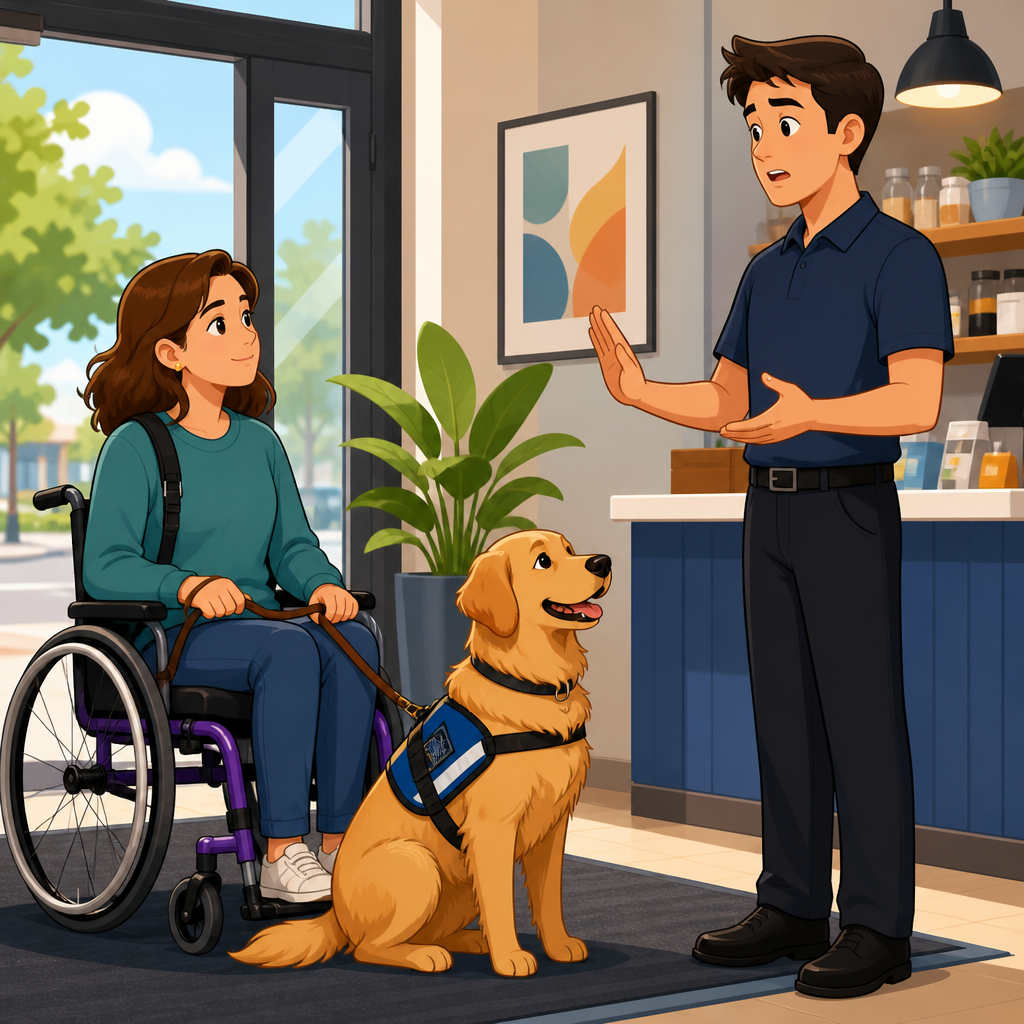
When can a service animal be removed from a business? Under the Americans with Disabilities Act, a business may ask that a service animal leave only in limited situations: when the animal is out of control and the handler does not take effective action, when the animal is not housebroken, or when the animal poses a direct threat that cannot be reduced by reasonable modifications. That rule sounds simple, but in practice it sits inside a broader set of rights and protections involving service animals, miniature horses, wheelchairs, walkers, canes, scooters, and other mobility devices. This article serves as a central guide to that full landscape.
A service animal, in the ADA context, is usually a dog individually trained to do work or perform tasks for a person with a disability. In some cases, a miniature horse must also be assessed for access under separate criteria. Emotional support animals, comfort animals, and therapy animals are different categories and do not receive the same public-access rights under the ADA. Mobility devices also split into distinct legal categories. Wheelchairs and manually powered aids such as walkers must be permitted where the public may go, while other power-driven mobility devices are evaluated through a reasoned safety analysis. Those distinctions matter because frontline staff often confuse them, and confusion leads to unlawful denials, avoidable conflict, and reputational risk.
I have worked through these issues with businesses, disability advocates, and operational teams, and the same questions come up repeatedly. Can staff ask for papers? What if another customer has allergies? What if a dog barks once? Can a store ban scooters? What about a golf cart in a crowded facility? Clear answers matter because the stakes are high. For disabled customers, access can determine whether they can shop, dine, travel, bank, or receive healthcare with dignity. For businesses, the cost of getting it wrong includes complaints to the Department of Justice, state law claims, training failures, and public backlash. A well-run policy protects safety without undermining civil rights, and that balance begins with understanding exactly when removal is lawful and when it is not.
The basic rule for service animal access in businesses
Businesses that are open to the public, including restaurants, hotels, stores, theaters, gyms, hospitals, professional offices, and transportation terminals, generally must allow a trained service animal to accompany its handler in areas where customers are allowed. Staff may not impose pet fees, isolate the customer, or steer them to lesser service. In day-to-day operations, the ADA permits only two questions when the disability and the animal’s role are not obvious: whether the dog is required because of a disability, and what work or task the dog has been trained to perform. Staff may not demand documentation, ask about the person’s diagnosis, require a demonstration, or insist on an identification card because the ADA does not require a national certification system.
The central access principle is that the animal is an auxiliary aid connected to the person’s equal use of the business. A guide dog leading a blind customer, a dog trained to alert to seizures, or a dog that retrieves dropped items for a person with limited dexterity is not a preference item. It is part of functional access. That is why blanket “no animals” policies must yield. Health codes do not override this requirement in places such as restaurants and grocery stores, except in limited back-of-house spaces where the public is not admitted. The legal analysis turns on behavior and safety, not on discomfort, stereotypes, or assumptions about breed, size, or appearance.
When a business may legally remove a service animal
A business can remove a service animal from the premises in three main situations. First, the animal is out of control and the handler does not take effective action to control it. Second, the animal is not housebroken. Third, the animal poses a direct threat to the health or safety of others that cannot be eliminated by reasonable modifications. These are narrow exceptions, and they are judged on actual conduct, not speculation.
Out of control means more than a single bark or a moment of distraction. In my experience, lawful removal usually involves repeated lunging, persistent barking that disrupts operations, jumping on patrons, running away from the handler, or blocking aisles in a way the handler does not correct. If the handler promptly regains control, removal is usually not justified. A service dog may briefly vocalize when alerting its handler to a medical event, and that alone does not make it removable. The question is whether the behavior prevents safe, orderly operations after the handler has had a fair chance to intervene.
Not housebroken is more straightforward. Urinating or defecating inside a business is a legitimate basis for removal. Staff should respond neutrally, document what occurred, and still offer the person the chance to return without the animal or to receive service by another available method if that would be effective. Direct threat is the most misunderstood standard. It requires an individualized assessment based on current behavior and objective evidence, not fear of dogs or generalized concern about sanitation. A growling dog that snaps at nearby customers may qualify. A calm dog of a disfavored breed does not.
What businesses cannot use as reasons for removal
Many common objections are not lawful grounds to exclude a service animal. Allergies and fear of dogs, by themselves, do not justify removal. The proper response is usually to separate the parties if possible, not to force the disabled customer out. Likewise, staff cannot remove a service animal because another customer says animals are unsanitary, because the dog is large, because it sheds, or because a manager thinks only “certified” dogs should be admitted. There is no ADA registration database, and online certificates sold by commercial websites do not determine legal status either.
Businesses also cannot exclude a service animal simply because local policy bans pets, because an employee prefers not to interact with animals, or because the dog uses equipment such as a harness, cape, or backpack that staff do not recognize. Breed restrictions are not a shortcut around federal law. Neither is a demand that the animal be carried or kept in a shopping cart. Service animals should generally remain on the floor or in the space where the handler controls them, unless the person’s disability requires another arrangement. The key point is this: exclusion must be tied to conduct, toileting, or a genuine direct threat, not to inconvenience or disbelief.
Miniature horses, wheelchairs, and other mobility devices
The rights and protections topic does not stop with dogs. The ADA separately addresses miniature horses that have been individually trained to do work or perform tasks for a person with a disability. Businesses must make reasonable modifications to allow them where possible after considering four factors: whether the horse is housebroken, whether it is under the owner’s control, whether the facility can accommodate its type, size, and weight, and whether its presence compromises legitimate safety requirements necessary for safe operation. In a spacious hotel lobby or outdoor venue, access may be practical. In a tiny upper-floor boutique with fragile stairs, it may not be.
Mobility devices follow a different framework. Wheelchairs and manually powered devices designed for use by individuals with mobility disabilities, such as walkers, crutches, or canes, must be allowed in any area open to pedestrian use. Other power-driven mobility devices, often called OPDMDs, include electronic personal assistance mobility devices, golf carts, and certain stand-up scooters. Businesses may not ban these automatically. They must assess whether the specific class of device can be used safely based on factors such as facility volume, pedestrian traffic, design, speed, and operational characteristics.
| Device or animal | General access rule | Main reason access may be limited |
|---|---|---|
| Service dog | Allowed in public areas | Out of control, not housebroken, or direct threat |
| Miniature horse | Reasonable modification after assessment | Size, weight, control, housebreaking, or safety constraints |
| Wheelchair or walker | Must be allowed where pedestrians may go | Very rare, usually only true physical impossibility |
| OPDMD such as golf cart or mobility scooter | Case-by-case safety assessment | Legitimate safety requirements based on actual operation |
In practical terms, this means a museum can require safe speeds for motorized devices, a stadium can designate accessible routes that avoid steep service ramps, and a retailer can prohibit reckless driving without banning mobility scooters across the board. Policies should define where devices may travel, any speed limits, and how staff should address congestion. What they cannot do is create arbitrary barriers for disabled patrons while allowing similar convenience devices for others.
How staff should respond in real situations
The best compliance programs translate legal standards into scripts and decision trees. Frontline employees should know the two permitted service-animal questions, the three main removal grounds, and the difference between a service animal and a pet. They should also know that if a service animal is properly removed, the person with the disability must still be offered the opportunity to obtain goods or services without the animal’s presence. That might mean takeout instead of dine-in after a disruptive incident, curbside delivery, or completing a transaction at a service desk once the animal has been taken outside.
Documentation matters. Managers should record the specific behavior observed, the handler’s response, any safety impact, and the accommodations offered afterward. Good records help show that the decision was individualized rather than discriminatory. Training should use realistic examples: a dog barking repeatedly in a movie theater, a guide dog lying quietly under a restaurant table, a mobility scooter navigating a narrow historic site, or a miniature horse arriving at a county fairground. Staff should practice neutral language such as, “Your dog is lunging at customers, and you need to bring it under control. If that cannot happen, we may need to ask that the dog be taken outside while we continue serving you.” That phrasing focuses on behavior, not blame.
For customers and advocates, the practical lesson is equally important. Keep the animal harnessed, leashed, or tethered unless those devices interfere with the disability-related task; maintain close control through voice or signal if equipment cannot be used; and be prepared to explain the trained task in plain language. For mobility device users, knowing a business’s route, elevator locations, and posted safety rules can prevent conflict before it starts. Clear communication often resolves issues long before rights need to be enforced formally.
Common disputes, enforcement, and what to do next
Disputes often begin with mistaken assumptions. Restaurants sometimes think food-safety rules ban all animals. Stores sometimes equate emotional support animals with service dogs. Venues sometimes fear liability if they allow a nontraditional mobility device. The ADA’s answer is consistency: assess the actual legal category, then apply the correct standard. The Department of Justice has repeatedly emphasized that public accommodations may not impose documentation requirements for service animals, may not exclude them based on breed, and may not deny access because staff believe another customer will object.
If a business violates these rules, a customer can start by asking for a manager and calmly stating the relevant standard. If the issue is not resolved, documenting names, times, witnesses, and the exact statements made can be invaluable. Complaints may be filed with the Department of Justice, and state or local disability laws may provide additional remedies. Many states have broader definitions or parallel protections, so federal law is the floor, not always the ceiling. Businesses should review counsel-approved policies regularly, especially if they operate in healthcare, hospitality, education, entertainment, or multi-site retail, where public interactions are frequent and inconsistency is common.
The bottom line is simple. A service animal can be removed from a business only when behavior, housebreaking, or a true safety threat justifies it. Everything else in this service animals and mobility devices hub flows from that principle: equal access is the rule, exclusion is the exception, and decisions must be based on observable facts. If you manage a business, audit your policy, signage, and employee training now. If you are a customer or advocate, use this guide as your starting point and build from it with the related rights and protections resources in this subtopic.
Frequently Asked Questions
When can a business legally require a service animal to be removed?
Under the Americans with Disabilities Act (ADA), a business can require a service animal to be removed only in narrow, specific circumstances. In general, the animal may be excluded if it is out of control and the handler does not take effective action to control it, if it is not housebroken, or if it poses a direct threat to the health or safety of others that cannot be eliminated or reduced through reasonable modifications. These are intentionally limited exceptions, and they do not give businesses broad discretion to exclude service animals simply because other customers are uncomfortable, afraid of dogs, or unfamiliar with disability access rules.
Just as important, the decision must be based on the animal’s actual behavior in that situation, not on assumptions or stereotypes. For example, a dog barking repeatedly, lunging, snapping, running loose through the business, or relieving itself indoors may justify removal if the handler cannot promptly correct the issue. By contrast, a service animal that is calm, under control, and performing disability-related work generally must be allowed to remain. Even when removal is justified, the business should still offer the person with a disability the opportunity to obtain goods or services without the animal present, if that can be done reasonably.
What does “out of control” mean under the ADA?
“Out of control” refers to behavior showing that the service animal is not being effectively managed by its handler in the business setting. The ADA does not require perfect behavior at every second, but it does require that the animal be under the handler’s control through a harness, leash, tether, or, when those devices interfere with the animal’s work or the person’s disability prevents their use, through voice commands, signals, or other effective means. If the animal is repeatedly barking without a legitimate service-related reason, jumping on people, wandering away from the handler, blocking aisles, or acting aggressively, a business may have grounds to intervene.
However, businesses should be careful not to label ordinary or isolated conduct as disqualifying. A single bark, a brief distraction, or movement related to performing a trained task does not automatically make a service animal “out of control.” The key question is whether the handler takes effective action once an issue arises. If the handler quickly regains control, redirects the dog, or otherwise corrects the problem, removal may not be appropriate. If the handler cannot or will not control the animal, then the business may ask that the animal leave. The focus should always remain on present behavior and the handler’s response, not on personal bias or generalized concern.
Can a business remove a service animal because employees or customers are afraid of dogs or have allergies?
No. Fear of dogs and allergies are not, by themselves, valid reasons under the ADA to exclude a service animal from a business. These issues can be real and important, but the law does not treat them as automatic grounds for removal. Instead, businesses are expected to try to accommodate everyone involved where possible. For example, staff may separate individuals, adjust seating, use different work areas, or take other practical steps to reduce contact. The presence of a service animal cannot be denied simply because another person is uncomfortable or objects to animals being in the establishment.
The only time a business may remove the animal is when one of the legally recognized conditions exists, such as lack of control, the animal not being housebroken, or a direct threat that cannot be resolved through reasonable measures. “Direct threat” is a high standard and must be based on objective evidence of a significant risk, not speculative worry. In other words, businesses must distinguish between personal preference and actual legal justification. An employee or customer’s fear does not override a disabled person’s ADA rights.
What is a “direct threat,” and how is it different from a general concern about safety?
A “direct threat” under the ADA means a significant risk to the health or safety of others that cannot be eliminated or reduced by reasonable modifications. This is a fact-specific standard. It requires more than a vague concern, generalized anxiety, or a belief that animals might be unpredictable. A business must look at the actual conduct of the specific service animal in the specific setting. For instance, if a service animal is acting aggressively, attempting to bite, or creating a serious and immediate hazard that the handler cannot control, that may rise to the level of a direct threat.
What does not qualify is equally important. A business cannot claim direct threat based on stereotypes about certain breeds, assumptions that all dogs carry disease, or a blanket rule against animals in food-service areas where service animals are otherwise permitted by law. The analysis must be individualized and grounded in real conditions. Before removing the animal, the business should also consider whether a reasonable adjustment could address the concern. If the risk can be managed without excluding the animal, removal would likely not be justified. This standard helps ensure that safety concerns are taken seriously without allowing businesses to bypass disability rights based on unsupported fears.
If a service animal is properly removed, does the business still have to serve the person with a disability?
Yes. If a business lawfully requires a service animal to be removed, it must still give the individual with a disability the opportunity to obtain the goods, services, or access being offered, as long as doing so is otherwise possible. Removal of the animal is not the same as removal of the person. For example, a restaurant that properly asks a service animal to leave because it is out of control should still allow the customer to stay and dine without the animal, arrange takeout, or otherwise provide service on the same general terms offered to others.
This point is often overlooked, but it is a central part of ADA compliance. Businesses should respond narrowly to the problem behavior rather than denying access altogether. They also should avoid escalating the situation through unnecessary confrontation or improper questioning. In many cases, a respectful explanation of the issue and a focused request regarding the animal is enough. The law aims to balance legitimate operational and safety concerns with strong protections for people with disabilities, and that balance is best maintained when businesses address the specific problem while continuing to provide access wherever they reasonably can.