ADA training for ushers, bouncers, and security teams handling lines, bags, and mobility devices is one of the most practical parts of venue compliance because these staff members make the first and most visible decisions a guest experiences. In stadiums, theaters, clubs, convention centers, museums, and houses of worship, front-of-house personnel control entry, queue movement, bag inspections, and the treatment of wheelchairs, walkers, scooters, canes, and service animals. When training is weak, small mistakes become access barriers, complaints, safety incidents, and avoidable legal exposure. When training is strong, staff can protect safety while preserving equal access, dignity, and speed at the door.
The Americans with Disabilities Act sets the baseline. Title II generally applies to state and local government facilities, and Title III applies to places of public accommodation operated by private entities. For teams working the entrance, the practical question is simple: can a person with a disability enter, move through screening, and receive the same service without unnecessary delay, interrogation, or exclusion? That question affects line management, bag check policies, mobility device handling, communication methods, and escalation decisions. It also affects documentation, because training records, incident reports, and written standard operating procedures often become the first evidence reviewed after a complaint.
I have seen this play out in crowded venues where one untrained guard says, “That scooter cannot come inside,” while a supervisor later reverses the decision after ten embarrassing minutes at the threshold. I have also seen the opposite: teams that use short scripts, lane signage, and role-based drills move hundreds of people efficiently while accommodating wheelchair users, guests with low vision, and patrons carrying medically necessary items. The difference is not abstract awareness training. It is operational training mapped to each role, each checkpoint, and each predictable friction point.
This hub page covers training and role-based education for ushers, bouncers, and security teams comprehensively. It explains what staff must know, what supervisors must document, where judgment is allowed, and where it is not. It also connects the subtopic to adjacent implementation work such as policy writing, event-day staffing, accessible route design, service animal procedures, and complaint response. If your organization needs a practical framework for compliance and implementation, start with the people who touch lines, bags, and mobility devices first.
Why role-based ADA training matters at entrances and checkpoints
Role-based training matters because not every employee makes the same decisions, and generic annual videos do not prepare staff for live entry conditions. Ushers typically guide guests to seats, routes, and amenities. Bouncers and door staff often verify identification, enforce occupancy rules, and manage line behavior. Security teams inspect bags, respond to prohibited item concerns, and decide when secondary screening is needed. Each role intersects with disability access differently, so the training must match the authority each worker actually uses.
The core standard is equal access with reasonable policy modification when needed, unless a legitimate safety requirement or direct threat standard applies. In plain terms, staff cannot create extra hurdles for disabled guests just because a line is busy or a device looks unfamiliar. A wheelchair is not luggage. A white cane is not a suspicious stick. A medically necessary ice pack, glucose supply, or communication device is not treated the same way as a convenience item under a generic bag policy. Frontline teams must understand those distinctions instinctively.
Good programs teach three layers. First, staff learn the legal and policy baseline: non-discrimination, effective communication, service animal rules, and mobility device principles. Second, they learn task-specific procedures, such as how to search a bag without separating a guest from medication or how to offer an alternate screening method if a metal detector or turnstile creates a barrier. Third, they practice decision-making under pressure through drills using realistic traffic conditions, loud environments, and partial information, because that is how mistakes usually happen.
Training also protects operations. Complaints at the door slow entry, trigger supervisor callouts, and create social media exposure in minutes. A team that can recognize an accessible lane need, explain a policy neutrally, and escalate without confrontation preserves throughput. In my experience, venues that train by role see fewer disputes not because they deny fewer items, but because they communicate the reason, the alternative, and the next step clearly.
What staff must know about lines, bag checks, and mobility devices
Every frontline employee should be able to answer six questions without guessing. What counts as a mobility device? What is the difference between a manual wheelchair, power wheelchair, walker, crutches, cane, and other power-driven mobility device? How should service animals be handled at entry? When can medically necessary items bypass ordinary bag limits? What alternate screening methods are available? When should a supervisor or ADA coordinator be called?
For mobility devices, the baseline is straightforward. Wheelchairs and manually used devices are generally allowed where the public can go, subject to real space and safety constraints rather than assumptions. Power wheelchairs and scooters are also typically permitted. Other power-driven mobility devices require an individualized assessment based on factors such as facility size, traffic, legitimate safety requirements, and risk of harm. That assessment should be made through policy and supervisor guidance, not improvised by a line guard in front of the guest.
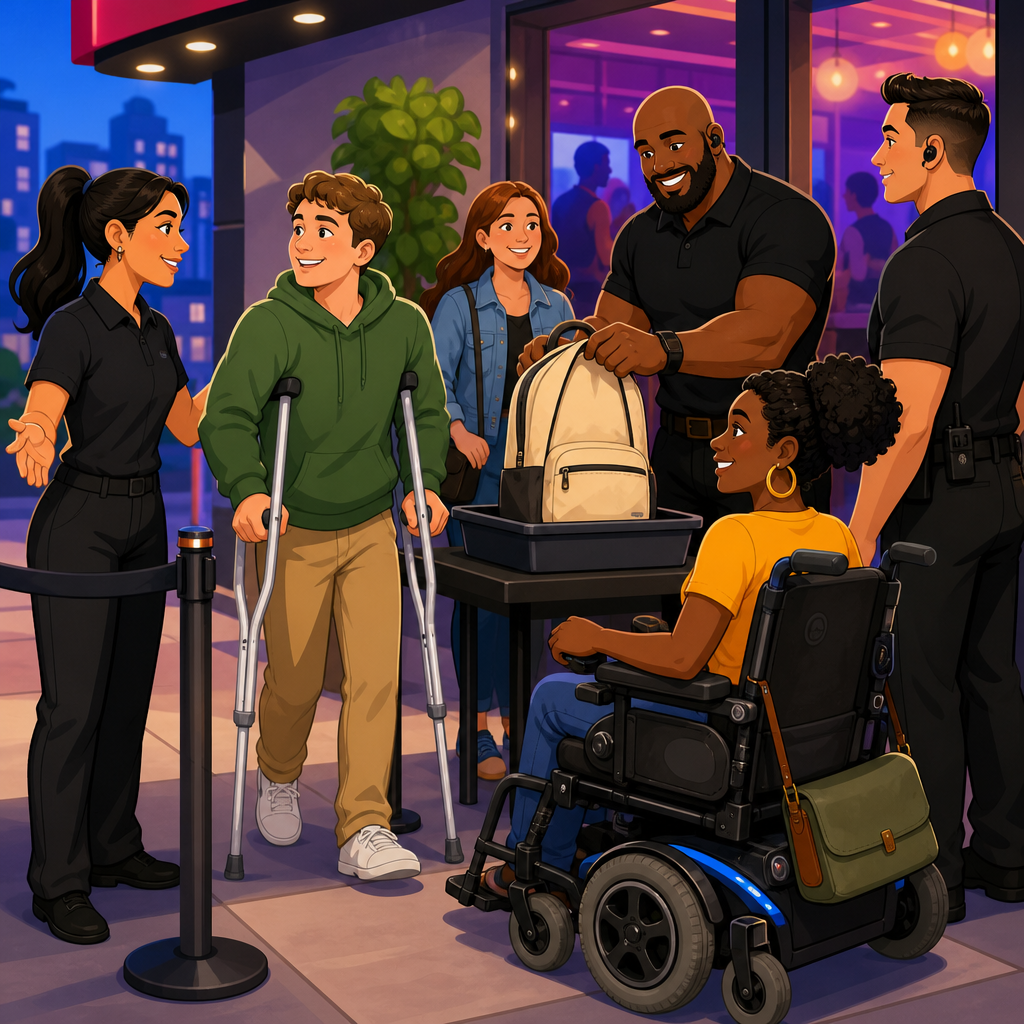
Bag procedures create frequent errors. Security teams often memorize prohibited items lists but are not taught how exceptions work. A venue may ban outside food generally, yet still need to allow medically necessary nutrition. It may restrict bag size, yet permit a larger bag carrying supplies related to a disability. It may require visual inspection, but should avoid unnecessary handling of private medical items and should explain the process before touching the contents. Respectful scripting matters here because privacy and dignity affect whether the interaction escalates.
Queue management also needs disability-specific guidance. Not every person who needs an alternate line uses a wheelchair. Someone with a balance impairment, cardiac condition, autism, chronic pain, or heat sensitivity may need a shorter wait, a place to sit, or a quieter screening route. Staff should not diagnose or debate the disability. They should know the venue’s approved modifications and how to offer them consistently.
| Role | Primary ADA training focus | Common mistake | Correct practice |
|---|---|---|---|
| Usher | Accessible routes, seating guidance, communication | Pointing vaguely instead of escorting | Provide clear directions and offer route assistance |
| Bouncer | Line management, de-escalation, policy modification | Denying entry based on appearance of a device | Use policy, not assumptions, and call a supervisor when needed |
| Security screener | Bag exceptions, alternate screening, respectful inspection | Separating guest from medication or mobility aid | Inspect with explanation and keep essential items accessible |
| Supervisor | Case review, incident documentation, escalation | Making ad hoc exceptions without records | Apply written standards and log outcomes for training review |
Building a training program that works on event day
An effective ADA training program for frontline teams is short, repeated, and tied to the venue’s actual floor plan and entry equipment. Start with written standard operating procedures. These should define accessible entrances, alternate screening methods, bag exception rules, service animal handling, mobility device procedures, and supervisor escalation paths. The wording should match public-facing policies so staff are not enforcing one rule while the website promises another. Internal consistency is a compliance issue, not just a communication preference.
Next, break the training into modules by role. Ushers need route-finding practice, seating transfer etiquette, and methods for communicating with guests who are deaf, hard of hearing, blind, low vision, or nonverbal. Bouncers need a clear line between behavior-based removal and disability-related conduct that requires patience or accommodation. Security teams need hands-on practice with visual bag checks, wanding alternatives, and safe interaction around wheelchairs and scooters. Supervisors need scenario review, complaint intake skills, and report writing standards.
Drills are where the program becomes real. Use live walk-throughs before doors open. Test whether a scooter can pass the stanchion layout without forcing a backtrack. Run a scenario where a guest carries insulin supplies in a larger bag than policy allows. Practice how a screener responds when a person cannot stand in a standard magnetometer line. If the answer requires three radio calls and ten minutes, the process is broken even if the written policy looks compliant.
Training frequency matters. New hires need onboarding before first solo shift. Returning seasonal workers need refreshers before each season. High-risk roles at major events benefit from pre-event toolbox talks of five to ten minutes reviewing that night’s access points, expected crowd volume, and escalation contacts. Learning management systems can track completion, but observation audits are what reveal whether staff can apply the content under pressure.
Scripts, signage, and escalation rules that reduce complaints
Most access complaints start with language, not intent. A staff member says, “You cannot bring that in,” when the better opening is, “Let me explain our screening options and any exceptions that apply.” Scripts should give personnel neutral, repeatable wording that protects both dignity and throughput. The goal is not robotic speech. The goal is consistency, especially in loud or stressful conditions where people default to blunt commands.
Useful scripts are short. For bag checks: “If this contains medically necessary items, we can screen it here and keep it with you.” For alternate lines: “If standing in this queue is difficult, I can bring you to the accessible screening point.” For mobility devices: “Your wheelchair stays with you unless you request assistance.” For uncertainty: “I want to get the right answer, so I am bringing a supervisor who handles accessibility decisions.” These phrases prevent staff from improvising legally risky statements.
Signage supports the script. Entry areas should mark accessible lanes, companion policies where relevant, prohibited items, and a clear point for accommodation questions. Good signage lowers confrontation because guests can self-identify the right lane before they reach a stressed screener. It also helps prove that the organization planned for access rather than treating accommodations as exceptions invented on the spot.
Escalation rules must be specific. Staff should know exactly when to call a supervisor, when to involve the ADA coordinator or event manager, and when security concerns justify temporary hold and review. The key principle is that unresolved accessibility questions should move up quickly, not stall in public view. In audits I have conducted, the fastest way to reduce complaints was not rewriting policy; it was limiting who could make final denial decisions involving mobility devices and medically necessary items.
Special situations: service animals, crowded venues, and emergency procedures
Service animals deserve dedicated coverage because confusion remains common. Staff may ask only limited questions when the need for the animal is not obvious, and they should not demand certification papers or special vests. The animal is not handled like a pet under a no-animals policy. Frontline teams need to know where relief areas are located, how to address disruptive behavior without targeting disability, and how to preserve access during evacuation or shelter-in-place procedures.
Crowded venues add another layer. During peak ingress, a guest using a walker may be physically safe but effectively blocked by compression around the lane merge. Training should cover crowd flow design, including wider turns, protected waiting space, and alternate routes that do not require a long backtrack against traffic. This is where coordination between operations and security matters. A theoretically accessible route that passes through a locked gate or merchandise queue is not operationally accessible.
Emergency procedures are often the weakest part of training. Teams know how to evacuate the general crowd, but not how to communicate with someone who is deaf during a fast-moving incident or what to do if an elevator is out of service after a shelter order lifts. The National Fire Protection Association, local fire code requirements, and the venue’s emergency action plan should align with disability procedures. Staff should know areas of refuge, evacuation chair protocols if used, and the chain of command for assisted egress.
These scenarios also reinforce a broader lesson: compliance and implementation are inseparable. A policy in a binder does not help if frontline teams cannot perform it at the speed of operations. That is why this training hub connects naturally to deeper articles on policy drafting, signage standards, accessible customer service, incident documentation, event security planning, and post-complaint corrective action.
How to measure training effectiveness and improve over time
Training is only complete when the venue can show that staff behavior changed. Start with metrics that matter operationally: complaint volume by entry point, average resolution time for access issues, supervisor call rate, bag exception processing time, and mystery-shopper results for accessible entry. Pair those with qualitative review of incident reports, guest feedback, and after-action notes from high-attendance events. Patterns reveal where scripts fail, where signage confuses, and which roles need retraining.
Documentation should be disciplined. Keep attendance logs, module outlines, scenario checklists, policy versions, and records of corrective coaching. If a complaint alleges discriminatory screening, being able to show the exact training delivered before the event is extremely important. It will not excuse a bad decision, but it does show governance, helps isolate whether the issue was policy or execution, and speeds remediation.
Continuous improvement works best when accessibility review is embedded into regular operations meetings, not isolated as an annual compliance exercise. Invite security leadership, front-of-house managers, guest services, and facilities staff to review the same incidents. Many access failures happen at handoffs between departments. The usher knows the route, but the gate is locked by security. The screener allows the medical bag, but the seat usher challenges it again. Cross-functional review eliminates these contradictions.
The main benefit of strong ADA training for ushers, bouncers, and security teams is simple: guests get safer, faster, more dignified access, and the organization reduces preventable risk. Role-based education turns broad legal duties into repeatable actions at the curb, the queue, the bag table, and the seating entrance. It helps staff distinguish between legitimate safety enforcement and unnecessary barriers. It gives supervisors a framework for consistent decisions, and it gives leadership records that support accountability.
As the hub for training and role-based education within compliance and implementation, this page should guide your next steps. Build written procedures, tailor modules by role, drill realistic scenarios, and measure performance at the exact points where guests encounter friction. Then expand into related topics such as policy harmonization, accessible communications, emergency planning, and complaint response. If you manage a public-facing venue, review your entry process this week, observe it with disability access in mind, and update training before the next busy event.
Frequently Asked Questions
What should ushers, bouncers, and security teams know about ADA rules when managing entry lines and screenings?
Front-of-house staff should understand that ADA compliance starts the moment a guest approaches the venue, not after they are already inside. Ushers, bouncers, and security teams are often the first people making practical decisions about access, so their actions can either support or block equal participation. Staff should be trained to recognize that guests with disabilities may need reasonable modifications to standard line procedures, screening steps, or entry routes. For example, a guest who cannot stand for long periods may need to wait in an accessible area, use a shorter route, or move through screening in a way that reduces unnecessary delay. A person with limited balance may need extra time to present a ticket or pass through a checkpoint. The key principle is equal access, not identical treatment.
Training should also make clear that staff cannot create extra barriers simply because a mobility device, disability-related item, or service animal is involved. Policies around ticket scanning, queue control, bag checks, and crowd movement should be applied consistently but flexibly when disability-related needs are present. Teams should know how to speak directly to the guest, avoid assumptions, and escalate questions to a trained supervisor when needed rather than improvising on the spot. Good ADA training gives employees practical scripts, clear authority to make common-sense adjustments, and enough confidence to handle busy entry conditions without turning accessibility into a confrontation. In real-world venue operations, that kind of preparation reduces delays, complaints, and legal risk while making the guest experience smoother for everyone.
How should staff handle wheelchairs, walkers, scooters, canes, and other mobility devices at the door?
Staff should treat mobility devices as essential tools for access, not as suspicious objects, inconveniences, or items to be separated from the guest. Wheelchairs, walkers, scooters, crutches, canes, and similar devices are often necessary for a person to move safely and independently, so training should emphasize that these items should generally stay with the guest unless there is a very specific and lawful reason that requires another approach. Security teams may inspect a mobility device as part of a neutral screening process, but they should do so respectfully, explain what is happening, and avoid touching or moving the device without permission whenever possible. Staff should never insist that a guest transfer out of a wheelchair or scooter just to satisfy a routine screening preference if another effective screening method is available.
It is also important for teams to understand the operational side of mobility-device access. Entry lanes should be wide enough to accommodate wheelchairs and scooters, temporary barriers should not block accessible routes, and line management should not force guests into tight turns, steep grades, or crowded choke points that create safety issues. If a venue offers storage for non-essential items, staff should know the difference between optional convenience storage and impermissibly separating a guest from a device they rely on. Training should include scenarios involving battery-powered devices, folding walkers during seating transitions, and guests who use more than one aid. The most effective approach is simple: ask before assisting, communicate clearly, and preserve the guest’s independence and dignity while maintaining legitimate safety procedures.
What is the correct way to handle bag checks when a guest has medical supplies, disability-related equipment, or service animal items?
Bag inspections involving disability-related items require both consistency and discretion. Many guests carry medications, refrigerated medical supplies, feeding equipment, diabetic supplies, seizure-response items, communication devices, spare mobility parts, or service animal care items that may not fit within a standard bag policy. ADA training should prepare staff to recognize that a venue’s usual size limits or prohibited-item procedures may need reasonable modification when the contents are necessary because of a disability. That does not mean security must ignore legitimate safety concerns, but it does mean employees should know how to inspect such items professionally without treating the guest as if they are violating the rules.
Best practice is to train teams to explain the screening process calmly, inspect only what is necessary for safety, and avoid demanding unnecessary medical details. Staff generally do not need a diagnosis to determine whether an item appears disability-related and should not pressure guests to disclose private health information in public. When further review is needed, a supervisor should be available to make a prompt decision in a respectful setting. Venues benefit from having a written process for exceptions, medically necessary bags, and screening alternatives so frontline employees are not inventing answers under pressure. When staff understand how to distinguish between an ordinary policy issue and a disability-related access need, they can maintain security standards while greatly reducing embarrassment, delay, and conflict at the checkpoint.
How should employees interact with guests who use service animals during entry, seating, and crowd movement?
Service animal situations are one of the most common areas where weak training leads to avoidable mistakes. Staff should know that a service animal is not a pet and should not be excluded because of a general no-animals policy. Front-of-house personnel should also understand the limited nature of appropriate questions. When it is not obvious that the animal is a service animal, staff may generally ask whether the dog is required because of a disability and what work or task the dog has been trained to perform. Employees should not demand documentation, require a special vest, ask for a demonstration of the task, or press the guest for details about their disability. Those missteps are common, highly visible, and often escalate quickly in public-facing environments.
Beyond entry, teams should be trained on practical accommodation. The guest and service animal should be allowed to use accessible routes, move through lines, and take part in venue activities in the same general way as other patrons unless a legitimate safety issue requires a specific adjustment. Staff should not pet, distract, feed, or separate the animal from its handler. If there is a concern about crowd flow, seating space, or emergency egress, employees should focus on problem-solving rather than exclusion. In the rare event that an animal is out of control or not housebroken, staff should involve a supervisor and address the behavior using the venue’s trained process. Well-trained teams know how to protect safety without reflexively treating every service animal as a policy exception or a disruption.
Why is ADA training especially important for security and guest-facing teams, and what should that training include?
ADA training is especially important for ushers, bouncers, and security personnel because they make fast decisions in high-pressure moments that shape a guest’s entire experience. These employees control access, manage queues, enforce bag rules, respond to crowd surges, and decide how people with visible and non-visible disabilities move through the venue. When training is weak, the result is often inconsistent enforcement, public misunderstandings, unnecessary confrontations, and access barriers that could have been prevented with a few practical adjustments. Because these interactions happen at the front door or in front of other patrons, mistakes are highly visible and can damage both trust and reputation immediately.
Strong training should go beyond legal buzzwords and focus on real venue operations. Teams should learn the basics of ADA obligations, disability etiquette, respectful communication, service animal rules, mobility-device handling, medically necessary bag procedures, accessible route awareness, and the difference between safety-based screening and unlawful barriers. They should also practice scenario-based responses: how to manage a guest who cannot stand in a long line, how to inspect a wheelchair without demeaning the user, how to handle a bag full of medical supplies, how to respond when a companion tries to speak for the guest, and when to call a supervisor. The best programs include scripts, escalation pathways, and role-specific guidance for entry staff, roaming security, and seating personnel. In short, effective ADA training helps venues create a safer, more consistent, and more legally compliant guest experience while giving staff the confidence to act appropriately under real-world conditions.