ADA training for hotel and restaurant staff is the foundation of practical accessibility, legal compliance, and consistent guest service. In hospitality, the Americans with Disabilities Act sets expectations for how employees welcome, communicate with, and accommodate guests with disabilities in lodging, dining rooms, bars, banquet spaces, and related public areas. For this subtopic, the two issues that most often determine whether service feels inclusive or exclusionary are service animals and communication access. They also create the most frontline uncertainty. Staff members need to know what questions are allowed, what actions are prohibited, when an accommodation is required, and how to respond calmly during busy shifts.
Training and role-based education matter because hospitality work is distributed across many touchpoints. A reservation agent may need to explain accessible room features accurately. A host may need to seat a guest with a service dog without delay or extra conditions. A bartender may need to communicate with a deaf guest without turning the interaction into a spectacle. A banquet captain may need to coordinate captioning, assistive listening, or sightline adjustments for an event. A general manager must turn legal standards into operating procedures, while supervisors reinforce them during pre-shift meetings and incident reviews.
In my experience helping hospitality teams update accessibility programs, the biggest failures rarely come from bad intent. They come from partial knowledge. Someone remembers that animals are not usually allowed in dining areas, but forgets that service animals are an exception. Someone wants to help a guest with low vision, but grabs an arm without asking. Someone assumes writing notes is always enough for communication access, when a more effective aid may be necessary depending on the setting. Good ADA training replaces improvisation with repeatable judgment.
This hub article explains how to build that judgment. It defines the core rules, shows how role-based education works, and gives practical examples for hotels and restaurants. It is designed as a central resource for training and implementation teams that need a reliable starting point for policies, onboarding, refreshers, and internal linking to deeper guidance on accessibility operations.
What ADA training covers in hotels and restaurants
ADA training in hospitality should cover legal basics, guest interaction standards, property-specific procedures, and role-specific responsibilities. At minimum, staff need to understand who the law protects, which areas of the business are public accommodations, how reasonable modifications work, and what effective communication means in day-to-day service. Training should also explain how state or local rules interact with federal requirements, especially for health codes, emergency procedures, and animal control policies.
For hotels, core scenarios include reservations, accessible room assignments, check-in communication, wayfinding, emergency information, shuttle use, and service in breakfast areas, lounges, pools, and meeting spaces. For restaurants, core scenarios include greeting and seating, menu access, ordering, restroom access, queue management, pickup counters, outdoor dining, and private events. The operational principle is simple: guests with disabilities must have an equal opportunity to access goods and services, with staff prepared to remove preventable barriers wherever policy and practice control the outcome.
Role-based education is essential because not every employee needs the same depth. Front desk agents and hosts need fast recall for guest-facing decisions. Managers need escalation protocols and documentation habits. Security and valet teams need training on mobility devices, routes, and respectful communication during emergencies. Banquet and event staff need stronger knowledge of auxiliary aids and service setup. Housekeeping needs protocols for entering rooms where a service animal may be present and for avoiding interference with accessibility features.
Service animals: the rules staff must know without hesitation
Service animal training should be precise because confusion creates immediate conflict. Under the ADA, a service animal is generally a dog individually trained to do work or perform tasks for a person with a disability. In limited cases, miniature horses may also require assessment. Emotional support, comfort, companionship, and therapy alone do not make an animal a service animal under this standard. That distinction matters because many hospitality employees have heard overlapping terms from airlines, housing rules, and social media, then apply the wrong framework on the floor.
When the need for the animal is not obvious, staff may ask only two questions: whether the dog is required because of a disability, and what work or task the dog has been trained to perform. Staff may not request documentation, require a special vest, demand demonstration of the task, or ask about the nature of the disability. Those limits need to be memorized. In training sessions I run, we drill them as a script because hesitation often leads employees to over-question guests or invent unofficial verification steps.
Access rules are equally important. A hotel or restaurant must generally allow a service animal anywhere the public is allowed to go, including lobbies, dining rooms, bars, guest floors, and outdoor service areas. Businesses cannot isolate the guest, charge a pet fee, or assign less desirable seating. They can charge for actual damage if they would charge any guest for similar damage. Staff should also know the narrow reasons a service animal may be excluded: if the animal is out of control and the handler does not take effective action, or if the animal is not housebroken. Fear of dogs or allergies, by themselves, are not valid reasons to deny access.
How service animal scenarios play out in real hospitality settings
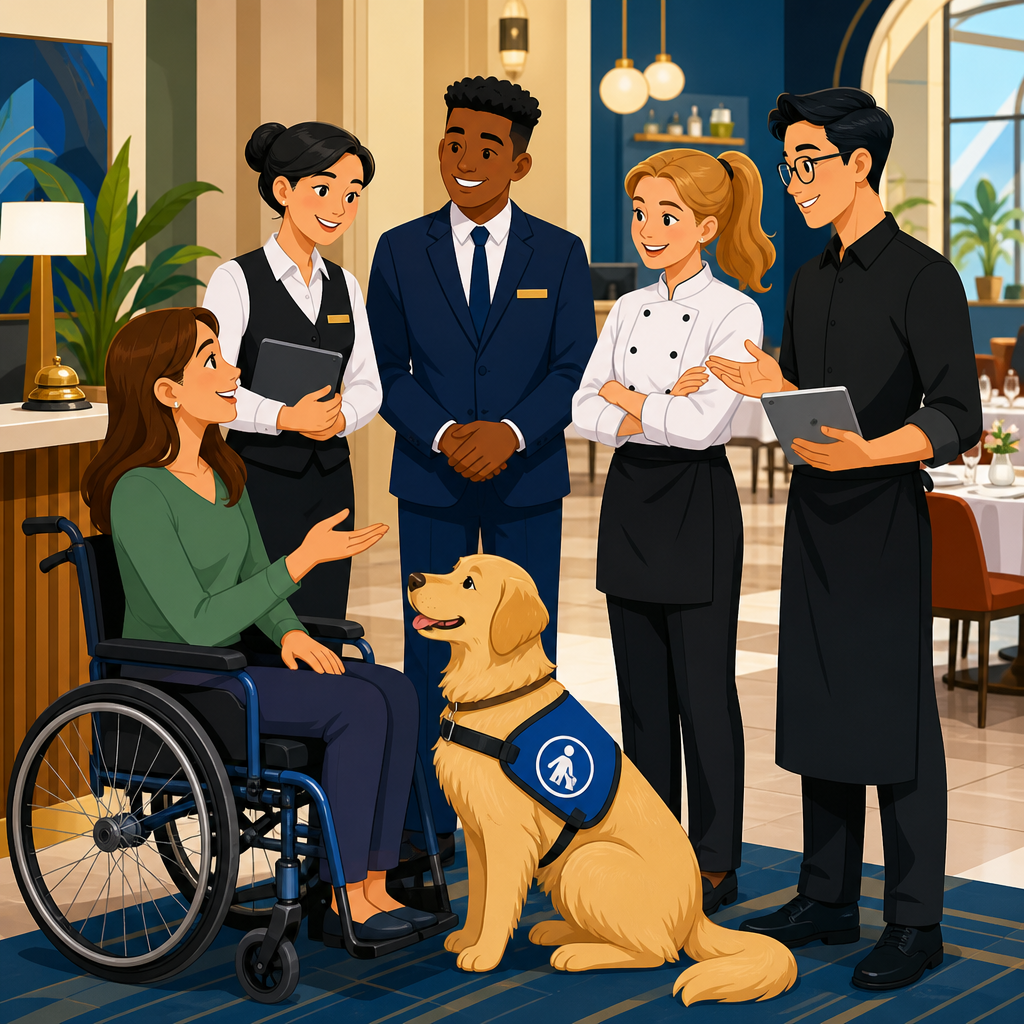
Examples make the rules usable. At a host stand, a guest arrives with a dog during a busy dinner rush. The host should not say, “Pets aren’t allowed.” The correct approach is to welcome the party, and only if the animal’s role is not apparent, ask the two permitted questions discreetly. If the answers confirm a service animal, seat the guest like any other party. Do not direct them automatically to the patio. If another diner complains, move the complaining diner if practical rather than penalizing the guest using the service animal.
At a hotel front desk, a guest checking in with a dog should not be sent to a pet-friendly floor unless that is the room type the guest booked. The agent may not add a cleaning surcharge or require a waiver not required of other guests. If the dog barks repeatedly in the room and the handler does not regain control, management may address the behavior just as they would any serious disturbance. The key is to focus on conduct, not disability status. I have found that this framing helps managers act confidently without crossing legal lines.
Food service concerns often trigger avoidable mistakes. Health codes do not override ADA access for service animals in customer areas. A restaurant can prohibit animals from kitchen and food preparation spaces that are off limits to the public, but not from the dining room. Staff should never feed, pet, distract, or separate a service animal from its handler. Servers should ask where the guest would like items placed and ensure aisles remain clear. These small service steps reduce safety risks and demonstrate competent training.
| Role | Common scenario | Correct response | Common error to avoid |
|---|---|---|---|
| Host or hostess | Guest arrives with dog | Ask only the two allowed questions if needed, then seat normally | Requesting papers or directing the guest outside |
| Front desk agent | Check-in with service animal | Assign the booked room type and explain amenities normally | Charging a pet fee or requiring a special form |
| Server | Table spacing issue | Offer practical seating that protects access routes | Touching or distracting the dog |
| Manager | Animal is barking uncontrollably | Address behavior, give handler a chance to correct it | Threatening removal based solely on presence of the animal |
Communication access: what effective communication means in practice
Communication access requires more than good intentions. The ADA expects hotels and restaurants to communicate with guests with disabilities as effectively as they communicate with others. Depending on the situation, that can involve exchanging written notes, reading printed text aloud, providing large print or digital materials, using captioned media, repositioning for lip reading, offering assistive listening devices, or arranging a qualified interpreter. The right aid depends on the complexity, length, importance, and context of the communication.
In routine restaurant transactions, a printed menu in accessible digital format, a clearly written order pad, or a staff member trained to communicate directly and patiently may be enough. In a hotel setting, however, more complex interactions can arise: explaining emergency procedures, discussing billing disputes, completing event contracts, or handling security incidents. In those situations, simple note writing may not achieve effective communication. The Department of Justice standard is functional effectiveness, not minimal effort. Teams need to evaluate the actual exchange rather than assume one tool fits every guest and every task.
Guests who are deaf or hard of hearing are only one part of communication access. Staff must also be prepared for blind or low-vision guests, guests with speech disabilities, guests with cognitive disabilities, and guests using augmentative or alternative communication methods. Training should cover direct communication etiquette: face the guest, not a companion; speak in a normal tone unless asked otherwise; confirm understanding without condescension; and allow extra processing time when needed. These habits improve service quality for everyone, especially in noisy hospitality environments.
Role-based communication training for front-of-house, events, and managers
Front-of-house staff need concise, repeatable communication practices. Hosts and servers should know how to offer menu access in multiple formats, describe table locations clearly, and adapt when background music, lighting, or crowd noise limits comprehension. Front desk staff should know how to use text-based communication tools, relay key property information accessibly, and document accommodation requests accurately in the property management system. Many hotels already use Opera Cloud, SynXis, or similar systems; training should show exactly where to note guest communication preferences so the next shift does not start from zero.
Event and banquet teams need deeper instruction because communication failures are expensive and public. A planner may request captioning for a corporate meeting, reserved sightlines for a guest who uses a wheelchair and service dog, or an assistive listening system that works with the ballroom’s audiovisual setup. Staff should understand common tools such as CART captioning, hearing loop systems, FM or infrared assistive listening, and qualified sign language interpreting. They also need procurement procedures: who approves vendors, how much lead time is required, and what backup plan exists if technology fails during the event.
Managers need the strongest judgment because they handle exceptions. They should be trained to assess whether a requested auxiliary aid is necessary, whether another equally effective option exists, and when denying a request would create legal risk. They should also know documentation standards. Record the request, the response, the operational constraints considered, and the final accommodation provided. Clear records help resolve complaints, train future supervisors, and identify recurring service gaps. In my work, the properties that improve fastest are the ones that treat accessibility requests as operational data, not isolated inconveniences.
Building a training program that actually changes staff behavior
Effective ADA training is not a once-a-year slideshow. It is a system that combines onboarding, job aids, scenario practice, manager coaching, and periodic refreshers. Start with a policy baseline that uses plain language and matches actual operations. Then translate that policy into role-specific modules lasting ten to twenty minutes each, supported by scripts, examples, and escalation paths. Short modules work better in hospitality because turnover is real, shifts are fragmented, and managers need material that can be delivered during orientation and reinforced in pre-shift meetings.
Scenario-based training is what changes behavior. For service animals, run examples involving a busy lobby, a breakfast buffet, a guest complaint about allergies, and an out-of-control dog. For communication access, practice check-in with a deaf guest, menu review with a blind guest using a phone screen reader, and an event client requesting captioning on short notice. Ask employees to respond in their own words, then coach the exact legal and service standard. This method exposes hidden assumptions much faster than lectures.
Measurement matters. Use mystery shopping, call reviews, reservation audits, incident logs, and guest feedback to see whether staff are applying the rules. Track metrics such as accessible booking accuracy, escalation time, accommodation fulfillment, and complaint resolution. Training should also connect to related compliance and implementation topics, including accessible reservations, website accessibility, event planning protocols, emergency preparedness, and maintenance of physical access features. As the hub for training and role-based education, this page should anchor those supporting procedures. Review your current program, close the knowledge gaps, and make accessibility competence part of everyday hospitality leadership.
Strong ADA training gives hotel and restaurant staff a practical advantage: they can serve guests confidently without guessing, delaying, or creating unnecessary conflict. Service animals and communication access are the clearest tests of whether an accessibility program works under real operating pressure. When employees know the two permitted service animal questions, understand where access must be granted, and focus on behavior rather than assumptions, they protect guest dignity and reduce legal exposure. When they understand effective communication, they can match the aid to the situation instead of relying on the easiest tool regardless of outcome.
The larger lesson is that training must be role-based, operational, and reinforced over time. Front desk agents, hosts, servers, banquet captains, housekeepers, security teams, and managers all affect compliance differently. A generic lecture will not prepare them for the moments that matter. Clear policies, realistic scenarios, documented procedures, and measurable follow-through will. That is how accessibility becomes part of service culture rather than a binder on a shelf.
Use this hub as the starting point for your compliance and implementation program. Build linked guidance for reservations, events, emergency planning, digital access, and complaint handling, then train each team on the decisions they actually make. Review your scripts, update your SOPs, and schedule refresher training now so the next guest interaction reflects competence, respect, and full access.
Frequently Asked Questions
What should hotel and restaurant staff know about service animals under the ADA?
Hotel and restaurant staff should understand that, under the ADA, a service animal is generally a dog that has been individually trained to do work or perform tasks for a person with a disability. In limited cases, a miniature horse may also qualify. The key point for hospitality teams is that a service animal is not a pet, emotional support animal, therapy animal, or companion animal under ADA public accommodation rules. Its role is directly connected to a person’s disability, and staff must treat the handler with the same welcome, respect, and access provided to every other guest.
In practice, this means service animals are typically allowed in guest rooms, lobbies, dining areas, bars, banquet spaces, and other public areas where customers are normally permitted to go. A hotel or restaurant cannot charge pet fees, isolate the guest, or assign “special” seating simply because the person uses a service animal. Staff also should not distract, pet, feed, or interact with the animal without permission, because doing so can interfere with the animal’s work.
Good ADA training helps employees distinguish between legitimate access rights and assumptions that can lead to exclusion. Front desk teams, hosts, servers, managers, event staff, and security personnel should all know the same core standards so the guest does not have to repeatedly explain their rights. When employees are trained consistently, the result is better service, lower legal risk, and a more welcoming environment for guests with disabilities.
What questions can staff legally ask when a guest brings a service animal?
When it is not obvious that a dog is a service animal, staff may ask only two limited questions: first, whether the dog is required because of a disability; and second, what work or task the dog has been trained to perform. Those two questions are the ADA standard, and they are designed to give businesses a practical way to confirm access without invading the guest’s privacy. Staff should ask them politely, briefly, and only when necessary.
Employees may not ask about the nature of the person’s disability, demand medical documentation, require proof of certification or registration, or insist that the animal demonstrate its task. They also should not ask for special identification cards, vests, or paperwork, because the ADA does not require these items. Many service animals wear harnesses or vests, but those are not legal prerequisites for access.
Training matters because the way the question is asked often determines whether the interaction feels respectful or confrontational. A calm script can help: “Welcome. Just to confirm, is this dog required because of a disability, and what task has it been trained to perform?” That approach is professional, neutral, and consistent. Staff should also know when not to ask at all. If it is already clear that the dog is guiding a blind guest or assisting with mobility, further questioning is usually unnecessary.
Can a hotel or restaurant ever ask a service animal to leave?
Yes, but only in narrow situations. A business may ask that a service animal be removed if the animal is out of control and the handler does not take effective action to control it, or if the animal is not housebroken. Those are the primary ADA-based reasons that justify exclusion. The focus must remain on actual behavior, not fear, assumptions, allergies, or discomfort from other guests or employees.
For example, if a dog is barking repeatedly in a dining room without a task-related reason, lunging at people, running freely through a banquet area, or relieving itself indoors, staff may address the issue. Even then, the response should be measured and professional. The business should give the handler an opportunity to correct the problem if possible. If removal becomes necessary, staff must still offer the person the opportunity to receive goods or services without the animal present, such as completing check-in, ordering food, or accessing available accommodations in another lawful way.
Employees should never remove a service animal simply because another guest is afraid of dogs or has allergies. Those issues should be handled by separating the parties when feasible, not by excluding the person with a disability. Clear training on these distinctions is essential in hospitality settings, where fast decisions are often made in crowded public spaces. Properly trained staff can de-escalate concerns, protect guest dignity, and maintain compliance at the same time.
What does communication access mean in hotels and restaurants under the ADA?
Communication access means ensuring that guests with disabilities can receive information, ask questions, make requests, and participate in services as effectively as other guests. In hotels and restaurants, that can affect nearly every part of the guest experience: reservations, check-in, menu review, ordering, billing, wayfinding, event participation, emergency instructions, and problem resolution. ADA compliance is not limited to physical access; it also includes the obligation to communicate effectively with people who are deaf, hard of hearing, blind, have low vision, or have speech disabilities.
In practical terms, effective communication may involve providing written information in accessible formats, reading menu items aloud when appropriate, exchanging notes, using captioned content, making sure visual and verbal instructions are both available, or using qualified interpreters in more complex situations. The right solution depends on the context, the length and importance of the communication, and the guest’s needs. A quick transaction at a coffee counter may require a different approach than a wedding planning meeting, banquet contract review, or discussion of hotel policies and emergency procedures.
Strong ADA training teaches staff not to guess what a guest needs and not to assume one method works for everyone. Instead, employees should ask simple, respectful questions such as, “What is the best way for us to communicate with you?” That mindset improves service immediately. It also helps prevent common failures, such as speaking only to a companion instead of the guest, relying solely on verbal announcements, or treating communication barriers as minor inconveniences rather than access issues.
How can hospitality staff improve communication access in everyday guest service?
Hospitality staff can improve communication access by building simple, repeatable practices into daily operations. At the front desk, that may mean keeping pens and notepads available, offering digital or printed written confirmations, and making sure important policies are not explained only verbally. In restaurants, it can include having readable menus, staff who can answer questions clearly and directly, and procedures for communicating specials, allergens, or service delays in more than one format when needed. In banquet and event settings, it may involve advance planning for interpreters, captioning, seating arrangements, or accessible presentations.
Just as important, staff should communicate with the guest directly, not through companions unless the guest requests that. They should speak clearly, allow extra time when needed, and avoid pretending to understand if they do not. If a guest has a speech disability, patience and attentive listening are often more helpful than rushing the interaction. If a guest is deaf or hard of hearing, background noise, lighting, and face visibility can make a major difference. In a busy hospitality environment, these adjustments are often low-cost but high-impact.
Training should also cover escalation procedures. Employees need to know when a routine accommodation is enough and when a manager or additional aid is required. For example, a simple written exchange may work for check-in, but a detailed dispute over charges, a safety incident, or a contractual event discussion may require a more robust communication method. The goal is consistent effective communication, not one-size-fits-all service. When hotels and restaurants prepare staff for these moments, they create a guest experience that is more inclusive, more professional, and more aligned with ADA expectations.