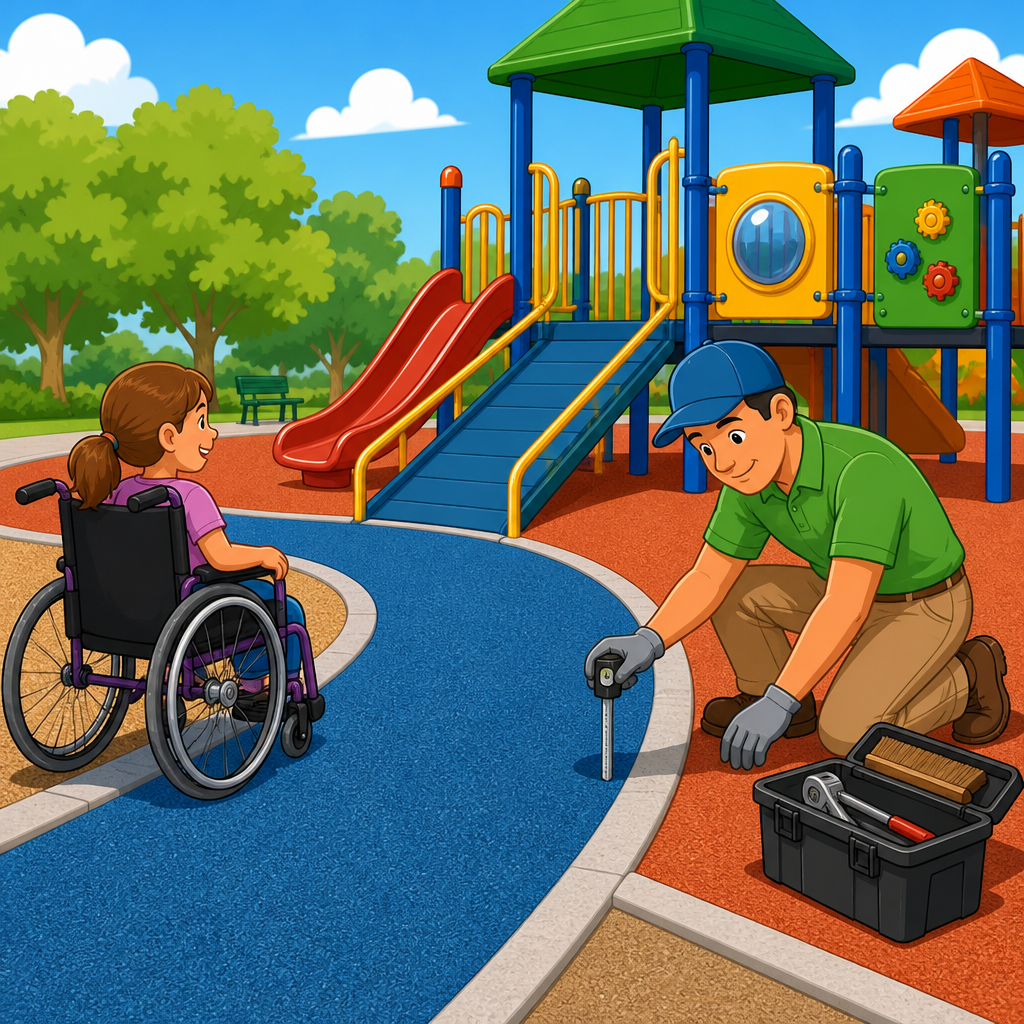
Accessible recreation depends on details that people often overlook, and playground surfacing is one of the most important. In parks, schools, churches, housing developments, and municipal play areas, the surface under and around equipment determines whether an accessible route remains truly usable after opening day. A compliant path at installation can become difficult, unstable, or unsafe within months if the surfacing is not maintained to recognized standards. For organizations responsible for recreation and sports facilities, that makes playground surfacing maintenance a core accessibility duty, not a cosmetic task.
Playground surfacing refers to the material used in use zones, circulation paths, and entry points around play components. Common types include engineered wood fiber, poured-in-place rubber, rubber tiles, bonded rubber, and synthetic turf systems designed for play. ASTM maintenance standards and performance tests provide the benchmark for how these materials should perform over time, especially for impact attenuation, firmness, stability, drainage, and accessibility. In practice, keeping an accessible route usable means inspecting the surface, correcting displacement and compaction, maintaining clear widths and slopes, and documenting repairs before conditions create barriers for wheelchair users, parents with mobility devices, or children using walkers and gait trainers.
This matters because accessible play is not limited to a ramp onto one structure. The route must connect parking, entrances, transfer systems, ground-level play components, and amenities such as benches or shade areas. I have seen many otherwise well-designed playgrounds lose usability because loose-fill surfacing migrated from edges, unitary surfacing developed curled seams, or water pooled at transitions. Recreation and sports facilities succeed when accessibility is treated as an ongoing operations issue. This hub explains how surfacing choices, ASTM maintenance practices, inspection routines, and facility management decisions work together to preserve access across playgrounds and related recreation environments.
Why Playground Surfacing Determines Whether Accessibility Lasts
Accessible routes in recreation and sports facilities must do more than exist on plan sheets. They must remain firm, stable, and slip resistant enough for everyday travel in real weather, under repeated use, and after seasonal wear. On playgrounds, surfacing is exposed to intense stress: foot traffic concentrates at slide exits, under swings, around spinners, and at transfer platforms; drainage patterns shift after storms; maintenance crews cross the area with carts; freeze-thaw cycles expand and contract edges. Each of those conditions affects whether a wheelchair caster tracks smoothly or stops at a lip, rut, or soft spot.
Loose-fill products such as engineered wood fiber can support accessibility when properly installed and maintained, but they require active management. Fibers compact where users travel and disperse where children kick, run, or land. This creates low areas, changing elevations, and exposed hard edges along borders or equipment footings. In contrast, unitary systems such as poured-in-place rubber usually provide more consistent wheelchair mobility, yet they are not maintenance free. Wear layers can separate, high-use points can crater, and ultraviolet exposure can harden or embrittle the surface. The central lesson is simple: no surface stays accessible by default.
For facility operators, surfacing affects risk, equity, and budget at the same time. A rough transition can exclude a child using a power wheelchair from reaching a panel or play table. A degraded impact surface can also increase injury exposure. Because surfacing touches both accessibility and safety, maintenance decisions should be coordinated between ADA compliance staff, risk managers, playground inspectors, and grounds teams. That cross-functional approach is especially important on multi-use sites where the playground sits alongside courts, walking loops, splash pads, athletic fields, and restrooms, all of which form part of the broader recreation accessibility network.
Key Standards and Tests That Guide Maintenance Decisions
The most important technical references for playground surfacing come from ASTM. ASTM F1292 addresses impact attenuation, meaning the ability of a surface system to reduce head injury risk in falls. ASTM F1951 measures accessibility performance for wheelchair movement by evaluating firmness and stability. ASTM F2223 covers guide specifications for performance of surfacing under and around playground equipment, and ASTM F2075 addresses engineered wood fiber. These documents serve different purposes, but together they shape how owners select, inspect, and maintain surfacing systems over time.
For day-to-day operations, ASTM F1951 is the standard most directly tied to whether the accessible route remains usable. If a surface no longer provides the firmness and stability needed for wheelchair travel, accessibility has deteriorated even if the material still looks acceptable from a distance. That distinction matters. I have reviewed sites where engineered wood fiber appeared level, but compacted wheel tracks and loose side scatter made independent movement difficult. I have also seen rubber surfaces pass a casual visual check while seam failure created enough vibration and resistance to discourage use.
Impact performance cannot be separated from accessibility. A playground operator may be tempted to top off loose-fill only where depths look low, but overfilling without proper leveling can alter route conditions and transitions. Likewise, a repair patch on poured-in-place rubber that restores fall protection but leaves a raised edge can create a mobility barrier. The right maintenance approach therefore balances two questions at once: does the surface still protect children in falls, and does it still permit usable access to the play experience? Standards-based maintenance answers both.
Common Surfacing Types in Recreation and Sports Facilities
Engineered wood fiber remains common because upfront cost is lower than many unitary systems and drainage can perform well when the base is designed correctly. However, it demands the most frequent maintenance. Fibers migrate, compact, decompose gradually, and need replenishment. Accessibility usually depends on regular raking, rolling, topping off, and edge checks. Facilities with limited staffing often underestimate this workload, especially on busy school or park sites where daily use is high.
Poured-in-place rubber offers continuous access and smoother mobility for many users. It is frequently the preferred choice where independent travel is a priority. The tradeoff is lifecycle cost. Repairs must match the existing system, substrate problems can telegraph through the surface, and poor installation details at drains, curbs, or equipment posts often become weak points. Rubber tiles can simplify localized replacement, but seams and adhesive failures require monitoring. Synthetic turf playground systems can support accessible circulation when properly specified with suitable infill and pad design, yet edge transitions and infill displacement need attention.
| Surface type | Primary accessibility advantage | Main maintenance challenge | Typical best-fit setting |
|---|---|---|---|
| Engineered wood fiber | Lower initial cost with accessible performance when compacted correctly | Migration, compaction loss, frequent replenishment | Parks with active maintenance crews |
| Poured-in-place rubber | Consistent wheelchair mobility and seamless routes | Wear-layer damage, cracking, expensive repairs | High-use inclusive playgrounds |
| Rubber tiles | Predictable travel surface and modular replacement | Seam separation, edge curl, adhesive failure | Smaller sites needing localized repair options |
| Synthetic turf systems | Attractive appearance with broad circulation areas | Infill movement, edge transitions, drainage issues | Play spaces integrated with landscape design |
How to Keep an Accessible Route Usable After Installation
A usable accessible route starts with identifying the full circulation network, not just the obvious path from gate to structure. On a recreation site, that route may include accessible parking access aisles, sidewalks, curb ramps, entry plazas, the play perimeter, equipment approaches, shade shelters, and connections to toilets or drinking fountains. Maintenance staff should map these segments and inspect them as one system. The route fails when any one link becomes difficult to traverse.
Routine inspection should focus on measurable conditions. For loose-fill surfaces, staff should check depth, displacement at exits and around swings, compaction on main travel lines, and containment at borders. For unitary materials, inspect seams, cracks, color-layer loss, depressions, ponding, vandalism cuts, and edge transitions to concrete or asphalt. Slopes should be reviewed where settlement may have occurred. Documentation matters: note date, weather, observed condition, corrective action, and follow-up. Photographs taken from the same viewpoint over time are useful for spotting progressive failure.
The best maintenance programs tie inspection frequency to use intensity and season. A neighborhood playground may need weekly checks, while a busy destination playground or school site may justify daily visual review plus formal monthly documentation. After heavy rain, snowmelt, special events, or freeze-thaw periods, surfaces should be reevaluated promptly. Fast response prevents small defects from becoming access barriers. For example, replacing a short section of failed tile edge early is far cheaper than waiting until the underlying base erodes and a larger area must be rebuilt.
Maintenance Planning for the Full Recreation and Sports Facilities Hub
Playgrounds sit within a wider family of recreation and sports facilities covered by accessibility standards, and surfacing decisions often influence adjacent amenities. An inclusive route may connect a playground to a picnic area, baseball spectator seating, a splash pad, an outdoor fitness zone, or a community center entrance. If one segment uses stable concrete and the next transitions to degraded loose-fill, the overall experience becomes fragmented. That is why this page serves as a hub: recreation accessibility must be managed as a connected system.
In practical terms, facility managers should align playground surfacing maintenance with broader site policies for inspection, procurement, and capital planning. The same work order platform used for trails, courts, and bleachers should track playground route issues. Staff training should cover mobility barriers in plain language, including caster snag points, abrupt level changes, soft zones, and narrowed clear widths. When replacement cycles are budgeted, owners should compare lifecycle performance rather than only first cost. A surface that requires weekly labor and frequent replenishment may cost more over ten years than a higher-priced unitary installation.
This broader view also helps with internal linking and content planning across the recreation topic. Supporting pages under this hub typically include accessible routes in parks, picnic and camping access, sports court circulation, aquatic facility entries, trail surfaces, and spectator accommodation. Playground surfacing is one of the clearest examples of how standards and operations intersect, but the principle applies throughout the subtopic: accessibility is preserved through maintenance, inspection, and informed reinvestment, not through design alone.
Procurement, Documentation, and When Replacement Is the Right Choice
Many accessibility problems begin in procurement language. Specifications that simply call for “ADA compliant surfacing” are too vague to protect owners. Contracts should identify the surfacing system, required test documentation, substrate preparation, drainage assumptions, warranty terms, transition details, and post-installation maintenance responsibilities. If engineered wood fiber is selected, include expectations for compaction, containment, replenishment intervals, and field accessibility verification. If a unitary system is selected, require repair procedures and compatible patch materials from the manufacturer.
Documentation after opening is equally important. Keep installation records, product data, inspection logs, invoices for repairs, and any field test results. This history helps distinguish normal wear from installation defects and supports defensible decisions if a user complaint arises. On several projects, maintenance logs made the difference between a disputed warranty denial and a successful corrective claim because the owner could show that cleaning, inspection, and repairs were performed consistently.
Replacement becomes the right choice when recurring repairs no longer restore usable access or when underlying base and drainage failures keep returning. A poured-in-place system with widespread cracking over a settling base is rarely fixed by surface patching alone. Engineered wood fiber that repeatedly washes out because of grade and runoff problems will continue to create barriers unless the drainage design is corrected. The goal is not to preserve a product indefinitely; it is to preserve access. When replacement best achieves that outcome, delaying it usually costs more in labor, complaints, and lost usability.
Playground surfacing and ASTM maintenance are central to keeping an accessible route usable across recreation and sports facilities. The core ideas are straightforward: choose surfacing with full lifecycle demands in mind, use ASTM standards to evaluate performance, inspect the route as a complete circulation system, and repair defects before they interrupt access. Accessibility on a playground is not secured when the ribbon is cut. It is secured when a child using a wheelchair can still move from the parking area to meaningful play options months and years later.
For organizations managing ADA Accessibility Standards across parks and recreation assets, this hub should guide both policy and field practice. Playgrounds connect directly to related topics such as park paths, aquatic venues, sports amenities, picnic areas, and spectator spaces. In each case, the lesson is the same: design establishes the opportunity for access, but maintenance preserves it. Review your current surfacing type, compare your inspection process to ASTM-based best practice, and identify where route conditions are most likely to degrade first.
If you oversee a playground, school campus, park system, or community recreation site, start with a documented surfacing audit this month. Walk the route, test the transitions, check the wear points, and update your maintenance plan before the next season of heavy use. Consistent attention keeps accessible routes usable, protects investment, and ensures recreation remains open to everyone.
Frequently Asked Questions
Why does playground surfacing maintenance matter so much for keeping an accessible route usable?
Playground surfacing maintenance matters because accessibility is not just about how a playground looks on opening day; it is about whether people can continue to move through and use the space safely over time. The accessible route in and around a play area depends heavily on the surface remaining firm, stable, and predictable for wheelchair users, people using walkers or canes, caregivers pushing mobility devices, and children with balance or sensory needs. When surfacing shifts, compacts unevenly, erodes, separates, or develops ruts and depressions, a route that was once easy to navigate can quickly become difficult or unusable.
This is especially important in high-use settings such as schools, parks, churches, apartment communities, and municipal playgrounds, where weather, drainage, foot traffic, and repeated play activity can change the performance of the surface in a short period of time. Loose-fill materials can migrate away from travel paths and around equipment entry points. Unitary surfaces can crack, curl, harden, or develop edge transitions that create resistance or trip hazards. Even a small change in slope, level, or surface consistency can affect usability for someone relying on smooth, dependable movement.
Maintenance also matters because surfacing serves more than one role. It supports accessibility, but it also contributes to fall attenuation, drainage performance, cleanliness, and overall risk management. If an owner overlooks maintenance, the result may be a playground that technically exists but no longer delivers meaningful access. In practical terms, keeping the accessible route usable requires regular inspection, prompt correction of wear, and an ongoing understanding of how the selected surfacing system performs under real-world conditions.
What ASTM standards are most relevant when maintaining playground surfacing?
Several ASTM standards are commonly referenced when evaluating and maintaining playground surfacing, and each one serves a slightly different purpose. One of the most important is ASTM F1292, which addresses impact attenuation, or how well a surface helps reduce the severity of injuries from falls. This standard is central to safety maintenance because a surface may still appear intact while no longer performing adequately in critical fall zones due to age, compaction, contamination, or material breakdown.
Another key standard is ASTM F1951, which focuses on the accessibility of surface systems under and around playground equipment. This standard is especially relevant to accessible routes because it measures how usable a surface is for mobility devices in terms of firmness and stability. If a surface no longer performs in a way that supports maneuverability, transfers, and circulation, accessibility can be compromised even if the area still looks acceptable from a distance.
ASTM F2223 is also important because it provides guidance related to the performance, installation, inspection, and maintenance of surfacing systems. It helps owners and operators understand that surfacing is not a one-time purchase but an ongoing operational responsibility. In addition, ASTM F1487, the broader playground equipment safety standard, includes requirements and references related to use zones, entanglement, entrapment, and surfacing interfaces that can affect how the ground plane functions around equipment.
For owners and managers, the practical takeaway is that ASTM compliance is not a static label. It is a continuing maintenance issue. A surface can meet the appropriate criteria at installation and later drift out of compliance if it is not inspected, tested, repaired, and documented on a routine basis. Working with knowledgeable installers, inspectors, and maintenance staff is often the best way to align day-to-day upkeep with these standards.
How often should playground surfacing be inspected and maintained?
Playground surfacing should be inspected on a schedule that reflects both manufacturer guidance and the actual conditions of the site. In general, a combination of routine visual checks, more detailed periodic inspections, and annual or scheduled professional evaluations is the most effective approach. High-use sites or locations exposed to severe weather may require more frequent attention than lightly used private facilities. The key is consistency. Small surface problems are much easier and less expensive to correct before they become widespread access or safety failures.
Routine visual inspections may happen daily or weekly depending on traffic levels. Staff should look for obvious issues such as displaced loose-fill material, exposed edges, pooling water, cracks, separated seams, worn paths, low areas at slide exits, or transitions that have become abrupt. These checks help identify problems that affect immediate usability and can often be addressed quickly through raking, topping off, cleaning, or cordoning off a damaged section until repairs are made.
More detailed inspections should be performed regularly to evaluate depth, compaction, drainage behavior, trip hazards, and the condition of high-stress areas such as access points, transfer stations, swings, and spinners. Over time, these locations tend to show wear first. For unitary systems, this may include checking for delamination, shrinkage, hardening, or bond failure. For engineered wood fiber or other loose-fill options, it may include measuring depth, checking for migration, and verifying that the route remains firm and stable enough for use.
Many owners also benefit from scheduled testing or third-party review, especially where compliance, liability, and public access are major concerns. Documentation is an important part of maintenance as well. Keeping records of inspections, repairs, replenishment, and testing helps demonstrate a good-faith effort to preserve both accessibility and safety. In short, there is no one-size-fits-all interval, but there should always be a written plan, a responsible party, and a repeatable process.
What are the most common signs that an accessible playground surface is starting to fail?
The earliest signs of surface failure are often subtle, which is why they are easy to miss until they begin affecting users directly. One of the most common warning signs is unevenness. This may appear as low spots, wheel ruts, depressions at play component entries, mounding in loose-fill materials, or differential settling between adjacent sections. These issues can make it harder for a child using a mobility device to travel independently and can create instability for anyone with limited balance.
Another common sign is a change in how the surface feels under use. If a wheelchair becomes harder to push across a route that was previously usable, if a walker catches unexpectedly, or if caregivers begin avoiding certain pathways because they are too soft or irregular, the surface may no longer be providing the firmness and stability needed for access. On unitary systems, cracks, lifting edges, seam separation, and worn-through top layers are strong indicators that maintenance or replacement is needed. On loose-fill surfaces, displaced material, exposed sub-base, compacted zones, and persistent thin spots often signal declining performance.
Drainage problems are another major red flag. Standing water, muddy conditions, erosion, or repeated washouts can quickly undermine both accessibility and safety. Moisture issues may point to deeper problems with the base, grading, or edge containment. In some cases, what appears to be a surfacing problem is really a site drainage problem that needs to be corrected to preserve the route long term.
Finally, user complaints should be treated as valuable evidence. If parents, therapists, teachers, or visitors report that a route feels rough, unstable, or inaccessible, those concerns deserve immediate evaluation. Surface failure is not always dramatic. Sometimes it shows up first as reduced independence, extra effort, or avoidance by the very people the accessible route is meant to serve.
What can owners and operators do to extend the life of playground surfacing and stay ahead of accessibility problems?
The best way to extend the life of playground surfacing is to treat maintenance as part of normal facility operations rather than an occasional repair project. That starts with choosing the right surface for the site’s budget, climate, traffic level, and maintenance capacity. Some systems require more frequent hands-on upkeep than others, and owners should be realistic about what their staff can support over time. A surface that performs well in theory may not remain accessible in practice if routine maintenance is neglected.
Once the playground is open, proactive care makes a major difference. For loose-fill surfaces, that means regular raking, redistribution, depth checks, and replenishment, especially in high-displacement areas. For unitary surfaces, it means cleaning, monitoring seams and edges, addressing drainage issues quickly, and repairing damaged sections before deterioration spreads. Keeping nearby trees, irrigation, and runoff under control can also reduce premature wear. Good drainage design and edge containment are especially important because they directly affect long-term usability.
Training staff is another smart step. The people who inspect grounds or supervise facilities should know what accessible surfacing problems look like, where wear tends to happen first, and when a condition rises from routine upkeep to a compliance or safety concern. It is also wise to keep manufacturer maintenance instructions on file and follow them closely, since some repairs and cleaning methods can affect product performance or warranty coverage.
Finally, owners should maintain a written inspection and repair log and budget for surfacing upkeep just as they would for playground equipment, landscaping, or building systems. Accessibility does not preserve itself. It is sustained through observation, documentation, and timely action. When organizations plan for maintenance instead of reacting to failure, they are far more likely to keep the accessible route usable, safe, and welcoming for everyone who depends on it.