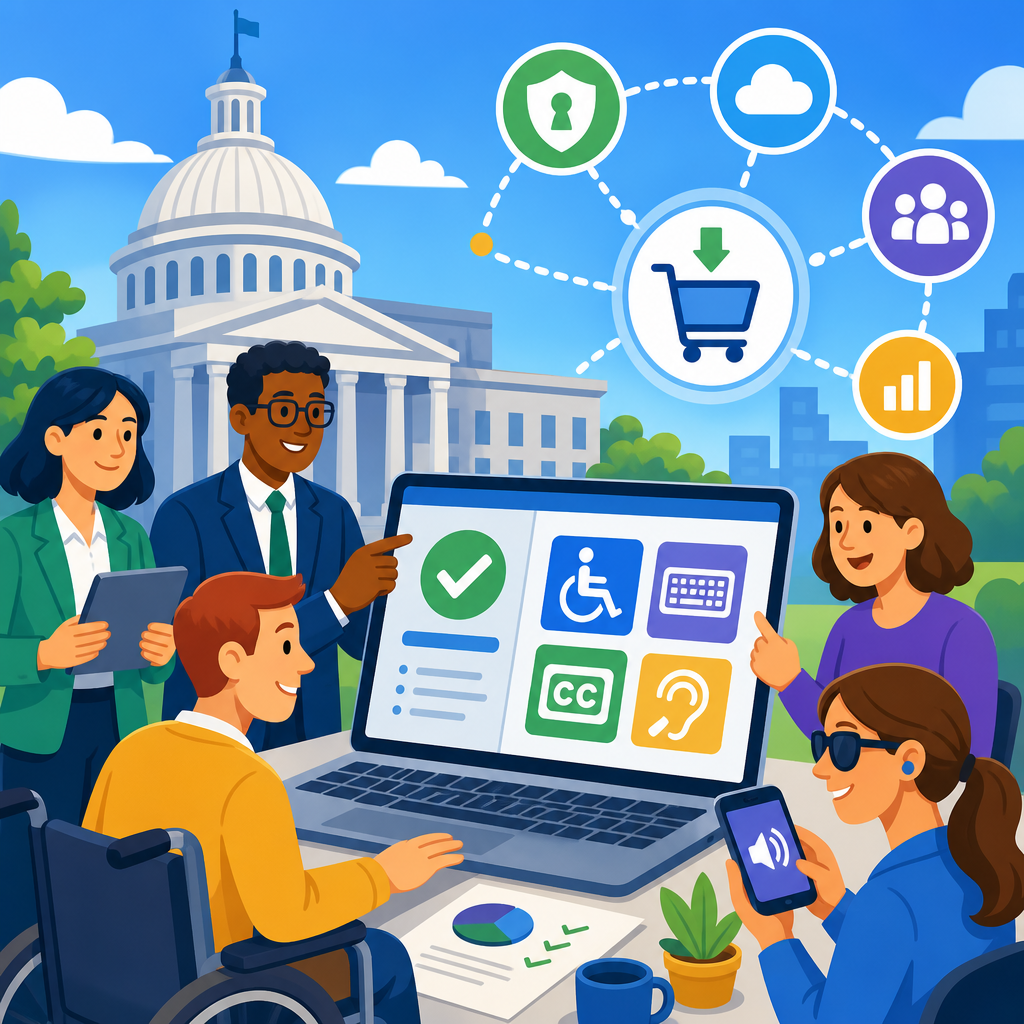
Government technology procurement trends are reshaping accessibility expectations, and agencies that buy software, hardware, and digital services now influence how inclusive public technology becomes for millions of people. In practice, procurement means the policies, standards, and contract steps governments use to evaluate, purchase, and manage technology. Accessibility, in this context, means digital tools and electronic information that people with disabilities can use effectively, including compatibility with screen readers, keyboard navigation, captions, color contrast, voice input, and plain-language design. ADA developments in technology and accessibility matter because public agencies increasingly deliver essential services online, from benefits enrollment and job applications to court records, public meetings, and transit alerts. When procurement rules require accessible products, vendors build better systems from the start; when requirements are weak, barriers become embedded in contracts, codebases, and citizen services for years. I have seen this firsthand in public-sector reviews where one inaccessible procurement decision forced expensive remediation after launch. This article explains the government technology procurement trends affecting accessibility, with emphasis on the ADA’s practical impact, related federal standards, enforcement pressure, and the operational shifts agencies and vendors should expect.
Why procurement now drives accessibility outcomes
Procurement has become one of the strongest levers for accessibility because it influences technology before implementation begins. A government agency can train staff on accessibility and publish inclusive design guidance, but if its contracts do not require accessible platforms, templates, and support services, those efforts fail quickly. The most important shift is that accessibility is moving from a discretionary feature to a baseline buying criterion. Agencies increasingly ask for conformance with WCAG 2.1 AA, compatibility with assistive technology, documented testing results, and remediation commitments tied to service-level obligations. That change reflects legal risk, public pressure, and a simple operational reality: inaccessible systems generate complaints, manual workarounds, and reputational damage.
The ADA is central to this shift even when contracts cite multiple authorities. Title II applies to state and local government services, programs, and activities, including digital offerings. Section 504 applies to entities receiving federal financial assistance, and Section 508 governs federal agencies’ information and communication technology. In real procurements, these frameworks work together. A city buying a new permitting platform may reference ADA obligations, incorporate WCAG-based technical requirements, and borrow procurement language derived from Section 508 practice. The result is broader harmonization. Vendors that once treated accessibility as a federal-only issue now encounter similar expectations in counties, school systems, transit authorities, and public universities.
Another reason procurement matters is timing. Accessibility defects are cheapest to address during requirements definition, architecture selection, design system setup, and content model planning. They are far more expensive after deployment, especially when a legacy enterprise platform is deeply integrated with identity systems, document workflows, payment processing, and archived records. Agencies have learned this through hard experience. A procurement office that requires an accessibility conformance report before award can avoid years of exceptions, custom patches, and citizen complaints later. That is why current government technology procurement trends increasingly emphasize due diligence, not just promises.
Standards convergence around WCAG, Section 508, and vendor documentation
The strongest procurement trend is convergence around common technical benchmarks. WCAG 2.1 Level AA has become the dominant accessibility target in government solicitations because it is specific enough to evaluate and broad enough to apply across web content, mobile experiences, and many software interfaces. Although the ADA itself does not list every technical criterion line by line, agencies often rely on WCAG because it provides testable success criteria covering perceivability, operability, understandability, and robustness. Procurement teams also continue to use Section 508 requirements and the Revised 508 Standards as a practical framework, especially for federal contracts and for state or local entities modeling established federal language.
Vendor documentation has become more important as agencies seek evidence, not generic assurances. The most common example is the Voluntary Product Accessibility Template, usually called a VPAT, which vendors use to describe how their products support accessibility requirements. A completed VPAT is not proof of compliance, and experienced buyers know that. Still, it is a useful screening tool when it is current, product-specific, and technically credible. In the last several years, better procurement teams have stopped accepting boilerplate VPATs at face value. They ask who authored the report, what version of the product was tested, which assistive technologies were used, what exceptions remain, and how quickly defects are typically fixed.
This documentation trend is producing more disciplined buying behavior. Agencies now request accessibility roadmaps, sample test scripts, issue severity classifications, and references from comparable public-sector deployments. They may ask whether the product supports screen readers such as JAWS, NVDA, and VoiceOver; whether keyboard focus order is logical; whether PDFs generated by the system are tagged; and whether video content includes synchronized captions and audio description workflows. These questions are increasingly standard because governments cannot rely on surface-level claims. Procurement is becoming a verification function, and accessibility is one of its most scrutinized dimensions.
How solicitation language and evaluation criteria are changing
Government solicitations are becoming more explicit about accessibility obligations across the full contract lifecycle. Older requests for proposals often included a single line stating that the vendor must comply with applicable accessibility laws. Newer documents usually break the issue into measurable requirements: pre-award disclosures, mandatory demonstrations, defect remediation timelines, compatibility testing, training deliverables, and content governance expectations. This is a major procurement trend because it treats accessibility as an operational capability rather than a legal footnote.
Evaluation criteria are changing as well. Agencies increasingly score accessibility separately instead of burying it under technical fit. That matters because weighted scoring changes vendor behavior. If accessibility accounts for ten or fifteen percent of the technical evaluation, suppliers devote resources to better testing, clearer product documentation, and stronger implementation planning. I have seen bids lose credibility immediately when they relied on a generic “compliant by design” statement but could not explain how modals behave with screen readers or how exported reports remain accessible.
| Procurement element | Older approach | Current accessibility-focused approach |
|---|---|---|
| Requirements | General legal compliance clause | Specific WCAG and assistive technology requirements |
| Vendor evidence | Brief promise of compliance | Current VPAT, test results, defect log, roadmap |
| Product demo | Feature walkthrough only | Keyboard-only, screen reader, zoom, caption demonstrations |
| Contract terms | Accessibility omitted after award | Remediation deadlines, acceptance criteria, support obligations |
| Governance | One-time review | Ongoing testing after updates and content changes |
This shift also affects negotiations. Agencies now ask for warranties tied to accessibility representations, audit rights, escalation paths, and commitments to maintain conformance after upgrades. Those details matter because accessibility regressions commonly appear during redesigns, framework migrations, and third-party integrations. Strong procurement language reduces ambiguity when defects emerge. It also helps internal teams align procurement, legal, security, UX, and compliance functions around a shared standard.
Enforcement pressure, litigation risk, and the ADA’s expanding digital reach
Another major trend is that procurement decisions are increasingly shaped by enforcement risk. The Department of Justice has repeatedly signaled that inaccessible digital services can violate the ADA, and public entities have faced investigations, settlement agreements, and lawsuits over websites, mobile applications, online forms, learning platforms, and self-service kiosks. Even when a case does not produce a headline judgment, the operational burden is substantial. Agencies must inventory systems, remediate legacy content, retrain teams, and monitor progress under strict deadlines. Procurement officers have noticed that accessibility failures are not abstract compliance problems; they become budget, staffing, and service-delivery problems.
The practical effect is that accessibility due diligence now appears earlier in acquisition planning. A county choosing a records portal may ask whether inaccessible search tools could block residents from obtaining public information. A transit authority procuring digital signage and trip-planning software may evaluate not only website accessibility but also audible announcements, contrast standards, and tactile or mobile alternatives. A public university adopting courseware may review whether quizzes, discussion boards, STEM content, and proctoring tools work with screen readers and captioning systems. These are ADA developments in technology and accessibility because they extend accessibility expectations beyond the public homepage into every procured digital interaction.
Litigation risk also exposes a common misconception: agencies cannot outsource responsibility simply because a vendor built the platform. If a public service is inaccessible, the agency remains accountable to the public. That reality is pushing governments to demand stronger indemnification language, clearer remediation obligations, and better post-launch support. It is also encouraging procurement teams to involve disability stakeholders and accessibility specialists before award. When agencies listen to actual users with disabilities, they identify defects that polished sales demos routinely hide.
Emerging technologies, legacy modernization, and practical buying decisions
Government buying patterns are also being shaped by rapid technology change. Cloud platforms, low-code tools, AI-assisted services, chat interfaces, biometric systems, and smart kiosks promise efficiency, but they also create new accessibility questions. For procurement teams, the trend is not rejecting innovation; it is demanding accessible implementation evidence before scaling it. A chatbot used for benefits screening must support screen readers, keyboard controls, clear error messaging, and escalation to human assistance. An AI transcription tool may reduce captioning costs, but it still needs quality review, speaker identification, punctuation accuracy, and multilingual support. A facial recognition access system may need an accessible alternative for users who cannot interact with it reliably or safely.
Legacy modernization creates a second pressure point. Many agencies are replacing aging mainframe-adjacent portals or heavily customized content management systems. During modernization, procurement choices determine whether accessibility debt is retired or simply migrated into a newer interface. Smart agencies now require accessibility checkpoints in discovery, design, user acceptance testing, and release management. They also evaluate design systems and component libraries because reusable accessible components lower long-term risk. For example, an accessible date picker, modal pattern, and form validation framework can prevent repeated errors across dozens of agency services.
Buyers should also distinguish between product accessibility and implementation accessibility. A platform may technically support accessible templates, but if the vendor’s implementation team populates unlabeled forms, inaccessible PDFs, or noncompliant color palettes, the live service still fails users. That is why procurement trends now include training, governance, and content migration requirements. Accessibility is not a procurement checkbox completed at contract signature; it is a performance obligation sustained through deployment and maintenance.
What agencies and vendors should do next
The direction of travel is clear: government technology procurement is becoming more evidence-based, more standardized, and less tolerant of vague accessibility claims. Agencies should update solicitation templates, require current accessibility documentation, score accessibility explicitly, and include users with disabilities in evaluations. They should align procurement with legal, digital, and content teams so that accessibility requirements remain consistent from planning through operations. Vendors should invest in continuous testing, maintain accurate VPATs, document known issues honestly, and train sales and implementation staff to answer detailed accessibility questions. The strongest suppliers now treat accessibility as a product quality discipline, not a customized concession for a few contracts.
For anyone tracking ADA developments in technology and accessibility, procurement is the hub issue because it connects law, design, engineering, budgeting, and public trust. Better procurement language produces better products. Better evidence produces better buying decisions. Better contracts produce faster remediation when problems appear. The benefit is tangible: residents can apply for services, attend meetings, access records, and complete everyday civic tasks without avoidable barriers. Review your current procurement standards, compare them against modern accessibility expectations, and make the next technology purchase the point where inclusion becomes enforceable rather than aspirational.
Frequently Asked Questions
1. How are government technology procurement trends changing accessibility expectations?
Government technology procurement is increasingly moving accessibility from a secondary compliance issue to a core purchasing requirement. When agencies buy software, hardware, cloud platforms, communication tools, kiosks, or digital services, they are now more likely to evaluate whether those products can be used effectively by people with disabilities before contracts are awarded. This shift matters because procurement decisions do not just affect internal staff. They also shape how residents, students, veterans, patients, and other members of the public interact with government services every day.
Several trends are driving this change. First, accessibility is being written more directly into solicitations, requests for proposals, contract language, and vendor qualification requirements. Second, agencies are paying closer attention to recognized standards such as Section 508 requirements and the Web Content Accessibility Guidelines, often expecting vendors to document conformance through accessibility statements, testing reports, or Voluntary Product Accessibility Templates. Third, procurement teams are becoming more aware that inaccessible technology creates legal, financial, and operational risk. If a system cannot be used by employees or the public, agencies may face complaints, remediation costs, delays, and reduced trust.
As a result, vendors are under greater pressure to demonstrate accessibility early, not after deployment. The broader impact is significant: when public-sector buyers consistently prioritize inclusive design, they raise market expectations for all technology providers and improve access to essential services for millions of people.
2. Why does accessibility matter so much in government procurement specifically?
Accessibility matters in government procurement because public agencies provide essential services that people cannot simply opt out of using. Whether someone is applying for benefits, accessing health information, paying taxes, completing school-related forms, attending a public meeting, or applying for a job, the technology behind those services must work for people with a wide range of disabilities. If an online form is incompatible with screen readers, a video lacks captions, a kiosk cannot be navigated without touch, or a document is unreadable by assistive technology, the result is more than inconvenience. It can become a barrier to civic participation, employment, education, healthcare, and basic government access.
Procurement is one of the most effective points to address this issue because it influences technology choices before systems are implemented. It is far easier and more cost-effective to require accessibility during planning and purchasing than to fix inaccessible products after deployment. Procurement also gives agencies leverage. By making accessibility a condition of doing business, governments can push vendors to improve product design, documentation, testing, and support.
There is also a strong legal and policy dimension. Government entities are often subject to federal, state, and local accessibility obligations, and procurement helps agencies align purchasing decisions with those responsibilities. Beyond compliance, accessibility supports better usability, stronger service delivery, and more equitable public outcomes. In other words, accessible procurement is not just about following rules. It is about making sure public technology actually serves the public.
3. What accessibility requirements are agencies looking for when evaluating technology vendors?
Agencies typically look for both documented accessibility commitments and practical evidence that a product works for users with disabilities. On the documentation side, procurement teams may request conformance information tied to standards such as Section 508 and WCAG. Vendors are often asked to provide a VPAT or similar accessibility conformance report, explain known limitations, and describe their remediation process. However, agencies are becoming more sophisticated and understand that paperwork alone is not enough.
In many cases, evaluators also want to know how accessibility is built into the vendor’s development lifecycle. That can include whether the company performs manual and automated testing, uses assistive technology during quality assurance, involves users with disabilities in product evaluation, trains its developers on accessible design, and maintains a process for fixing issues after launch. Agencies may also examine whether customer support materials, user guides, training resources, and help desks are accessible, since accessibility extends beyond the core product interface.
Another important factor is interoperability with assistive technologies and compatibility across devices and environments. Government buyers may ask whether a platform supports keyboard-only navigation, screen readers, captions, color contrast requirements, resizable text, error identification, and accessible authentication. For hardware and self-service systems, they may evaluate physical access features, tactile controls, speech output, and alternative input methods. Overall, the trend is toward deeper scrutiny: agencies want proof that accessibility is an ongoing capability, not a one-time claim included to win a contract.
4. How can poor procurement practices create accessibility problems later on?
Poor procurement practices often create accessibility problems that become expensive, visible, and difficult to fix after implementation. If an agency focuses only on price, speed, or technical features without evaluating accessibility in a meaningful way, it may end up purchasing tools that exclude employees or members of the public. Once that technology is integrated into operations, replacing it or remediating it can require additional funding, contract amendments, training changes, and service disruptions.
One common problem is treating accessibility as a checkbox rather than an evaluation criterion with real weight. For example, a vendor may submit a generic compliance statement, but if procurement staff do not verify it, the agency may discover too late that forms are inaccessible, documents cannot be read by assistive technology, or critical workflows fail for keyboard and screen-reader users. Another issue is failing to include accessibility requirements in contracts, service-level agreements, and acceptance criteria. Without enforceable terms, agencies may have limited ability to require timely fixes or hold vendors accountable.
Poor coordination across departments can also undermine outcomes. Procurement officers, IT teams, legal staff, accessibility specialists, and program managers may all play a role, but if they are not aligned, accessibility expectations can be inconsistent or incomplete. The result is often a reactive cycle: complaints are filed, emergency workarounds are created, and agencies spend more time and money fixing avoidable barriers. Strong procurement practices help prevent these problems by addressing accessibility early, clearly, and contractually.
5. What are the best practices for making government technology procurement more accessible?
The strongest approach is to embed accessibility throughout the entire procurement lifecycle rather than addressing it at the end. That starts with planning. Agencies should define accessibility needs at the earliest stage of a project, identify applicable legal and technical standards, and involve accessibility experts and end users where possible. During market research, agencies can ask vendors targeted questions about accessible design processes, testing methods, product roadmaps, and remediation timelines. This helps distinguish vendors with mature accessibility practices from those offering only minimal compliance language.
Solicitations should state accessibility requirements clearly and specifically. That includes referencing applicable standards, requiring detailed conformance documentation, asking vendors to disclose known issues, and making accessibility part of scoring criteria. Contracts should then reinforce those expectations with measurable obligations, such as remediation deadlines, accessibility testing before acceptance, ongoing maintenance responsibilities, and consequences for nonperformance. Agencies should also require that updates, new features, and support materials remain accessible over time.
Equally important is post-award oversight. Accessibility should be monitored during implementation, configuration, content creation, and maintenance, not just at procurement close. Agencies benefit from governance processes that include regular testing, user feedback, issue tracking, and vendor accountability reviews. Training is another best practice. Procurement officials, IT teams, and program leaders need enough accessibility literacy to ask informed questions and assess vendor responses. When these practices are in place, procurement becomes a powerful tool for reducing barriers, improving public service delivery, and building more inclusive digital government.


