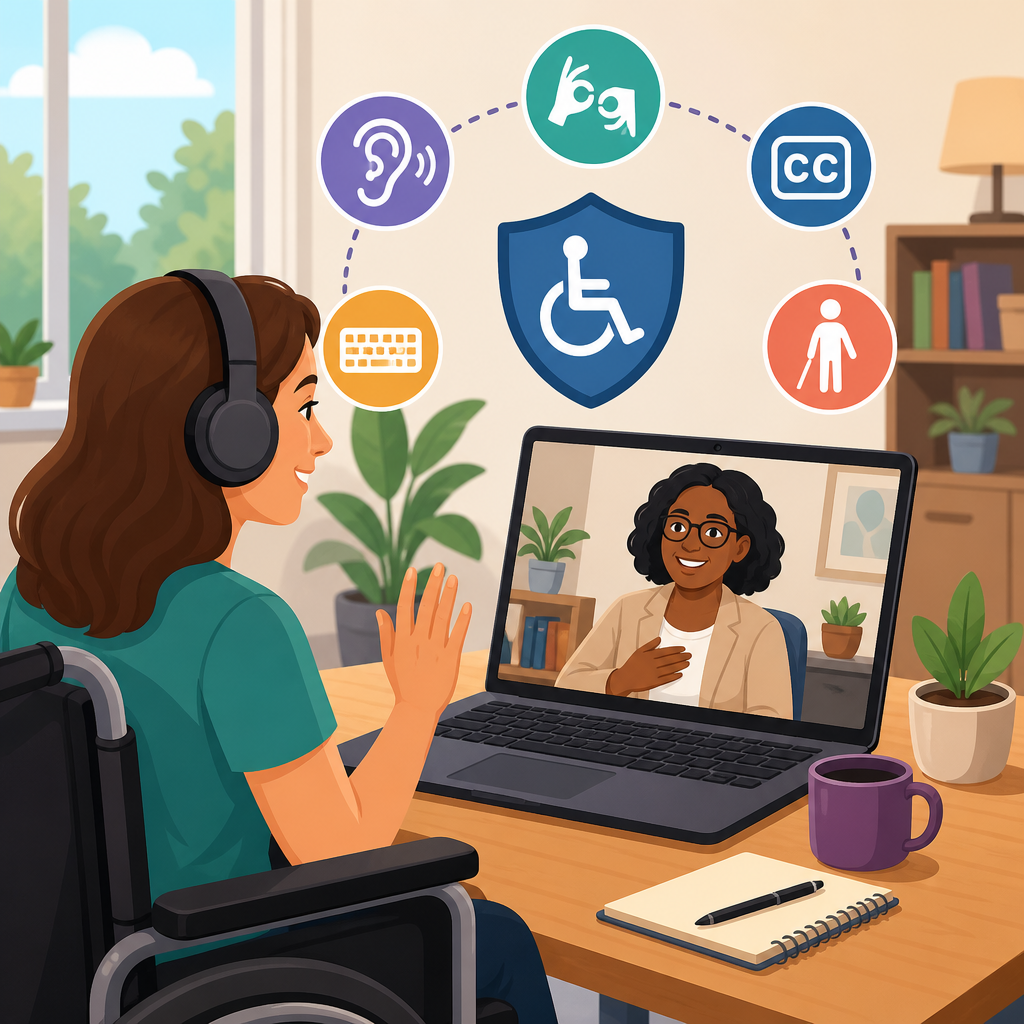
ADA rights in telehealth, telepsychology, and remote intake matter because disability access obligations do not disappear when care moves to a screen, an app, a portal, or a phone line. Patients still need effective communication, equal opportunity to participate, reasonable modifications to policies and procedures, and protection from screening practices that exclude them because of disability. In practice, these rights arise when a deaf patient needs accurate captioning for a therapy session, when a blind patient cannot complete a digital intake form with a screen reader, when an autistic patient needs a quieter communication method than a live video call, or when a person with limited hand dexterity cannot navigate a patient portal without keyboard access.
The legal foundation comes primarily from the Americans with Disabilities Act, especially Title II for public health systems and Title III for private providers that qualify as public accommodations, along with Section 504 of the Rehabilitation Act for federally funded programs. Telehealth refers broadly to remote delivery of healthcare services through video, audio, messaging, remote monitoring, and digital platforms. Telepsychology is remote mental health assessment and treatment provided by psychologists and related professionals through secure communication technology. Remote intake includes online registration, consent, screening questionnaires, scheduling, identity verification, and pre-visit communications that happen before treatment begins. These front-end processes are often where access failures occur first.
I have worked on accessibility reviews of patient portals, online forms, and virtual care workflows, and the recurring lesson is simple: access barriers in remote care are usually built into ordinary administrative choices, not exotic edge cases. A clinic picks a video platform without live caption support. A health system requires every patient to upload identification through a mobile interface that fails with screen readers. A counseling practice sends PDF intake packets that are image based, impossible to complete electronically, and unusable for patients with low vision or dyslexia. These are operational decisions, and they are fixable when organizations understand their obligations.
This hub page covers ADA rights in practice and emerging issues across telehealth, telepsychology, and remote intake so readers can recognize problems early and respond effectively. It explains what equal access means in remote care, where telehealth accessibility failures commonly happen, how providers should approach accommodations, what standards and tools matter, and which newer issues deserve close attention as virtual care expands. It also serves as the gateway topic for related articles on digital accessibility, communication access, intake forms, service animals during home based visits, language access interactions, algorithmic bias, and complaint options when a provider does not provide meaningful access.
What ADA rights require in remote healthcare settings
In remote care, ADA rights are not abstract principles; they translate into concrete duties. Providers must offer qualified patients with disabilities an equal chance to obtain healthcare services and benefits. They must make reasonable modifications when policies or procedures would otherwise block access, unless doing so would fundamentally alter the service. They must furnish appropriate auxiliary aids and services when needed for effective communication, unless doing so would create an undue burden or fundamental alteration. They cannot use eligibility criteria or intake methods that tend to screen out people with disabilities unless the criteria are necessary for the service being offered.
Effective communication is one of the most important concepts in telepsychology and telehealth. The Department of Justice and long standing ADA guidance treat communication access as a functional question: can the patient actually receive information, ask questions, give informed consent, and participate in care with substantially equivalent effectiveness? For a deaf patient, that may require a qualified sign language interpreter integrated into the video session or reliable real time captioning. For a blind patient, it may require an accessible portal, tagged documents, and verbal explanation of visual instructions. For a patient with a speech disability, it may mean permitting relay services, typed chat, or extended turn taking rather than insisting on a fast paced audio only call.
Remote settings also trigger the duty to modify standard workflows. If a practice normally requires all new patients to complete online intake before scheduling, it may need to offer telephone intake, accessible electronic forms, or staff assistance when the standard process is inaccessible. If identity verification depends on a smartphone camera and gesture based app controls, a provider may need an alternative method. If a telepsychology practice uses timed screening questionnaires that disadvantage people with cognitive disabilities, extra time or a supported completion option may be necessary.
Where access barriers usually appear first
Most organizations focus on the live appointment, but the most damaging barriers often arise earlier. Scheduling systems may be inaccessible to keyboard only users or incompatible with screen readers such as JAWS, NVDA, or VoiceOver. Automated reminders may be sent only by text, excluding patients who use TTY, relay, or alternate communication formats. Consent forms may require an electronic signature tool that cannot be operated without a mouse. Video platforms may lack pinning options for interpreters or may place captions over critical on screen content. Intake questionnaires may use color alone to identify errors, making completion difficult for users with low vision or color blindness.
Telepsychology adds another layer because rapport, privacy, sensory environment, and crisis planning can all affect accessibility. Some patients with PTSD, autism, traumatic brain injury, or certain anxiety disorders may communicate better through structured chat, audio only visits, or slower paced video sessions. Others need support persons present, breaks, simplified instructions, or written summaries after the appointment. A rigid one format model can become discriminatory if it ignores predictable disability related needs that can be accommodated without changing the essential nature of care.
Remote intake is particularly risky because it determines who gets through the door. Clinics often rely on third party software for registration, insurance collection, e-signatures, symptom screeners, and document uploads. If those vendors do not meet accessibility expectations, patients may be shut out before any clinician knows there is a problem. In audits, I routinely see inaccessible CAPTCHA challenges, unlabeled form fields, auto logouts that erase answers, and secure messages that cannot be opened by assistive technology users. These failures do not just frustrate patients; they can delay treatment and expose providers to legal complaints.
| Remote care stage | Common ADA issue | Practical accommodation or fix |
|---|---|---|
| Scheduling | Portal cannot be used with keyboard or screen reader | Offer accessible booking flow, phone scheduling, and staff-assisted scheduling |
| Intake forms | PDF or e-sign tool is inaccessible | Provide accessible web forms, tagged documents, or assisted completion |
| Video visit | No captioning or interpreter integration | Enable accurate captions and platform support for qualified interpreters |
| Telepsychology session | Standard format overwhelms patient sensory or cognitive needs | Allow breaks, alternate modalities, written prompts, or audio only options |
| Follow-up care | Instructions sent only in inaccessible format | Send accessible summaries, plain-language directions, and alternate formats |
Telehealth platform accessibility and recognized standards
Providers do not need to guess what accessible digital design looks like. The most widely used benchmark is the Web Content Accessibility Guidelines, currently version 2.1 and increasingly 2.2, especially Level AA success criteria. While WCAG is not the ADA itself, it is the practical standard most accessibility professionals, health systems, courts, and settlement agreements use when evaluating websites, portals, and web applications. For mobile apps, platform specific guidance from Apple and Google matters, but the same principles apply: perceivable content, operable controls, understandable workflows, and robust compatibility with assistive technology.
For telehealth, accessibility also includes communication and conferencing features beyond ordinary web design. A platform should support keyboard navigation, screen reader labels, sufficient color contrast, resizable text, clear focus indicators, accessible chat, interpreter spotlighting or pinning, controllable captions, and compatibility with relay services. If group therapy or family meetings are offered, the platform should manage multiple speakers without making captions unusable or crowding out an interpreter window. Security controls required by HIPAA should be implemented in ways that do not create unnecessary accessibility barriers.
Procurement is the point where many access failures can be prevented. Before adopting a telemedicine or intake vendor, providers should request a current VPAT, ask how accessibility testing was performed, and verify whether disabled users were included in usability reviews. A VPAT is not proof of accessibility, but it is a useful disclosure document when read critically. In my experience, the most reliable process combines contract language, technical review, real user testing, and a remediation timeline. Buying first and fixing later usually means patients encounter barriers for months or years.
Accommodation decisions, documentation, and limits
A provider does not have to grant every requested change exactly as asked, but it must engage seriously with the access need and provide an effective alternative when one exists. The patient’s preferred auxiliary aid or communication method deserves primary consideration in many contexts because the patient often knows what works best. If a deaf patient requests a qualified interpreter for a complex psychiatric intake, auto captions alone may not be enough. If a patient with low vision asks for large print forms but uses a screen reader more effectively, an accessible electronic form may be better than paper. The key is effectiveness, not convenience for the organization.
Documentation should focus on logistics, not suspicion. Staff should record the accommodation requested, what was provided, and whether it worked, then flag recurring needs in the chart or scheduling system so the patient is not forced to renegotiate access at every visit. Front desk scripts, scheduling notes, and telehealth reminders should include accommodation fields that actually trigger operational action. Good systems make access routine. Bad systems treat every request as an exception and leave patients to educate staff repeatedly.
There are limits. The ADA does not require modifications that would fundamentally alter the nature of a service or impose an undue burden, but those defenses are narrower than many providers assume. Cost alone is rarely the end of the analysis, especially for larger systems. The assessment should consider the resources of the organization as a whole, not just one department. If a requested remote format would compromise clinical standards or safety, the provider should explain why and look for another effective option rather than ending the conversation.
Emerging issues in telepsychology and remote intake
Several newer trends are changing how ADA rights are applied in practice. First, asynchronous care is expanding. Patients may complete mental health screeners, send symptom updates, receive psychoeducation, or communicate with clinicians through secure messaging rather than live visits. These systems must still be accessible. If a chatbot intake tool cannot handle screen readers, plain language needs, or speech input, it may unlawfully screen out disabled patients before care begins. If automated follow-up messages are impossible to read with assistive technology, continuity of care suffers.
Second, algorithmic triage and risk scoring are entering intake workflows. Systems may prioritize appointments based on symptom reports, prior utilization, language patterns, or engagement metrics. Disability bias can creep in when models treat communication differences, mobility limits, missed digital tasks, or psychiatric history as signals of lower suitability or higher risk without context. Providers remain responsible for the consequences of tools they deploy. Accessibility and nondiscrimination reviews should occur before implementation, not after complaints.
Third, identity verification and fraud prevention systems are becoming a major barrier. Facial matching tools can fail for people with certain physical differences, camera use can be impossible for some blind or motor impaired users, and rigid document upload rules can block legitimate patients. Equivalent verification pathways are essential. Fourth, remote care frequently intersects with licensing, emergency response planning, and home privacy concerns. A patient may need a support person, closed captions visible only to them, or backup communication methods if a crisis disrupts the primary platform. These are not edge considerations in telepsychology; they are part of competent care.
How providers and patients can protect access in practice
The most effective telehealth accessibility programs are operational, not symbolic. Providers should map the full patient journey from search and scheduling through follow-up, test each step with assistive technology, train staff on accommodation protocols, and monitor failures the same way they monitor privacy or billing errors. Accessibility should be included in vendor contracts, quality assurance, grievance procedures, and incident review. Patients should be told how to request accommodations before the first appointment, not after a failed visit.
Patients and advocates can improve outcomes by documenting barriers clearly: what service was sought, what technology was used, what access feature failed, what accommodation was requested, and how the provider responded. Screenshots, dates, call logs, and copies of inaccessible forms are useful. Many access problems are resolved quickly once they reach a compliance officer, practice manager, patient relations department, or disability services lead. When they are not, internal grievances, state licensing complaints, Section 504 complaints, or ADA enforcement pathways may be appropriate depending on the provider type.
ADA rights in telehealth, telepsychology, and remote intake are ultimately about usable care, not merely digital convenience. Equal access means patients with disabilities can schedule, consent, communicate, receive treatment, and follow care plans through remote systems that work in real life. The central lesson from current practice and emerging issues is straightforward: every remote touchpoint is part of healthcare delivery and must be designed, purchased, and managed accordingly. Use this hub as your starting point for the broader Rights and Protections subtopic, review related pages on specific barriers and remedies, and audit your own remote care process now before access failures become missed care.
Frequently Asked Questions
Do ADA protections still apply when healthcare or mental health services are provided through telehealth, telepsychology, or remote intake?
Yes. The ADA does not stop applying just because care is delivered through a video platform, patient portal, mobile app, online forms, text system, or phone line instead of in a physical office. If a provider, clinic, hospital, counseling practice, or healthcare system is covered by the ADA, its disability access obligations generally continue in digital and remote settings. That means patients with disabilities must still have an equal opportunity to schedule appointments, complete intake paperwork, communicate with providers, receive instructions, participate in treatment, and benefit from the service as a whole.
In practical terms, remote care must be accessible in the same meaningful way that in-person care must be accessible. A patient who is deaf or hard of hearing may need accurate real-time captioning, video relay access, or a qualified sign language interpreter for a therapy session or medical consultation. A blind patient may need a screen-reader-compatible portal and forms that can be completed without visual barriers. A patient with limited manual dexterity may need more time to complete remote intake or an alternative to drag-and-drop signature tools. A patient with an intellectual, cognitive, or psychiatric disability may need instructions presented in a clearer format or a modified process for reminders and follow-up steps.
The core legal idea is that disability access duties do not disappear when the “front door” becomes digital. Equal access, effective communication, reasonable modifications, and protection from exclusionary screening criteria still matter. If the technology itself creates barriers, the provider may need to change the platform, offer auxiliary aids and services, or modify procedures so that the patient can participate fully and safely.
What does “effective communication” mean in telehealth and telepsychology appointments?
Effective communication means the provider must communicate with a patient with a disability in a way that is as clear, accurate, timely, and meaningful as communication with other patients. In telehealth and telepsychology, this is especially important because so much of the interaction depends on audio, video, text, and digital interfaces. If a patient cannot hear the provider well, cannot see critical on-screen information, cannot understand complex remote instructions, or cannot use the platform’s communication features, the visit may not be truly accessible even if it technically takes place.
For example, a deaf patient may need more than auto-generated captions, especially if the session involves mental health counseling, medication discussion, informed consent, trauma history, or other nuanced and sensitive communication. In those situations, accuracy matters, and a qualified interpreter or high-quality real-time captioning may be necessary. A hard of hearing patient may need amplified audio, captioning, or the ability to type questions in real time. A blind or low-vision patient may need verbal descriptions of visual information shared on screen and documents that can be accessed with assistive technology. A patient with a speech disability may need extra time, alternative communication methods, or acceptance of relay services. A patient with cognitive disabilities may need simplified explanations, confirmation of understanding, and a slower-paced remote intake process.
Effective communication is not satisfied by offering whatever is easiest for the provider. The communication method has to actually work for the patient and for the specific medical or therapeutic context. The stakes in telepsychology can be especially high because a missed word, an inaccurate caption, or a platform that prevents full expression may interfere with diagnosis, rapport, safety planning, informed consent, and treatment outcomes.
Can a provider refuse accommodations by saying its telehealth platform or remote intake system cannot support them?
Not automatically. A provider cannot avoid ADA obligations simply by choosing a platform, vendor, or workflow that creates disability barriers. If the technology the provider uses makes communication ineffective or blocks a patient from participating, the provider may need to adopt reasonable modifications, provide auxiliary aids and services, or use a different method of delivering care. In other words, the patient should not bear the consequences of an inaccessible technology choice when accessibility could reasonably be addressed.
This issue comes up often with remote intake forms, identity verification tools, e-signature systems, waiting room links, and therapy platforms. A portal may time out too quickly for someone using assistive technology. A form may not be readable by a screen reader. A required video check-in process may exclude a patient who cannot use the interface because of vision, dexterity, speech, or cognitive limitations. A therapy platform may lack accurate captioning or may not allow an interpreter to join easily. In these situations, the provider should consider alternatives such as accessible forms, staff-assisted intake by phone, extended completion times, interpreter integration, accessible PDFs or HTML forms, alternative login procedures, or a different telehealth platform entirely.
The ADA generally expects covered entities to make reasonable changes unless doing so would fundamentally alter the service or create an undue burden. That is a fact-specific analysis, not a blanket excuse. A provider usually cannot rely on convenience, habit, or vendor limitations alone. If remote systems are part of how care is delivered, accessibility should be part of how those systems are selected and used.
Are remote intake questionnaires, eligibility rules, or scheduling procedures allowed to screen out patients with disabilities?
They should not. The ADA protects against eligibility criteria and screening practices that unnecessarily exclude or disadvantage people with disabilities. In remote care, this can happen when a provider adopts rules or digital processes that seem neutral on paper but, in practice, block access for disabled patients. The problem may arise before the appointment even begins, such as during online scheduling, registration, consent, symptom reporting, insurance verification, or remote triage.
Examples include requiring all patients to use a web portal that is not accessible to screen readers, rejecting relay calls, insisting on voice-only phone verification from a patient with a speech disability, using intake questions that route certain patients away from care because they disclose psychiatric disability, or setting strict response-time rules that are difficult for patients with cognitive, neurological, or dexterity-related disabilities to meet. A clinic might also create remote behavior policies that fail to account for disability-related communication differences, attention issues, processing delays, or support person involvement.
Providers are generally expected to examine whether their procedures are necessary and whether they can be modified to avoid unnecessary exclusion. If a rule or intake design has the effect of keeping disabled patients from accessing care when an alternative is available, that raises ADA concerns. Accessibility is not only about the live appointment itself; it also includes all the gates a patient must pass through to reach care. Remote intake, scheduling, and screening systems should be structured so that disability does not become a barrier to entry.
What can patients do if they encounter accessibility barriers in telehealth, telepsychology, or remote intake?
Patients can start by identifying the barrier as specifically as possible and asking for a concrete accommodation or modification. It often helps to explain what is not working and what would make the service accessible. For example, a patient might request a qualified interpreter for a telepsychology session, accurate real-time captioning instead of automated captions, an accessible intake form compatible with screen readers, extra time to complete remote paperwork, verbal review of consent forms, or an alternative scheduling method if the portal is inaccessible. Specific requests tend to make it easier for providers to understand the problem and respond appropriately.
It is also useful to communicate early, ideally before the appointment, but patients still have the right to raise concerns when barriers become apparent during the process. Keeping records can be important, including screenshots, copies of messages, dates of calls, names of staff members, descriptions of inaccessible features, and notes about how the barrier affected access to care. If the first staff member does not resolve the issue, patients can ask to speak with a practice manager, patient relations office, ADA or disability coordinator, compliance department, or another decision-maker with authority to arrange accommodations.
If a provider continues to deny effective communication, refuses reasonable modifications, or relies on inaccessible systems without offering workable alternatives, patients may consider filing an internal complaint, contacting a regulatory agency, or seeking legal guidance. The key point is that digital care is still care, and patients do not give up disability rights when treatment moves online. Telehealth, telepsychology, and remote intake should be designed and delivered in a way that allows disabled patients to participate fully, privately, safely, and on equal terms.