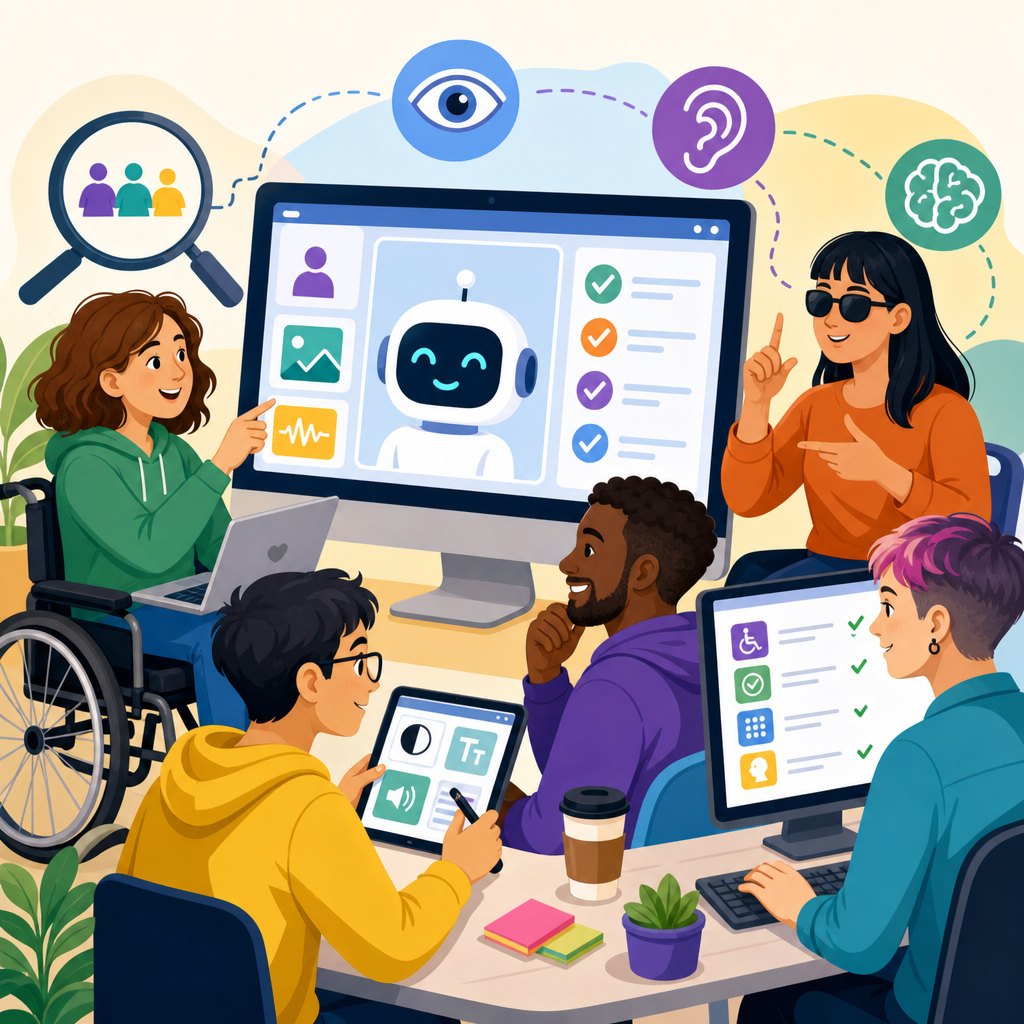
Disability bias testing for AI products is the disciplined process of checking whether an automated system disadvantages people with disabilities in access, accuracy, safety, privacy, or outcomes, and it has become a core requirement for any organization deploying AI in customer service, hiring, education, healthcare, finance, or public-facing digital tools. In the context of AI and ADA, the issue reaches far beyond website accessibility. It includes whether speech recognition fails for users with dysarthria, whether résumé screening downgrades applicants with nontraditional employment patterns linked to disability, whether vision models misread assistive devices, and whether chatbots create barriers for people using screen readers, captions, alternative input devices, or cognitive supports. I have seen teams discover these failures late, often after a pilot has already shaped policy, and the remediation cost is always higher than if testing had been built into product development from the start.
The Americans with Disabilities Act sets a practical baseline: covered entities cannot exclude qualified individuals with disabilities, deny equal enjoyment of goods and services, or rely on methods of administration that produce discriminatory effects. For AI products, that means accessibility and nondiscrimination are not separate tracks. A system can meet many technical accessibility checks and still be biased in its predictions, recommendations, authentication flow, or escalation logic. Likewise, a statistically accurate model can still be unusable if prompts, output timing, color contrast, keyboard navigation, or captions create access barriers. A practical framework must test both. It must also account for related legal signals from Section 504, Section 508, the Fair Housing Act, employment rules enforced by the EEOC, and consumer protection expectations from agencies such as the FTC and DOJ.
This hub article explains how to build disability bias testing into the AI lifecycle, from scoping and dataset review to human override, procurement, incident response, and documentation. It also clarifies a central point many teams miss: disability is highly heterogeneous and often context dependent. Blind users are not a monolith. Deaf users are not a monolith. Cognitive disability spans many functional needs. Temporary, situational, and invisible disabilities matter too. Testing therefore cannot rely on a single benchmark or one-time audit. The goal is to establish repeatable evidence that an AI product works for disabled people in real conditions, with measurable quality thresholds, clear governance, and documented remediation when failures appear.
Why AI and ADA compliance starts with a broader definition of harm
When organizations ask whether their AI tool is compliant, they often jump straight to interface checks or demographic fairness metrics. Disability requires a broader harm model. The product may create exclusion, delay, humiliation, safety risks, privacy intrusion, reduced autonomy, or denial of reasonable modification. In practice, I start by mapping where the system can affect a disabled person: data collection, identity verification, model inference, ranking, recommendations, appeal paths, and customer support. A voice bot that cannot understand some speech patterns is not only less convenient; it may block access to benefits or medical scheduling. A proctoring model that flags eye movement can misclassify neurodivergent students or users with motor conditions. A fraud model may treat adaptive technology usage as suspicious behavior.
Answering the question directly: what counts as disability bias in AI? Any design, data choice, threshold, policy, or deployment decision that predictably reduces equal access or worsens outcomes for disabled users compared with nondisabled users counts as disability bias. That includes direct exclusion, proxy discrimination, and failure to provide an effective alternative. The ADA analysis is functional. If the result is unequal participation or burdensome access, the organization has a problem, even if no one intended harm and even if disability labels were absent from the training data. Teams should therefore test user journeys, not just models in isolation, because the legal and practical risk usually emerges in the full service experience.
Disability bias testing also matters because disability data is frequently missing, sensitive, or legally constrained. Unlike some fairness reviews, you may not have a complete protected attribute column. That does not eliminate the duty to assess risk. It means you need multiple methods: participatory research, task-based usability testing, synthetic scenario analysis, targeted red teaming, complaint pattern analysis, and outcome reviews where lawful and appropriate. The strongest programs combine all of them.
A practical framework for disability bias testing across the AI lifecycle
A workable framework has six stages: use-case triage, barrier mapping, representative evaluation, human review design, deployment controls, and post-launch monitoring. Use-case triage asks how significant the decision is, who is affected, what disabilities are likely implicated, and whether an accessible non-AI path exists. Barrier mapping documents likely failure points for sensory, motor, speech, cognitive, psychiatric, and chronic health disabilities. Representative evaluation tests with disabled users and assistive technology under realistic conditions. Human review design sets escalation rights, override authority, and reasonable modification procedures. Deployment controls cover logging, threshold setting, notices, vendor commitments, and rollback plans. Post-launch monitoring tracks complaints, drift, updates, and recurring accessibility regressions.
The table below shows how mature teams operationalize this process.
| Lifecycle stage | Key testing question | Evidence to collect | Example failure |
|---|---|---|---|
| Use-case triage | Could the AI affect access, eligibility, safety, or essential services? | Risk classification, affected-user map, legal review notes | AI receptionist becomes the only intake path for patients |
| Data and design review | Are disability-related patterns missing, mislabeled, or treated as anomalies? | Dataset documentation, feature inventory, proxy analysis | Typing cadence used as a fraud signal penalizes motor impairments |
| User testing | Can disabled users complete tasks effectively with assistive tech? | Task success rate, time on task, error logs, qualitative interviews | Screen reader users cannot review generated loan terms |
| Model evaluation | Do outputs differ materially across disability-relevant scenarios? | False positive and false negative analysis, scenario matrix | Speech model accuracy drops sharply for users with stutters |
| Governance | Can a person appeal, get help, or request modification? | Escalation SOPs, staffing plan, response-time standard | No live agent option after biometric verification failure |
| Monitoring | Will new releases reintroduce barriers or bias? | Accessibility regression tests, complaint dashboard, audit trail | Model update breaks caption timing in a learning platform |
This framework works because it ties bias testing to product decisions. It does not treat disability as a niche accessibility checklist. It treats it as a quality, safety, and civil rights requirement.
How to test datasets, models, and interfaces for disability-related failure modes
Testing begins before model training. Review datasets for representational gaps and hidden proxies. If your system processes speech, include samples covering accent variation, background noise, assistive communication devices, and speech disabilities where consent and governance support that collection. If your system scores job candidates, inspect whether employment gaps, inconsistent work histories, educational pathways, or disclosure-related language become adverse signals. If your system analyzes video, test how wheelchairs, prosthetics, service animals, white canes, atypical movement, or involuntary motions are classified. Datasheets for Datasets and model cards are useful here because they force teams to document intended use, exclusions, and known limitations.
Model testing should include both aggregate performance and scenario-based evaluation. Aggregate accuracy can conceal serious subgroup failures. I prefer a scenario matrix built around tasks and harms: authentication, navigation, summarization, recommendations, ranking, captioning, and refusal behavior. For each task, define expected performance and known edge cases. Then measure false rejects, false alarms, latency burdens, abandonment rates, and escalation success. In a voice authentication pilot, for example, a team may find that overall equal error rate looks acceptable, yet users with certain speech impairments face disproportionate lockouts. The correct response is not to force repeated attempts. It is to provide a reliable alternate verification path and reconsider whether voice biometrics is appropriate for that use case.
Interface testing must cover WCAG conformance and beyond. WCAG 2.2 is an important benchmark for perceivable, operable, understandable, and robust content, but AI interfaces create extra risks: dynamic content updates that screen readers do not announce, auto-scrolling transcripts, unlabeled confidence indicators, inaccessible feedback widgets, and generated summaries that omit critical context. Plain-language review matters for users with cognitive disabilities. So does control over pace, repetition, transcript access, and error recovery. In practice, I recommend testing with NVDA, JAWS, VoiceOver, TalkBack, keyboard-only navigation, switch devices where relevant, captioning workflows, and low-vision settings such as zoom and high contrast. Automated scanners help, but they do not replace task-based human testing.
Human oversight, reasonable modification, and procurement controls
Human oversight is often described too vaguely. For AI and ADA purposes, it must be specific enough to prevent dead ends. A meaningful review process allows a disabled user to contest an outcome, reach a trained human, submit context the model could not capture, and obtain a timely resolution. The reviewer must have authority to override the system. If the AI handles high-impact tasks such as screening applicants, assigning service priority, detecting fraud, or moderating educational participation, the appeal path should be visible, simple, and accessible in multiple formats. A hidden email address is not enough. Nor is a nominal review by staff who simply restate the model score.
Reasonable modification should be built into service design. If a chatbot times out too quickly for a user with cognitive fatigue, extend the session or provide asynchronous completion. If biometric login fails because of disability-related variation, offer document-based or agent-assisted verification. If automated captioning is inaccurate for a deaf student relying on technical terminology, provide human-corrected captions or transcripts. The core principle is effectiveness, not performative accommodation. Organizations should document when an AI feature is optional, when a parallel path exists, and how frontline staff trigger modifications without forcing intrusive disclosures.
Procurement is another major risk point. Many companies buy AI components and assume the vendor has handled disability bias. That assumption is unsafe. Contracts should require accessibility conformance reports, known limitations, update notice obligations, incident cooperation, audit support, and remediation timelines. Ask vendors whether they have tested with disabled users, which assistive technologies they validated, how they measure subgroup error, and whether critical functions remain available without the AI feature. If a vendor cannot answer these questions concretely, the buyer is inheriting unmanaged legal and operational risk.
Governance, documentation, and continuous monitoring for defensible compliance
A defensible program documents decisions from the start. Keep an AI impact assessment that names the use case, affected populations, legal theories, expected benefits, alternatives considered, accessibility requirements, testing methods, residual risks, and approval conditions. Maintain versioned records of model changes, prompt changes, interface revisions, and vendor updates. Log disability-related complaints in a way that supports trend analysis without oversharing sensitive data. Define triggers for re-evaluation, such as error spikes, new deployment contexts, merger integrations, or policy changes. This is how organizations move from ad hoc accessibility fixes to repeatable governance.
Post-launch monitoring should answer four questions: Are disabled users completing key tasks? Are they receiving comparable outcomes? Are support and appeal channels working? Are updates introducing regressions? Useful metrics include task completion by assistive technology condition, fallback usage rates, false rejection rates, time to human escalation, complaint category frequency, and remediation time. Qualitative signals matter too. Repeated comments such as “the system kept looping,” “my screen reader missed the status message,” or “support told me to use someone else’s phone” often reveal a design flaw faster than a dashboard does.
This hub page should anchor every deeper article in your AI and ADA content cluster because the subject is interdisciplinary. It touches product design, civil rights law, procurement, model risk management, privacy, security, and customer operations. The central takeaway is straightforward: disability bias testing for AI products is not a one-time audit and not a narrow compliance exercise. It is a practical framework for proving that automated systems remain accessible, fair, and usable in real life. Organizations that adopt this framework reduce legal exposure, improve product quality, and serve more people effectively. Start with one high-impact use case, map disability-related harms, test with real users and assistive technology, and make human override and alternative access nonnegotiable.
Frequently Asked Questions
What is disability bias testing for AI products, and why does it matter beyond basic accessibility?
Disability bias testing for AI products is the structured process of evaluating whether an AI system creates unequal barriers or harms for people with disabilities across the full product experience. That includes not only whether a website or app can technically be used with assistive technology, but also whether the underlying model, interface, workflow, and decision logic produce worse results for users with disabilities. In practice, this means testing for disparities in access, accuracy, safety, privacy, usability, and downstream outcomes.
This matters because AI can fail in ways that traditional accessibility reviews do not catch. A chatbot may be keyboard accessible yet still generate confusing responses for users with cognitive disabilities. A speech recognition system may work well for many users but perform poorly for people with speech differences. A hiring model may not directly ask about disability, yet still disadvantage disabled applicants by penalizing employment gaps, nonstandard communication patterns, or alternative methods of completing assessments. In healthcare, education, finance, and customer service, these issues can translate into exclusion, incorrect decisions, higher friction, reduced autonomy, or serious legal and reputational risk.
In the context of AI and ADA, disability bias testing goes beyond compliance checklists. It asks a more fundamental question: does the system treat disabled people fairly in real use? That requires organizations to evaluate representative user journeys, model outputs, fallback paths, escalation options, and the cumulative effect of design choices. A product can appear accessible on the surface while still producing disability-related harms in the actual decision-making process. That is why disability bias testing has become a core part of responsible AI governance rather than a niche add-on.
What types of disability-related risks should organizations test for in AI systems?
Organizations should test for a broad set of risks because disability bias can appear at multiple layers of an AI product. The most obvious category is access risk: whether users with visual, hearing, mobility, speech, cognitive, neurodivergent, or mental health-related disabilities can effectively interact with the system. This includes screen reader compatibility, caption quality, alternative input support, time limits, error recovery, readable language, and the ability to complete critical tasks without relying on a single mode such as speech, drag-and-drop, or rapid typing.
The next category is performance risk. AI systems may be measurably less accurate for certain disabled users or disability-related contexts. Examples include speech recognition struggling with atypical speech patterns, computer vision misreading assistive devices, emotion or engagement detection drawing flawed conclusions from facial expressions or movement differences, and automated assessment tools mistaking disability-related behaviors for deception, low confidence, or lack of competence. These failures can become especially harmful when the system is used to rank, score, recommend, monitor, or deny access.
Safety and dignity risks also deserve close attention. Some systems produce outputs that are not just inaccurate but actively harmful, such as making unsafe healthcare suggestions, exposing users to manipulative nudges, or steering them away from accommodations. Privacy risk is another major issue. AI systems may infer disability status from behavior, language, biometrics, or usage patterns without clear notice or legitimate need. Even when the model is not designed to identify disability, logs, transcripts, metadata, or embeddings can create sensitive data exposure.
Finally, organizations should test outcome risk. This means looking beyond a single interaction to see whether disabled users experience worse final results, such as lower hiring progression, higher fraud flags, reduced educational recommendations, more customer support dead ends, or less favorable lending pathways. A practical disability bias testing framework treats these risks as interconnected. It does not assume that passing a usability review or a legal review automatically means the AI system is equitable in real-world operation.
How do you build a practical framework for disability bias testing in AI products?
A practical framework starts by defining where disability-related harm could occur in the product lifecycle. Begin with use-case scoping: what the AI does, who is affected, what decisions it influences, and what level of harm is possible if it performs poorly for disabled users. High-impact contexts such as hiring, healthcare, education, finance, insurance, and public services should receive deeper review because small performance gaps can translate into meaningful exclusion or legal exposure.
From there, map the end-to-end user journey. Identify each point where disability bias could enter: data collection, prompts or inputs, model inference, ranking logic, explanation layers, human review, appeals, and fallback mechanisms. For each step, establish test criteria across five practical dimensions: access, accuracy, safety, privacy, and outcomes. This gives teams a disciplined structure instead of a vague fairness goal. For example, under access, you may test whether every critical task can be completed without speech. Under accuracy, you may compare model performance across relevant disability-related scenarios. Under safety, you may evaluate whether errors create heightened harm. Under privacy, you may assess whether disability-related information is unnecessarily inferred or retained. Under outcomes, you may measure whether disabled users reach materially worse end states.
The strongest frameworks combine technical testing with lived-experience testing. Synthetic benchmarks and adversarial prompts are useful, but they are not enough on their own. Include disabled participants, disability advocates, accessibility specialists, product teams, legal counsel, and responsible AI reviewers in the process. Create structured test cases that reflect realistic interactions, edge cases, accommodation needs, and points of failure. Then document findings, severity, mitigations, residual risk, and ownership. A framework becomes operational when it is tied to release gates, procurement reviews, model change management, incident response, and post-launch monitoring. In other words, the goal is not a one-time audit. It is a repeatable governance process that catches disability bias before deployment and continues to detect it after launch.
What does good disability bias testing look like in high-impact use cases such as hiring, healthcare, and customer service?
In hiring, good testing examines whether the AI tool disadvantages candidates whose disabilities affect speech, eye contact, movement, typing speed, employment history, or test-taking format. If the product evaluates interviews, assessments, resumes, or candidate communications, teams should test whether disability-related traits are being treated as negative signals. They should also verify that accommodations are available and meaningful, such as alternative input methods, extended time, non-video pathways, human review options, and clear instructions. Just as important, employers should measure downstream outcomes. If disabled candidates are screened out at higher rates, that is a strong indicator that something in the process requires redesign, regardless of whether the model appears neutral on paper.
In healthcare, the standard is even higher because safety risks can be immediate. Testing should assess whether symptom checkers, triage tools, transcription systems, care navigation bots, and risk models perform reliably for people with sensory, cognitive, communication, or mobility disabilities. A model should not assume that atypical communication signals low urgency, nor should it ignore the role of assistive technology or caregiver mediation in how patients interact. Teams need to evaluate clinical safety, consent clarity, privacy handling, and escalation pathways when the AI is uncertain. If the system might be used by patients with a wide range of functional needs, then the testing environment should reflect that reality.
In customer service, strong disability bias testing focuses on whether disabled users can actually resolve their issue without disproportionate burden. Many organizations deploy AI support tools that trap users in voice-only flows, inaccessible verification loops, or repetitive chatbot interactions that break down when language is nonstandard or when a user needs accommodation. Good testing checks whether users can switch channels, reach a human, authenticate in alternative ways, and receive responses that are understandable and actionable. Across all of these sectors, the defining feature of good testing is that it measures real task completion and equitable outcomes, not just whether the interface seems polished or the model scores well on generic benchmarks.
How often should disability bias testing be performed, and who should be involved?
Disability bias testing should not be treated as a one-time prelaunch event. It should happen throughout the AI product lifecycle: during design, before procurement or vendor approval, prior to deployment, after major model or interface changes, and continuously through post-launch monitoring. Any meaningful change to prompts, training data, ranking logic, third-party APIs, moderation layers, user flows, or accommodation features can alter the disability risk profile. Even if the core model remains the same, shifts in usage patterns or deployment settings can create new barriers.
The right testing cadence depends on risk level. High-impact systems should undergo formal review at every major release, with ongoing monitoring for complaints, escalation trends, error patterns, and outcome disparities. Lower-risk systems still need periodic checks, especially if they are public-facing or used at scale. Incident triggers should also prompt immediate retesting. For example, if users report speech recognition failures, inaccessible identity verification, or biased automated scoring, teams should treat those signals as governance events, not isolated support issues.
Effective testing is cross-functional by design. Product managers, machine learning engineers, UX researchers, accessibility specialists, QA teams, legal and compliance leaders, privacy professionals, and responsible AI reviewers all have distinct roles. Most importantly, disabled users and disability subject-matter experts should be included in planning, testing, and remediation. Without that perspective, organizations often miss the practical realities of how harm appears in real workflows. The most mature programs also assign clear accountability: someone owns the test plan, someone approves risk acceptance, someone tracks mitigations, and leadership receives


