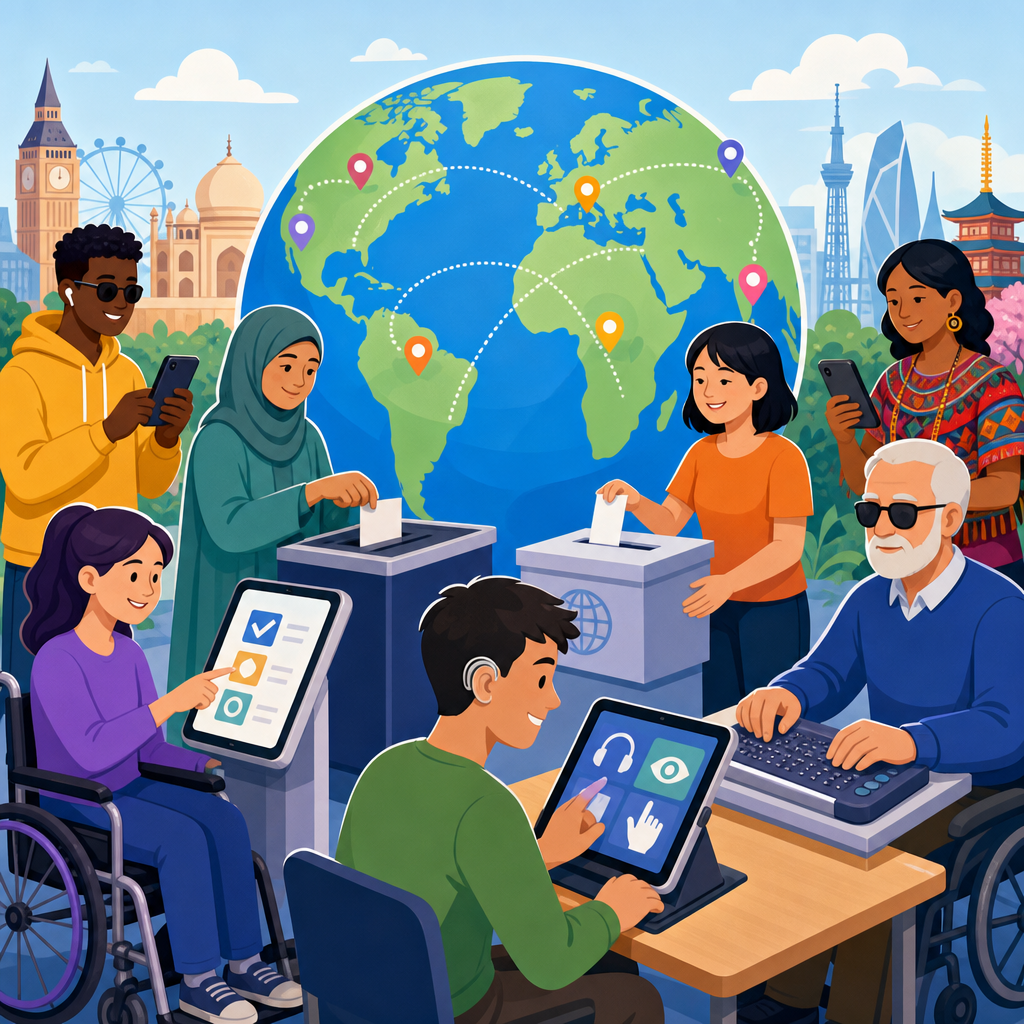
Accessible voting technology determines whether citizens with disabilities can participate in democracy privately, independently, and with confidence. In election administration, accessibility means more than adding a ramp to a polling place or printing one ballot in large type. It includes ballot design, assistive hardware, remote access workflows, registration systems, poll worker training, procurement standards, and legal safeguards that preserve secrecy and voter intent. Around the world, governments are testing different combinations of these tools to remove barriers for blind voters, deaf voters, voters with limited dexterity, neurodivergent voters, older adults, and people with temporary impairments.
This topic matters because voting barriers are rarely isolated technical glitches; they are failures of system design. I have seen election teams focus narrowly on equipment certification while overlooking simpler obstacles such as confusing instructions, poor contrast on signage, inaccessible websites, or rushed poll worker setup that renders otherwise compliant devices unusable. A truly accessible voting system works across the entire journey: discovering election information, registering, requesting accommodations, marking a ballot, verifying choices, casting securely, and receiving confirmation where law permits. When any one stage fails, participation drops and trust erodes.
International approaches are especially useful because no single country has solved every accessibility challenge. Some jurisdictions lead in tactile interfaces and audio ballot delivery, others in plain-language voter communication, mobile polling support, or rigorous standards for public sector digital services. Comparing these models helps election officials avoid reinventing solutions and understand tradeoffs. A ballot-marking device may improve privacy for blind voters, for example, yet still fail voters with cognitive disabilities if the interface uses dense instructions and inconsistent navigation. Remote electronic return may expand access for some overseas or disabled voters, but it introduces significant security and verifiability concerns. The central lesson is that accessibility must be engineered alongside usability, security, and administrative practicality from the start.
As a hub within an international perspective on election access, this article maps the major innovations and strategies shaping accessible voting technology worldwide. It explains the main categories of tools, shows how different countries have implemented them, and highlights the governance choices that make technology succeed or fail. It also points toward related subtopics such as digital accessibility standards, vote-by-mail accommodations, election website usability, procurement policy, and inclusive testing with disabled users. For election authorities, advocates, and researchers, the goal is straightforward: identify what works, under what conditions, and why those lessons travel across borders.
Core models of accessible voting technology
Accessible voting technology generally falls into four categories: accessible in-person ballot marking, remote accessible ballot delivery, assistive communication and information tools, and supporting infrastructure such as registration portals and poll books. In practice, the strongest systems combine all four. A voter may use an accessible website to confirm eligibility, receive plain-language instructions and captioned videos before election day, check in at a polling place with an accessible electronic poll book, mark a ballot on a device with audio and tactile controls, and verify selections before casting a paper record. Accessibility is cumulative, not modular.
In-person ballot-marking devices remain the backbone of accessible voting in many democracies because they preserve a voter-verified paper trail while supporting headphones, sip-and-puff inputs, tactile keypads, screen magnification, high-contrast displays, and alternative navigation. The United States has deployed such devices under requirements tied to the Help America Vote Act, while parts of Europe and Australia have explored or piloted similar methods in selected elections. The operational advantage is clear: voters can mark independently without requiring another person to read or fill the ballot. The limitation is equally clear: one accessible machine per polling place is not enough if it is badly positioned, not powered on, or unfamiliar to staff.
Remote accessible ballot systems are often used for voters who cannot physically complete a paper ballot. These systems typically allow a voter to receive and mark a ballot digitally using their own assistive technology, then print and return it by mail, or in some cases return it electronically where law allows. This model can be transformative for blind voters because personal devices often provide better accessibility than public machines. However, the closer a system moves toward online ballot return, the more serious the security, coercion, malware, and auditability concerns become. Election agencies that adopt remote accessible voting must define the problem precisely and limit the solution accordingly.
International legal and standards frameworks
Accessible voting technology does not emerge in a vacuum; it is driven by legal obligations and technical standards. The most influential global instrument is the United Nations Convention on the Rights of Persons with Disabilities. Article 29 requires states to guarantee political participation on an equal basis with others, including by ensuring voting procedures, facilities, and materials are appropriate, accessible, and easy to understand and use. That language matters because it connects physical access, information design, and usability rather than treating accessibility as a single hardware issue.
At the implementation level, many jurisdictions rely on established digital accessibility standards, particularly the Web Content Accessibility Guidelines, for election websites, voter portals, and informational materials. For hardware and software procurement, governments may reference EN 301 549 in Europe, Section 508 standards in the United States, or national disability legislation that incorporates similar principles. These frameworks create baseline expectations for keyboard navigation, screen reader compatibility, color contrast, captions, error identification, and understandable content. In my experience, they are most effective when written directly into contracts, acceptance testing, and vendor maintenance obligations rather than cited only at a policy level.
Election law also shapes what technology is even possible. Secret ballot requirements, voter-verifiable paper audit trails, chain-of-custody rules, certification procedures, and data protection laws can all support or constrain accessibility choices. Countries that require paper-based auditing, for example, tend to favor accessible ballot-marking devices over purely electronic recording systems. Jurisdictions with strong privacy regimes may be more cautious about centralized voter-assistance databases or biometric authentication. Good policy does not pit accessibility against integrity. It specifies how both will be protected at once.
What different countries are doing in practice
Countries have taken varied paths based on their electoral systems, disability rights frameworks, and administrative capacity. Australia has used the National Relay Service and has piloted telephone-assisted voting models for blind and low-vision voters in certain contexts, most notably in New South Wales through iVote before security concerns and operational issues prompted renewed scrutiny. The lesson from Australia is not that innovation failed; it is that accessible remote voting requires continuous security review, transparent public testing, and realistic limits on scale.
Estonia is often cited for internet voting, but its relevance to accessibility is more nuanced. Online voting can reduce mobility barriers, especially for voters who struggle to reach polling places, yet accessibility depends heavily on the usability of authentication tools, interface clarity, and compatibility with assistive technology. Internet voting convenience should not be confused with comprehensive accessibility. If identity verification relies on hard-to-use card readers or inaccessible mobile flows, many disabled voters remain excluded.
The United Kingdom has focused significant attention on tactile voting device requirements, large-print sample ballots, and policy reviews into assistive equipment at polling stations. Electoral Commission guidance has increasingly emphasized practical aids beyond one legacy device, including magnifiers, improved lighting, seating, and communication support. Canada has combined strong plain-language election communication with accommodation pathways that vary by province and federal administration. Elections Canada has tested tools such as magnifiers, braille lists of candidates at some polling locations, and accessible information resources, illustrating that incremental changes across the voting journey often produce greater gains than a single flagship device.
In the United States, accessible ballot-marking devices are widespread, but implementation quality varies sharply by state and county. The best jurisdictions treat accessibility as an operations discipline: pre-election logic and accuracy testing includes accessibility features, poll workers rehearse setup, curbside options are clearly defined, and county websites publish accommodation details in multiple formats. The weakest jurisdictions technically comply on paper while leaving voters to discover broken headphones, missing privacy shields, or staff who do not know how to activate audio ballots. Comparative analysis across these countries shows a consistent truth: policy intent means little without last-mile execution.
Design principles that consistently improve access
The most reliable international innovations are not always the most futuristic. They are the design choices that reduce cognitive load and increase user control. Plain language is one of them. Election instructions written at a practical reading level, with short sentences and explicit steps, improve performance for voters with intellectual disabilities, limited literacy, limited proficiency in the dominant language, and first-time voters. Consistent navigation is another. When each screen uses the same button order, audio cues, and confirmation logic, voters make fewer errors and need less assistance.
Multimodal interaction is equally important. Audio-only support helps some voters, but pairing audio with tactile controls, visual zoom, high contrast, and adjustable timing serves a broader population. Error prevention features also matter. Systems should warn clearly about undervotes, explain overvotes before final submission, and allow easy review of contests without forcing the voter through a confusing linear path. In usability sessions I have observed, the difference between an acceptable and an excellent system is usually not a dramatic feature. It is whether the interface respects the voter’s pace and makes recovery from mistakes obvious.
| Strategy | Accessibility benefit | Implementation example |
|---|---|---|
| Audio ballot with tactile keypad | Enables private voting for blind and low-vision voters | Polling-place ballot-marking devices in many U.S. counties |
| Plain-language instructions | Reduces confusion for voters with cognitive disabilities and low literacy | Election guides rewritten with short steps and icons in Canada and the UK |
| Remote accessible ballot marking | Lets voters use personal assistive technology at home | Digital ballot delivery portals for voters with print disabilities |
| Inclusive polling-place kits | Supports varied needs beyond one device | Magnifiers, seating, task lighting, hearing loops, and pen grips |
Another principle is compatibility with mainstream assistive technology. Election systems should work with screen readers such as JAWS, NVDA, and VoiceOver; speech recognition tools; refreshable braille displays where feasible; and standard switch devices. Proprietary accessibility layers often create new barriers because they behave differently from tools voters already know. When agencies permit voters to use familiar hardware and software, training needs drop and independence rises. This is one reason remote accessible ballot marking can outperform public kiosks for some users, despite the policy constraints that surround it.
Operational strategies that separate success from failure
Accessible voting technology succeeds through operations, not procurement alone. The first operational requirement is inclusive user testing. Election agencies should test with blind voters, deaf voters, voters with limited dexterity, wheelchair users, people with intellectual disabilities, and older adults using their actual assistive tools. Laboratory conformance testing cannot substitute for this. I have watched systems pass checklist reviews yet fail immediately when a real voter tried to navigate a timed session with a screen reader and noise-canceling headphones in a busy polling place environment.
Training is the next differentiator. Poll workers need scripts and hands-on practice, not a single slide that says accessible equipment is available. They must know where the device is, how to initialize it, how to connect accessories, how to maintain privacy while assisting, and how to troubleshoot common failures without taking control away from the voter. Jurisdictions that perform well often use short scenario-based drills before each election cycle. They train for respectful communication as much as for hardware operation.
Finally, accessibility must be monitored like any other election performance metric. Agencies should track wait times for accessible stations, equipment incident rates, website accessibility defects, accommodation requests, and voter feedback after elections. Public reporting builds trust and reveals patterns. If a county sees repeated failures with headphone ports, inaccessible PDF notices, or curbside procedures that delay voters by thirty minutes, it has actionable evidence. Internationally, the most mature programs treat accessibility as continuous quality improvement rather than a one-time compliance event.
Emerging issues and where this subtopic goes next
Several emerging issues now define the next phase of accessible voting technology. The first is the intersection of cybersecurity and remote accessibility. Election officials are under pressure to expand digital options, but any move toward electronic ballot return must be evaluated against serious risks documented by security researchers and standards bodies such as NIST. The question is not whether digital access is desirable; it is which parts of the process can be digitized safely and which should remain paper-based to preserve auditability and public confidence.
The second issue is AI-assisted communication. Automated captioning, translation, voice interfaces, and document remediation can help election offices publish more accessible content at scale. Yet these tools also introduce accuracy risks, especially in legal instructions and ballot information where a small error can mislead a voter. Human review remains essential. The third issue is demographic change. Aging populations in Europe, East Asia, and North America mean accessibility features increasingly benefit the electoral mainstream, not only a legally defined minority.
As the hub for international innovations and strategies in accessibility, this page connects the field’s core themes. The strongest global approaches combine rights-based law, rigorous standards, inclusive design, secure technology choices, realistic operations, and direct input from disabled voters. No country offers a perfect template, but the evidence is clear: when election systems are built for real users, participation becomes more independent, more private, and more trustworthy. Use this hub to explore the deeper articles on standards, remote access, procurement, website design, and polling-place practice, then apply the lessons to your own election context.
Frequently Asked Questions
1. What is accessible voting technology, and why does it matter in election administration?
Accessible voting technology refers to the tools, systems, and processes that allow voters with disabilities to register, receive information, mark ballots, verify selections, and cast votes privately and independently. In practice, this can include tactile keypads, audio ballot interfaces, sip-and-puff compatibility, screen-reader-friendly registration portals, ballot-marking devices, accessible absentee workflows, and clear ballot layouts designed for voters with low vision, cognitive disabilities, or limited dexterity. It also includes the policies and operational decisions that determine whether those tools actually work on election day.
Its importance goes well beyond convenience. The central democratic principle at stake is equal participation. If a voter must rely on another person to read, mark, or return a ballot, privacy and independence are reduced. If a polling place has an accessible entrance but the check-in tablet, ballot instructions, or voting machine cannot be used by a voter with a disability, access is incomplete. Accessible voting technology closes that gap by making the entire voting journey usable, not just the doorway.
Election administrators increasingly recognize that accessibility is a system-wide responsibility. That means technology procurement, user testing, poll worker training, ballot design, legal compliance, and contingency planning all need to align. When accessibility is built into the election process from the start, jurisdictions are better able to preserve voter intent, maintain ballot secrecy, reduce errors, and strengthen trust in the legitimacy of the result.
2. How do different countries approach accessible voting technology?
Global approaches vary widely, but most fall along a spectrum from basic physical accommodation to more comprehensive, rights-based election design. Some countries focus primarily on polling-place accessibility, such as ramps, priority lines, and magnifying tools. Others have adopted assistive voting devices that provide audio guidance, tactile controls, and adjustable displays to help voters mark ballots independently. A smaller group has expanded accessibility into remote and digital workflows, including accessible voter information portals, online registration systems compatible with assistive technology, and remote ballot-marking options for eligible voters.
Legal frameworks often shape how far these efforts go. In some jurisdictions, disability rights laws and constitutional protections have pushed election agencies to provide private and independent voting methods as a matter of equal treatment. In others, reforms are driven by election modernization programs, court decisions, pressure from civil society organizations, or international commitments related to political participation and non-discrimination. Countries with stronger centralized election systems may be able to deploy consistent standards nationwide, while more decentralized systems often produce uneven accessibility depending on local budgets, procurement decisions, and administrative capacity.
Despite these differences, a common lesson emerges internationally: accessibility works best when it is integrated rather than added later. Countries that make accessibility part of standards-setting, vendor requirements, public testing, and staff training tend to achieve more reliable outcomes. They also tend to understand accessibility broadly, covering not just the voting machine itself, but voter education materials, wayfinding, language access, transportation coordination, and complaint resolution procedures. The most effective global models treat accessible voting technology as a core election integrity issue, not a niche accommodation.
3. What technologies and design features make voting more accessible for people with disabilities?
A wide range of technologies and design features can improve accessibility when they are thoughtfully implemented. Ballot-marking devices are one of the most discussed examples because they can allow voters to navigate ballots using headphones, tactile buttons, paddles, or alternative input devices. Adjustable font size, high-contrast displays, and text-to-speech support can help voters with low vision or blindness. For voters with limited manual dexterity, accessible controls, proper table height, and compatibility with personal assistive devices can make a significant difference. These tools are especially important when they let the voter review choices before final submission.
Ballot and interface design are just as important as the hardware. A poorly structured ballot can create confusion even on an accessible device. Clear instructions, logical contest order, plain language, strong visual contrast, adequate spacing, and error-prevention prompts all support usability. For voters with cognitive disabilities or limited literacy, simpler layouts and consistent navigation can reduce mistakes and anxiety. Accessibility also extends to registration and voter information systems, which should work with screen readers, keyboard navigation, captioned video, and mobile devices.
In addition, many election systems are expanding access through remote or hybrid solutions. Accessible electronic ballot delivery for absentee voters, downloadable ballots compatible with assistive technology, and accessible cure processes for signature or identification issues can help voters who cannot easily travel to a polling place. However, these tools must be balanced with strong security, auditability, and privacy safeguards. The best accessible voting technologies are not isolated gadgets; they are part of a coordinated system that enables voters to act independently while preserving confidence in the election process.
4. What are the biggest challenges governments face when implementing accessible voting technology?
One major challenge is the gap between formal compliance and real usability. A jurisdiction may technically provide an accessible machine or claim to meet legal standards, yet still fail voters because the equipment is difficult to set up, poll workers are unfamiliar with it, audio ballots are incomplete, or accessible pathways break down at key moments. Accessibility often fails in the details: dead batteries, missing headphones, inaccessible websites, poorly trained temporary staff, or ballots that were never tested with actual users with disabilities.
Funding and procurement are also persistent barriers. Election agencies often work under tight deadlines and limited budgets, and accessibility can be treated as an optional upgrade rather than a baseline requirement. If procurement rules do not clearly define accessibility standards, vendors may deliver products that appear compliant on paper but perform poorly in practice. Maintenance, storage, software updates, replacement parts, and technical support must also be considered. A one-time purchase is not enough; accessible voting technology requires ongoing investment and operational planning.
Another challenge is balancing accessibility, security, and public trust. Remote or electronic solutions may increase independence for some voters, but they can raise concerns about authentication, ballot secrecy, audit trails, and system resilience. These concerns are legitimate and need serious attention, but they should not become an excuse for inaction. The most effective governments address the tension openly by involving disability advocates, security experts, election officials, and technologists in the design process. Successful implementation depends on testing, transparency, contingency planning, and a willingness to evaluate whether a solution actually preserves both access and election integrity.
5. What should policymakers and election officials prioritize to improve accessible voting worldwide?
First, they should treat accessibility as a core democratic requirement rather than a specialized service. That means embedding it into election law, technical standards, budgeting, procurement, and performance reviews. Accessibility should be specified from the beginning of any modernization effort, whether the project involves voting machines, voter registration platforms, absentee ballot systems, or polling-place operations. Clear standards help jurisdictions buy the right tools, and enforceable rules help ensure those tools are available everywhere voters need them.
Second, policymakers should prioritize direct consultation with people with disabilities and the organizations that represent them. The most reliable way to improve accessible voting is to include users in design, pilot testing, training feedback, and post-election review. Real-world testing often reveals problems that internal compliance checks miss, such as confusing audio prompts, poor screen contrast, inaccessible signatures processes, or instructions that are technically accurate but practically unusable. Accessibility improves fastest when administrators listen to lived experience and respond with measurable changes.
Finally, election officials should invest in the full ecosystem that supports accessible participation. That includes training poll workers thoroughly, publishing voter education materials in accessible formats, ensuring websites and mobile tools meet accessibility requirements, planning backup procedures for equipment failure, and collecting data on what works and what does not. Internationally, progress is strongest where governments combine legal protections, modern technology, operational discipline, and continuous evaluation. In other words, accessible voting worldwide improves not through a single device or policy, but through a sustained commitment to making every stage of the voting process usable, private, independent, and trustworthy.