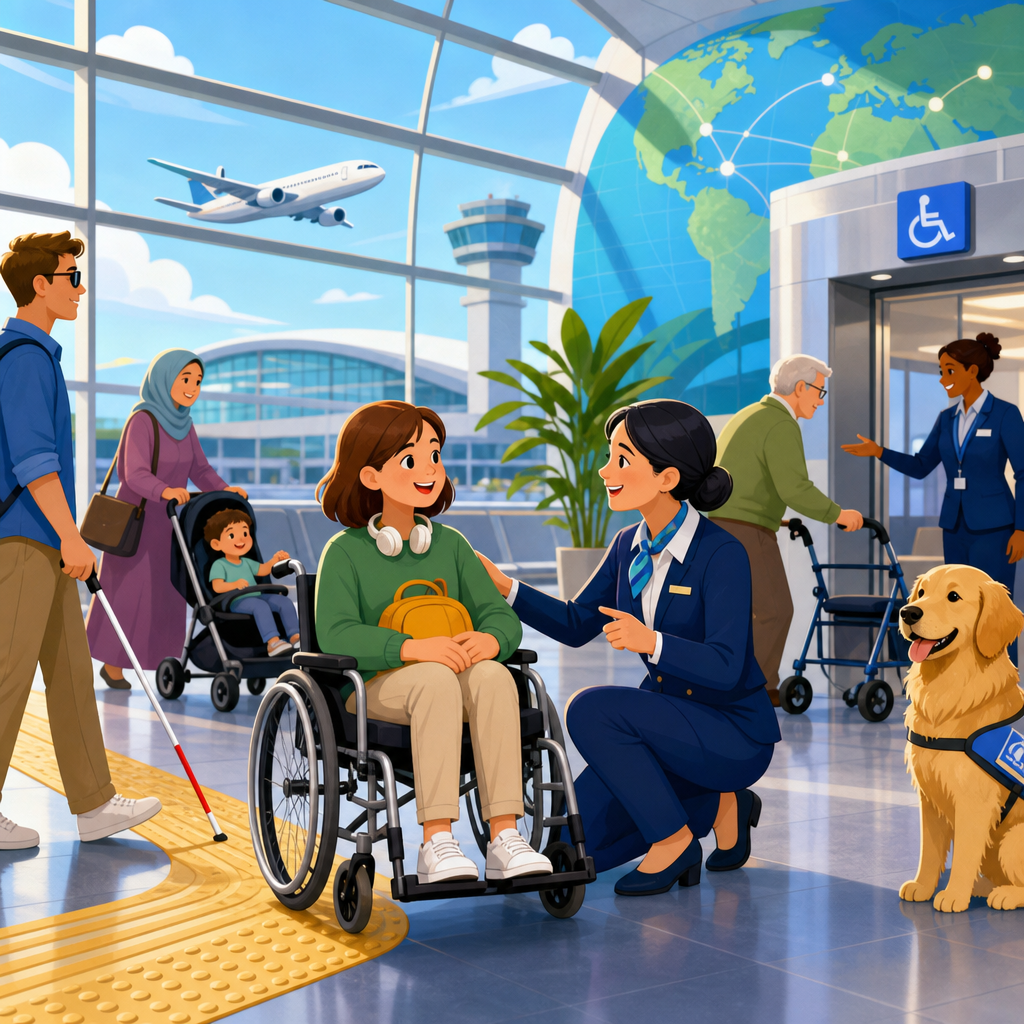
Global airports are redesigning the travel experience around accessibility and traveler support because air travel only works well when every passenger can move through it safely, independently, and with dignity. In this international perspective, accessibility means more than wheelchair ramps or designated assistance desks. It includes step-free routes, tactile guidance, visual paging, hearing loops, multilingual wayfinding, neurodiversity support, app-based assistance requests, trained staff, and clear procedures for disruptions. Traveler support is equally broad. It covers escort services, mobility equipment handling, hidden disability recognition, service animal relief areas, quiet rooms, real-time information, and policies that reduce stress at check-in, security, boarding, connections, and arrivals.
I have worked on airport content and service design projects where the biggest lesson was simple: passengers judge accessibility less by a single feature than by whether the whole journey hangs together. A modern terminal can still fail if an elevator is hidden, signage is inconsistent, or staff handoffs break down. That is why leading airports now treat accessibility as an end-to-end operations issue rather than a compliance checklist. The shift matters because global passenger volumes are rising, populations are aging, and more airports are competing on service quality as a differentiator. It also matters because accessibility improvements help many groups at once, including families, first-time international travelers, people with temporary injuries, and anyone under time pressure in a complex environment.
Across regions, the most effective airport accessibility strategies combine infrastructure, digital tools, staff training, and measurable service standards. In Europe, operators often align with PRM service frameworks and national equality rules. In the United States, airports and airlines work within the Air Carrier Access Act and related Department of Transportation guidance. In Asia-Pacific and the Middle East, major hubs increasingly build accessibility into new terminal design, using universal design principles from the start rather than retrofitting later. This hub article maps the main international innovations and strategies in accessibility so readers can understand what leading airports are doing, why those measures work, and where future improvements are likely to come from.
How Global Airports Are Building Accessibility into Terminal Design
The strongest accessibility programs begin with physical design. Airports such as Singapore Changi, Hamad International, Heathrow, and Incheon have invested in step-free circulation, wide corridors, frequent seating, accessible restrooms, and intuitive vertical transport placement. Those choices sound basic, but they determine whether passengers can navigate independently. In practice, the best terminals place elevators where people naturally expect them, not behind retail zones or around service corridors. They maintain consistent flooring transitions, reduce glare, and use color contrast to distinguish pathways, doors, and hazards. Tactile paving and braille signage support blind and low-vision travelers, while hearing loops and captioned information improve access for deaf and hard-of-hearing passengers.
Wayfinding is one of the most underrated accessibility investments. Airports that perform well usually standardize icons, keep sign language plain, and repeat key directions at decision points rather than assuming a traveler will remember one instruction given fifty meters earlier. Amsterdam Schiphol and Heathrow have both emphasized clearer wayfinding systems because a missed turn in an airport has cascading effects: stress rises, walking distances increase, and assistance teams can lose contact with passengers. Rest areas also matter. Older travelers, people with chronic pain, and pregnant passengers benefit from seating with arms and backs positioned at regular intervals. Family rooms, adult changing facilities, and accessible toilets with reliable maintenance standards are increasingly seen as core infrastructure rather than premium extras.
Good design also considers sensory load. Large hubs are noisy, bright, and crowded; that can be overwhelming for autistic travelers, people with PTSD, or anyone experiencing travel anxiety. Airports including Shannon, Gatwick, and Dubai have introduced quiet spaces, sensory rooms, or reduced-stimulation areas in response. These spaces are most effective when supported by pre-travel information, so passengers know where they are, who can use them, and whether advance booking is needed. Physical accessibility, then, is not a narrow engineering issue. It is a layered design discipline that links architecture, human factors, maintenance, and operations.
Traveler Support Services That Make the Journey Work
Infrastructure only solves part of the problem. The real test comes when passengers need coordinated support across multiple touchpoints. Most major airports now offer pre-booked or on-demand assistance for passengers with reduced mobility, but service quality varies widely depending on staffing levels, handoff procedures, and airline coordination. The best programs confirm requests in advance, provide clear meeting points, track response times, and ensure escorts remain with passengers through critical transitions such as bag drop, security screening, passport control, boarding, and connections. Airports that consistently perform well treat assistance as a timed operational service, not as an ad hoc courtesy.
Hidden disability support has expanded quickly in the past decade. Programs inspired by the sunflower lanyard model, first associated with Gatwick, are now visible across many airports because they offer a discreet signal that a passenger may need more time, simpler communication, or reduced stress during screening and boarding. The value is not the lanyard alone; it is the staff training behind it. Without training, identifiers can become symbolic rather than functional. Effective training teaches employees how to give concise instructions, avoid sensory overload, respect autonomy, and ask before providing physical help. Airports in Australia, Canada, the United Kingdom, and parts of Europe increasingly include disability awareness modules for frontline teams, contractors, and security staff.
Support also extends to service animals, medical equipment, and mobility devices. Airports in the United States commonly provide service animal relief areas after security because long dwell times make them essential. Wheelchair handling has become a major operational focus as regulators and advocacy groups scrutinize damage rates for personal mobility devices. A powered wheelchair is not standard baggage; it is customized mobility equipment that can be difficult or impossible to replace during a trip. Better airports address this through staff handling protocols, battery documentation procedures, and direct communication with passengers about dimensions, loading constraints, and return timelines on arrival.
| Accessibility area | What leading airports do | Why it matters for travelers |
|---|---|---|
| Wayfinding | Use consistent icons, tactile paths, multilingual signs, and repeated decision-point signage | Reduces missed turns, stress, and dependence on staff |
| Assistance services | Track requests, define meeting points, and manage escorts through handoffs | Improves reliability from check-in to boarding and arrivals |
| Sensory support | Offer quiet rooms, sensory maps, and pre-travel guidance | Helps neurodivergent and anxious passengers regulate stimulation |
| Digital tools | Provide app-based requests, live updates, indoor navigation, and accessible websites | Gives travelers more control and better information |
| Staff capability | Train security, customer service, and contractors on disability inclusion | Turns policies into usable, respectful service |
Digital Accessibility, Real-Time Information, and Multilingual Guidance
Digital accessibility is now central to traveler support because the airport journey begins long before arrival at the terminal. Passengers need to know how to request assistance, where to park, which entrance to use, what screening rules apply to medication, and how long walking distances may be. Airports that lead in this area publish detailed accessibility pages, not generic marketing copy. They specify dimensions for accessible parking, terminal maps, contact methods, escort booking cutoffs, and assistance points with photos. They make those pages usable with screen readers, keyboard navigation, alt text, readable contrast, and plain-language structure. An inaccessible website undermines even a well-designed terminal.
Inside the airport, mobile apps and digital kiosks are becoming more useful when they are built inclusively. Real-time gate changes, queue times, indoor navigation, and accessibility alerts help all passengers, but especially those who need extra planning time. A traveler with limited stamina may choose a different restroom, lounge, or security lane if walking estimates are available. A deaf passenger benefits when public announcements are mirrored promptly on screens and apps. Translation tools also matter. International hubs serve travelers who may not read the local language or may struggle with complex written instructions under stress. Clear multilingual information, supported by internationally recognized pictograms, reduces missed flights and unnecessary staff interventions.
Some airports are also testing location-aware services. Bluetooth beacons, QR wayfinding, and app-triggered notifications can guide passengers to assistance points or boarding areas with fewer verbal instructions. These systems are promising, but they work only when paired with privacy protections, strong maintenance, and fallback options for people without smartphones. Digital inclusion requires redundancy. Every critical instruction should be available visually, audibly, and through staff support. In my experience, the airports that handle disruption best are not the most technologically flashy; they are the ones that ensure information appears in multiple formats at the same time.
Training, Standards, and the Operational Side of Inclusion
Accessibility succeeds or fails in day-to-day operations. An airport can install accessible infrastructure and still deliver a poor experience if frontline staff are rushed, uncertain, or unable to solve exceptions. That is why mature programs rely on standard operating procedures, recurrent training, service level targets, and joint planning between airport operators, airlines, ground handlers, and security authorities. For example, assistance teams need escalation paths when an arriving wheelchair is delayed, when a passenger is separated from a caregiver, or when a gate change creates an impossible transfer window. Clear ownership prevents vulnerable travelers from being left in procedural gaps.
Recognized standards and audits help airports improve consistency. Many operators benchmark customer experience through Airport Service Quality surveys from Airports Council International, while accessibility improvements may be informed by national building codes, disability legislation, and universal design guidelines. Mock journeys, sometimes conducted with disability advocacy groups, are especially valuable because they reveal issues no paper audit catches. I have seen walkthroughs identify simple but serious failures: signage blocked by pop-up retail, inaccessible call buttons, assistance desks with poor sightlines, and security scripts delivered too quickly for travelers with cognitive disabilities. Fixing those issues usually costs less than major capital works, but only if management measures them.
Training needs to go beyond awareness and into task competence. Staff should know how to describe directions without pointing vaguely, how to guide a blind passenger correctly, how to communicate with someone using a speech device, and how to handle mobility aids without causing damage. Security teams need protocols for private screening, medication inspection, and respectful communication. Retail and lounge staff should understand that accessibility is not limited to designated special assistance teams. Every employee who interacts with passengers affects the accessibility of the journey.
International Leaders, Emerging Practices, and the Next Phase
Different airports stand out for different reasons. Changi is often cited for intuitive passenger flow and calm terminal design. Heathrow has invested in accessibility guidance, assistance services, and hidden disability support at scale. Schiphol has focused on wayfinding and smoother transfers, which are crucial in a major connecting hub. In North America, airports such as Vancouver and Minneapolis-Saint Paul are frequently noted for inclusive amenities and traveler information, while several U.S. hubs have expanded post-security relief areas and sensory programs. Newer Gulf hubs have the advantage of integrating accessibility features into large, modern terminals from the beginning, though service consistency remains the true measure.
Emerging practices include sensory maps that identify noisy zones, low-light rooms for decompression, virtual familiarization tours for autistic travelers, and more precise mobility equipment handling procedures. Another important shift is the move from separate “special” processes toward mainstream inclusive design. When signage is clearer, seating is better placed, and digital updates are more accessible, support improves for everyone without isolating disabled passengers. That is the strategic lesson global airports are learning: accessibility scales best when it is embedded into the core passenger journey.
This hub on international innovations and strategies in accessibility should help readers evaluate airport performance beyond headline claims. Look for evidence of joined-up design, reliable assistance, accessible digital information, trained staff, and measurable standards. The airports making the biggest difference are not simply adding features; they are removing friction across the entire trip. For airlines, airport operators, tourism boards, and travelers, that creates a practical benefit: smoother journeys, fewer failures, and more confident travel. Use this page as your starting point, then explore related articles in the International Perspective series to compare regions, regulations, and airport-specific programs in greater detail.
Frequently Asked Questions
1. What does accessibility at global airports actually include beyond ramps and wheelchair assistance?
At leading airports, accessibility now covers the entire passenger journey, not just a few physical accommodations. That includes step-free routes from curb to gate, elevators and ramps placed where travelers naturally need them, tactile walking surface indicators for blind and low-vision passengers, high-contrast signage, visual paging systems, hearing loops, accessible restrooms, adult changing facilities, and seating areas designed for different mobility and sensory needs. Many airports are also improving check-in kiosks, self-service bag drops, and security lanes so they can be used more easily by travelers with limited dexterity, wheelchair users, and people who need extra time or alternative interaction methods.
Just as importantly, airports are expanding accessibility into communication and support services. Multilingual wayfinding, app-based assistance requests, live chat tools, captioned announcements, and staff trained in disability awareness all help reduce stress and uncertainty. Some airports also offer quiet rooms, sensory maps, hidden disability programs, and pre-travel planning resources for neurodivergent passengers or travelers with non-visible disabilities. In practice, the most effective airport accessibility strategies are the ones that treat access as a system-wide design standard rather than a special service added only when someone asks for help.
2. How are airports supporting travelers with sensory, cognitive, or non-visible disabilities?
Airports around the world are increasingly recognizing that many passengers need support that is not immediately visible. For travelers with autism, ADHD, dementia, PTSD, anxiety, or other cognitive and sensory conditions, busy terminals can be overwhelming because of crowds, noise, lighting changes, and unfamiliar procedures. In response, some airports have introduced sensory rooms, quiet zones, low-stimulation waiting spaces, and pre-journey guides that explain each airport step in plain language. Others provide sensory maps showing noisier and calmer areas, as well as rehearsal programs that allow passengers and families to practice the airport experience before a real trip.
Support for non-visible disabilities also often includes discreet assistance programs, such as lanyards or voluntary identifiers that signal to staff a traveler may need more time, clearer instructions, or extra patience. These initiatives work best when backed by staff training, because the real value comes from employees knowing how to respond appropriately and respectfully. Rather than making assumptions, well-trained teams learn to communicate clearly, offer choices, and avoid creating unnecessary pressure. This shift matters because accessibility is not only about removing physical barriers; it is also about making the airport experience understandable, predictable, and humane for people whose needs may not be obvious at first glance.
3. What kinds of technology are airports using to improve traveler support and accessibility?
Technology is playing a major role in helping airports offer more responsive and personalized support. Many international airports now allow passengers to request wheelchair service, language support, or other special assistance through mobile apps or online booking systems before they arrive. Digital tools can also provide real-time indoor navigation, gate updates, estimated walking times, and accessible route options that help travelers avoid stairs, long detours, or confusing transfers between terminals. For blind and low-vision passengers, some airports are testing beacon-based navigation, audio guidance, and smartphone-compatible maps that make large terminals easier to navigate independently.
Technology is also improving communication. Visual paging displays, captioned public announcements, self-service kiosks with accessible interfaces, and multilingual digital signage help passengers receive information in formats that match their needs. In some airports, video remote interpretation and translation services are being used to support travelers who are deaf, hard of hearing, or not fluent in the local language. The strongest examples of airport innovation, however, use technology to complement human support rather than replace it. Digital systems are most effective when they shorten waiting times, improve independence, and give staff better information so they can provide timely, respectful assistance when it is needed.
4. Why is staff training such an important part of airport accessibility?
Even the best-designed terminal can fall short if staff are not prepared to assist people appropriately. Accessibility depends heavily on how front-line employees communicate, solve problems, and respond under pressure. Travelers may need help at check-in, security, boarding, immigration, baggage claim, or while moving between terminals, and those interactions can shape the entire travel experience. Training helps employees understand different types of disabilities, respectful language, safe mobility assistance, communication techniques for deaf or blind passengers, and how to support travelers with cognitive or sensory needs without being patronizing or intrusive.
Well-trained staff also improve consistency. Instead of relying on individual judgment or assumptions, airports can create service standards that make support more reliable across departments and shifts. This matters because accessibility often breaks down in transitions, such as during security screening, irregular operations, gate changes, or delays. Staff who understand both procedure and empathy are better able to explain what is happening, offer alternatives, and maintain a traveler’s dignity when plans change. In global aviation, where airports serve people from many cultures, age groups, and ability levels, staff training is not a secondary feature. It is one of the most practical and visible ways airports turn accessibility policies into real-world passenger support.
5. How do accessibility improvements benefit all travelers, not just people with disabilities?
One of the most important ideas in airport design is that accessibility improvements often make travel better for everyone. Clear signage, intuitive layouts, step-free paths, better lighting, more seating, quieter spaces, multilingual directions, and easy-to-use digital tools help a wide range of passengers, including older adults, families with strollers, people recovering from injuries, travelers carrying heavy bags, and anyone navigating an unfamiliar airport under time pressure. Features created with accessibility in mind tend to reduce confusion, shorten delays, and make the environment more comfortable and predictable.
This broader benefit is why many airports are moving toward universal design principles. Instead of creating separate solutions for a small group of users, they design systems and spaces that work well for the greatest number of people from the start. That approach improves operational efficiency too, because fewer passengers need ad hoc assistance when the environment is easier to understand and move through independently. In that sense, accessibility is not only a compliance issue or a customer service add-on. It is a strategic investment in safer, smoother, more dignified travel for everyone who passes through the airport.