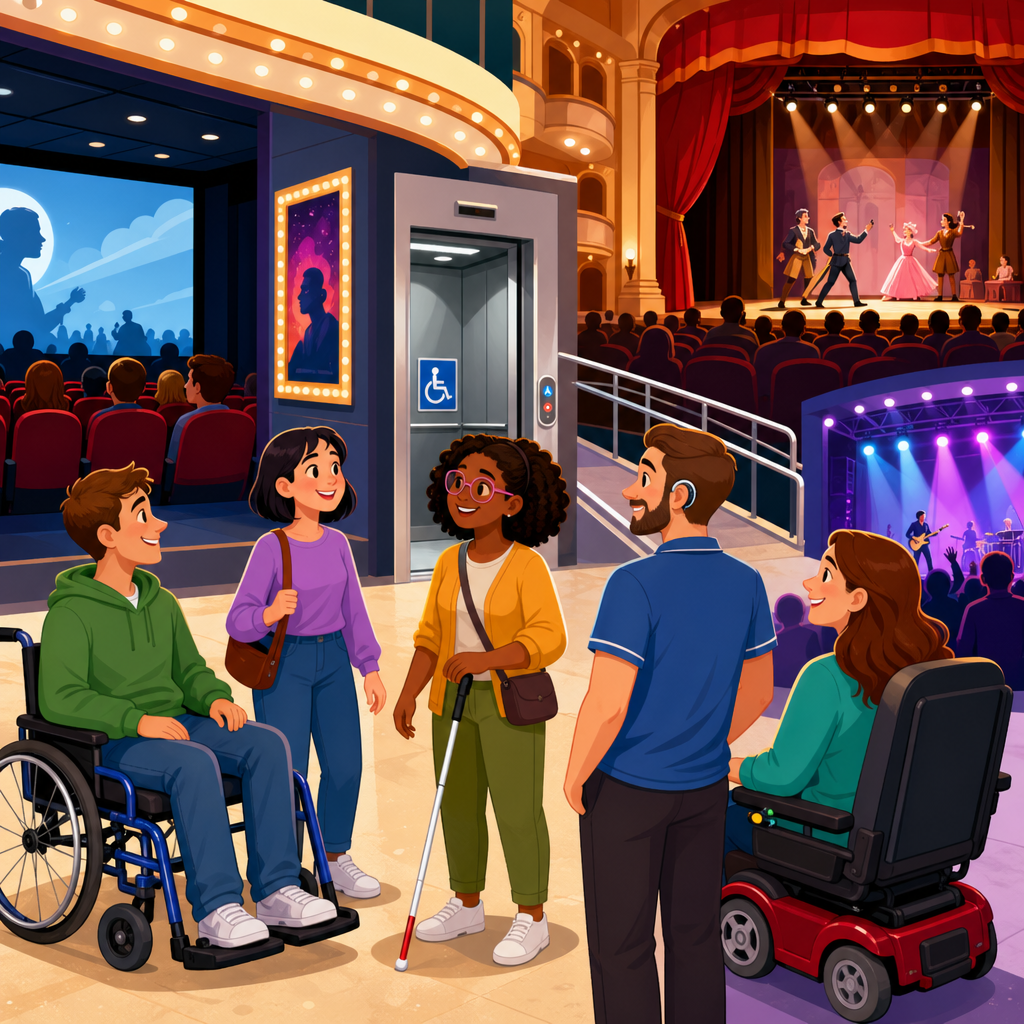
Understanding ADA rights in entertainment venues starts with a practical question: can a person with a disability enjoy a movie, play, or concert with equal access, dignity, and independence? Under the Americans with Disabilities Act, the answer is yes. The ADA is a federal civil rights law that prohibits disability discrimination in places open to the public, including cinemas, theaters, stadium-style performing arts centers, and concert halls. When I have reviewed venue policies and accessibility plans, the core issue has always been the same: access is not a courtesy. It is a legal obligation tied to design, operations, ticketing, communication, and staff conduct.
For entertainment venues, the most important rules usually arise under Title III of the ADA, which covers private businesses that serve the public, and sometimes Title II, which applies to state and local government-operated venues. Basic rights under the ADA include accessible entrances and routes, wheelchair seating integrated with other seating choices, effective communication for guests who are deaf, hard of hearing, blind, or have low vision, equal opportunity to buy tickets and attend programs, reasonable modifications to policies when needed, and the right to use service animals in most public areas. These rights matter because entertainment is not optional in civic life. Cultural participation, community events, school performances, comedy shows, film screenings, and live music all shape how people connect with society.
This hub article explains the baseline protections that apply across entertainment venues, where the rules differ by setting, and what visitors should expect before, during, and after an event. It also clarifies a point that often causes confusion: the ADA does not require perfection or erase every logistical challenge, but it does require equal access unless a requested change would fundamentally alter the service or create an undue burden. Knowing that distinction helps patrons ask for what the law supports and helps venues build systems that work in the real world.
Which entertainment venues must follow ADA requirements
Most entertainment venues open to the public must comply with ADA accessibility rules. A privately owned movie theater, Broadway touring house, comedy club, casino showroom, music venue, opera hall, amphitheater, and independent cinema generally fall under Title III. A city-owned civic auditorium, public university performing arts center, county fair concert hall, or municipally operated theater generally falls under Title II. The legal source differs, but the practical expectation is similar: a disabled patron must have an equal chance to enter, obtain information, purchase tickets, find seating, use restrooms and concessions, and experience the program.
Older buildings are not exempt simply because they are historic or built before accessibility codes became common. In my experience, older venues are where confusion is greatest. The ADA treats new construction, alterations, and existing facilities differently. New or altered spaces must meet applicable accessibility standards, while existing venues must remove architectural barriers when doing so is readily achievable, meaning easily accomplishable without much difficulty or expense. Historic properties may use alternative methods when standard changes would threaten historic significance, but they still must provide access to the maximum extent feasible. That can mean a lift instead of a long ramp, relocated services, or accessible seating in an alternate but comparable location.
Basic physical access rights inside cinemas, theaters, and concert halls
Physical access begins long before a guest reaches a seat. The route from parking or passenger drop-off to the entrance must be usable. Entrances should not force disabled patrons to use a service door or back alley when the public uses a grand front entry, unless no other compliant option exists. Inside, accessible routes should connect lobbies, ticket counters, restrooms, concession areas, bars, merchandise points, and seating sections. Common barriers include heavy manual doors, narrow queue lanes, inaccessible restroom stalls, raised VIP platforms without lift access, and temporary furniture that blocks circulation space.
Wheelchair seating is one of the most visible ADA rights in entertainment venues, and it is more specific than many patrons realize. Accessible seating must be integrated into the seating plan and provide lines of sight comparable to those for other attendees. In assembly areas, that means disabled guests should have choices in price range, viewing angles, and audience experience rather than a single isolated location. Federal guidance and case law have long emphasized that people using wheelchairs cannot be segregated into inferior sections. Companion seating must also be provided nearby. In theaters with sloped floors or stadium configurations, the design must account for viewing over standing spectators when that is part of the normal audience experience, particularly in concert settings.
Venues also need policies that keep accessible features usable. I have seen compliant floor plans undermined by poor event management: portable bars placed in wheelchair spaces, camera platforms blocking accessible sight lines, or ushers moving companions away from designated seats. The ADA reaches operations as well as architecture. If a venue has accessible seating on paper but repeatedly makes it unusable in practice, that is an access failure, not a minor inconvenience.
Communication access and auxiliary aids for patrons with sensory disabilities
Communication access is a basic ADA right, and it applies across the entertainment experience. For guests who are deaf or hard of hearing, venues may need to provide auxiliary aids and services such as assistive listening systems, captioning equipment, open caption screenings, qualified sign language interpreters for certain live events, or written materials when appropriate. The specific aid depends on context. A mainstream film shown in a modern cinema may require closed captioning devices if the theater uses digital systems covered by Department of Justice rules. A live post-show talkback may require an interpreter or real-time captioning if needed for effective communication. A concert venue may need to provide an interpreter for lyrics and spoken stage content when requested in advance and when necessary for equal access.
For patrons who are blind or have low vision, rights can include audio description for films where available, accessible ticketing websites, readable digital communications, braille or large-print materials when appropriate, and staff assistance with wayfinding. Effective communication is not satisfied by telling a blind guest to bring a companion or telling a deaf guest to read lips in a dark auditorium. The legal standard is effectiveness, not minimal effort.
Advance notice matters, but venues cannot use it as a blanket excuse. Some services, like interpreters for a specific performance, reasonably require lead time. Others, like maintaining assistive listening devices in working order or offering accessible website functions, should be routine. Staff training is critical here. A venue may technically own listening receivers or caption devices, but if front-of-house employees cannot locate, charge, clean, or troubleshoot them, the patron still loses access.
Ticketing, seating choices, and service policies patrons can expect
Accessible ticketing is where many ADA disputes begin because unequal systems often look neutral until you test them. Patrons with disabilities have the right to buy accessible seats during the same hours, through the same methods, and at the same price levels as other members of the public. The Department of Justice ticketing rules require venues to identify and sell accessible seating in a way that allows disabled patrons to purchase those seats online, by phone, or in person, depending on how standard tickets are sold. A venue cannot require unnecessary proof of disability before selling an accessible seat, though it may make limited inquiries to confirm that the seat is needed for accessibility.
Patrons are also entitled to seating choices. If a theater offers orchestra, mezzanine, balcony, premium, and budget seating, accessible locations should be available across comparable ranges when the layout permits. When events sell out, venues may release unsold accessible seats under controlled conditions, but they must preserve them for people who need them up to the point allowed by policy and law. Companion seats should stay with the accessible location whenever possible. Problems often arise when ticketing platforms mislabel wheelchair spaces, fail to show aisle transfer seats, or prevent disabled patrons from purchasing more than one adjacent companion seat even when inventory exists.
| ADA right | What it means in practice | Common venue mistake |
|---|---|---|
| Accessible ticketing | Buy access seats through normal sales channels | Forcing phone-only sales with limited hours |
| Integrated seating | Choose among locations and price levels | Offering one isolated wheelchair section |
| Companion seating | Sit with family or friends nearby | Separating companions into different rows |
| Effective communication | Use captioning, listening devices, interpreters, or description when needed | Devices unavailable, uncharged, or staff untrained |
| Reasonable modifications | Adjust ordinary rules when necessary for access | Rigid no-reentry or bag policies without exceptions |
| Service animal access | Allow trained service animals in public areas | Demanding certificates or excluding by default |
Policy modifications are part of basic ADA rights too. If a no-food rule conflicts with diabetes management, if a no-reentry policy interferes with disability-related needs, or if a bag policy affects medical supplies, the venue must consider a reasonable modification unless it would fundamentally alter the service or create a direct threat. This is where individualized assessment matters. Blanket refusals are risky and often unlawful.
Service animals, companion support, and respectful treatment by staff
Entertainment venues must generally allow service animals accompanying a person with a disability in areas where the public may go. Under federal ADA rules, a service animal is usually a dog individually trained to do work or perform tasks for a person with a disability. Staff may ask only two limited questions when the disability is not obvious: whether the dog is required because of a disability and what work or task the dog has been trained to perform. Staff may not demand documentation, require a special vest, or charge pet fees. A service animal can be excluded only in narrow circumstances, such as when it is out of control and the handler does not take effective action, or if it is not housebroken.
Companions, aides, and interpreters also affect access. Venues do not have to admit every support person for free in all circumstances, but they cannot structure policies to defeat access. For example, if a disabled guest needs a personal care attendant to attend safely, the venue should have a clear and fair policy for admission and seating. Some publicly funded programs, membership plans, or accessibility initiatives may offer attendant tickets, but the ADA itself focuses on equal access rather than automatic free entry. Staff should communicate these distinctions carefully to avoid misinformation.
Respectful treatment is not a soft extra; it shapes whether legal rights are usable. Ushers should address the patron directly, not only the companion. Security staff should know how to inspect mobility devices or medical equipment without creating humiliation or delay. Box office teams should understand transfer seats, wheelchair locations, caption devices, and accommodation request channels. In accessibility audits I have reviewed, poor staff training causes as many complaints as physical barriers do.
How to request accommodations and what to do when access fails
The most effective way to request an accommodation is to contact the venue as early as possible, use plain language, and ask for a specific solution tied to the event. A patron might request wheelchair seating with two companion seats, an ASL-interpreted performance, a captioning device, early entry due to mobility limitations, permission to bring medically necessary food, or an accessible route to a premium lounge. Good venues publish accessibility contacts, device availability, seating maps, and policy details online. That transparency helps everyone.
If access fails, documentation matters. Save confirmation emails, screenshots of inaccessible ticketing pages, photos of blocked accessible routes, names of staff involved, and notes about what happened. Start by asking for an on-site supervisor or accessibility manager to resolve the issue in real time. Many problems can be fixed immediately if the right employee is empowered to act. If not, a written complaint to venue management creates a record. Patrons may also file complaints with the U.S. Department of Justice in appropriate cases, and state or local disability rights agencies may offer additional remedies. Private legal action is also possible, especially when barriers are ongoing.
The main benefit of understanding ADA rights in cinemas, theaters, and concert halls is simple: knowledge turns a vague sense of unfairness into clear expectations and practical action. Patrons should expect equal access to buildings, seating, communication, ticketing, and policies. Venues should treat accessibility as part of operations, not as an exception handled only after complaints. If you attend or manage entertainment events, review your rights, check the venue’s accessibility information before you go, and speak up early when something is missing. Better access is achievable, and the ADA provides the foundation for it.
Frequently Asked Questions
What ADA rights do people with disabilities have in cinemas, theaters, and concert halls?
Under the Americans with Disabilities Act, people with disabilities have the right to equal access to places of public accommodation, which includes movie theaters, live performance venues, and concert halls. In practical terms, that means a venue cannot exclude someone because of a disability, cannot impose unnecessary barriers that prevent meaningful participation, and must provide access in a way that preserves dignity and independence whenever possible. These protections apply to many parts of the entertainment experience, including entering the building, purchasing tickets, moving through common areas, finding seating, using restrooms, accessing concessions, and exiting safely.
The ADA also requires venues to make reasonable modifications to policies, practices, and procedures when necessary to serve patrons with disabilities, unless doing so would fundamentally alter the nature of the service. Depending on the situation, that can include allowing a service animal, providing accessible seating options, offering effective communication aids, or adjusting standard procedures that otherwise create disability-related barriers. The law does not guarantee every accommodation a patron might prefer, but it does require venues to provide equal opportunity and effective access rather than a separate or inferior experience.
For many entertainment venues, ADA compliance also involves physical accessibility. Accessible routes, entrances, seating locations, counters, restrooms, and parking may all be relevant. Newer facilities generally must meet modern accessibility standards, while older facilities may have ongoing obligations to remove barriers where doing so is readily achievable. The key point is that equal enjoyment of entertainment is not a courtesy or optional upgrade. It is a civil right protected by federal law.
Are entertainment venues required to provide wheelchair-accessible seating and companion seating?
Yes. Entertainment venues generally must provide wheelchair-accessible seating and companion seating in a way that offers patrons with disabilities choices comparable to those available to other guests. Accessible seating should not be clustered only in undesirable locations or limited to a single price level if the venue offers a range of seating options to the general public. In cinemas, theaters, and concert halls, this usually means accessible spaces must be integrated into the seating plan and dispersed where appropriate so guests with disabilities can choose from different viewing angles, ticket prices, and audience experiences.
Companion seating is also an important part of meaningful access. A patron using a wheelchair or other mobility device should generally be able to sit with family members, friends, or assistants rather than being isolated from the rest of the party. Venues are expected to provide adjacent companion seats and to handle ticketing policies in a way that does not unfairly limit access to those seats. If a venue allows members of the public to purchase tickets through online platforms, box offices, subscriptions, or presales, accessible seating should be available through comparable channels as well.
Another critical issue is line of sight. In many assembly spaces, wheelchair seating must provide views comparable to those offered to other patrons, including over standing spectators where required. This issue often matters at concerts and popular performances where audience members may stand for extended periods. If an accessible seat leaves a patron unable to see the event while others around them can, that may raise serious ADA concerns. Venues should also have policies to prevent misuse of accessible seats while still ensuring they remain available to those who need them.
What accessibility services might a venue have to provide for guests who are deaf, hard of hearing, blind, or have low vision?
The ADA requires places of public accommodation to provide appropriate auxiliary aids and services when needed to ensure effective communication, unless doing so would result in an undue burden or fundamentally alter the nature of the service. In entertainment settings, that can include captioning devices, open caption screenings, assistive listening systems, sign language interpreters in some circumstances, audio description, Braille or large-print materials, and staff assistance with orientation or navigation. What is required depends on the type of venue, the nature of the event, and the communication needs involved.
For movie theaters, captioning and audio description technologies are often central accessibility tools. Patrons who are deaf or hard of hearing may need closed caption equipment or information about open-caption screenings, while patrons who are blind or have low vision may benefit from audio description devices that describe key visual elements of the film. In live performance settings, effective communication may look different. A theater or concert hall may need to provide assistive listening devices, make performance information available in accessible formats, or consider interpreter requests depending on the event and circumstances.
Just as important, the service must be usable in practice, not merely listed in a policy. Devices should be functioning, staff should know how to distribute and troubleshoot them, and patrons should be told clearly what is available and how to request it. A venue that advertises accessibility but provides broken equipment, inconsistent support, or untrained employees may still fall short of ADA obligations. Effective communication under the law means more than symbolic compliance. It means a patron can actually receive the information and content needed to enjoy the event on terms that are meaningfully equal.
Can a venue refuse entry because of a service animal, mobility device, or disability-related accommodation request?
In many cases, no. The ADA generally requires entertainment venues to allow service animals that are individually trained to do work or perform tasks for a person with a disability. Staff may ask limited questions when the disability and need for the animal are not obvious, but they cannot demand documentation, require certification, or insist that the animal demonstrate its task. A service animal can be excluded only in limited circumstances, such as when the animal is out of control and the handler does not take effective action, or when the animal is not housebroken. Fear of animals or generalized concerns from other patrons are usually not valid reasons to deny access.
Mobility devices are also protected. Wheelchairs and manually powered mobility aids must generally be permitted in all areas open to pedestrian use. Other power-driven mobility devices may also need to be allowed unless the venue can show legitimate safety requirements based on actual risks rather than assumptions or stereotypes. A venue should not create rules that force a person with a disability to transfer unnecessarily, use a less effective route, or accept a diminished experience simply because staff are unfamiliar with disability access requirements.
Accommodation requests should be evaluated carefully and individually. Whether the request involves early entry, accessible drop-off, seating adjustments, policy modifications, or communication support, the venue should consider whether the change is reasonable and necessary for equal access. Blanket denials can be problematic, especially when based on convenience or a misunderstanding of the ADA. The law aims to ensure that disability-related needs are addressed through practical, fact-specific solutions rather than one-size-fits-all restrictions.
What should someone do if a cinema, theater, or concert hall is not complying with the ADA?
The first step is often to document the problem clearly and specifically. That may include saving tickets, taking photos where appropriate, keeping screenshots of inaccessible ticketing systems, noting the names of employees involved, and writing down what happened as soon as possible. It helps to identify whether the issue involved physical access, seating, communication aids, service animal access, staff conduct, or another barrier. Specific details can make it much easier to resolve the matter quickly and can be important if further action becomes necessary.
In many situations, it makes sense to raise the issue directly with venue management or the company’s customer service department. Some problems, such as inaccessible seating assignments, broken captioning equipment, or staff misunderstanding of service animal rules, may be resolved through prompt internal review. A clear written complaint can be especially effective because it creates a record of the accessibility barrier and gives the venue an opportunity to respond. Requesting a practical remedy rather than only expressing frustration often helps move the conversation forward.
If the venue does not correct the issue, additional options may include filing a complaint with the U.S. Department of Justice, contacting a state or local civil rights agency if applicable, or consulting an attorney experienced in disability rights law. The best path depends on the facts, the urgency of the issue, and whether the problem appears isolated or systemic. The broader point is that ADA violations in entertainment venues are not just customer service failures. They may be civil rights violations, and patrons are entitled to seek meaningful remedies when equal access is denied.