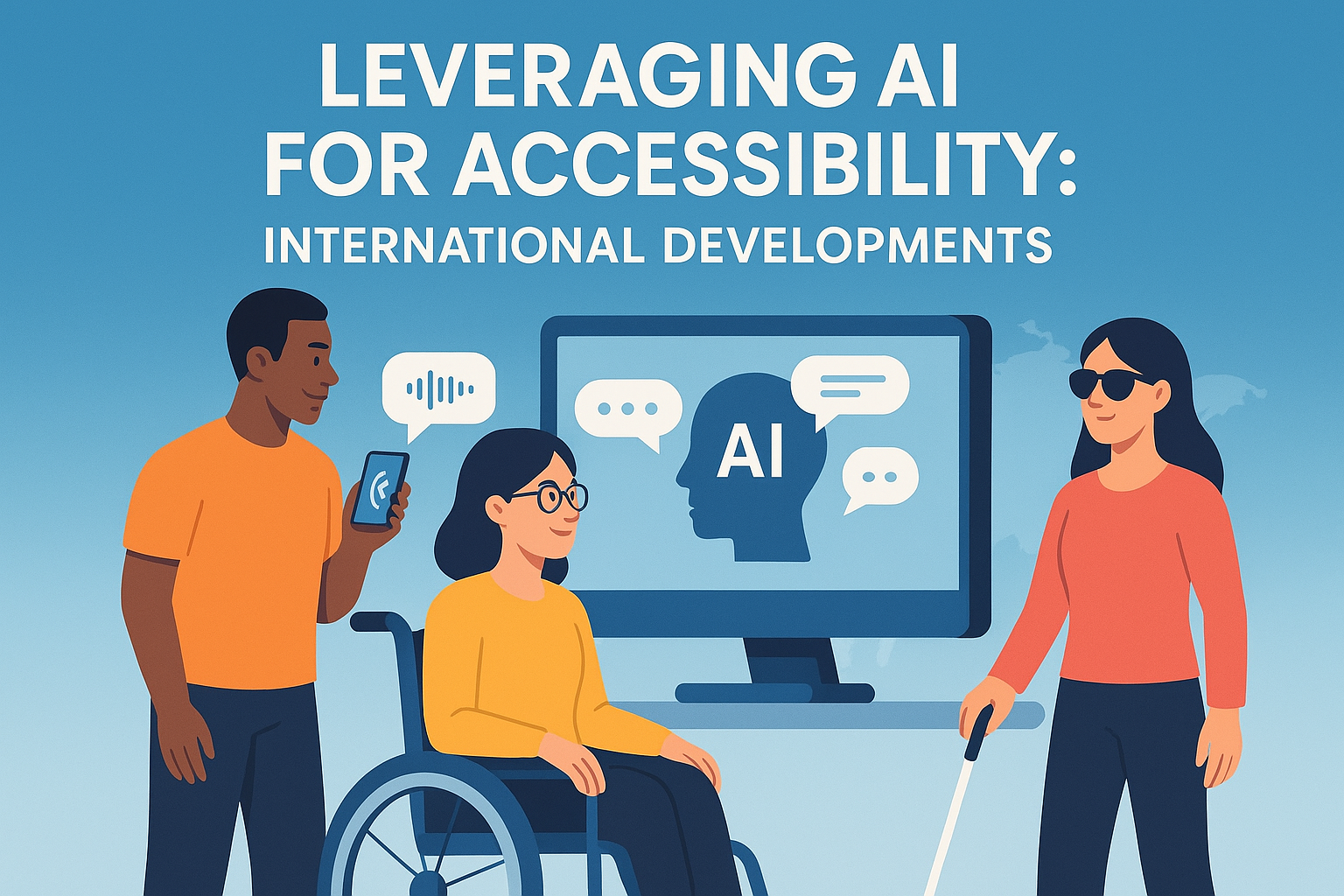
In a world where digital transformations are shaping the future, the incorporation of artificial intelligence (AI) into the realm of accessibility is not just a technological advancement—it is a societal imperative. As technology continues to evolve, ensuring that it remains inclusive to individuals with disabilities is crucial for equitable access. The term “accessibility” refers to the design of products, devices, services, or environments to be usable by people with disabilities. Meanwhile, “artificial intelligence” describes advanced computing technologies that simulate human intelligence processes like learning, reasoning, and self-correction. By leveraging AI for accessibility, we can significantly enhance the quality of life for people with disabilities worldwide, enabling them to engage more fully in society, education, work, and entertainment.
One of the primary reasons this topic matters is because of the sheer number of people it affects. According to the World Health Organization, approximately 15% of the global population—over a billion people—live with some form of disability. These individuals often face significant barriers to participating in everyday activities that others may easily take for advantage. AI, with its potential to customize and improve user experiences, is uniquely positioned to tear down these barriers. By doing so, it not only offers a lifeline to millions of individuals but also contributes to the creation of a more inclusive world.
How AI is Revolutionizing Assistive Technology
AI is profoundly transforming assistive technology, making it more effective and personalized than ever before. Assistive technology includes software and devices designed to aid individuals with disabilities in performing tasks that might otherwise be difficult or impossible. Speech recognition software, for instance, uses AI to translate spoken words into text, helping individuals with physical impairments to communicate effectively. Applications such as Apple’s Siri and Google’s Assistant demonstrate AI’s role in this field by allowing users to interact with their devices through voice commands.
A striking real-world example is Microsoft’s Seeing AI app, which utilizes AI to describe the world to visually impaired users. By pointing the phone camera at various objects, the app can narrate the user’s surroundings, read text, and even recognize faces. This application empowers visually impaired individuals to gain insights into their environments, promoting greater independence and social interaction. Through such innovations, AI is continually pushing the boundaries of what’s possible in assistive technology.
AI-Based Language Processing for the Deaf and Hard of Hearing
For individuals who are deaf or hard of hearing, language processing technologies are being propelled into new dimensions by AI advancements. Real-time transcription services, powered by AI, are becoming more precise and accessible. Such services play a pivotal role at conferences, lectures, and meetings, enabling participants to keep up with discussions by reading transcriptions simultaneously.
Google’s Live Transcribe is a prime example. This AI-driven application provides real-time, speech-to-text transcription, allowing deaf and hard of hearing users to participate in conversations without the need for a human interpreter. It can also identify critical sounds like sirens or alarms, providing additional safety features. The app demonstrates how AI can break down communication barriers, promoting inclusivity in public and private interactions alike.
AI Enhancements in Education for Increased Accessibility
AI technology is making significant strides in education, particularly in creating more accessible learning environments for students with disabilities. Educational tools and platforms that integrate AI offer personalized learning experiences by adjusting content to fit individual needs, styles, and paces, thus enabling all students to thrive.
For example, the AI tool Read&Write is designed to support students with learning disabilities such as dyslexia. This tool provides features like text-to-speech, word prediction, and advanced spelling correction, assisting students in better understanding and completing their coursework. Read&Write fosters a supportive learning environment, enabling educators to tailor instructions to meet every student’s unique needs, thus enhancing educational outcomes for those who may struggle with traditional learning methods.
| AI Accessibility Tool | Target Disability | Key Feature |
|---|---|---|
| Seeing AI | Visual Impairment | Describes environments and objects |
| Live Transcribe | Hearing Impairment | Real-time speech-to-text |
| Read&Write | Learning Disabilities | Text-to-speech and word prediction |
Global Initiatives in AI and Accessibility
Several countries and organizations are actively pursuing AI-driven initiatives to enhance accessibility. These initiatives not only aim to support people with disabilities but also to set a global standard for inclusive technology development. In the European Union, the European Accessibility Act encourages the development of products and services that are accessible to persons with disabilities. By implementing comprehensive legislation, the EU aims to integrate accessibility into the core of its digital and AI strategies.
An example from the private sector is IBM’s Accessibility Research, which engages in developing AI solutions to remove accessibility barriers. Their AI Fairness 360 toolkit, for instance, assists developers in detecting and mitigating bias in AI models to ensure fairness in AI-driven accessibility tools. Such initiatives exemplify a growing recognition of the need to embed accessibility considerations into AI research and deployment from the ground up.
The Role of AI in Telemedicine and Accessibility
AI is swiftly becoming a strategic component in the realm of telemedicine, enhancing accessibility for individuals who might face challenges in accessing traditional healthcare facilities. Telemedicine refers to the provision of healthcare services remotely through technology. For individuals with mobility impairments or those living in remote areas, access to healthcare can be significantly improved through AI-enhanced telemedicine platforms.
AI tools in telemedicine can facilitate remote diagnosis, patient monitoring, and personalized treatment plans. For example, the Ada Health app uses AI algorithms to assess symptoms and provide decision support for healthcare providers. By leveraging AI, telemedicine is transforming how people with disabilities interact with healthcare systems, offering them a more convenient and accessible means of obtaining medical care.
AI and Smart Home Technologies for Independent Living
The advent of smart home technologies, integrated with AI, is facilitating independent living for individuals with disabilities. Smart home systems equipped with AI, such as Amazon Echo’s Alexa or Google Home, can enable users to control various home functions through simple voice commands or touchless interfaces. These technologies are essential in ensuring that individuals with limited mobility can live independently and comfortably.
For instance, voice-controlled systems can manage environment settings such as lighting, temperature, and security. By using AI to learn and predict the preferences and habits of users, these systems not only improve convenience but also ensure the safety and comfort of individuals who might otherwise require assistance from a caregiver. As the technology advances, the potential applications for AI in smart home technology continue to grow, paving the way for more inclusive living spaces.
AI for Simplifying Workplace Accessibility
AI is a game-changer in creating inclusive workplaces by ameliorating accessibility for employees with disabilities. AI-powered tools can provide invaluable support by altering the workspace to better fit the needs of those with disabilities, thus fostering a more diverse workforce. By making workplaces more accessible, companies can tap into the skills and talents of employees who might otherwise be overlooked.
For example, the AI tool Aira assists visually impaired employees by connecting them with remote visual interpreters who help them navigate their work environment effectively. Moreover, companies are increasingly adopting AI-based HR tools that assess a candidate’s skills and talents without bias, ensuring that disabilities do not act as barriers to employment opportunities. Such advancements highlight AI’s role in advancing workplace inclusivity and diversity.
Conclusion: The Future of AI and Accessibility
Summarizing the profound implications of AI on accessibility, it becomes clear that technology holds the promise of a more inclusive future for individuals with disabilities. From transforming assistive technology and education to improving telemedicine and smart home functionalities, AI’s influence is wide-ranging and essential. The key takeaway for stakeholders in technology, policy making, and disability advocacy is that leveraging AI for accessibility is not just an opportunity but a responsibility to uphold the rights and quality of life for people with disabilities.
As the global community continues to harness AI’s potential, the task ahead is to ensure that the development and deployment of these technologies are equitable and inclusive. Policymakers, businesses, and innovators who prioritize inclusive design will lead the charge in a new era of digital empowerment. For individuals interested in furthering this mission, getting involved with advocacy groups, supporting inclusive policies, or contributing to research and development in this field can serve as actionable steps. Together, these efforts can drive transformative change, fostering environments that accommodate everyone, regardless of ability.
In taking these steps, we commit to advancing a society where technology bridges gaps rather than widens them, making an inclusive world the standard rather than the exception.
Frequently Asked Questions
1. What is the role of AI in enhancing accessibility for individuals with disabilities?
AI plays a pivotal role in enhancing accessibility by providing tools and solutions that can adapt to the individual needs of people with disabilities. Through machine learning algorithms, AI can personalize user experiences by predicting and catering to unique accessibility requirements. For example, AI-driven voice recognition systems are able to understand and transcribe spoken language into text for individuals who are deaf or hard of hearing. Meanwhile, image recognition technology can describe visual elements to those who are blind or have low vision. The intelligent capabilities of AI also include predictive text and real-time translation services, which can be particularly beneficial to individuals with cognitive or learning disabilities. Moreover, AI technology is exceptional in automating routine tasks and providing haptic feedback, thereby facilitating easier interaction with digital environments for those with motor impairments.
2. How are international developments influencing AI accessibility solutions?
International developments play a critical role in shaping AI accessibility solutions. Countries across the globe are recognizing the value of incorporating inclusive designs into their tech ecosystems. International collaborations, like the Global Initiative for Inclusive ICTs (G3ict) and the AI for Accessibility initiative by Microsoft, drive innovation and establish best practices on a global scale. Furthermore, regulatory frameworks and guidelines, such as the UN Convention on the Rights of Persons with Disabilities, push nations to prioritize AI accessibility efforts. This international focus encourages knowledge sharing and the dissemination of new technologies, ensuring that solutions cater to diverse cultural and individual needs. Innovations in one part of the world can be quickly adapted and improved in another, broadening access and ensuring that breakthroughs reach as many people as possible.
3. What challenges are faced when implementing AI for accessibility initiatives globally?
While AI for accessibility offers promising solutions, there are numerous challenges in implementation, particularly on a global scale. One major challenge is the uneven availability of resources, including technology infrastructure, which varies significantly between regions and affects the deployment of AI solutions. Moreover, cultural diversity and different languages necessitate the adaptation of AI systems to cater comprehensively to varied user groups. There’s also a prevalent issue of bias within AI algorithms, which can inadvertently marginalize already underrepresented groups. Ensuring diversity in data sets used for training AI models is crucial, yet often complicated to achieve. Additionally, there’s the overarching challenge of addressing privacy concerns and ensuring data security, an aspect that can particularly impact the adoption of AI solutions among users who are skeptical of technology. Finally, the establishment and harmonization of regulatory standards can be difficult, limiting the scope and speed of international collaboration.
4. What advancements have been made in AI technology to support people with cognitive disabilities?
Significant advancements have been made in AI technology to support individuals with cognitive disabilities, which include a range of conditions that affect learning, memory, problem-solving, and attention. AI-driven learning support tools and apps have revolutionized the ways in which people with cognitive disabilities interact with digital content. These tools can provide step-by-step instructions and reminders to assist with task completion and schedule management. AI also offers real-time speech-to-text transcription and simplification of complex language, aiding comprehension. Additionally, AI systems can now offer adaptive learning, personalizing content delivery to match the speed and understanding level of the user. Virtual assistants powered by AI also offer on-demand support, promoting independence while assisting users with various tasks—from organizing activities to navigating social interactions. These advancements enable a more inclusive and supportive environment, allowing individuals with cognitive disabilities to better engage with technology and society.
5. What are the potential future developments in AI for accessibility?
The future of AI in accessibility is brimming with potential, fueled by ongoing research and technological advancement. In the near future, we can expect AI systems to become even more adaptive, utilizing biometric feedback like eye-tracking and emotional recognition to tailor their responses more precisely. The integration of AI with augmented and virtual reality technologies promises enriched educational and vocational experiences for individuals with disabilities. Moreover, developments in natural language processing are expected to enhance communication aids, enabling more nuanced interactions in real-time. We may also see significant improvements in autonomous technology, such as self-navigating devices and vehicles, which significantly increase mobility for individuals with physical impairments. Additionally, there is a focus on increasing the scalability and affordability of these AI solutions, ensuring universal access irrespective of geographical or economic constraints. The ethical development of AI, with a spotlight on inclusivity and fairness, will remain at the forefront to ensure that these technologies benefit all users equitably.