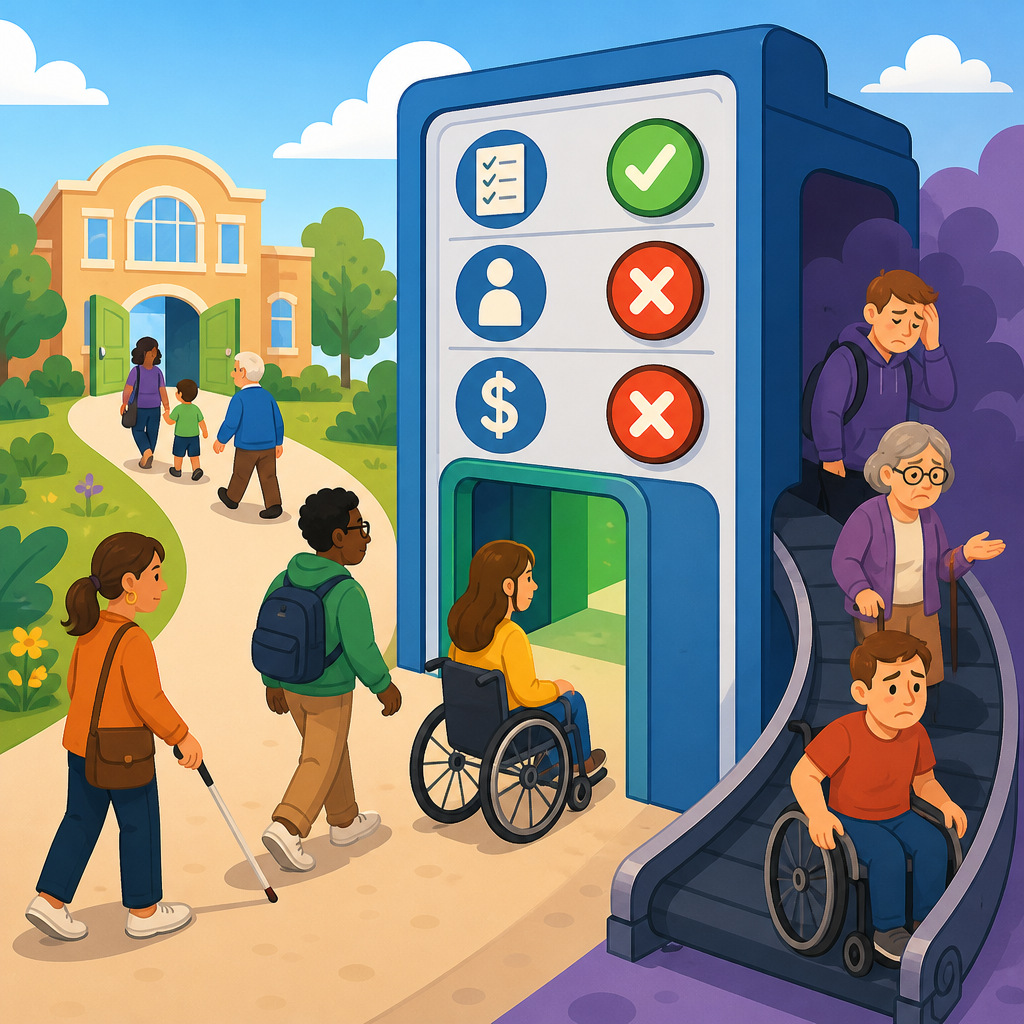
Title III of the Americans with Disabilities Act bars places of public accommodation from using eligibility criteria that screen out or tend to screen out people with disabilities, unless those criteria are necessary for providing the goods, services, facilities, privileges, advantages, or accommodations being offered. In practice, that rule reaches far beyond ramps and restrooms. It applies to membership requirements, safety policies, identification rules, reservation systems, online forms, participation standards, and everyday business procedures that look neutral on paper but exclude disabled customers in operation. I have seen this issue arise most often when an organization assumes a business rule is automatically lawful because it applies to everyone. Under Title III, equal wording is not enough. The real question is whether a rule blocks access for disabled people, whether the barrier is necessary, and whether a reasonable modification can preserve both access and legitimate business needs.
Understanding this standard matters because Title III covers a vast share of daily life: restaurants, hotels, retail stores, hospitals, banks, theaters, gyms, museums, schools, professional offices, transportation depots, and websites or apps closely tied to physical locations. The legal framework comes primarily from 42 U.S.C. § 12182 and the Department of Justice regulation at 28 C.F.R. § 36.301, which specifically addresses eligibility criteria. The rule works alongside related duties, including reasonable modifications of policies, practices, and procedures; effective communication; removal of architectural barriers where readily achievable; and equal enjoyment of goods and services. As a hub for Title III public accommodations, this article explains what eligibility criteria are, when business rules become unlawful screens, how necessity is evaluated, what common industries get wrong, and how organizations can audit their practices before a complaint, demand letter, or lawsuit forces the issue.
What eligibility criteria mean under Title III
Eligibility criteria are the conditions a business sets for who may enter, participate, buy, reserve, register, or receive a service. Some are obvious, such as age minimums, training prerequisites, identification requirements, or dress codes. Others are embedded in process design: requiring all customers to complete a touchscreen check-in without staff assistance, limiting reservations to voice telephone calls, demanding handwritten signatures, or insisting that a participant hear verbal instructions without captioning or visual backup. Title III prohibits criteria that screen out or tend to screen out individuals with disabilities, or any class of individuals with disabilities, from fully and equally enjoying public accommodations.
The phrase “tend to screen out” is important. A business does not need to intend discrimination for liability to exist. If the predictable effect of a rule is exclusion, the analysis starts there. For example, a testing center that requires all applicants to read printed instructions without magnification may screen out people with low vision. A fitness club that requires members to navigate a turnstile too narrow for many mobility devices may screen out wheelchair users. A restaurant that requires online reservations through an inaccessible booking tool may screen out blind users who rely on screen readers. In each case, the rule or process may be framed as standard procedure, but Title III asks how it functions for disabled people in the real world.
This issue is central to public accommodations because businesses often focus on physical design while overlooking operational rules. Yet many access failures are administrative, not architectural. I have reviewed policies that looked harmless in compliance binders but repeatedly failed disabled customers at the front desk, on the phone, or during registration. The law addresses those failures directly. If a criterion excludes disabled people and is not necessary, it must be removed or modified.
When a business rule is necessary and when it is not
Not every screening rule violates Title III. The statute and regulation allow eligibility criteria that are necessary for the provision of the goods or services being offered. “Necessary” is a demanding standard. It is not the same as convenient, customary, inexpensive, or preferred by staff. The business should be able to explain why the criterion is genuinely tied to the nature of the service or to a legitimate safety requirement based on actual risk, not stereotypes or generalized fears.
A simple example is a scuba certification requirement for participation in an advanced open-water dive. If the operator can show that the certification measures essential skills directly related to underwater safety, the criterion is likely necessary. By contrast, a blanket rule that no one using insulin may join a recreational excursion would almost certainly fail. Diabetes does not inherently disqualify a person from participation, and individualized assessment is required when safety is at issue. The Department of Justice has long taken the position that safety requirements must be based on actual risks and not mere speculation, stereotypes, or generalizations about individuals with disabilities.
Courts analyzing Title III issues often distinguish between essential eligibility standards and overbroad proxies. Requiring a museum patron to present a valid ticket is usually necessary. Requiring that the patron stand in a long line when an accessible alternative could be provided is not. Requiring a driver’s license where driving is essential may be lawful. Requiring a driver’s license as universal identification for hotel check-in, when another reliable form of ID would work, can become problematic for people whose disabilities affect driving. The narrower and more evidence-based the criterion, the better its legal footing.
Common public accommodation rules that screen out disabled customers
Across Title III industries, several recurring business rules create avoidable risk. Reservation systems are a major one. Hotels and event venues sometimes require all customers to use inaccessible booking engines, fail to identify accessible room features accurately, or impose stricter cancellation rules when a guest requests an accessible room. Retail and banking settings often require signatures, PIN entry, or kiosk use without offering staff assistance or accessible interfaces. Health care providers may insist that patients bring their own interpreter, use family members for communication, or complete intake solely through inaccessible patient portals. Gyms and recreation providers sometimes adopt “independent use only” policies that exclude people who need assistance from a support person.
Service animal conflicts also reveal how screening rules operate. Under Title III, businesses generally must permit service animals, with limited exceptions. A “no pets” rule is not unlawful by itself, but applying it to exclude service animals is. Likewise, theaters and lecture halls may violate Title III when they require disabled patrons to purchase companion seats under less favorable terms, limit wheelchair seating choices, or refuse captioning devices absent a valid operational justification. The pattern is consistent: a business adopts a general rule to simplify operations, then fails to account for disability access.
| Business rule | Why it screens out | Compliant alternative |
|---|---|---|
| Telephone-only reservations | Excludes many deaf or speech-disabled users | Offer accessible online and text-based booking |
| Government ID limited to driver’s license | Disadvantages people who do not drive because of disability | Accept equivalent government-issued identification |
| No outside assistance allowed | Blocks entry for patrons needing a support person | Permit support persons unless a specific safety issue exists |
| Touchscreen-only check-in | Excludes blind users and some users with dexterity limitations | Provide accessible kiosks or immediate staff assistance |
| No animals policy applied uniformly | Improperly excludes service animal handlers | Modify policy for trained service animals |
How eligibility criteria interact with reasonable modifications and effective communication
Eligibility criteria do not exist in isolation. In most Title III disputes, they overlap with the duty to make reasonable modifications and the duty to ensure effective communication. That overlap matters because a business may defend a criterion as neutral while ignoring the modifications that would remove its exclusionary effect. For example, a cooking school may require students to follow safety instructions. That criterion may be necessary. But if the school refuses to provide instructions in accessible formats, denies captioning for demonstrations, or refuses to allow adaptive techniques, the school may still violate Title III.
Health care provides some of the clearest examples. A clinic may require informed consent before treatment, which is plainly necessary. Yet if the clinic provides consent forms only in small print, refuses auxiliary aids for deaf patients, or relies on a child to interpret complex medical information, the criterion becomes inaccessible in application. The same is true online. A business may require account creation, but if CAPTCHAs are not accessible, form labels fail screen readers, or time limits expire before a user with a manual dexterity disability can complete the process, the access failure is operational and legally significant.
This is why Title III compliance should be built around customer journeys, not isolated policies. Map the steps a person must complete, identify where a disability-related barrier appears, and ask whether a modification, auxiliary aid, or alternative method would allow equal participation without fundamentally altering the service or creating an undue burden. Businesses that perform this analysis early avoid the common mistake of defending a process that could have been adjusted at minimal cost.
Direct threat, safety, and individualized assessment
Businesses often invoke safety when defending exclusionary rules, but Title III permits safety-based restrictions only under a disciplined standard. A public accommodation may impose legitimate safety requirements necessary for safe operation, yet those requirements must rest on actual risks. Where exclusion is based on a claimed direct threat, the analysis should be individualized and grounded in current medical knowledge or the best available objective evidence. Factors commonly considered include the nature, duration, and severity of the risk; the probability the potential injury will occur; and whether reasonable modifications will mitigate the risk.
This means blanket exclusions are usually vulnerable. A spa cannot simply ban all patrons with seizure disorders from using facilities. A golf course cannot exclude all wheelchair users from greens based on assumptions about turf damage if adaptive mobility devices can be used safely. A daycare open to the public cannot deny enrollment because staff are uncomfortable administering routine medication if the request can be handled through a reasonable policy adjustment. The Supreme Court’s reasoning in disability cases repeatedly emphasizes that decisions must be rooted in evidence rather than fear or paternalism.
From a compliance perspective, document the rationale for safety standards, identify the essential function being protected, and train staff to escalate unusual cases instead of improvising denials at the point of service. Frontline employees create many Title III disputes because they are left to interpret rules without guidance. Written standards, decision trees, and access training reduce inconsistency and improve defensibility.
Digital access and modern screening barriers in public accommodations
Although Title III was enacted in 1990, eligibility criteria now frequently operate through digital systems. Reservation platforms, loyalty programs, patient portals, self-service kiosks, event registration tools, and mobile apps all determine who can access a business. When those systems are inaccessible, they can screen out disabled users just as effectively as a locked staircase. The Department of Justice has reinforced this point through rulemaking on web accessibility for state and local government and through longstanding enforcement positions that public-facing digital barriers can violate disability law. In the private sector, the most widely used technical benchmark remains the Web Content Accessibility Guidelines, currently WCAG 2.1 AA in most settlements and policies, with growing attention to WCAG 2.2.
Examples are concrete. A restaurant app that requires drag-and-drop gestures without keyboard alternatives may exclude users with motor impairments. A ticketing site that fails to expose seat maps to assistive technology may prevent blind users from selecting accessible seating. A bank that requires spoken responses for identity verification without equivalent text or relay-compatible options may screen out deaf customers. These are not edge cases. They are routine design choices that become legal access barriers when no equivalent path exists.
For businesses managing Title III risk, digital accessibility should be treated as an eligibility issue, not just a technical issue. Procurement language, usability testing with disabled users, accessibility statements, and remediation workflows belong in the same compliance conversation as policies for service animals or companion seating. If customers must pass through a digital gate to obtain a service, that gate must be accessible.
How businesses can audit and fix screening rules
The most effective Title III compliance programs start with an inventory of rules, not a list of buildings. Gather written policies, website flows, employee scripts, vendor requirements, and unwritten practices that affect entry or participation. Then test each one against four questions: does it exclude disabled people in practice, is it genuinely necessary, can a reasonable modification preserve access, and are staff trained to apply the modified rule consistently? I recommend reviewing complaints, mystery shopping results, call center logs, and abandoned online transactions because they reveal patterns that formal policies often miss.
Next, prioritize high-frequency barriers. Reservation systems, intake forms, check-in procedures, support-person rules, payment authentication, and emergency procedures usually affect the most customers. Revise policies in plain language, build alternative paths that are easy to request, and assign ownership for implementation. For digital systems, include accessibility in vendor contracts, require conformance testing, and retest after updates. For physical locations, ensure frontline employees understand that equal treatment does not mean rigidly identical treatment.
As a hub page for Title III public accommodations, this article points to the central takeaway: many disability access violations begin as ordinary business rules. Eligibility criteria become unlawful when they screen out disabled people and are not truly necessary, or when a reasonable modification would remove the barrier without fundamentally altering the service. Public accommodations that examine policies, safety assumptions, digital workflows, and communication methods through this lens reduce legal exposure and serve customers more effectively. Start with your highest-impact rules, document why each exists, and change the ones that exclude people unnecessarily. That is how Title III moves from abstract compliance to equal access in daily life.
Frequently Asked Questions
What does Title III mean by “eligibility criteria,” and why does it matter for people with disabilities?
Under Title III of the Americans with Disabilities Act, “eligibility criteria” refers to the rules, standards, conditions, or screening requirements a business uses to decide who can access its goods, services, facilities, privileges, or advantages. That can include obvious requirements, such as proof-of-identity policies or membership rules, but it also includes less visible barriers like reservation procedures, website form requirements, application steps, documentation demands, and safety-based restrictions. The law prohibits places of public accommodation from using criteria that screen out or tend to screen out people with disabilities unless the business can show the rule is actually necessary for the offering in question.
This matters because disability discrimination often happens through neutral-sounding policies rather than outright exclusion. A business may believe it is treating everyone the same, but a one-size-fits-all rule can still disproportionately block people with disabilities from participating. For example, a policy requiring all customers to complete a process only through a visually inaccessible online form may exclude blind users. A rule demanding verbal communication only may shut out people with speech disabilities. A blanket requirement that a customer stand in line for long periods without alternatives may burden people with mobility impairments or chronic medical conditions. Title III is designed to address exactly these kinds of structural barriers.
The key legal point is that the focus is not limited to physical access. Businesses covered by Title III must look at how their rules operate in practice. If a policy has the effect of excluding disabled customers, patients, patrons, members, or guests, the business should ask whether that requirement is truly necessary or whether there is a different way to achieve the same legitimate objective without unnecessary exclusion.
When can a business legally keep a rule that may screen out people with disabilities?
A business may keep an eligibility criterion that screens out or tends to screen out people with disabilities only if the criterion is necessary for providing the goods, services, facilities, privileges, advantages, or accommodations being offered. “Necessary” is an important and demanding standard. It does not mean merely convenient, familiar, administratively easier, or based on generalized assumptions about disability. The business should be able to identify a real operational, safety, or program-related reason for the rule and explain why a less exclusionary alternative would not work.
In practice, this often arises with safety policies, age or supervision requirements, documentation requirements, and participation conditions. A business may impose legitimate safety standards, but those standards must be based on actual risks rather than stereotypes or speculation. For instance, a policy cannot simply assume that people with certain disabilities are dangerous, disruptive, or incapable. If safety is the concern, the business should consider whether individualized assessment, auxiliary aids, or reasonable policy modifications would address the issue without unnecessary exclusion.
Courts and enforcement agencies generally look at the relationship between the rule and the service being offered. If the criterion is overbroad, inconsistently applied, or not meaningfully tied to the nature of the service, it is more likely to be challenged. The best question for a business to ask is: “Do we truly need this exact requirement to provide this service safely and effectively, or are we using it because it is our standard way of doing things?” If the answer is the latter, the policy may create ADA risk.
What are some common examples of business rules that can violate Title III by screening out disabled individuals?
Common examples appear in both physical and digital settings. Reservation systems are a major one. If a hotel, restaurant, clinic, or event venue only accepts reservations through an inaccessible website or app, people with visual, manual, or cognitive disabilities may effectively be excluded. Similarly, online intake forms that time out too quickly, cannot be navigated by keyboard, require uploading documents in inaccessible formats, or are incompatible with screen readers can function as unlawful screening criteria.
Identification and verification policies are another frequent problem. A business may require a particular form of ID presentation or signature method that some customers with disabilities cannot provide in the usual way. If the underlying goal can be met through another reliable method, refusing flexibility may violate Title III. The same is true for communication rules, such as requiring phone calls when a deaf customer needs text-based or relay access, or insisting on in-person verbal interaction when other accessible communication methods are available.
Membership criteria, “independence” requirements, and attendance policies also deserve scrutiny. A gym, club, educational program, tour operator, or recreational business may have rules that appear neutral but effectively exclude people who use service animals, need assistance completing paperwork, require extra time, or need support persons. Blanket “no exceptions” policies are especially risky. So are rules that prohibit necessary medical equipment, deny seating modifications, or refuse alternative methods for check-in or participation. The ADA often turns on whether the business has built flexibility into its procedures rather than forcing disabled individuals into a rigid process that was not designed with accessibility in mind.
How do safety concerns fit into Title III, and can a business rely on safety rules to deny access?
Safety can be a legitimate concern under Title III, but it is not a free pass for exclusion. A place of public accommodation may impose legitimate safety requirements that are necessary for safe operation, but those requirements must be based on actual risks, not speculation, fear, or stereotypes about disability. That means a business cannot lawfully deny access just because staff members are uncomfortable, unfamiliar with a disability, or worried about hypothetical problems. The ADA requires a more grounded analysis.
For example, if a business claims a person with a disability cannot participate in an activity safely, it should be able to point to objective reasons tied to the specific activity and the individual circumstances. It should also consider whether modifications, assistance, or different procedures could reduce the risk while still allowing access. A blanket exclusion is much harder to justify than an individualized assessment. This is especially important where businesses rely on broad categories, such as barring all people with seizure disorders from an activity, refusing all customers who use oxygen equipment, or assuming all psychiatric disabilities create a safety threat. Those kinds of assumptions can run directly against ADA principles.
Businesses should document the basis for safety rules and regularly review whether those rules are current, narrowly tailored, and applied consistently. From a compliance perspective, the strongest safety policies are those that identify a real hazard, explain why the requirement is needed, and preserve room for individualized consideration where appropriate. From a customer perspective, that approach also tends to produce fairer, more respectful outcomes.
What should businesses do to review and fix eligibility criteria that may unlawfully screen out people with disabilities?
Businesses should start by auditing the full customer experience, not just the physical premises. That means reviewing websites, mobile apps, intake systems, reservation tools, payment processes, identity verification steps, customer service scripts, attendance requirements, and all written policies that affect who can participate and how. The goal is to identify any rule that could exclude or burden people with disabilities, whether intentionally or not. This review should include edge cases and practical realities, such as whether customers can complete key steps without speaking, seeing standard print, standing for extended periods, using a mouse, signing in a traditional way, or meeting tight deadlines without accommodation.
Once a potentially problematic rule is identified, the business should ask two questions: first, does this criterion screen out or tend to screen out people with disabilities; and second, if it does, is it truly necessary for the service being offered? If the answer to the second question is uncertain, the business should consider alternatives. That may include modifying the policy, adding exceptions, providing auxiliary aids and services, creating accessible digital pathways, training staff on flexible implementation, or allowing equivalent methods of compliance. A policy is often defensible when its purpose is legitimate and the business has taken reasonable steps to avoid unnecessary exclusion.
Training is critical. Even a well-drafted policy can create liability if front-line employees apply it rigidly or misunderstand what the ADA requires. Staff should know when to escalate accommodation requests, how to evaluate alternatives, and why “we treat everyone the same” is not always the right legal answer. Finally, businesses should revisit these issues periodically, especially when launching new technology, changing vendors, or updating customer procedures. Under Title III, accessibility is not just about building design; it is about whether the rules of access themselves are fair, necessary, and usable by people with disabilities.


