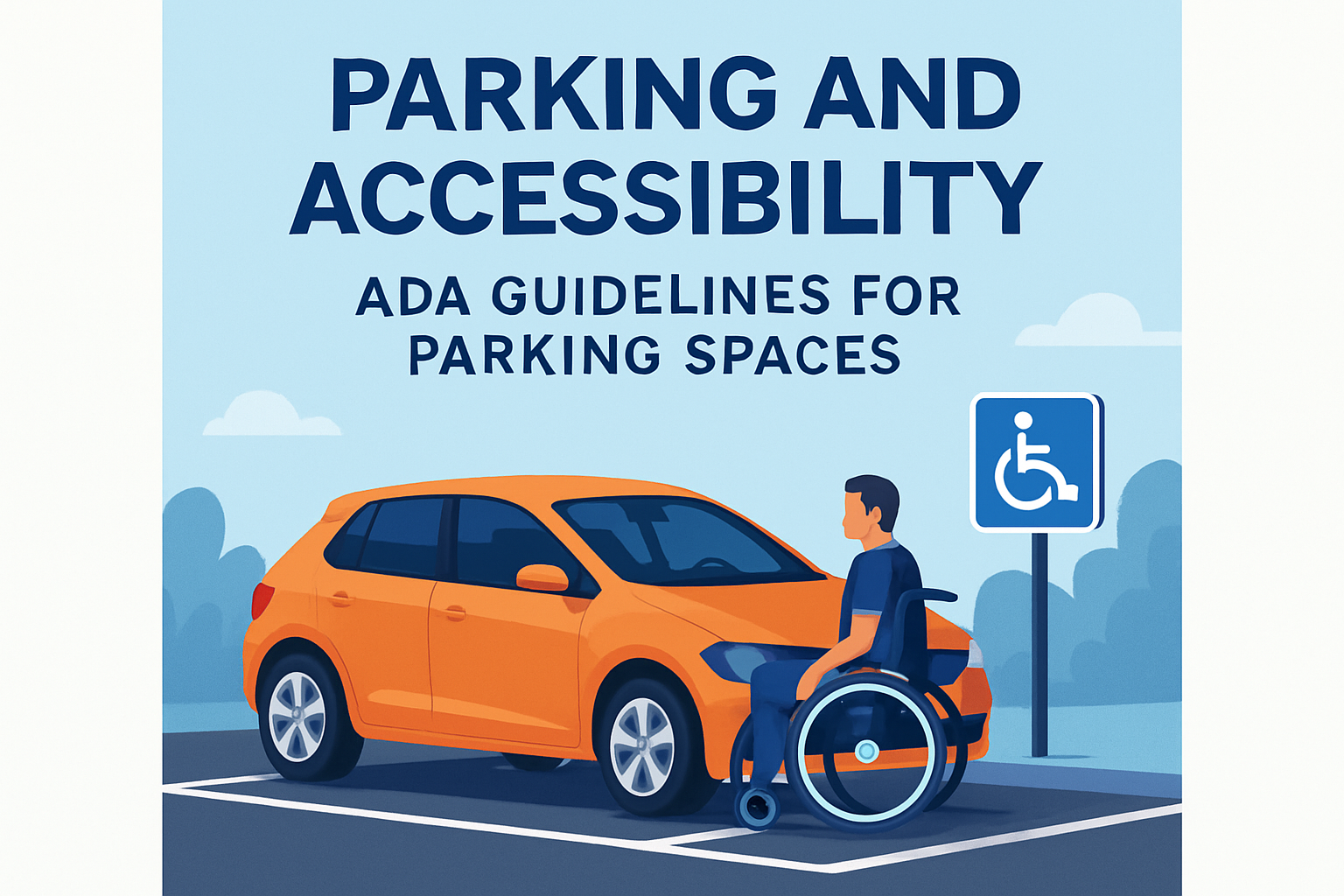
Accessible parking is a basic feature of inclusive design, yet it is also one of the most misunderstood parts of the Americans with Disabilities Act. Property owners, facility managers, contractors, and business operators often know they need designated spaces, but they may not understand how many spaces are required, how wide they must be, where signage belongs, or how an access aisle connects to an accessible route. ADA parking guidelines exist to remove barriers before a person ever reaches the entrance. When they are followed correctly, they improve independence, reduce legal risk, and make sites usable for people with mobility disabilities, wheelchair users, van users, older adults, and many others.
The ADA, enacted in 1990, is a federal civil rights law that prohibits discrimination based on disability. Its design requirements are detailed in the 2010 ADA Standards for Accessible Design, which apply to many public accommodations, commercial facilities, and state and local government sites. In parking areas, the standards address the number of accessible spaces, van accessibility, slope, surface condition, signage, and the required accessible route from parking to the building. These rules are not optional cosmetic upgrades. They are measurable technical standards intended to make arrival, exit, and entry possible without unsafe detours or avoidable obstacles.
Parking accessibility matters because a compliant space is only useful when every part works together. A wide stall without a properly marked access aisle still blocks wheelchair transfer. A correctly sized van space is ineffective if the curb ramp empties into traffic. Signage mounted too low can disappear behind parked vehicles. Snow storage, cracked pavement, and faded striping can turn a compliant lot into a daily hazard. For businesses, inaccessible parking creates immediate customer friction and can trigger complaints, lawsuits, and expensive restriping work. For users, it can mean pain, delay, embarrassment, or the inability to enter a site at all.
How many accessible parking spaces are required
The ADA uses a scoping table based on the total number of parking spaces in a facility. As parking supply increases, the number of required accessible spaces also rises. For example, a lot with 1 to 25 total spaces needs 1 accessible space. A lot with 26 to 50 spaces needs 2. At 51 to 75 spaces, 3 are required, and at 76 to 100 spaces, 4 are required. The pattern continues upward, with larger facilities calculating accessible spaces according to the ranges in the standard. At least one of every six accessible spaces, or fraction of six, must be van accessible.
These counts apply per parking facility, not simply across an entire property. If a hospital campus has separate visitor, staff, and clinic parking lots, each lot may need its own compliant count based on the spaces provided there and the accessible entrance it serves. Medical facilities have additional rules. Outpatient physical therapy and rehabilitation facilities, for instance, require 20 percent of patient and visitor spaces to be accessible. Hospitals that specialize in treating mobility impairments also face a higher ratio. These enhanced requirements reflect the predictable needs of the people using those sites.
A common mistake is assuming that employee-only areas are exempt. They are not automatically exempt if the parking serves a facility covered by the ADA. Another mistake is counting a shared accessible space for two separate lots divided by curbs, gates, or long travel paths. Accessibility is about practical use, so users should not have to cross unsafe routes or remote areas to reach the entrance they need. During restriping projects, owners should verify current counts, because adding or removing general spaces can alter the number of required accessible spaces and the required van-accessible minimum.
Dimensional rules for standard and van-accessible spaces
An accessible parking space must include both the vehicle stall and an adjacent access aisle. Under the ADA Standards, a standard accessible car space must be at least 96 inches wide, and its access aisle must also be at least 60 inches wide. A van-accessible space can be configured in two ways: either a 132-inch-wide stall with a 60-inch access aisle, or a 96-inch-wide stall with a 96-inch access aisle. In both cases, the total usable width allows deployment of ramps or lifts and gives room for side transfer from a wheelchair.
Van spaces require vertical clearance as well as width. Parking spaces, access aisles, and the vehicle route to and from van spaces must provide at least 98 inches of vertical clearance. This rule matters at garages, canopies, and entry structures where beams, signs, or pipes may reduce height. A site can stripe compliant van spaces on paper yet still fail users if the route forces tall accessible vans under an 84-inch bar. Clearance should be identified early in design and checked again after maintenance changes such as adding sprinkler lines or overhead wayfinding signs.
Access aisles must adjoin the accessible route and generally cannot overlap with vehicle traffic lanes in a way that compromises safety. They may be shared by two accessible spaces, which is common in efficient lot layouts, but they must remain clearly marked so drivers do not park in them. Many jurisdictions require striping color or no-parking hash marks beyond the federal minimum. While the ADA does not specify paint color, visibility is critical. Blue striping, diagonal hatch marks, wheel stops placed carefully, and durable thermoplastic markings all help preserve the aisle’s purpose over time.
Location, routes, and surface requirements that make spaces usable
Accessible spaces must be located on the shortest accessible route to an accessible entrance. Shortest does not always mean physically closest if stairs, steep slopes, or inaccessible doors block the way. A compliant route must connect parking to the building without forcing users behind loading docks, through service alleys, or into moving traffic. In facilities with multiple accessible entrances, accessible spaces should be dispersed where practical so people can park near the entrance serving their destination. This is especially important at malls, campuses, stadiums, and medical complexes with several distinct functions.
Slope is one of the most overlooked technical issues. Parking spaces and access aisles should be level enough for stable wheelchair transfer, with a maximum slope of 1:48 in all directions. Even slight cross slopes can cause a wheelchair to roll during transfer or create dangerous ramp deployment angles. Resurfacing projects often unintentionally change slope, especially near drains and curb lines. Best practice is to field-measure after paving using a digital smart level or electronic slope meter rather than assuming a contractor matched plan elevations exactly.
Surface condition also affects compliance. The ADA requires spaces and access aisles to be stable, firm, and slip resistant. Broken asphalt, loose gravel, standing water, and heaved concrete joints can all interfere with mobility devices. In northern climates, snow and ice management is part of practical accessibility. Piling snow in access aisles or on curb ramps effectively removes the space from use. Retail centers that contract winter services should identify accessible stalls, aisles, and routes on site maps and require priority clearing in service agreements to avoid recurring barriers and complaints.
| Requirement | Standard Accessible Space | Van-Accessible Space |
|---|---|---|
| Minimum stall width | 96 inches | 132 inches, or 96 inches with wider aisle |
| Minimum access aisle width | 60 inches | 60 inches or 96 inches |
| Vertical clearance | Not specifically increased | 98 inches along space and route |
| Required signage | Accessible designation | Accessible designation plus van accessible sign |
| Typical user need | Side transfer or mobility aid use | Ramp or lift deployment from accessible van |
Signage, markings, and common compliance mistakes
Every accessible parking space must be identified by signs with the International Symbol of Accessibility. Van spaces must include signage designating them as van accessible. The ADA does not require the symbol painted on the pavement, but many owners include it because pavement markings improve visibility and reduce misuse. Sign height matters. Signs should be mounted high enough that they remain visible when vehicles are parked in the adjacent space. If drivers cannot see the sign until after parking, enforcement becomes difficult and misuse increases.
One frequent compliance error is relying on old dimensions from state manuals or local habits instead of checking current ADA requirements and any stricter state code. California, Texas, Florida, and other states may layer additional technical rules, enforcement procedures, or signage language on top of federal standards. Another common problem is locating the access aisle on the wrong side of a van space, where it conflicts with the accessible route or vehicle lift operation. For angled parking, layout must account for the direction of travel and transfer safety, not just fit the striping template.
Maintenance failures create many real-world violations. Faded hatch markings invite drivers to park in the access aisle. Missing van-accessible signs leave spaces unusable for enforcement. Bollards, planters, cart corrals, and sandwich boards are often placed in aisles or on curb ramps by staff who do not realize they are blocking required clearance. Businesses should include parking checks in routine property inspections. A simple monthly checklist covering striping visibility, sign condition, slope changes from repairs, route obstructions, and winter operations can prevent both user frustration and costly remediation.
Designing beyond minimum compliance
Meeting the ADA minimum is essential, but better parking design often goes further. Wider routes, covered drop-off zones, brighter lighting, and clear wayfinding improve usability for people with temporary injuries, parents unloading children, and older adults with limited stamina. Hospitals increasingly pair accessible parking with digital wayfinding apps and color-coded zone signage to shorten travel time from vehicle to clinic. At airports, accessible spaces near elevators and payment stations reduce complex navigation. These improvements may not all be mandated, but they support the broader goal of equitable access and usually improve the experience for every visitor.
Owners planning new construction or restriping should work with qualified architects, civil engineers, and accessibility specialists rather than treating parking as the last paint decision. Early coordination helps align drainage, curb ramps, sidewalks, and entrances before pavement is poured. Tools such as laser measurement devices, Building Information Modeling workflows, and post-construction accessibility audits can catch issues before they become complaints. The strongest approach is simple: count spaces correctly, build the required dimensions accurately, protect the route, and maintain the lot so the design continues working every day.
ADA parking guidelines are precise because arrival is the first step in access. A compliant parking space is not just a marked stall; it is a connected system of dimensions, signs, slopes, surfaces, and routes that allows a person with a disability to enter a site safely and independently. The most important takeaways are straightforward: provide the correct number of spaces, include the required van-accessible ratio, size stalls and aisles accurately, place them on the shortest accessible route, and maintain markings and surfaces so the spaces remain usable in real conditions.
For businesses and property owners, the benefit of getting parking right is immediate. Customers can reach your entrance without unnecessary barriers, staff and visitors can move with dignity, and your facility is less exposed to complaints, enforcement actions, and retrofit costs. For designers and contractors, accuracy in parking layout prevents expensive rework after inspection. For communities, accessible parking supports fuller participation in daily life, from shopping and medical visits to work and recreation.
If you manage, design, or renovate a site, review your parking area against the current ADA Standards and any applicable state code, then correct problems before users are forced to point them out. A measured audit, fresh striping, proper signage, and routine maintenance can turn a marginal lot into one that truly welcomes everyone.
Frequently Asked Questions
1. How many accessible parking spaces are required under ADA guidelines?
The number of accessible parking spaces required depends on the total number of parking spaces in a parking facility, not just on how many people with disabilities are expected to visit. This is one of the most important parts of ADA parking compliance, and it is also one of the most commonly misunderstood. The ADA uses a scoping table that tells property owners and facility operators how many accessible spaces must be provided based on the total parking count in each lot or parking structure.
For example, if a parking facility has 1 to 25 total spaces, at least 1 accessible space is required. If there are 26 to 50 spaces, at least 2 accessible spaces are required. As the total number of spaces increases, the number of required accessible spaces increases as well. In larger facilities, the requirements continue to scale upward. This means compliance is not optional and cannot be based on guesswork, convenience, or what the owner believes is “probably enough.”
It is also important to understand that van-accessible spaces are part of the total required number of accessible spaces, not in addition to them. In general, at least 1 out of every 6 accessible spaces must be van accessible. If a facility has only 1 accessible space, that space must typically be van accessible. This is meant to make sure people who use lifts, ramps, or other mobility equipment can safely enter and exit their vehicles.
Another detail that often causes confusion is how parking is counted. Accessible parking requirements are generally applied separately to each parking facility. In many situations, a property may have multiple parking areas, and each one may need to be reviewed on its own depending on how the site is used. This matters because accessible spaces should be located where they are useful, not clustered in a distant area that technically meets a number but creates a real barrier for users.
Medical facilities may have additional requirements. For example, outpatient physical therapy facilities and rehabilitation facilities often require a higher percentage of accessible parking, and hospital settings that provide mobility-related treatment can also have specific standards. Because of this, owners of healthcare properties should be especially careful not to assume that the standard parking table is the only rule that applies.
In practical terms, the best approach is to count every parking space in the facility, check the applicable ADA scoping requirements, identify how many accessible spaces are needed, and then determine how many of those must be van accessible. A property owner should also verify whether state or local accessibility codes are stricter than federal ADA rules, because meeting only one standard may not always be enough. ADA compliance is about more than paint and signs. It starts with providing the correct number of spaces so people can access a site with dignity, safety, and independence.
2. What are the size and layout requirements for accessible parking spaces and access aisles?
Accessible parking spaces must be designed with enough room for people to get in and out of their vehicles safely, including those using wheelchairs, walkers, scooters, crutches, or lifts. The parking space itself is only one part of the requirement. The access aisle next to the space is just as important because it provides the clear area needed for entering, exiting, loading, and unloading.
Under ADA guidelines, a standard car accessible parking space must be at least 96 inches wide. Next to it, there must be an access aisle that is also at least 60 inches wide. For van-accessible parking, the layout can be done in one of two compliant ways: either a 96-inch-wide parking space with a 96-inch-wide access aisle, or a 132-inch-wide parking space with a 60-inch-wide access aisle. These dimensions are intended to create the clearance needed for van ramps or lifts and for safe maneuvering beside the vehicle.
The access aisle must run the full length of the parking space. It cannot be shortened, squeezed, or blocked by curbs, posts, wheel stops, landscaping, or stored materials. It also cannot be used as an extra parking area. In other words, the striped aisle next to an accessible space is not decorative pavement. It is a required usability feature and must remain clear.
Another key rule is that access aisles must connect to an accessible route leading to the accessible entrance of the facility. This is where many parking lots fail compliance. A property may have a correctly sized parking space and aisle, but if the aisle empties into a curb with no curb ramp, crosses behind moving vehicles without proper design, or leads to a broken or steep sidewalk, the parking area still creates a barrier. ADA parking compliance does not end at the painted stall lines. The accessible route is part of the full requirement.
Surface conditions matter too. Accessible spaces and access aisles must be stable, firm, and slip resistant. They should be maintained so that potholes, crumbling pavement, loose gravel, standing water, snow buildup, or severe cracking do not interfere with use. The slope of the parking space and aisle is also critical. These areas generally must be kept as level as possible and within ADA limits so mobility devices can be used safely and vehicle lifts can function properly. Excessive slope is a common violation because even if a space looks acceptable, too much incline can make transfers dangerous.
The layout should also allow people to use the space without being forced into traffic whenever possible. For that reason, accessible spaces are usually best located on the shortest accessible route to the entrance they serve. Designers and property managers should think about real-world use: Can someone open a door fully? Can a lift deploy? Can a wheelchair user move from the access aisle to the sidewalk without a barrier? If the answer is no, then the parking design may not be truly accessible, even if some markings are present.
In short, accessible parking requires correct width, correct aisle dimensions, a full-length clear access aisle, a compliant surface and slope, and a direct connection to an accessible route. The measurements matter, but the usability matters just as much. The goal is to make sure a person can arrive, exit their vehicle, and reach the building entrance safely and independently.
3. Where should signs for accessible parking spaces be placed, and what do they need to say?
Accessible parking signage plays a major role in making spaces identifiable and enforceable. Without proper signs, even correctly sized accessible spaces can be overlooked, misused, or disputed. ADA-compliant signage helps drivers recognize which spaces are reserved, helps property owners show that the spaces are designated correctly, and helps support enforcement against unauthorized parking.
Each accessible parking space must be marked with the International Symbol of Accessibility. Van-accessible spaces must also include a designation that clearly identifies them as van accessible. In most cases, this is shown with a sign that includes the words “Van Accessible.” This distinction matters because not every accessible space is built the same way, and drivers of vans with ramps or lifts need to know which spaces provide the extra room they require.
Signs should be mounted so they are visible when a vehicle is parked in the space. This is an important practical point. If a sign is placed too low, it may be hidden by the parked vehicle itself, which makes it difficult to see and weakens enforcement. Mounting height requirements may also be affected by local or state codes, so owners should check those in addition to federal standards.
It is also important to understand the difference between federal ADA rules and state or local parking enforcement rules. The ADA addresses accessibility features such as identification of the space, but some states or municipalities require additional wording on signs, such as “Minimum Fine,” “Permit Required,” or “Unauthorized Vehicles Subject to Tow.” A property owner might have a space that meets ADA signage basics but still fail local enforcement requirements if required penalty language is missing.
Painted symbols on the pavement can be useful as an added visual cue, but pavement markings alone are generally not enough to satisfy the need for identification. A sign is still needed. This is especially important in areas where snow, dirt, poor lighting, or normal wear can obscure pavement markings. Relying only on paint often creates problems over time.
Placement also matters in relation to the space itself. The sign should correspond clearly to the specific accessible space it identifies so there is no confusion about which stall is reserved. In lots with multiple adjacent accessible spaces, signage should be arranged in a way that makes the designation of each space clear, including which ones are van accessible.
For best results, property owners should think of signage as part accessibility feature, part communication tool, and part compliance protection. A clearly visible sign with the right symbol and any required local wording helps prevent misuse, supports people who need the space, and reduces the risk of complaints or citations. Signs may seem like a small detail compared with dimensions and routes, but in practice, they are one of the most visible and most enforceable parts of ADA parking compliance.
4. How does an access aisle connect to an accessible route, and why is that so important?
An access aisle is not supposed to end in the middle of nowhere. Its purpose is to create a safe transition from the vehicle to the accessible route that leads into the building or facility. This connection is one of the most critical parts of ADA parking design because a parking space is only useful if the person can continue the trip from the lot to the entrance without encountering barriers.
An accessible route is a continuous, unobstructed path that connects accessible parking spaces and access aisles to an accessible building entrance. That route must be usable by people with mobility disabilities and should not force them into unsafe conditions. In a compliant layout, a person exits the vehicle into the access aisle, moves from the aisle onto the accessible route, and then follows that route to the entrance without dealing with steps, abrupt level changes, steep slopes, missing curb ramps, or narrow blocked walkways.
This is where many properties run into trouble. A lot may have correctly striped accessible parking, but the access aisle might lead directly to a curb with no curb ramp. Or the route may require the user to travel behind parked cars and through active drive lanes. In other cases, the sidewalk may be too narrow, broken, excessively sloped, or blocked by poles, planters, merchandise displays, trash containers, or temporary signs. Any of these conditions can make a seemingly compliant parking space unusable.
The accessible route should be the shortest practical accessible path to the accessible entrance the spaces serve. Accessible spaces should be located so users do not need to take long detours or travel through hazardous vehicle areas. If there are multiple accessible entrances, parking should be dispersed where appropriate so people can reach the entrance relevant to the part of the facility they need to use.
Curb ramps are a common part of this connection, but they have to be designed and located carefully. A curb ramp should not project into an access aisle in a way that reduces required clear width or creates a hazardous slope where people need to deploy a lift or maneuver a wheelchair. The transition from the aisle to the route should be smooth and predictable. When curb ramps, sidewalks, and parking geometry are not coordinated, the result is often technical noncompliance and real-world inaccessibility.
Maintenance is just as important as initial design. Even a properly built accessible route can become unusable if it is neglected. Cracked concrete, heaving pavement, drainage problems, leaf buildup, snow and ice, overgrown landscaping, and stored equipment can all interrupt the route. Property operators should inspect these areas regularly because accessibility is not a one-time striping project. It is an ongoing responsibility.
At a practical level, the question to ask is simple: Can a person park, exit their vehicle, and reach the entrance safely, directly, and independently? If the answer is no, then the parking arrangement is not doing what ADA guidelines are meant to achieve. The access aisle and accessible route work together as one system, and if one part fails, the whole path of travel is compromised.
5. What are the most common ADA parking mistakes property owners and managers make?
Some ADA parking mistakes are obvious, but many are surprisingly easy to overlook. One of the most common problems is providing the wrong number of accessible spaces. A property may have added one or two accessible spaces years ago and never updated them after parking was expanded, restriped, or reconfigured. If the total parking count changed, the required number of accessible and van-accessible spaces may have changed too.
Another frequent mistake is incorrect dimensions. Spaces may be too narrow, access aisles may be undersized, or van spaces may be labeled as van accessible without actually providing the extra width required. This is especially common after resurfacing or restriping projects where contractors follow old layouts, maximize stall count, or fail to verify current accessibility requirements. A space is not compliant just because it has blue paint or a wheelchair symbol.
Signage errors are also widespread. Sometimes signs are missing entirely, mounted too low to be seen over parked vehicles, or fail to identify van-accessible spaces correctly. In other cases, the ADA basics are present but state-required enforcement language is missing. This can lead to confusion, misuse, and local code violations even when the owner believed the lot was properly marked.
A major issue is failure to provide a usable accessible route from the parking area to the entrance. This includes missing curb ramps, routes that cross traffic in unsafe ways, steep or broken sidewalks, and access aisles that empty into barriers. Many owners focus heavily on the parking stall itself and not enough on where the user goes after leaving the vehicle. That gap in thinking creates one of the most serious accessibility failures.
Poor surface conditions are another recurring problem. Potholes, uneven asphalt, ponding water, loose gravel, deteriorated striping, and excessive slope can all make accessible parking difficult or dangerous to use. Even if the lot was compliant when first built, wear and tear can quickly create barriers. Maintenance is part of compliance. Faded paint, damaged signs, and cracked routes should not be treated as minor cosmetic issues.
Improper use of access aisles is also common. Businesses sometimes place cones, carts, storage bins, promotional displays, or snow piles in the striped aisle, not realizing that the aisle is required clear space. Others allow vehicles to encroach into the aisle because the layout is too tight or wheel stops are placed poorly. When the aisle is blocked, the accessible space may become effectively unusable.
There is also a common misunderstanding that ADA compliance is only required for new construction. In reality, businesses and property owners often have ongoing obligations, especially when alterations are made or when barriers can be removed more readily. Assuming an older lot is automatically exempt can be a costly mistake. Accessibility expectations apply broadly, and complaints often arise in existing facilities where owners believed age alone protected them.
Finally, many owners fail because they treat ADA parking as a checklist item instead of a user experience issue. Compliance is not just about whether a space exists. It is about whether a person with a disability can actually use it safely and reach the building without help. The most successful approach is to review parking from arrival to entrance, measure dimensions carefully, inspect signage and route conditions regularly, and correct problems before they lead to complaints, injuries, or enforcement actions. When property owners understand that accessible parking is the beginning of access, not the end of it, they make better decisions and create spaces that work for everyone.