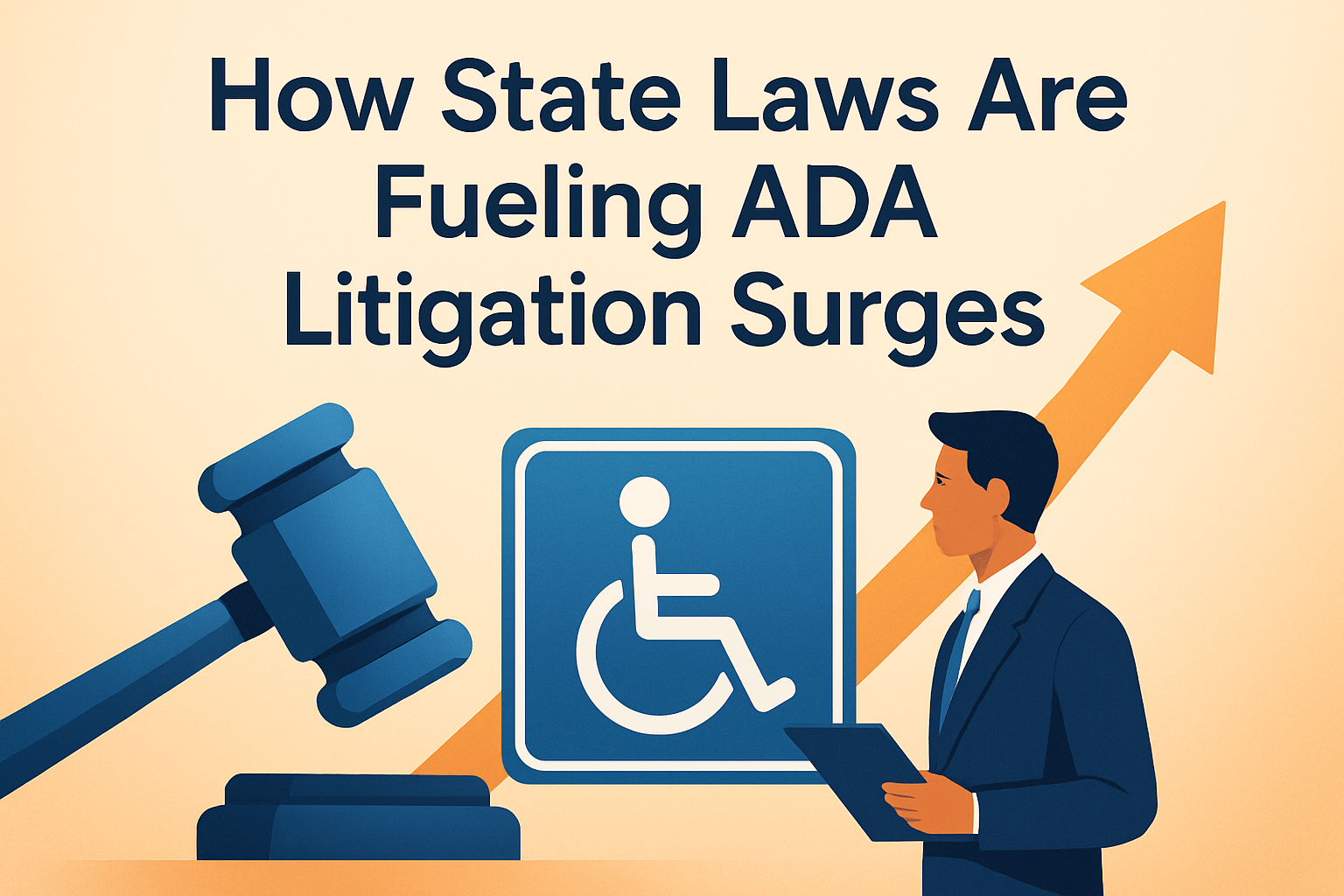
State laws are accelerating Americans with Disabilities Act claims by adding damages, expanding standing rules, and creating procedural pathways that make accessibility lawsuits more attractive to file and harder for businesses to ignore. The core issue is simple: the ADA is a federal civil rights law that prohibits disability discrimination, but many of today’s litigation spikes are being driven by state statutes that go further than federal law. After years of reviewing accessibility disputes, demand letters, and remediation plans, I have seen the same pattern repeatedly: where state law offers plaintiffs stronger remedies, filings rise faster.
Understanding this trend requires defining a few terms. ADA Title III governs accessibility in places of public accommodation such as stores, restaurants, hotels, healthcare offices, banks, and many websites connected to physical businesses. Under federal law, private plaintiffs generally can seek injunctive relief and attorneys’ fees, but not monetary damages in most Title III cases. State disability access laws can change that equation. Some allow statutory damages, some incorporate building code violations into civil claims, and some make it easier for serial litigants to bring repeat actions. That combination can dramatically alter litigation economics.
Why does this matter? Because ADA litigation now affects far more than large retailers or national hotel chains. Small businesses, franchisees, landlords, e-commerce brands, medical practices, and professional offices are frequent targets. A missing accessible parking sign, an unreadable PDF intake form, a checkout flow that fails with screen readers, or a bathroom mirror mounted too high can trigger claims. In states with plaintiff-friendly statutes, even minor barriers can generate fast settlements because defense costs usually exceed the cost of resolving the matter early.
For business owners, compliance professionals, and legal teams, the practical question is not whether federal law applies; it does. The real question is how state statutes amplify risk beyond the ADA baseline. Searchers often ask, “Why are ADA lawsuits increasing?” The direct answer is that federal obligations remain constant, but state-level remedies, procedural rules, and enforcement cultures differ widely. Those differences create hotspots where litigation clusters.
Why state law changes the economics of ADA cases
Federal ADA Title III cases are expensive to defend and usually focused on fixing barriers, not paying damages. That matters because litigation behavior follows incentives. When a plaintiff can recover only injunctive relief, a case often turns on remediation timelines, mootness arguments, and attorneys’ fees. When state law adds minimum statutory damages per visit or per violation, the same factual allegation suddenly carries immediate settlement value. In practice, that is the main reason state laws fuel litigation surges.
California is the clearest example. The Unruh Civil Rights Act and Disabled Persons Act can allow monetary recovery in accessibility cases, and California’s construction-related accessibility regime incorporates technical standards in ways that make site inspections and claims highly granular. I have reviewed matters where the disputed conditions included parking slope measurements, counter heights, door pressure, signage placement, and restroom fixture clearances. Each barrier was inexpensive to fix compared with the legal exposure generated by a demand letter. That mismatch encourages volume filings.
New York illustrates a different path. Federal ADA website accessibility suits have been especially active there, in part because state and city human rights frameworks create a legal environment that plaintiffs’ firms understand well and courts see frequently. Although website claims involve unsettled issues compared with built-environment cases, the concentration of businesses, dense plaintiff bar, and favorable forum dynamics all contribute to persistent filing levels. Florida has also seen substantial activity, particularly because businesses are numerous, tourism is high, and accessibility barriers are easy to identify across hospitality and retail properties.
Businesses often ask whether these cases are about technicalities. Sometimes the disputed issue looks technical, but the legal principle is not. Accessibility standards exist so disabled people can enter, navigate, purchase, communicate, and participate independently. A one-inch threshold, an inaccessible online booking engine, or a noncompliant parking access aisle may seem minor to an owner, yet it can stop a wheelchair user, blind customer, or mobility-impaired patient from using the service at all. Courts and regulators assess those barriers functionally, not emotionally.
Which state-law mechanisms drive the biggest surges
Not every state fuels litigation the same way. In my experience, five mechanisms matter most: statutory damages, incorporation of building-code standards, broad standing rules, permissive treatment of tester plaintiffs, and local procedural familiarity among plaintiff firms. When those elements align, filings increase quickly.
| Mechanism | How it increases filings | Common example |
|---|---|---|
| Statutory damages | Creates immediate financial settlement pressure beyond injunctive relief | Per-visit damages claims in accessibility actions |
| Code-based claims | Lets plaintiffs use measurable design standards as evidence | Parking slope, restroom clearance, signage height disputes |
| Broad standing | Makes it easier for repeat plaintiffs to allege injury and intent to return | Serial suits against chains in multiple locations |
| Tester recognition | Allows plaintiffs to investigate barriers without planning a purchase | Website reviews by blind or low-vision testers |
| Active local bar | Reduces filing friction because lawyers know the venue and settlement ranges | High-volume filings in major metro districts |
Statutory damages are the strongest accelerant because they convert a compliance dispute into a damages case. Building-code integration is the second major accelerant because it makes claims easier to document. A plaintiff’s expert or investigator can measure a cross slope, note a grab bar location, photograph a blocked route, and compare the condition against the 2010 ADA Standards for Accessible Design or state standards. That evidence is concrete, repeatable, and persuasive in early negotiations.
Standing and tester doctrines also matter. Businesses often assume a lawsuit requires proof that a customer was definitely going to buy something that day. That is not always true. Courts have long recognized tester standing in civil rights contexts, and accessibility plaintiffs frequently allege they encountered a barrier and were deterred from returning. In states or circuits where those allegations are routinely accepted, filing risk rises. The legal threshold is lower than many owners expect.
How physical-access cases and website cases differ
ADA litigation surges are not confined to ramps and parking lots. Physical-access claims remain common because barriers are visible and measurable, but website accessibility cases have grown because digital commerce is now essential. The legal theories overlap, yet the proof, defenses, and remediation paths are different.
For brick-and-mortar properties, plaintiffs usually rely on dimensional noncompliance, inaccessible routes, service counters, seating, restrooms, signage, or transaction barriers. Standards are highly specific. The ADA Standards set technical requirements for clear floor space, turning radius, reach ranges, toilet room configuration, and accessible parking. State law can intensify exposure by linking these features to damages claims. In those matters, a Certified Access Specialist, architect, or accessibility consultant often becomes central to defense strategy.
Website cases are more fluid because the ADA does not contain website-specific technical standards in the statute itself. Still, the Department of Justice has consistently taken the position that the ADA applies to web content offered by covered entities. In real compliance work, Web Content Accessibility Guidelines, especially WCAG 2.1 Level AA, function as the operational benchmark. Plaintiffs typically allege barriers involving screen-reader compatibility, keyboard navigation, unlabeled form fields, inaccessible menus, missing alt text, low-contrast text, or checkout failures.
State laws can magnify website claims even when the doctrinal landscape remains unsettled. If a state human rights or anti-discrimination statute is broad, plaintiffs can plead parallel state causes of action alongside ADA claims. That raises leverage. I have seen companies spend heavily not because the merits were overwhelming, but because the cost of litigating jurisdiction, standing, and mootness issues across federal and state theories exceeded the cost of fixing the site and settling fees.
A critical distinction is remediation speed. Many physical barriers can be fixed quickly if a qualified consultant inspects the site early. Digital remediation often takes longer because accessibility defects are embedded in templates, third-party plugins, payment gateways, PDFs, and mobile app components. That delay can affect litigation posture. Plaintiffs know a business cannot always remediate a complex site in thirty days, which makes rapid settlement more likely.
Why certain jurisdictions become ADA litigation hotspots
Litigation hotspots do not emerge by accident. They form where legal incentives, business density, and procedural familiarity intersect. California, New York, and Florida are repeatedly cited because they combine large numbers of public accommodations with active plaintiffs’ firms and well-developed case law. Those conditions lower the transaction cost of filing another case.
Venue culture matters more than many executives realize. In districts where judges regularly see ADA claims, the parties understand the expected rhythm: early site inspection, targeted discovery, mediation, remediation commitments, and fee negotiation. That predictability encourages filing volume. Plaintiff firms can standardize intake, pleading templates, expert relationships, and demand strategies. Defendants, especially smaller ones, often have no comparable system in place.
Urban density is another overlooked factor. A single plaintiff or tester can visit many noncompliant locations in a compact area, document recurring issues, and generate multiple suits efficiently. The same dynamic applies online. A law firm targeting inaccessible retail sites can review dozens in a week using screen readers like JAWS or NVDA, keyboard-only navigation, browser extensions such as axe DevTools, and manual testing protocols. When state law supports recovery, scale follows.
There is also an enforcement culture effect. Some states and cities invest more in disability rights awareness, local access boards, and plaintiff-side expertise. That does not create frivolous cases; it creates a mature ecosystem in which violations are more likely to be identified and pursued. From a risk-management perspective, that means businesses should map exposure geographically rather than treating ADA compliance as a uniform national issue.
How businesses can reduce risk before a claim arrives
The most effective response to state-driven ADA litigation surges is not better settlement tactics; it is earlier compliance work. Businesses that wait for a demand letter are already behind. The right approach is to build an accessibility program that covers facilities, digital properties, procurement, training, and documentation.
Start with a credible audit. For physical locations, use a qualified accessibility specialist who understands the 2010 ADA Standards, applicable state requirements, and local code interplay. For websites, combine automated scanning with manual testing by experienced auditors and disabled users when possible. Automated tools catch only part of the problem. In my projects, the highest-risk issues were often keyboard traps, modal focus problems, mislabeled buttons, inaccessible PDFs, and third-party checkout defects that scanners only partially flagged.
Next, prioritize fixes by legal exposure and user impact. Accessible parking, entrances, restrooms, service counters, and transaction pathways should come first on the built side. Online, focus on navigation, forms, product discovery, account creation, booking, and checkout. Document every remediation step. If litigation arises, a dated audit report, work orders, development tickets, consultant recommendations, and retesting results can materially improve the defense narrative.
Training is equally important. Store managers block accessible routes with displays. Marketing teams upload unreadable PDFs. Developers launch redesigns without keyboard testing. Facilities teams repaint parking lots incorrectly. These are process failures, not one-time mistakes. Strong companies assign ownership, create review checkpoints, and revisit accessibility after every renovation, platform update, or vendor change. If your organization has compliance pages, procurement standards, or development guidelines, link them internally and make them operational, not decorative.
State laws are fueling ADA litigation surges because they reshape incentives around accessibility enforcement. Federal law sets the nationwide duty to provide equal access, but state statutes often determine whether a violation becomes a routine fix or a fast-moving lawsuit with meaningful settlement pressure. Statutory damages, code-based claims, tester-friendly standing, and concentrated local plaintiff bars explain why some jurisdictions produce far more filings than others.
The business lesson is straightforward. Treat accessibility as an enterprise risk issue, not a narrow legal technicality. Audit facilities and websites, remediate the barriers that block real use, maintain documentation, and monitor state-specific exposure where you operate. Companies that do this well spend less on emergency defense and serve more customers effectively. Review your highest-risk locations and digital journeys now, because in plaintiff-friendly states, delay is what turns a compliance gap into litigation.
Frequently Asked Questions
Why are state laws causing ADA lawsuits to increase so quickly?
State laws are driving many of the recent increases in accessibility litigation because they often give plaintiffs more legal tools than the federal Americans with Disabilities Act alone. The ADA is a federal civil rights statute, and in many cases it allows private plaintiffs to seek injunctive relief, meaning a court order requiring a business to fix barriers. What it generally does not provide in private actions is monetary damages. By contrast, some state laws allow statutory damages, minimum damages, attorneys’ fees, or broader remedies that make filing a claim more economically viable. That changes the litigation landscape in a major way.
In practical terms, when a state statute adds a damages component or lowers procedural hurdles, a lawsuit becomes more attractive to bring and harder for a business to dismiss as a minor compliance issue. Some states also recognize broader theories of standing, which can allow more individuals to sue based on encounters with barriers or deterrence from returning to a location or website. Others have consumer protection, civil rights, or public accommodations laws that overlap with ADA claims and create additional causes of action. The result is that businesses are not just facing federal accessibility requirements; they are often facing layered state-law exposure that increases both litigation risk and settlement pressure.
How do state statutes differ from the federal ADA in accessibility cases?
The key difference is that state statutes may go further than federal law in both remedies and procedure. The ADA sets a national baseline by prohibiting discrimination on the basis of disability in places of public accommodation, employment, transportation, and other covered settings. But states are free to enact laws that provide equal or greater protection. In litigation, that often means a plaintiff brings an ADA claim alongside one or more state-law claims, and those state claims may significantly alter the stakes of the case.
For example, a state law may permit monetary recovery for each violation, allow easier access to attorneys’ fees, define covered entities more broadly, or provide a more plaintiff-friendly framework for showing injury. In some jurisdictions, a claimant may not need to prove exactly the same type of harm that would be emphasized in federal court. In others, state accessibility provisions are tied to building standards, civil rights acts, or unfair business practices statutes, creating multiple legal paths from the same alleged barrier. That is why businesses cannot assume ADA compliance analysis begins and ends with federal law. The real exposure often depends on the specific state where the claim is filed and how that state’s courts interpret disability access rights.
What kinds of businesses are most affected by these state-driven ADA litigation surges?
Businesses that interact directly with the public tend to face the greatest exposure, especially retailers, restaurants, hotels, medical offices, entertainment venues, service providers, property owners, and e-commerce companies. Any business that operates a customer-facing website, mobile app, or physical location can become a target if alleged accessibility barriers exist. State-law claims can intensify that risk because they may apply to the same facts that would support a federal ADA claim while adding financial incentives for plaintiffs and their counsel.
Smaller and mid-sized businesses are often especially vulnerable because they may not have dedicated accessibility compliance teams or regular legal audits. A single issue such as inaccessible parking, restroom design, entry paths, checkout counters, online forms, or missing website accessibility features can become the basis for a lawsuit. Multi-location businesses face even greater complexity because a compliance issue repeated across sites can create recurring claims. Digital accessibility is another major pressure point, since state-law theories are increasingly being used in website and app litigation. The broader lesson is that no business should assume it is too small, too local, or too niche to attract attention. If a state creates favorable conditions for filing accessibility suits, virtually any public-facing business can be affected.
Why do state law claims make accessibility lawsuits harder for businesses to ignore or resolve cheaply?
State law claims increase pressure because they can convert what might otherwise be a fix-and-comply issue into a damages-driven dispute. Under the ADA alone, some businesses may view litigation primarily as a compliance problem that can be addressed by remediation and negotiated injunctive relief. But when state statutes authorize damages, penalties, or more substantial fee recovery, the economics shift. Even if the underlying accessibility issue is correctable, the legal exposure may already be significant by the time the complaint is filed.
These cases can also be harder to resolve cheaply because state-law claims may survive even when a business believes the federal claim is narrow, technical, or potentially moot after remediation. A plaintiff may allege multiple violations under overlapping statutes, raising defense costs and complicating settlement strategy. In addition, businesses often must respond quickly to preserve evidence, assess compliance, engage accessibility experts, and evaluate whether there are similar issues in other locations or digital properties. That urgency can create leverage for plaintiffs. From a risk-management perspective, state laws make accessibility litigation more than a theoretical regulatory concern; they turn it into a concrete business, legal, and financial issue that companies must address proactively.
What should businesses do to reduce the risk of ADA and state accessibility lawsuits?
The most effective response is a proactive, documented accessibility compliance strategy that accounts for both federal and state law. Businesses should begin with an accessibility audit of their physical locations, websites, mobile apps, and customer-facing processes. For physical spaces, that means evaluating parking, entrances, routes, restrooms, seating, counters, signage, and other public accommodation features. For digital assets, it means reviewing website navigation, forms, images, keyboard access, screen-reader compatibility, captions, and other common accessibility issues. Identifying barriers early is almost always less expensive than defending a lawsuit later.
Just as important, businesses should work with counsel and qualified accessibility professionals who understand the laws in the states where they operate. A federal-only review is often not enough. Companies should also adopt written policies, train employees, establish procedures for handling accessibility complaints, maintain records of remediation efforts, and revisit compliance regularly rather than treating it as a one-time project. If a demand letter or lawsuit does arrive, a documented history of good-faith efforts can help shape the response and may improve resolution options. The central takeaway is straightforward: because state laws are adding damages, expanding standing, and creating easier procedural pathways, businesses should treat accessibility as an ongoing legal priority, not a reactive afterthought.