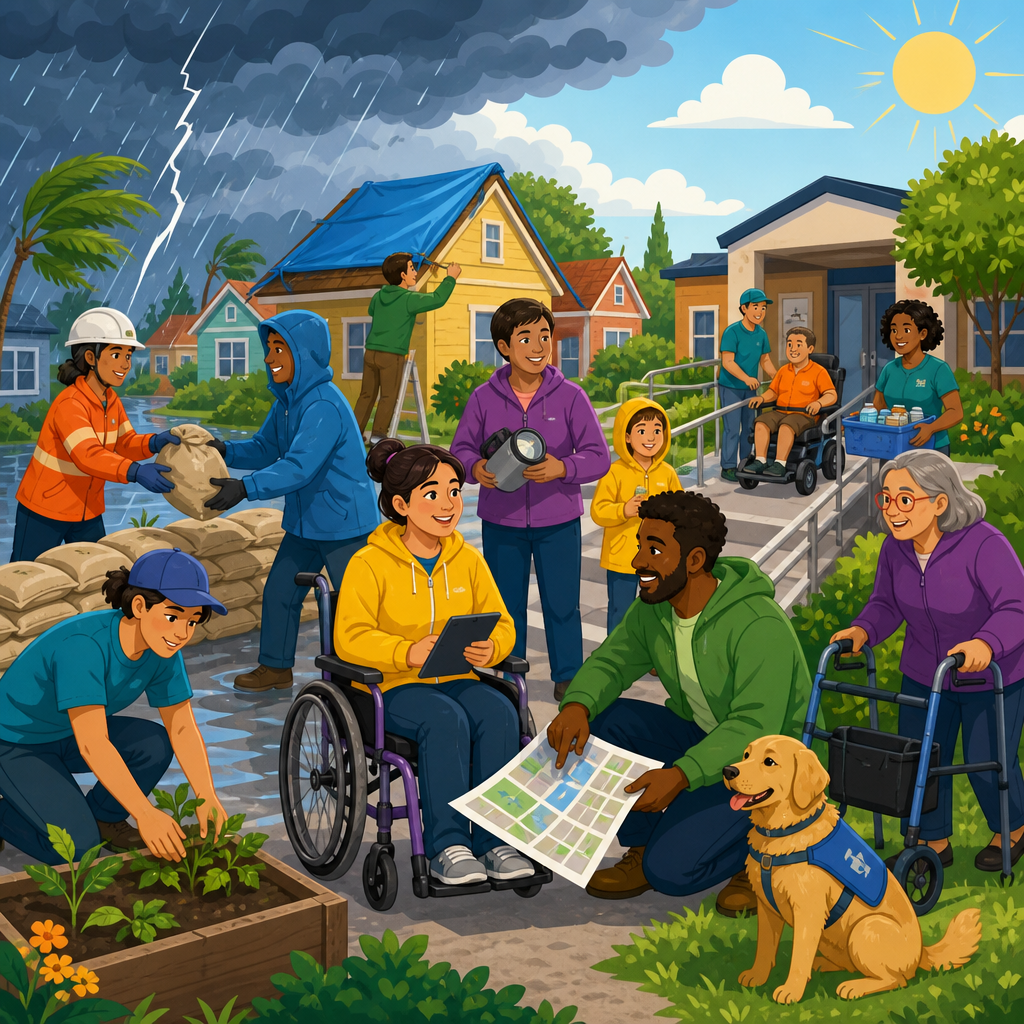
Community-based solutions for extreme weather and disability access are the practical systems, policies, and partnerships that help disabled people stay safe before, during, and after climate-driven emergencies. In this context, extreme weather includes hurricanes, floods, heat waves, wildfires, winter storms, tornadoes, and prolonged power outages. Disability access means more than ramps and door widths. It includes communication access for Deaf and hard-of-hearing residents, evacuation support for wheelchair users, backup power for people who rely on oxygen or ventilators, sensory-aware shelter design, medication continuity, paratransit coordination, and recovery services that remain usable when normal infrastructure fails.
I have worked with local emergency planning teams and disability advocates long enough to see the same pattern repeat: plans look complete on paper, then break down because they were not built with disabled residents at the center. A county may publish an evacuation map, yet fail to provide it in plain language, Braille-ready formats, captioned video, or screen-reader-friendly webpages. A shelter may technically open, yet lack cots at transfer height, refrigeration for insulin, quiet rooms for autistic evacuees, charging for power wheelchairs, or interpreters for public briefings. Community-based planning closes these gaps because it starts where people actually live, travel, communicate, and depend on support.
This matters more every year. The National Weather Service, FEMA, CDC, and state emergency management offices all recognize that disasters disproportionately harm people with disabilities, older adults, and people with complex medical needs. Risk increases when transportation is limited, housing is inaccessible, information is inconsistent, or home care networks are disrupted. Strong community engagement and advanced ADA support reduce avoidable injuries, speed evacuations, protect independence, and improve recovery outcomes. They also help jurisdictions meet legal obligations under the Americans with Disabilities Act, Section 504 of the Rehabilitation Act, the Fair Housing Act, and emergency management guidance that requires equal access to programs, services, and communications.
As a hub under Resources and Support, this guide explains how communities can build accessible preparedness systems, not just isolated accommodations. It covers inclusive planning, accessible warning systems, evacuation and shelter operations, resilient infrastructure, mutual aid, and recovery design. Each section answers a practical question local leaders, nonprofit staff, caregivers, and residents often ask: what must be in place before the next storm, heat event, or wildfire smoke emergency arrives? The central answer is consistent across settings. Communities protect disabled residents best when disability organizations, emergency managers, health providers, transit agencies, housing operators, and neighbors plan together, train together, and test their plans under realistic conditions.
Why community engagement is the foundation of disability-inclusive emergency planning
Community engagement is not a public meeting added at the end of planning. It is the operating method for identifying barriers, setting priorities, and validating whether emergency systems work in real life. The most effective jurisdictions create ongoing advisory structures that include Centers for Independent Living, developmental disability councils, Deaf service organizations, autism advocates, public health staff, accessible transportation providers, and residents who use personal care attendants or durable medical equipment. These groups can identify failure points that standard hazard plans miss, such as elevator dependence during outages, inaccessible debris routes, or text alerts that do not describe evacuation transportation pickup procedures clearly enough.
Engagement works when it is specific and compensated. Asking disabled residents to review plans without paying for their time often produces shallow input and excludes people with limited income or support capacity. Better practice is to fund advisory stipends, provide interpreters and captioning, offer remote participation, cover transportation, and distribute agendas in accessible formats ahead of time. Local governments should also map trusted messengers, including faith leaders, home health agencies, peer support groups, and tenant associations in accessible housing complexes. During emergencies, people act faster on messages delivered through networks they already trust.
Another essential principle is co-design. Rather than asking whether a finished shelter layout is accessible, planners should invite wheelchair users, blind residents, Deaf residents, and people with sensory or cognitive disabilities to help design intake flow, sleeping areas, signage, pet accommodation, and charging zones from the beginning. In one coastal county I advised, a shelter walkthrough with disability advocates uncovered nine barriers in thirty minutes, including inaccessible shower controls, no visual wayfinding from registration to medical support, and narrow cot spacing that prevented wheelchair turning. Fixing those issues before hurricane season cost far less than trying to improvise solutions during landfall.
Accessible alerts, risk communication, and public information systems
The first question most residents ask in a disaster is simple: how will I know what is happening and what to do next? Accessible alerts answer that question directly, in multiple formats, without delay. Emergency communication must be redundant because no single channel reaches everyone. Effective systems combine Wireless Emergency Alerts, NOAA Weather Radio, SMS, phone calls, social media, television crawls, local radio, door-to-door notification, and community partner outreach. Every message should state the hazard, location, timeframe, protective action, transportation instructions, and where to get updates.
For disability access, format details matter. Videos need open captions and, when possible, American Sign Language interpretation. Graphics must include alt text and high-contrast design. Websites should support screen readers, keyboard navigation, and mobile use during low-bandwidth conditions. Plain-language versions help people with intellectual disabilities, limited English proficiency, and stressed caregivers process instructions quickly. Audio-only messages should avoid vague references like “that area” and instead name streets, landmarks, or map zones. If a boil-water notice or evacuation order changes, agencies must clearly label what is new rather than forcing users to compare multiple posts.
Trusted communication also depends on consistency. Public information officers, transit agencies, school districts, utility companies, and hospitals should use common terminology and linked updates so residents are not forced to reconcile conflicting instructions. The table below shows the difference between minimum compliance and strong practice.
| Emergency communication need | Minimum approach | Community-based strong practice |
|---|---|---|
| Evacuation alert | Single text message | Text, voice, captioned video, ASL briefing, partner outreach, accessible map links |
| Shelter information | Address only | Address, accessibility features, transportation options, pet policy, power charging, medical support details |
| Heat emergency notice | General warning | Cooling center hours, accessible transit routes, backup power resources, hydration guidance, wellness check contacts |
| Power outage update | Estimated restoration time | Restoration estimate plus medically vulnerable registry outreach and battery charging locations |
In practice, communities should test communications with disabled users before emergencies. A quarterly alert drill can reveal whether message length breaks screen-reader flow, whether maps load on older phones, and whether translated materials preserve urgency accurately. If one lesson stands out from recent hurricanes and wildfire events, it is this: information that arrives late, in the wrong format, or without actionable detail is not accessible, even if it technically exists.
Evacuation, transportation, and shelter operations that actually work
When extreme weather threatens, evacuation planning succeeds only if transportation and destination are both accessible. Many local plans still rely too heavily on private vehicles and family support, yet a large share of disabled residents cannot drive, cannot transfer into standard buses, or cannot leave home without medications, service animals, oxygen supplies, communication devices, or personal attendants. Strong plans identify these dependencies in advance through voluntary registries, utility medical baseline programs, home health coordination, and neighborhood outreach led by trusted organizations.
Accessible transportation requires more than one lift-equipped bus. Communities need contracts with paratransit operators, wheelchair-accessible taxis, school transportation, and nonemergency medical transport providers, all with clear activation triggers. Pickup procedures must account for apartment complexes, rural areas, and buildings where elevators may fail. Drivers and dispatchers need training on securement, service animals, communication boards, and evacuation of people with limited speech or cognition. In wildfire zones, smoke exposure during transport is another issue; vehicles should carry masks appropriate to guidance and route passengers quickly to cleaner air spaces when possible.
Shelters must support function, not just occupancy. FEMA and the Department of Justice have repeatedly emphasized that general population shelters are expected to serve people with disabilities through reasonable modifications, effective communication, and many basic health-related supports. That includes accessible restrooms and bathing, refrigeration for medication, charging stations, backup power, cots or beds usable for transfers, pathways wide enough for mobility devices, quiet spaces, and policies that allow service animals. Some residents will still need medical shelters or hospital care, but communities should not send everyone with a disability into segregated settings simply because general shelters were poorly planned.
One practical improvement is a shelter accessibility checklist used during preseason inspections and live activations. Teams should verify parking, route clearance, door hardware, registration counters, signage, acoustic conditions, lighting, toilet access, sleeping layout, charging capacity, interpreter access, and complaint resolution procedures. Communities that run annual full-scale exercises with disability volunteers consistently perform better because they expose the operational details that tabletop plans overlook.
Resilient housing, power, health support, and neighborhood networks
Most disaster harm happens at home, not in official shelters. That is why community-based solutions must extend into housing, utilities, and daily support systems. For many disabled residents, the most urgent threat during heat waves, winter storms, and hurricanes is loss of electricity. Power drives ventilators, oxygen concentrators, suction equipment, hospital beds, communication devices, refrigerated medications, and power wheelchairs. Local resilience planning should identify residents with high energy dependence, coordinate with utilities on outage prioritization where allowed, and expand access to battery backups, community charging hubs, and microgrids in accessible facilities.
Housing design also matters. Multifamily properties should have emergency communication systems with visual and audible alerts, evacuation chairs where appropriate, backup power for critical common areas, and management protocols for wellness checks that respect resident autonomy. Affordable accessible housing developments can become resilience anchors when they include community rooms for cooling, backup refrigeration, and partnerships with home care agencies. After major storms, I have seen buildings fare reasonably well structurally while residents still faced crisis because elevator outages trapped wheelchair users and inaccessible temporary repairs blocked entrances for weeks.
Health continuity depends on coordination among pharmacies, dialysis centers, federally qualified health centers, hospitals, and personal care networks. Communities should prearrange emergency refill policies, transportation for treatment, portable medical record access, and cross-jurisdiction agreements for displaced residents. During heat emergencies, for example, case managers can prioritize outreach to people using medications that impair thermoregulation or increase dehydration risk. During floods, replacement plans for damaged wheelchairs, hearing aids, and transfer equipment must be activated quickly, often through nonprofit partners and durable medical equipment vendors.
Neighborhood networks are the force multiplier. Block captains, mutual aid groups, tenant leaders, and volunteer organizations can perform check-ins, relay alerts, and identify unmet needs long before formal systems arrive. The key is structure. Good programs use consent-based contact lists, clear privacy rules, multilingual materials, and role definitions that prevent volunteers from acting beyond training. A simple three-tier model works well: neighbors handle check-ins and basic information, community organizations coordinate supplies and transport requests, and emergency agencies address life safety operations. That layered model protects independence while reducing isolation.
Advanced ADA support in recovery, funding, and long-term community resilience
Recovery is where many disability access failures become permanent unless communities act deliberately. Debris removal can block curb ramps and paratransit stops. Temporary housing can be unusable for wheelchair users. Assistance applications may be inaccessible online or confusing in plain language. Public meetings about rebuilding may exclude residents through poor acoustics, no captioning, or inaccessible venues. Advanced ADA support means embedding accessibility into every recovery workflow from the first damage assessment through long-term mitigation projects.
Local governments should assign disability access leads within emergency management and recovery offices, with authority to coordinate across housing, public works, transit, public health, and procurement. Damage assessment teams need protocols for documenting disability-related impacts such as lost ramps, failed elevators, inaccessible detours, destroyed medical equipment, and interruption of attendant services. Those details strengthen requests for state, federal, philanthropic, and insurance support because they translate broad hardship into documented functional needs and code-relevant repairs.
Funding strategies should combine immediate relief with mitigation investments. Examples include generator or battery incentive programs for medically necessary equipment, resilient retrofits in accessible housing, accessible cooling centers, curb ramp hardening during street reconstruction, and redundant communication platforms. Communities can align these projects with Hazard Mitigation Assistance, Community Development Block Grant disaster recovery funds, Medicaid waiver supports where applicable, and local capital improvement plans. The smartest jurisdictions do not treat disability access as a side issue; they use it as a design standard for resilience spending.
The main benefit of this approach is durable safety. When communities engage disabled residents as planners, not afterthoughts, emergency systems become clearer, faster, and more reliable for everyone. Accessible alerts improve public response. Better shelters reduce unnecessary medical transfers. Resilient housing and backup power preserve health and independence. Strong recovery planning prevents temporary disruption from becoming long-term exclusion. If you manage local resources and support services, start now: review your emergency plans with disability partners, test one accessible communication drill, and fix the first barrier you find today.
Frequently Asked Questions
What are community-based solutions for extreme weather and disability access?
Community-based solutions are local systems, partnerships, and practical plans designed to help disabled residents prepare for, respond to, and recover from extreme weather emergencies. Instead of relying only on individual households to “be ready,” these solutions build support into the community itself. That can include accessible evacuation planning, neighborhood check-in networks, transportation assistance, backup power strategies for people who use medical equipment, inclusive emergency shelters, multilingual and accessible alerts, and recovery programs that account for disability-related needs.
In this context, disability access goes far beyond building entrances and physical mobility. It also includes plain-language emergency communication, captioning and sign language interpretation for public updates, visual alerts for Deaf residents, audio access for blind and low-vision residents, sensory-aware shelter spaces, medication continuity, personal care support, durable medical equipment charging, and planning for people with cognitive, intellectual, psychiatric, and chronic health disabilities. A strong community-based approach recognizes that disabled people are not a small “special population” separate from everyone else. They are part of every neighborhood, apartment complex, school district, and emergency planning zone.
The most effective solutions are created with disabled people, not just for them. That means local governments, emergency managers, disability organizations, transit agencies, utility providers, mutual aid groups, health systems, and residents work together to identify barriers before disaster strikes. When communities take this inclusive approach, emergency plans become more realistic, communication becomes more effective, and life-saving resources are more likely to reach people who need them in real time.
Why is disability-inclusive emergency planning especially important during hurricanes, heat waves, floods, wildfires, and power outages?
Extreme weather can turn everyday access barriers into immediate safety threats. A missed text alert, inaccessible evacuation route, elevator shutdown, closed pharmacy, or shelter without power for medical devices can quickly become life-threatening. Disabled people are often disproportionately affected because many emergency systems still assume everyone can drive, hear spoken announcements, read small print, tolerate crowded shelters, climb stairs, relocate quickly, or go without electricity, medication, and support services for days at a time.
Each type of extreme weather creates different risks. During hurricanes and floods, residents may need rapid evacuation, accessible transportation, and shelters that can accommodate mobility devices, service animals, refrigeration for medication, and personal assistance needs. Heat waves are especially dangerous for people with certain chronic illnesses, respiratory conditions, and those who rely on powered medical equipment or cannot safely regulate body temperature. Wildfires can trigger respiratory distress, require sudden evacuation, and disrupt communication and transportation across wide areas. Winter storms can isolate residents, interrupt home care services, and cause dangerous outages. Prolonged power outages are particularly serious for people who use oxygen concentrators, ventilators, power wheelchairs, communication devices, stair lifts, or refrigerated medication.
Disability-inclusive planning matters because delays cost lives. When emergency systems are built to be accessible from the start, communities can reduce confusion, improve response times, and prevent avoidable injuries and deaths. Inclusive planning also strengthens resilience for everyone. Clear alerts, better transportation coordination, stocked cooling centers, backup communication systems, and neighborhood support networks help older adults, families with young children, people with temporary injuries, and anyone facing transportation or communication barriers during a crisis.
What should an accessible community emergency plan include?
An accessible community emergency plan should include multiple layers of support before, during, and after an emergency. First, it needs accessible communication systems. Emergency alerts should be available in text, voice, visual, multilingual, captioned, plain-language, and screen-reader-friendly formats. Public briefings should include live captioning, qualified sign language interpretation, and information posted in formats that are easy to find and understand. Communities should not assume one platform reaches everyone; residents may need alerts by phone, text, radio, email, door-to-door outreach, and trusted community organizations.
Second, the plan should include accessible evacuation and transportation strategies. That means identifying residents who may need assistance on a voluntary and privacy-conscious basis, coordinating wheelchair-accessible vehicles, planning pickup points, preparing for people who travel with service animals, and ensuring evacuation sites are physically and programmatically accessible. Accessible transportation cannot be improvised at the last minute. It requires agreements with transit providers, paratransit systems, school districts, rideshare partners, and emergency services ahead of time.
Third, shelters and resilience hubs should be designed to meet a wide range of disability needs. They should have accessible entrances, restrooms, cots or sleeping options, charging stations for medical and communication devices, refrigeration for medication, backup power, quiet spaces, air filtration when possible, and staff trained in disability etiquette and accommodation procedures. Policies should clearly allow service animals and support continuity of care. If shelters are only technically open but functionally inaccessible, they will not protect the people most at risk.
Finally, a strong plan includes recovery support. Communities need systems for debris cleanup, housing assistance, benefit replacement, home repairs, case management, replacement of assistive devices, continued transportation access, and reestablishing home care and medical support. Recovery often lasts much longer than the emergency itself, and disabled residents may face prolonged displacement or interruptions in services. A complete accessible emergency plan addresses the full timeline of disaster, not just the first evacuation order.
How can neighborhoods, local organizations, and emergency managers work together to protect disabled residents?
The most effective collaboration starts with relationship-building long before an emergency occurs. Emergency managers should partner with independent living centers, disability rights groups, Deaf and hard-of-hearing organizations, aging services, public health agencies, housing providers, schools, utility companies, and grassroots mutual aid networks. These partners understand real-world barriers and can help shape outreach, communication, shelter operations, and recovery strategies. Inclusive planning should involve disabled residents directly in advisory groups, drills, and decision-making, rather than consulting them only after plans are already written.
At the neighborhood level, communities can create practical support systems such as block-based check-in networks, shared emergency contact trees, accessible wellness calls, and volunteer teams trained to assist with information sharing, supply delivery, and evacuation coordination. Apartment managers, faith communities, tenant associations, and local nonprofits can help identify common access needs, map residents who may require support on a voluntary basis, and connect people to preparedness resources such as backup batteries, go-bags, cooling centers, and transportation options. Trust is critical. Many disabled people have had negative experiences with institutions, so outreach works best when it comes through familiar, credible local partners.
Emergency managers can strengthen these local efforts by formalizing partnerships, funding disability-led preparedness initiatives, and integrating access requirements into every stage of planning. That includes procurement contracts, public messaging templates, shelter standards, training exercises, and after-action reviews. Communities should also test their systems in drills that include realistic disability scenarios, such as a resident who uses a power wheelchair during an outage or a Deaf family trying to access evacuation information during a fast-moving storm. Collaboration becomes effective when accessibility is treated as a core operating requirement, not an optional add-on.
What are the most practical steps communities can take right now to improve safety and access before the next extreme weather event?
Communities can make meaningful improvements quickly by focusing on a few high-impact actions. One of the most important is upgrading emergency communication so alerts and instructions are accessible across formats. This means using captioned video, ASL interpretation, text alerts, plain-language updates, accessible websites, social media posts with image descriptions, translated materials, and backup communication methods when internet or power access is limited. Clear communication is often the first point of failure in a disaster, so improving it has immediate benefits.
Another practical step is identifying and strengthening accessible places people can go during emergencies, such as cooling centers, clean-air spaces, resilience hubs, and shelters. These sites should be evaluated for transportation access, backup power, wheelchair accessibility, restroom usability, sensory considerations, and the ability to support people who use medication, assistive technology, or personal care services. Communities should also map accessible transportation resources and create agreements with providers before emergencies happen, rather than trying to coordinate rides under crisis conditions.
Local leaders should also invest in community outreach and preparedness education led by disability organizations and trusted neighborhood partners. That can include training residents on personal emergency plans, creating voluntary support registries with strong privacy protections, distributing preparedness supplies, and teaching neighbors how to safely check in on each other during outages or evacuations. At the policy level, communities should update emergency plans, shelter standards, utility restoration priorities, and public funding strategies to reflect disability access as a non-negotiable part of resilience planning.
Perhaps most importantly, communities should listen to disabled residents about what actually works. Simple changes such as reliable charging access, better transit coordination, visual alert systems, quiet spaces, medication storage, or accessible transportation scheduling can dramatically improve safety outcomes. The goal is not perfection overnight. It is steady, intentional progress that treats disabled people as essential members of the community whose safety must be built into every extreme weather response.


