ADA compliance in hospitality shapes how hotels, restaurants, resorts, bars, event venues, and travel businesses serve guests with disabilities in a safe, dignified, and legally compliant way. The Americans with Disabilities Act, signed in 1990, is a civil rights law that prohibits discrimination based on disability in places of public accommodation, including most hospitality properties. For operators, compliance is not a narrow checklist limited to wheelchair ramps or parking spaces. It covers physical access, communication, policies, employee training, digital experiences, reservation systems, and the practical details that determine whether a guest can actually use a service independently. In an industry built on welcome, convenience, and guest satisfaction, ADA compliance matters because it affects legal exposure, brand reputation, and revenue at the same time.
Hospitality businesses serve a broad range of travelers and diners, including people with mobility, hearing, vision, cognitive, and speech disabilities. In the United States, the Centers for Disease Control and Prevention has reported that more than one in four adults lives with some type of disability. That is not a niche audience. It represents millions of potential hotel guests, restaurant patrons, conference attendees, wedding clients, and tourists, along with their families and companions. When a property lacks accessible entrances, usable guest rooms, readable menus, captioned media, or trained staff, it creates barriers that can push customers toward competitors. By contrast, accessibility improvements often benefit everyone, from parents with strollers to older travelers carrying luggage.
Understanding the ADA in hospitality starts with a few key terms. “Public accommodation” refers to private businesses open to the public, such as inns, hotels, restaurants, theaters, gyms, and retail stores. “Reasonable modification” means adjusting policies or practices when necessary to serve a person with a disability, unless doing so would fundamentally alter the nature of the service. “Effective communication” requires businesses to communicate with guests with disabilities as effectively as they do with others, using tools such as captioning, written materials, accessible websites, or auxiliary aids when appropriate. “Accessible design” refers to physical standards, including route widths, restroom features, maneuvering clearances, and guest room requirements described in the 2010 ADA Standards for Accessible Design.
For hospitality leaders, the challenge is translating law into operations. A stylish boutique hotel may have beautiful interiors yet fail if its accessible room lacks clear floor space around the bed. A popular restaurant may offer excellent food but still frustrate guests if the entrance has a step, the restroom stalls are too narrow, or staff do not know how to interact with service animal handlers. ADA compliance is therefore both strategic and practical. It requires auditing facilities, revising procedures, documenting accessible features accurately, and training teams to respond confidently. Done well, it reduces complaints and creates smoother guest experiences from booking to checkout. Done poorly, it can lead to lawsuits, settlements, and lost trust.
What ADA compliance means for hospitality businesses
The ADA applies differently depending on whether a hospitality business is newly built, altered, or operating in an older facility. New construction and alterations generally must meet the 2010 ADA Standards closely. Existing properties that have not been altered still have obligations to remove architectural barriers when doing so is “readily achievable,” meaning easily accomplishable without much difficulty or expense. For example, adding clear signage, lowering a paper towel dispenser, rearranging tables to widen an accessible route, or installing offset hinges on restroom doors may be relatively low-cost changes. More extensive structural work, such as installing an elevator in a small older building, may involve a different analysis, but owners cannot simply ignore barriers because a property predates the ADA.
Hotels face especially detailed obligations. Accessible guest rooms must include features such as clear turning space, accessible bathrooms, beds positioned for maneuvering, and reachable controls. Some rooms must provide mobility features, while others must offer communication features like visual alarms and notification devices. The reservation process also matters. Guests must be able to identify and book accessible room types with enough detail to assess whether the accommodations meet their needs. The Department of Justice has emphasized that hotels should describe accessible features in a way that is specific and useful, not generic. Saying “ADA room available” is rarely enough; guests need information about roll-in showers, tub benches, door widths, hearing-access kits, and accessible routes to common areas.
Restaurants and bars have their own pressure points. Dining areas need accessible seating and routes, service counters may need a lowered accessible portion, and restrooms must provide compliant turning space, grab bars, and accessible fixtures. Menus should be available in alternative formats when needed, and staff should understand how to read menu items aloud for guests with visual impairments. Buffets, self-service drink stations, and condiment areas often create hidden barriers if counters are too high or aisles are crowded. Even outdoor dining can raise accessibility issues when furniture placement, temporary platforms, or uneven surfaces block access. Hospitality operators should evaluate the full guest journey, not just the front door.
Physical accessibility: from parking lots to guest rooms
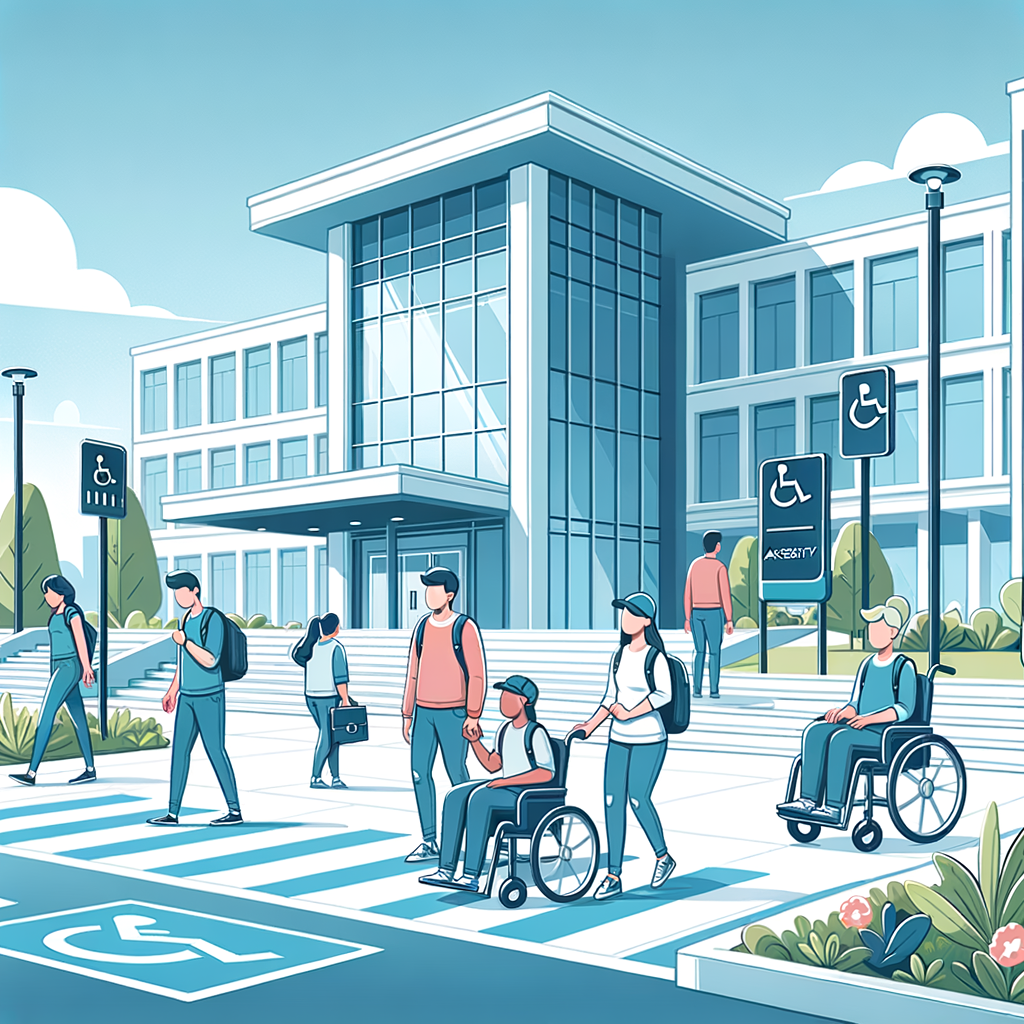
Physical accessibility starts before a guest enters the building. Parking areas require the right number of accessible spaces, proper dimensions, access aisles, signage, and an accessible route to the entrance. A beautifully renovated lobby will not solve the problem if a wheelchair user cannot travel safely from the parking lot because of steep slopes or missing curb ramps. Entrances need adequate clear width, stable surfaces, and door hardware that guests can operate without tight grasping or twisting. Revolving doors alone are not sufficient; there must be an accessible alternative nearby. Once inside, routes to the front desk, elevators, restaurants, meeting rooms, pools, and restrooms must remain usable and free of obstructions such as decorative furniture or housekeeping carts.
Guest room design is often where hotels either earn trust or trigger complaints. An accessible room is not simply a standard room with a grab bar added later. The bathroom layout matters as much as the fixture list. Roll-in showers need enough clear floor space, seats when required, handheld shower units, and controls placed within reach ranges. Toilets need proper side clearance and grab bar placement. Closets, thermostats, drapery controls, peepholes, and light switches must be reachable. If the room includes a kitchenette, the sink and appliances must meet accessibility requirements as well. These details are critical because guests may book an accessible room precisely because they cannot improvise around bad design.
| Hospitality area | Common barrier | Practical improvement |
|---|---|---|
| Parking | Missing access aisle or faded markings | Restripe spaces, add upright signs, verify slope compliance |
| Entrance | Step at main door | Install ramp or provide compliant accessible entrance on same route |
| Lobby | Front desk too high | Add lowered transaction counter section |
| Guest room | Insufficient maneuvering space beside bed | Reconfigure furniture layout and verify clearance |
| Restaurant | Tight table spacing | Adjust floor plan to maintain accessible routes |
| Restroom | Grab bars or accessories mounted incorrectly | Reinstall to ADA standard heights and locations |
Swimming pools, spas, fitness centers, and event spaces deserve special attention because they are frequently marketed as signature amenities. Under ADA rules, many pools require an accessible means of entry, such as a pool lift or sloped entry, depending on size and configuration. Fitness rooms need accessible routes to equipment and enough circulation space. Ballrooms and meeting spaces should provide accessible seating distribution, not a token space at the back of the room. Wedding venues, rooftop bars, and historic inns often overlook these areas because they focus on aesthetics or preservation, but accessibility must be integrated into design, sales, and event planning from the start.
Communication access, service policies, and staff training
ADA compliance is not limited to architecture. Communication access affects every point of contact, especially in hospitality where service interactions are constant. Guests who are deaf or hard of hearing may need visual alarms, captioned televisions, assistive listening systems in meeting rooms, or written communication at check-in. Guests with vision disabilities may need verbal orientation to the room, digital documents compatible with screen readers, or menu assistance. Effective communication depends on context. For a simple transaction, exchanging written notes may work. For a complex meeting with legal, medical, or financial significance, a qualified interpreter may be necessary. Staff should know how to assess the situation instead of making assumptions.
Service animal policies are another frequent source of confusion. Under the ADA, service animals are generally dogs individually trained to perform tasks for a person with a disability. Emotional support animals are treated differently under federal law in many hospitality contexts. Staff may ask only limited questions when the disability is not obvious: whether the dog is required because of a disability and what work or task it has been trained to perform. They cannot demand documentation, require the dog to wear special gear, or isolate the guest. In restaurants, a service dog can accompany the handler even where pets are otherwise prohibited. Clear training prevents embarrassing mistakes that quickly become public complaints.
Training should also cover respectful interaction. Employees should address the guest directly rather than speaking only to a companion. They should not touch mobility devices or service animals without permission. They should know how to offer assistance without being patronizing, and they should understand that accessibility requests are operational needs, not exceptions to normal service standards. Strong hospitality brands build these practices into onboarding, refresher training, and manager coaching. Large hotel groups often use scenario-based modules, while independent properties can rely on short role-play sessions and written service standards. The most effective programs connect compliance to guest experience, showing staff how small actions shape comfort, privacy, and trust.
Digital accessibility, enforcement risks, and business value
Modern hospitality begins online, so digital accessibility has become a major compliance and revenue issue. Hotel websites and restaurant platforms must allow users with disabilities to research locations, view menus, reserve tables, book rooms, and request accommodations. Common barriers include missing image alt text, poor keyboard navigation, unlabeled booking fields, low color contrast, inaccessible PDFs, and video content without captions. Many businesses use third-party booking engines, menu platforms, and event registration tools, but outsourcing does not eliminate responsibility. Following Web Content Accessibility Guidelines, especially WCAG 2.1 AA, is a practical benchmark widely used by developers, auditors, and legal teams. Tools such as WAVE, axe DevTools, and Siteimprove can help identify problems, but manual testing remains essential.
Enforcement risk is real. ADA lawsuits and demand letters against hotels, restaurants, and travel-related businesses have risen over the past decade, often focusing on inaccessible websites, inaccurate room descriptions, parking barriers, and restroom defects. Settlements can require remediation, policy changes, staff training, monitoring, and payment of attorney fees. Even when a claim does not end in a large payout, responding consumes management time and can disrupt operations. Proactive audits are far cheaper than crisis response. Many operators work with accessibility consultants, architects, and counsel to conduct site surveys, prioritize fixes, and create implementation schedules. Documenting efforts also helps demonstrate good-faith compliance if a complaint arises.
The business case for accessibility is strong. Travelers with disabilities and their companions represent significant spending power, and accessible properties often earn loyalty because reliable access is still inconsistent across the market. Accessibility improvements can lift online reviews, reduce booking friction, and support group business from associations, universities, and government clients that expect inclusive venues. Simple upgrades frequently deliver broad benefits: lever handles help guests with luggage, captions assist viewers in noisy bars, and step-free routes improve deliveries and stroller access. Hospitality is ultimately about removing friction. Businesses that treat ADA compliance as an ongoing quality standard, rather than a legal burden, position themselves for stronger guest satisfaction and more resilient operations.
ADA compliance in hospitality is best understood as a promise made visible through design, service, technology, and daily decision-making. Hotels need accessible rooms that function in real life, not only on paper. Restaurants need routes, restrooms, and service practices that let every diner participate comfortably. Event venues, pools, websites, and booking systems must be usable by people with a wide range of disabilities. Across all these settings, the essentials are consistent: know the standards, audit the full guest journey, train employees carefully, fix barriers systematically, and communicate accessible features accurately.
The biggest advantage of strong compliance is not merely avoiding legal trouble. It is building a hospitality experience that more people can trust. Accessibility expands market reach, strengthens reputation, and aligns operations with the core purpose of the industry: making guests feel welcome. Properties that invest in accessible design and inclusive service often discover that improvements benefit many other customers as well. Review your facility, website, policies, and staff training now, prioritize the most meaningful changes, and turn ADA compliance into a lasting competitive strength.
Frequently Asked Questions
1. What does ADA compliance really mean in hospitality, and which businesses does it apply to?
ADA compliance in hospitality means making sure guests with disabilities can access, use, and enjoy a business’s services, spaces, and experiences without unfair barriers. In simple terms, it is about equal access. In the hospitality world, that includes far more than just adding a ramp at the front entrance. It affects how a property is designed, how staff interact with guests, how reservations are handled, how public spaces are arranged, how websites function, and how policies are written and enforced.
The Americans with Disabilities Act, or ADA, is a civil rights law signed in 1990. It prohibits discrimination based on disability in places of public accommodation. For hospitality operators, that usually includes hotels, motels, inns, resorts, restaurants, bars, cafés, banquet halls, conference centers, entertainment venues, spas, clubs, tourist attractions, transportation-related guest services, and many other businesses that serve the public. Even if a business is small, independently owned, or in an older building, ADA obligations may still apply.
One of the biggest misunderstandings in hospitality is thinking ADA compliance only concerns people who use wheelchairs. In reality, the law covers a much wider range of disabilities. That includes mobility disabilities, hearing disabilities, vision disabilities, speech disabilities, cognitive or developmental disabilities, and certain medical conditions that substantially limit major life activities. Because of that, compliance touches many parts of the guest experience, not just the physical entrance.
For example, in a hotel, ADA compliance can involve accessible parking, step-free entrances, accessible guest rooms, usable bathrooms, lowered counters where appropriate, visual and audible emergency alerts, accessible pool or spa access where required, and reservation systems that accurately describe accessible room features. In a restaurant, it can involve accessible seating routes, tables that can accommodate mobility devices, restrooms guests can use independently, service policies that allow service animals, and communication methods for guests who are deaf, hard of hearing, blind, or have low vision. In event venues and resorts, the scope can be even broader because guest experiences often involve lodging, food service, transportation, recreation, entertainment, ticketing, and crowd movement.
ADA compliance also goes beyond construction features. It includes reasonable modifications to policies, practices, and procedures when needed to serve guests with disabilities, unless doing so would fundamentally alter the nature of the service. It also includes providing auxiliary aids and services when necessary for effective communication, unless there is an undue burden. That means businesses may need to think about things like captioning, written communication options, assistive listening systems, accessible digital content, or staff procedures for assisting guests in respectful ways.
Another important point is that ADA compliance is not something a business handles once and forgets. Hospitality properties change over time. Furniture gets moved. Paths of travel become blocked. Websites are redesigned. Menus go digital. Staff turnover happens. Renovations occur. Events create temporary setups. All of these things can affect accessibility. That is why ongoing review matters just as much as initial design.
At its core, ADA compliance in hospitality is both a legal responsibility and a customer service standard. It helps businesses welcome more guests, reduce legal risk, improve reputation, and create a better experience for everyone. When operators understand it as part of everyday hospitality rather than a burden or side issue, they are much more likely to build environments that are inclusive, safe, and easier to navigate for all guests.
2. Is ADA compliance only about physical accessibility like ramps, parking spaces, and door widths?
No, and this is one of the most important things hospitality operators need to understand. Physical accessibility is a major part of ADA compliance, but it is only one part. The law reaches into nearly every point where a guest interacts with a hospitality business. If a hotel has compliant parking and an accessible entrance but its reservation system is confusing, its staff are not trained, its policies exclude service animals, or its menus are inaccessible to some guests, it can still have serious ADA-related problems.
Physical accessibility includes the items people most commonly think of first. That means accessible parking spaces, curb ramps, stable and slip-resistant walking surfaces, accessible entrances, adequate door widths, maneuvering clearance, elevator access where required, guest room accessibility, restroom accessibility, accessible dining areas, reception desks, and routes connecting key spaces. In hospitality, this is especially important because guests are often navigating unfamiliar environments while carrying luggage, moving through crowded areas, or attending events where layouts temporarily change.
But ADA compliance also includes communication accessibility. A guest who is blind or has low vision may need information in a format they can use. A guest who is deaf or hard of hearing may need an effective communication method depending on the situation. A guest with a speech disability may communicate differently with front desk or restaurant staff. Businesses are expected to think about how information is shared, not just whether the building itself can be entered.
Digital accessibility is another growing part of the conversation. Many guest interactions now happen online before anyone arrives on-site. Guests book rooms, view amenities, read menus, reserve tables, purchase event tickets, sign waivers, request transportation, and check policies through websites and apps. If those digital tools are difficult or impossible to use with screen readers, keyboard navigation, or other assistive technologies, guests with disabilities may be blocked long before they reach the property. For hospitality businesses, that can turn into both a customer service problem and a legal risk.
Operational policies also matter. For example, if a restaurant has a “no animals” rule, it still generally must allow service animals under ADA rules. If a hotel requires all guests to use a mobile app for room access, it may need an accessible alternative for guests who cannot use that system. If an event venue changes seating layouts in a way that isolates guests with disabilities or removes integrated options, that creates an accessibility concern. If staff insist on speaking only to a companion instead of directly to the guest with a disability, that may not be a technical building violation, but it is still poor and potentially discriminatory service.
Training is a major but often overlooked piece of compliance. A perfectly designed accessible room can still fail the guest if staff do not know where it is, do not understand its features, or accidentally assign it to someone else. A restaurant may technically allow service animals, but if employees challenge guests improperly or seat them in a less desirable area, the result is still exclusion. Real compliance depends on how the business operates day to day.
There is also a difference between what exists on paper and what guests actually experience. A pathway that was compliant when designed may become unusable if furniture, décor, planters, housekeeping carts, portable bars, buffet stations, or event equipment block it. A lowered counter is not helpful if it is always piled with brochures, payment devices, or decorative items. An accessible restroom is not truly accessible if supplies are placed where they limit turning space. Hospitality businesses need to look at accessibility as a living operational issue, not just a design feature.
So while ramps, parking spaces, and door widths are absolutely important, ADA compliance in hospitality is much broader. It includes physical access, communication access, digital access, service policies, reservation practices, emergency planning, and staff behavior. The businesses that do this well usually treat accessibility as part of the total guest journey from booking to arrival to on-site experience to checkout.
3. What are the most common ADA compliance issues hotels, restaurants, and venues run into?
Hospitality businesses often run into ADA compliance issues not because they intend to exclude anyone, but because accessibility gets handled inconsistently, misunderstood, or pushed aside during busy operations. Some of the most common problems are surprisingly basic. Others are more complex and happen because operators focus only on buildings and forget about service, technology, and policy.
In hotels, one frequent issue is accessible room management. Some properties have accessible rooms, but the reservation system does not clearly identify the specific features of each room. Guests may not be able to tell whether a room has a roll-in shower, transfer shower, visual alarms, accessible route, lower fixtures, or other needed features. In other cases, accessible rooms are incorrectly given to guests who did not request them, leaving guests who genuinely need them without an appropriate option. Front desk teams also sometimes fail to understand the difference between room types, which can create major problems at check-in.
Another common hotel issue is route obstruction. Hallways, lobbies, breakfast areas, and pool decks may technically meet accessibility standards when empty, but become difficult to use when luggage carts, housekeeping carts, furniture, signage stands, decorative displays, or temporary event setups narrow the path. This happens often in hospitality because spaces are constantly being rearranged for convenience, sales, or aesthetics. Operators do not always realize how quickly these changes can interfere with accessibility.
Restrooms are another frequent source of complaints and risk in both hotels and restaurants. Even when restrooms were originally built with accessibility in mind, day-to-day use can undermine that. Trash cans may block maneuvering space. Baby-changing stations may intrude into circulation areas. Toilet paper dispensers, shelves, or hooks may be placed poorly. Door pressure may be too heavy. Sinks may be hard to reach because of storage underneath. These seem like small details, but they directly affect whether a guest can use the restroom independently and with dignity.
Restaurants often run into seating and route issues. Tables can be packed too tightly. Hosts may lead guests with disabilities to awkward or isolated locations rather than offering real choice. Queue lines may be narrow or confusing. Outdoor dining layouts may leave uneven surfaces or little maneuvering room. Buffets and self-service stations may be arranged in ways that are difficult to reach. Restroom access may involve steps, heavy doors, or blocked pathways. Staff may also misunderstand service animal rules, which remains a very common issue in food and beverage settings.
Communication barriers are another major category across the hospitality industry. A guest may not be able to read a digital-only menu if no accessible alternative is available. A guest who is deaf or hard of hearing may struggle to receive important information during check-in, safety briefings, or event instructions. A guest who is blind may encounter inaccessible wayfinding, poor signage contrast, or unreadable digital kiosks. Even when staff are trying to help, lack of training can turn a simple interaction into a frustrating one.
Websites and online booking tools create a growing number of issues. Hospitality businesses increasingly rely on digital systems, but many of those systems are not designed with accessibility in mind. Common problems include images without useful text descriptions, booking calendars that are difficult to navigate by keyboard, pop-ups that interfere with screen readers, forms with unclear labels, inaccessible PDFs, and room descriptions that fail to explain accessibility features accurately. Since many guests first interact with a property online, these problems can prevent access before the in-person experience even begins.
Policies also create trouble when they are written too rigidly or enforced without flexibility. Examples include requiring every guest to wait in a standard line when an alternative could be provided, refusing reasonable seating adjustments, mishandling requests related to service animals, or insisting on one communication method when another is needed for effective communication. In event settings, temporary setups are especially risky. Stages, dance floors, vendor booths, portable bars, and banquet seating can all create accessibility issues if not planned carefully.
Emergency procedures are another overlooked area. It is not enough for a property to be accessible during normal operations. Guests with disabilities also need to be considered in fire alarms, evacuation planning, shelter-in-place procedures, and emergency communications. Visual alarms, audible alarms, staff preparedness, and clear communication protocols matter greatly in hotels and large venues where guests may be unfamiliar with the building.
Overall, the most common ADA issues in hospitality tend to fall into a few patterns: inaccurate assumptions, poor training, blocked accessible features, inaccessible digital tools, and failure to think through the entire guest journey. The businesses that avoid these problems are usually the ones that conduct regular audits, train staff repeatedly, review policies, and treat accessibility as an operational priority rather than a one-time project.
4. How can hospitality businesses improve ADA compliance in a practical, day-to-day way?
The most effective way to improve ADA compliance in hospitality is to treat accessibility as part of daily operations, not just as a building or legal issue. Compliance becomes much more manageable when operators break it into practical areas: physical spaces, digital tools, service policies, staff training, and regular review. Businesses do not need to guess their way through it. They need a structured process and a real commitment to following through.
A strong starting point is an accessibility review of the guest experience from beginning to end. Think through the full path a guest takes. Can they use the website? Can they reserve an accessible room or table with confidence? Can they find the entrance easily? Is parking usable? Is the route clear? Can they check in, be seated, use the restroom, access amenities, understand instructions, and exit safely? Looking at the entire experience often reveals gaps that are easy to miss when departments work in isolation.
Physical inspections should happen regularly, not only during renovation projects. Hospitality spaces change constantly. Managers should check that accessible parking remains properly marked, accessible routes are clear, doors are functioning properly, counters are usable, restrooms remain unobstructed, dining layouts preserve access, and accessible guest room features are maintained. Pools, patios, meeting rooms, and seasonal areas should also be reviewed because those spaces are often modified more frequently.
Hotels should pay special attention to reservation practices. Accessible rooms should be clearly identified in booking systems with accurate descriptions of their features. Staff should understand those features well enough to answer questions and match guests to appropriate rooms. There should also be procedures in place to protect accessible inventory for guests who need it and to avoid reassigning those rooms casually. This is one of the most practical and important steps hotels can take.
Restaurants and venues should review seating practices, queue management, and service procedures. Guests with disabilities should be offered meaningful choices, not automatically routed to the least desirable area. Paths between tables should remain usable. Outdoor seating should be reviewed for slope, surface stability, and spacing. Self-service areas should be set up so guests can access them or receive assistance appropriately. If the business uses QR-code menus only, there should be an accessible alternative available.
Staff training is essential. Employees should know basic ADA expectations relevant to their role. Front desk teams need to understand accessible room features and respectful communication. Hosts and servers need to know service animal rules and accessible seating practices. Event staff need to understand route clearance and integrated seating concepts. Managers need to know how to respond to accommodation requests without panic, defensiveness, or guesswork. Training should be practical, scenario-based, and repeated, especially in industries with high turnover.
Hospitality businesses should also review policies and remove unnecessary barriers. Ask simple but important questions. Does any policy make it harder for a guest with a disability to use the service? Is there flexibility where reasonable? Are there alternatives when the usual process does not work for someone? Accessibility problems often come from routine rules that were never evaluated from a disability access perspective.
Digital accessibility should be addressed proactively. Websites, booking engines, menus, event registration pages, and guest communications should be reviewed for accessibility. Businesses should work with developers and vendors who understand accessible design. Content teams should use clear labels, readable text, and descriptive information for accessible features. This is especially important because many hospitality companies rely on third-party systems, and accessibility problems can still affect the guest experience even when the tool is outsourced.
Guest feedback can be very useful if it is taken seriously. If a guest points out an accessibility barrier, that is valuable operational information. Businesses should have a process for documenting concerns, resolving immediate issues where possible, and identifying longer-term fixes. Defensive responses usually make situations worse. Responsive and respectful handling builds trust and helps improve the property over time.
Finally, businesses should consider working with qualified accessibility professionals, especially when renovating, building new spaces, or reviewing high-risk areas like lodging inventory, restrooms, pools, websites, and event facilities. Legal counsel and accessibility consultants can help interpret obligations and spot issues that are easy to overlook internally. The cost of proactive review is often far lower than the cost of complaints, lawsuits, rushed retrofits, or damage to brand reputation.
In day-to-day practice, good ADA compliance looks like this: clear paths, accurate information, flexible procedures, respectful communication, working accessible features, and staff who know what to do. When those pieces are in place, accessibility becomes less of a scramble and more of a normal part of running a professional hospitality business.
5. Why is ADA compliance so important for hospitality businesses beyond just avoiding legal trouble?
ADA compliance matters for many reasons beyond lawsuits, penalties, or complaints, even though legal risk is certainly one important factor. At the most basic level, hospitality is about welcoming people. If a guest cannot enter the building easily, reserve the right room, read the menu, use the restroom, move through the dining area, understand important instructions, or enjoy amenities with dignity, then the business is failing at a core hospitality function. Accessibility is not separate from service. It is part of service.
There is also a strong business case. People with disabilities travel, dine out, attend events, book stays, celebrate milestones, and influence group decisions. Their families, friends, coworkers, and caregivers often make choices together. If a property is known for being accessible, clear, and respectful, that reputation can drive bookings, repeat business, and positive reviews. If it is known for barriers, embarrassment, or confusion, the opposite can happen quickly. In hospitality, word of mouth matters, and guest trust is extremely valuable.
Good accessibility can also improve the experience for many people who may not even identify as having a disability. Wider routes help guests with luggage, strollers, or temporary injuries. Clear signage helps everyone in unfamiliar spaces. Captions can help in noisy environments. Digital accessibility often improves usability overall. Better room descriptions reduce confusion for all travelers. In that sense, accessibility improvements frequently create broader operational benefits and a smoother guest experience across the board.
Brand reputation is another major reason ADA compliance matters. Hospitality businesses depend heavily on public perception. A single negative accessibility experience can become a damaging review, complaint, social media post, or legal filing. On the other hand, businesses that are known for thoughtful accessibility often stand out positively. Guests notice when staff handle requests smoothly, when information is accurate, and when spaces are easy to use without extra stress. Those experiences shape loyalty.
There is also an internal benefit. When a business takes accessibility seriously, operations tend to become more disciplined. Staff training improves. Maintenance checks become more thorough. policies become clearer. Teams get better at solving guest problems calmly and consistently. Managers pay closer attention to how spaces function in real life, not just how they look in marketing photos. These habits strengthen service quality overall.
From a risk management standpoint, proactive ADA compliance helps businesses avoid costly reactive decisions. Fixing problems early is usually less expensive than responding after a complaint or claim. Lawsuits can bring legal fees, settlement costs, required remediation, negative publicity, and time-consuming disruptions. Even when a business believes it is trying its best, that does not eliminate the impact of poor documentation, inconsistent training, or inaccessible systems. Prevention is almost always the better path.
ADA compliance also reflects the values of modern hospitality. Guests increasingly expect businesses to be inclusive, thoughtful, and socially responsible. Accessibility is part of that expectation. Companies that ignore it can seem out of touch or indifferent. Companies that embrace it send a different message: everyone is welcome here, and we have put real thought into making that true.
Importantly, dignity plays a huge role. Guests should not have to fight for basic access, explain their needs repeatedly, or feel like a burden for requesting what should already be considered. In hospitality, little moments matter. The ease of check-in. The comfort of being seated with everyone else. The ability to use the restroom without assistance. The confidence that a booked room actually meets stated needs. These are not minor details to the guest living them. They shape whether an experience feels relaxing, stressful, respectful, or humiliating.
So yes, ADA compliance helps reduce legal exposure. But beyond that, it supports better service, stronger reputation, wider market reach, more consistent operations, and a more inclusive guest experience. In hospitality, that is not just a compliance win. It is a business win and a human one.