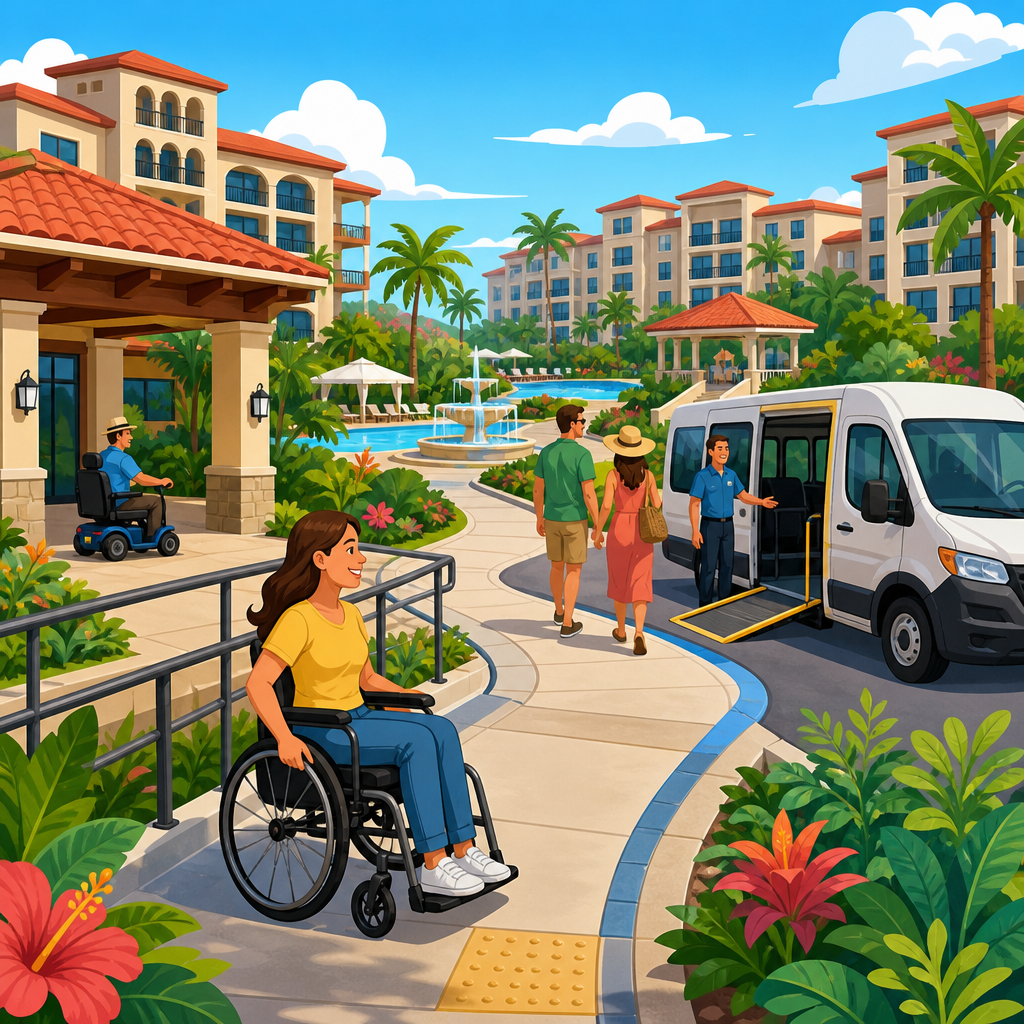
Accessible routes in resorts with multiple buildings, shuttles, and amenities determine whether a guest can actually use the property they paid for, not just enter the lobby. In hotels and lodging, an accessible route is the continuous, unobstructed path that connects parking, arrival points, guest rooms, dining, recreation, meeting space, transportation, and other common-use areas in a way that people with mobility, sensory, or stamina-related disabilities can use independently. At large resorts, that path rarely consists of one hallway. It usually includes sidewalks, ramps, elevators, pool gates, wayfinding systems, and sometimes on-property shuttles moving between distant buildings. I have audited properties where the guest room itself met dimensional requirements, yet the real barrier was the steep hill to breakfast, the missing curb ramp at the spa entrance, or the shuttle lift that staff did not know how to deploy. That gap matters because accessibility in lodging is judged by the whole guest journey. It affects legal compliance, operational efficiency, reviews, group sales, and brand reputation. For this hotels and lodging hub, the core question is simple: can a guest move from arrival to every promised amenity safely, predictably, and with dignity?
Resorts create unique accessibility challenges because they are miniature campuses. A downtown hotel may have one entrance, one elevator core, and stacked amenities. A destination resort may spread rooms across villas, towers, bungalows, conference wings, marinas, beaches, golf facilities, and remote parking lots. Weather, topography, and seasonal operations complicate the route further. The Americans with Disabilities Act Standards for Accessible Design provide the baseline in the United States, while operators also need to consider Fair Housing Act overlap in certain mixed-use properties, state accessibility codes, and brand standards. The practical task is mapping every required connection and identifying where a guest needs an equivalent accessible path rather than a separate, inferior workaround. When done well, accessible route planning reduces complaints, supports older travelers, helps parents pushing strollers, and improves circulation for everyone. It also becomes the organizing framework for this entire subtopic, because nearly every lodging accessibility issue traces back to route continuity.
What Counts as an Accessible Route in Hotels and Lodging
An accessible route in lodging is not limited to wheelchair travel, though wheelchair usability is a key test. It includes width, slope, cross slope, surface stability, door maneuvering clearances, level changes, reach ranges, elevator access, signage, and communication features that let guests identify and follow the route. In plain terms, a resort must connect accessible parking and passenger loading areas to the registration desk, then to accessible guest rooms, and from those rooms to each type of public amenity offered. If the property advertises a pool, restaurant, fitness center, event venue, shuttle stop, or beach club, the route to that feature matters as much as the feature itself. I advise teams to audit routes by travel scenario rather than by building. Start with real guest paths: arriving by car, arriving by rideshare, checking in with luggage, reaching breakfast, attending a wedding, getting to the pool, boarding the shuttle, and exiting during an emergency.
The most common failure is assuming an accessible room solves accessibility. It does not. A compliant guest room located at the top of a steep exterior path without handrails is not meaningfully accessible. Neither is an accessible cottage reachable only by gravel. Another frequent mistake is treating service roads as substitute routes even when they lack separation from vehicles, lighting, drainage control, or directional signage. The route must be usable, safe, and reasonably equivalent. In many resorts, the best solution is not a major rebuild but a network approach: adding curb ramps at decision points, correcting isolated vertical changes, widening one gate in a fence line, synchronizing elevator access hours with amenity hours, and ensuring the shuttle fills the remaining gap between distant zones.
How to Map a Multi-Building Resort Campus
The fastest way to improve accessibility at a large resort is to build a route inventory. Create a base map showing every guest building, parking area, shuttle stop, entrance, elevator, restroom, and amenity. Then trace the primary guest path and at least one backup path for closures or weather. During fieldwork, measure running slope, cross slope, clear width, threshold height, and distance between rest points. Note surface transitions such as pavers to concrete, concrete to boardwalk, or boardwalk to packed sand. Photograph every decision point. On several resort audits, this process revealed that the official accessible path existed on paper but depended on staff unlocking side gates or opening meeting wing doors that were kept closed after 6 p.m. A route that works only during ideal staffing conditions is not reliable enough for lodging operations.
Prioritize what the guest actually needs first. Registration, guest rooms, public restrooms, dining, transportation, and emergency egress should be evaluated before low-use specialty spaces. After that, review high-revenue amenities such as spas, rooftop bars, wedding lawns, and conference centers, because inaccessible routes there directly affect group business and event contracts. A useful standard is to ask whether a guest using a mobility device can complete the same stay itinerary as a non-disabled guest without extra planning. If the answer is no, the route network still has gaps. This page serves as the hotels and lodging hub because each related guide, from pools to parking to guest room communication features, should link back to this campus-wide route analysis.
Common Resort Route Barriers and Practical Fixes
Most barriers fall into a handful of repeat categories. Exterior slopes are common, especially on waterfront and hillside sites. Where regrading is unrealistic, operators often need switchback ramps, handrails, resting intervals, or a reliable shuttle connection. Surface issues come next: loose gravel, cobblestone joints, broken expansion joints, and tree-root heaves can stop front casters or create trip hazards. Door hardware and gate latches are another frequent problem, particularly at pool entries and side entrances intended to complete the route. Vertical circulation failures include inaccessible mezzanines, detached buildings without elevators, and lifts that are out of service or used for storage. Finally, information barriers matter. If a route exists but guests cannot find it, the property still creates exclusion in practice.
| Barrier | Typical Resort Example | Operational or Design Fix |
|---|---|---|
| Excessive slope | Path from villas to main lobby on a hill | Regrade short segments, add ramp switchbacks, or provide scheduled accessible shuttle service |
| Unstable surface | Gravel path to beachfront restaurant | Replace with firm walkway, boardwalk, or stabilized aggregate rated for mobility devices |
| Route interruption | Accessible path blocked by locked gate after dark | Change security hardware, adjust policies, and post clear directional signage |
| Vertical access gap | Spa treatment level reachable only by stairs | Install elevator or platform lift, or relocate equivalent services to an accessible floor |
| Transportation gap | Remote parking and detached conference wing | Use accessible shuttles with trained staff and documented dispatch procedures |
Practical fixes work best when they combine capital improvements with operations. For example, replacing one inaccessible route segment may cost far less than adding duplicate services in multiple buildings. At the same time, even a well-designed route fails without maintenance. I have seen perfect curb ramps blocked by planters, accessible parking used for valet staging, and shuttle lifts rendered useless by dead batteries. Resorts should assign route ownership to engineering, housekeeping, transportation, and front office together, not to one department in isolation. Accessibility on a spread-out campus is a systems issue.
Shuttles, Trams, and Internal Transportation
Shuttles are essential when a resort is too large, too steep, or too dispersed for every amenity to be linked by a practical pedestrian route alone. But transportation only solves the problem if it is accessible in reality, not just in fleet specs. Vehicles need compliant lifts or ramps where required, securement systems, audible and visual stop information when appropriate, and enough dwell time for boarding. Staff need hands-on training to deploy equipment confidently and respectfully. In mystery-shop tests, one of the most common failures is not mechanical; it is staff uncertainty. Drivers say the accessible van is unavailable, cannot locate tie-downs, or suggest a different restaurant because the stop is inconvenient. That is an operations problem with legal and service implications.
The stop environment matters too. An accessible shuttle vehicle is undermined by a stop with no curb ramp, no shelter, poor lighting, or a narrow waiting pad. Route planning should connect guest rooms to shuttle stops with the same level of care applied to the lobby. Resorts should publish shuttle frequency, operating hours, and request procedures in confirmation emails, websites, in-room materials, and the front desk script. If a guest must call for pickup, the call process must itself be accessible and dependable. Properties serving meetings or weddings should also test surge conditions. A lift-equipped shuttle that works for one rider may fail operationally when 300 attendees leave a ballroom at once and the accessible vehicle is trapped in a separate loop.
Amenities: Pools, Dining, Spas, Beaches, and Event Space
Amenities often create the most visible accessibility complaints because they are central to the resort experience. Pools require both route access and compliant means of entry, such as lifts or sloped entries, depending on the pool type and regulatory requirements. The route to the pool deck must avoid surprise steps, narrow gates, and steep transitions. Dining raises its own issues: hosts frequently seat guests in scenic outdoor sections reached only by steps, while the accessible path leads to a side entrance near service corridors. Equivalent service means the accessible route should support the same reservation experience, atmosphere, and hours of use. Spas need accessible locker rooms, treatment rooms, and relaxation areas, not only one compliant restroom near reception.
Beaches and waterfront amenities are more complex because nature limits permanent construction, yet that does not remove the obligation to provide access where achievable and required. Many resorts now use roll-out beach mat systems, accessible viewing decks, transfer systems for watercraft programs, and beach wheelchairs with balloon tires. Event and meeting spaces deserve equal attention because group travel often exposes route failures quickly. A wedding lawn may be marketed heavily online, but if the route from drop-off to seating crosses grass with a sharp grade, guests and family members can be excluded from a major life event. Conference guests face similar issues when breakout rooms, stages, buffet lines, and outdoor receptions are dispersed across separate buildings. In lodging, amenity access is not a bonus feature. It is part of the product being sold.
Wayfinding, Booking Accuracy, and Guest Communication
Even a well-designed campus can feel inaccessible when information is vague or inaccurate. Booking systems should describe accessible guest rooms and route conditions precisely: roll-in shower versus tub with grab bars, hearing-access features, distance from lobby, elevator location, shuttle dependence, and any terrain considerations. Avoid generic labels like accessible room available. Guests need enough detail to decide whether the property fits their needs. Front desk teams should be able to explain the shortest accessible path to each amenity and offer printed or digital campus maps that mark elevators, curb ramps, shuttle stops, and step-free entries. QR-based maps can help, but only if they are readable by screen readers and usable without forced app downloads.
Signage should support independent navigation. Directional signs need consistent terminology, high contrast, logical placement at decision points, and confirmation markers along longer routes. Resorts with multiple towers often confuse guests by using internal staff names for buildings that do not match guest-facing branding. That creates avoidable disorientation, especially for blind or low-vision travelers relying on verbal directions. Communication also includes service recovery. When a route is temporarily out of service because of construction, flooding, or elevator repair, staff should proactively offer alternatives, not wait for a complaint. The strongest properties treat accessible route information as live operational data, updated daily like occupancy or weather conditions.
Maintenance, Audits, and the Business Case
Accessible routes fail gradually unless resorts inspect them continuously. Preventive maintenance should cover walking surfaces, door closers, pool lifts, elevator call buttons, signage, lighting, shuttle securement systems, and vegetation encroachment. Seasonal properties need pre-opening inspections because winter damage, sand accumulation, or deferred repairs often create spring hazards. The best audit programs combine annual technical reviews with routine departmental checklists and guest feedback analysis. Tools such as GIS campus maps, digital work-order systems, and photo-based inspections make this easier. I recommend logging barriers by severity, frequency, guest impact, and fix type so leadership can separate quick wins from capital projects.
The business case is direct. Accessible route improvements reduce complaint handling time, lower legal exposure, strengthen group sales, and broaden the market to older adults, multigenerational families, and travelers with temporary injuries. They also improve online reputation. Reviews rarely praise a compliant cross slope, but they do praise a resort where a grandparent could reach dinner, a wheelchair user could get to the wedding lawn, or a traveler with limited stamina did not have to choose between the pool and the restaurant. For hotels and lodging, this hub topic ties the entire accessibility program together: parking, transportation, guest rooms, amenities, and operations only work when the route between them works. Map your campus, test every guest journey, train every department, and fix the weak links first. That is how resorts turn accessibility from a checklist into a dependable guest experience.
Frequently Asked Questions
What is an accessible route in a large resort, and why does it matter beyond the main lobby?
An accessible route in a resort is the continuous, usable path that allows a guest with a disability to move independently between the important parts of the property. That includes far more than the entrance or front desk. In a resort with multiple buildings, detached guest room wings, restaurants, pools, spas, meeting rooms, beaches, golf facilities, shuttle stops, and activity areas, the route has to connect all of the spaces a guest is expected to use during a normal stay. If a guest can check in at an accessible lobby but cannot reach their room, the breakfast area, the pool deck, the conference center, or the shuttle pickup point without encountering stairs, steep grades, broken pavement, or missing curb ramps, the property is not functioning accessibly in any meaningful real-world sense.
This matters because accessibility in lodging is about actual usability, not partial access. A guest does not book a resort simply to stand in the reception area. They book the full experience, including sleeping accommodations, dining, transportation, recreation, and shared amenities. For guests with mobility disabilities, stamina limitations, vision impairments, or other conditions that affect navigation, a disconnected property can turn a vacation, wedding, conference, or family trip into a stressful and exclusionary experience. A truly accessible route helps ensure that guests can participate alongside everyone else rather than having to request workarounds, rely on staff for transport through back-of-house paths, or skip amenities they paid to use.
Which areas should be connected by accessible routes at a resort with multiple buildings and amenities?
At a large resort, accessible routes should connect the key arrival and use areas throughout the property, not just a handful of isolated points. That typically includes accessible parking, passenger drop-off zones, sidewalks and walkways, the check-in area, accessible guest rooms, public restrooms, restaurants, bars, lounges, meeting and event spaces, fitness centers, pools and pool decks where applicable, spas, retail areas, business centers, outdoor gathering spaces, shuttle stops, and other common-use amenities offered to guests. If the resort advertises a feature as part of the guest experience, there should be an accessible way to get to it and use it, unless a very specific exception applies.
In practical terms, this is especially important in properties that are spread across a campus-like layout. Resorts often have separate towers, villas, cottages, conference buildings, and recreation zones connected by outdoor paths or internal roads. If one building is accessible but the route between buildings is not, the guest experience is still broken. The same is true when a resort provides transportation between areas. Shuttle loading zones, waiting areas, and boarding processes must be considered part of the access system. A guest may technically be able to reach a distant restaurant only by crossing steep terrain or using a shuttle that cannot accommodate mobility devices, which means the route is not genuinely accessible. The overall question is simple: can a disabled guest get from where they arrive to where they need to go, throughout the property, with the same relative independence as other guests?
How do shuttles affect accessibility at sprawling resorts?
Shuttles can either improve accessibility or become a major barrier, depending on how they are designed and operated. At large resorts, shuttles are often essential because distances between buildings and amenities may be too long for many guests to walk comfortably, especially in heat, rain, hilly terrain, or low-light conditions. For guests who use wheelchairs, scooters, walkers, canes, or who have limited endurance, an accessible shuttle system may be the difference between fully enjoying the property and being effectively confined to one section of it. That means accessibility is not just about whether a vehicle exists; it is about whether the vehicle and the entire shuttle process are usable.
An accessible shuttle system should include accessible vehicles or equivalent transportation, safe boarding areas, clear signage, reliable scheduling, and staff who know how to assist appropriately without creating delay or embarrassment. Guests should be able to identify where to wait, understand when the shuttle is coming, board without encountering unnecessary obstacles, and travel to major destinations on the property. If the only route to a distant building or amenity is via shuttle, and the shuttle is not wheelchair accessible or cannot accommodate common mobility devices, that portion of the resort may effectively be inaccessible. Properties also need to think beyond wheelchair users. Audible and visual information, clear route communication, and predictable pickup procedures help guests with sensory disabilities or cognitive disabilities use transportation more independently. In short, the shuttle is part of the accessible route whenever it functions as the connector between the resort’s buildings and amenities.
What are common accessibility problems guests encounter on routes between resort buildings and amenities?
Some of the most common problems are surprisingly basic but have a major impact. Guests often run into broken or uneven sidewalks, paths made of loose gravel or sand, missing curb ramps, steep slopes, narrow walkways, heavy doors along the route, or stairs that force a long detour to find an elevator. At outdoor resorts, routes may also become inaccessible because of poor drainage, standing water, inadequate lighting, or pathways that are technically present but too far from the main guest circulation pattern to be practical. In multi-building properties, another frequent issue is that the accessible guest room is located in one area while dining, events, or recreation are located in another area without an equally usable connection.
Transportation-related problems are also common. A resort may advertise internal shuttle service, but the shuttle stop might be unmarked, inaccessible, or far from the actual building entrance. Staff may give inconsistent information about which vehicles can handle wheelchairs or when an accessible option is available. Guests with stamina-related disabilities may find that the official accessible path exists on paper but requires a long, exhausting travel distance that makes it unrealistic for repeated daily use. Wayfinding is another major issue. If accessible entrances, elevators, ramps, or transportation pickup points are poorly signed, guests may end up navigating service corridors or asking for help repeatedly. These problems do not just create inconvenience; they can prevent equal use of the property and undermine the purpose of accessible lodging.
What should travelers ask before booking a resort to confirm the accessible routes actually work for their needs?
Travelers should ask specific, experience-based questions rather than relying on general statements like “we are ADA compliant” or “the property is accessible.” Those phrases often do not explain how the resort actually functions across a large campus. A better approach is to ask how a guest would travel from arrival to the accessible room, and from that room to the restaurant, pool, meeting space, beach access point, spa, shuttle stop, and other amenities they plan to use. Ask whether the route is step-free, whether elevators are required, whether there are steep outdoor grades, and whether transportation is needed between buildings. If a shuttle is part of the route, ask whether it can accommodate wheelchairs or scooters and how often it runs.
It is also smart to ask for details about distances and terrain. Many resorts are technically connected by accessible paths, but the paths may be long, exposed, hilly, or difficult for someone with limited stamina or balance. Guests should ask whether accessible parking is near their building, whether there are curb ramps at crossings, whether the main dining and activity areas are reachable without stairs, and whether there are alternate accessible entrances that are clearly marked and unlocked during regular hours. If recreation is important, ask about routes to pool decks, accessible seating areas, fitness facilities, and event spaces. The most useful answers come from staff who can describe the property in concrete terms. If the response is vague, inconsistent, or overly scripted, that can be a sign to dig deeper before booking. For a large resort, accessibility is only meaningful if the routes between buildings, transportation, and amenities work as a connected system in real life.


