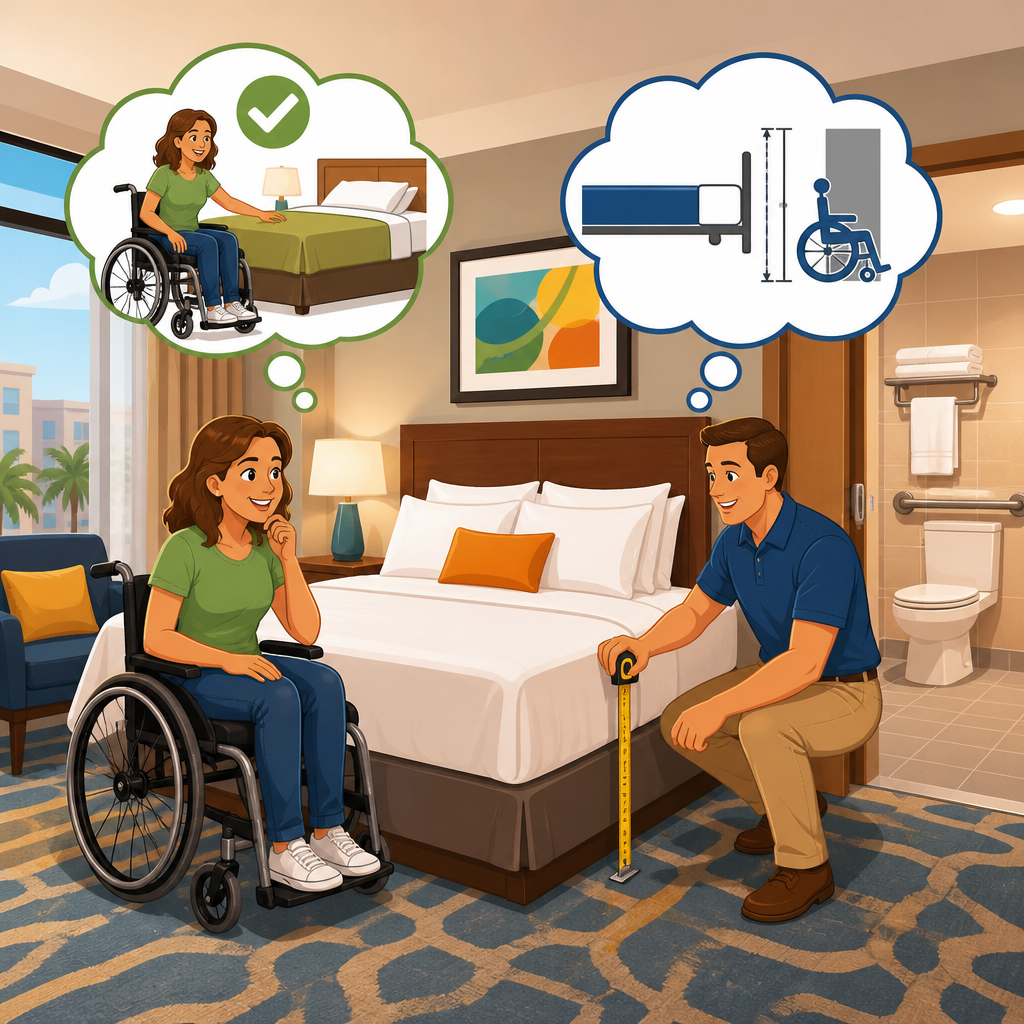
Hotel bed height can determine whether a stay feels routine or becomes a painful, unsafe, and exhausting series of transfers, which is why guests often ask one question before booking: how high is the bed, and will I be able to get into it independently? In hotels and lodging, bed height is more than a comfort preference. It affects wheelchair users, older travelers, people recovering from surgery, guests with balance limitations, and caregivers assisting with lateral or pivot transfers. I have reviewed lodging accessibility details with property managers, inspected guest room layouts, and helped families compare “accessible” listings that looked compliant online but failed in practical use once a guest arrived. The gap between what travelers need and what regulations actually require is where confusion starts.
To understand that gap, it helps to define the terms clearly. Bed height usually means the distance from the finished floor to the top of the compressed mattress surface where a guest transfers. Transfer access refers to the ability to move safely from a wheelchair, scooter, walker, or standing position onto the bed and back again. In accessibility work, a room can satisfy many technical requirements and still be difficult to use if the bed is too high, too low, too soft, or blocked by furniture. Hotels & lodging operators often focus on features that are explicitly measured by law, such as door clear width, turning space, toilet clearances, and roll-in showers. Guests, by contrast, experience accessibility through outcomes: Can I enter the room, reach controls, use the bathroom, and transfer to the bed without injury or assistance?
The ADA is central to this discussion, but many travelers are surprised to learn that the federal accessibility standards are very detailed in some areas and notably silent in others. The 2010 ADA Standards for Accessible Design address lodging scoping, guest room dispersion, communication features, route clearances, and bathroom fixtures. They do not prescribe a specific accessible hotel bed height. That absence matters because front desk staff frequently assume that any room labeled accessible must also have a compliant bed transfer height. It does not. Guests then arrive expecting a standardized setup that simply does not exist across brands, ownership groups, or room types. Some properties use low platform beds around 20 to 23 inches high. Others install pillow-top mattresses on thick box springs and frames that push sleeping surfaces closer to 28 or even 30 inches.
Why does this matter so much? Because transfer safety depends on height matching, side approach clearance, mattress stability, and the user’s transfer method. A wheelchair seat may be 19 inches high, while a hotel bed may sit six to ten inches above it. That difference can turn a lateral transfer into an uphill lift. For a guest with limited upper body strength, a high bed may be inaccessible without staff or caregiver help. A bed that is too low can be equally difficult for someone who relies on sit-to-stand mechanics or has knee and hip limitations. This article serves as the hub for Hotels & Lodging accessibility guidance by explaining what the ADA specifies, what it leaves undefined, what guests should ask before booking, and what operators can do to reduce real-world transfer barriers.
What the ADA Specifies in Hotel Guest Rooms
The ADA sets enforceable requirements for many parts of an accessible hotel room, even though it does not set a mandatory hotel bed height. Under the 2010 standards, lodging facilities must provide a required number of mobility-accessible rooms and communication-accessible rooms based on total room count. These rooms must be dispersed among various classes of guest rooms, which means a property cannot cluster all accessible rooms in one least desirable category. Mobility-accessible rooms must connect to accessible routes, provide sufficient maneuvering clearances, and include accessible bathrooms with either a roll-in shower or transfer shower in the required distribution. Doors generally need a minimum 32-inch clear opening, routes typically need at least 36 inches of clear width, and turning spaces usually require a 60-inch diameter circle or compliant T-turn configuration.
Guest room elements also matter. Operable parts such as thermostats, light switches, peepholes, and drapery controls must fall within accessible reach ranges. Toilet compartments, lavatories, grab bars, shower seats, and handheld shower units have detailed placement rules. In many inspections, these are the features owners verify because they are clearly addressed in standards, plan review, and risk management checklists. Beds are present in the room, but the ADA treats them indirectly by requiring an accessible sleeping room, not by assigning a transfer surface height in the way medical facilities or specialized equipment standards might. That distinction is often misunderstood by both travelers and hotel staff.
For guests, the practical takeaway is simple: an ADA room designation does not guarantee a bed that aligns with your wheelchair cushion height or transfer technique. It usually means the room should provide accessible circulation and required fixture clearances. If the room includes enough space on both sides of the bed, that may support transfer access better than a standard room, but the sleeping surface itself can still be problematic. I have seen accessible rooms with excellent bathroom compliance and a bed so tall that a manual wheelchair user could not transfer safely without improvised steps, which is not an acceptable workaround.
What Guests Need for Safe Bed Transfers
Guests do not experience accessibility as a legal checklist; they experience it as body mechanics. A safe transfer typically depends on four variables: transfer height, side clearance, surface firmness, and stability. Height is usually the first screening issue. Many wheelchair users prefer a bed height close to their wheelchair seat height, often in the roughly 19-to-23-inch range, though ideal height varies by cushion, transfer board use, leg function, and caregiver technique. A guest using a slide board may need the bed at or slightly below wheelchair seat height. A guest who stands and pivots may prefer a slightly higher surface that reduces knee flexion. There is no one universal accessible height, which helps explain why the law does not assign a single perfect number.
Clear floor space beside the bed is the second major factor. A room can have an acceptable bed height but still fail in practice if a nightstand, luggage bench, desk chair, or fixed platform base blocks side approach. Transfer direction matters too. Some guests transfer better to the left, others to the right, and many need at least one unobstructed side with enough room to position the wheelchair at the correct angle. Mattress compression adds another layer. A soft pillow-top may measure 24 inches unoccupied yet sink several inches under body weight, making return transfers harder. Firmness therefore affects effective height, not just comfort.
Caregiver access is often ignored in online room descriptions. In real lodging use, a spouse, aide, or family member may need room to assist with gait belts, slide boards, or a two-person repositioning task. Bed frame design also matters. Deep recessed platform bases can block foot placement for standing transfers. Decorative side rails or bulky footboards can limit approach angles. Adjustable beds, when available, may help some users but are still uncommon outside extended-stay, boutique wellness, or specialty accessible inventory. The guest need is not merely “lower bed equals accessible.” The real need is a predictable transfer setup that matches the traveler’s method.
| Transfer factor | What guests need | Common hotel issue | Why it matters |
|---|---|---|---|
| Bed height | Close match to wheelchair or standing transfer height | Mattress and frame combinations vary widely by brand and room type | Large height gaps increase fall risk and caregiver strain |
| Side clearance | Open space on at least one preferred transfer side | Nightstands and benches block wheelchair positioning | Without approach space, even a good bed height is unusable |
| Mattress firmness | Stable surface with predictable compression | Soft pillow-top mattresses sag under load | Compression changes effective transfer height |
| Frame design | Open access for feet, boards, and caregiver positioning | Platform bases, footboards, and bulky trim obstruct movement | Obstructions interfere with pivot and lateral transfers |
Where Hotels & Lodging Commonly Fall Short
Across Hotels & Lodging, the most common failure is assuming that accessible inventory is self-explanatory. Booking engines may list “accessible room,” “mobility accessible,” or “hearing accessible” with little operational detail. Bed type may be stated, but bed height almost never is. Front desk agents may not know whether a king room sits higher than a double queen accessible room, whether maintenance can remove a box spring, or whether a bed frame is fixed. Housekeeping teams sometimes add thick mattress toppers that change transfer height without anyone realizing the accessibility impact. Brand standards focused on design consistency can also conflict with transfer usability if signature bedding packages elevate the sleeping surface too much.
Another recurring issue is inconsistent measurement. One manager may report bed height from floor to mattress top before compression. Another may measure to the bed frame or box spring. A third may simply estimate. From the guest perspective, an inaccurate answer is often worse than no answer, because it creates false confidence. I advise properties to measure from the finished floor to the top of the mattress at the transfer edge with standard bedding in place and to note whether the surface compresses significantly. That method does not create a legal standard, but it creates a repeatable operational one.
Room layout changes create additional problems. Renovations may replace low-profile hospitality bases with residential-style frames. New carpet and pad can effectively reduce under-door clearance and slightly alter relative transfer heights. A room that once worked for repeat guests may become inaccessible after a soft-goods refresh. Extended-stay properties sometimes perform better because they offer more floor space and simpler furniture layouts, but that is not guaranteed. Luxury hotels may offer larger rooms yet still use exceptionally high mattresses for aesthetic reasons. Budget properties may have lower beds but inadequate circulation space. There is no reliable price-to-accessibility formula.
Questions Guests Should Ask Before Booking
Because the ADA does not specify hotel bed height, informed pre-booking questions are the guest’s best tool. Ask the property to measure the bed from the floor to the top of the mattress where you would transfer, not to the box spring or decorative base. Ask whether that height differs by room type, bed type, or accessible room category. Confirm whether there is clear floor space on both sides of the bed and whether either side is blocked by fixed furniture. If you use a slide board, ask for the width of open space beside the preferred transfer side. If you travel with a caregiver, ask whether there is enough room for assisted transfer positioning.
It is also reasonable to ask whether the bed can be lowered by removing a foundation, changing legs, or substituting a different frame. Some properties can accommodate this; many cannot because of housekeeping protocols, franchise standards, or safety concerns. Ask whether photos of the actual accessible room can be emailed. Request confirmation of shower type, toilet grab bar layout, and route from elevator to room at the same time, because bed transfer access should be evaluated as part of the full lodging experience. If reservations staff cannot answer, ask for engineering or housekeeping, since they often know the physical room setup better than central booking agents.
Document the answers in writing if possible. Email confirmation helps if the assigned room differs from what was described. It also gives the property a fair chance to prepare. In my experience, hotels respond better when the request is specific: “I need a bed approximately 22 inches high with open space on the right side for wheelchair transfer” produces clearer results than “I need an accessible room.” Specificity improves outcomes because it translates a broad legal label into an operational task.
What Better Hotel Practice Looks Like
The best-performing lodging properties treat transfer access as part of usability, not just compliance. They maintain room-level accessibility profiles that include measured bed height, clearance on each side, shower type, and any fixed obstructions. They train reservations, front desk, housekeeping, and engineering teams to use the same terminology. They also verify accessible rooms after renovations, mattress replacements, or furniture swaps. This is especially important in Hotels & Lodging portfolios where ownership changes and third-party management can erode institutional knowledge about which room actually works for which guest profile.
Practical improvements are not always expensive. Removing an unnecessary bench, using movable nightstands where design standards allow, selecting lower-profile foundations, and standardizing measurement procedures can materially improve transfer access. Some properties keep bed risers out of accessible rooms and specify firmer mattresses to reduce sink. Others flag rooms with the best side clearance for guests who disclose wheelchair transfers. The most credible operators never promise universal suitability. Instead, they explain the exact room conditions, acknowledge limits, and help the guest decide. That transparency builds trust and reduces emergency reassignments at check-in.
Hotels & Lodging brands that want stronger accessibility performance should treat this article as the hub issue for the category: bed transfer access connects room design, reservation accuracy, staff training, risk reduction, and guest satisfaction. When the physical room matches the traveler’s method, independence increases and injury risk falls. When properties rely only on the ADA minimums, they may remain technically compliant while still failing the guest. Review your accessible room data, measure your beds consistently, and give travelers the specifics they need before they book.
Frequently Asked Questions
Does the ADA require hotel beds to be a specific height?
No. One of the most important things guests and hotel operators need to understand is that the ADA does not set a specific mattress or top-of-bed height for hotel beds. The ADA Standards for Accessible Design address many features in lodging rooms, including accessible routes, clear floor space, doors, bathrooms, grab bars, and communication features, but they do not give a required bed height the way they do for some other elements. That means a hotel can technically have an ADA-accessible guest room and still provide a bed that is too high or too low for many travelers to transfer safely and independently.
This gap between compliance and usability is exactly why bed height creates so much confusion. Guests often assume that if a room is labeled accessible, the bed will automatically work for wheelchair transfers or for someone with mobility limitations. In practice, that is not always true. A room may meet the technical requirements for accessibility on paper while still creating a real-world barrier if the bed is several inches higher than the guest’s wheelchair seat, transfer board setup, or safe standing transfer range.
So the better question is not only, “Is the room ADA compliant?” but also, “What is the actual bed height from the floor to the top of the compressed mattress where I would transfer?” That practical measurement often matters more to the guest than the compliance label alone. For many travelers, especially wheelchair users and people with limited leg strength or balance, transfer access depends on the bed being close to their seated height, stable, and reachable with enough surrounding clear floor space to maneuver safely.
Why is hotel bed height such a big issue for transfer access?
Bed height directly affects whether a person can perform a safe lateral transfer, pivot transfer, or assisted transfer without excessive strain, instability, or risk of falling. If a bed is too high, the guest may not be able to get onto it at all without being lifted, climbing, or using an unsafe workaround. If it is too low, standing up can become equally difficult, particularly for older adults, guests recovering from surgery, or anyone with weakness, arthritis, or reduced trunk control. What seems like a small difference in inches can completely change whether a transfer is manageable.
For wheelchair users, a common concern is the relationship between the wheelchair seat height and the hotel bed height. Even a modest mismatch can make a level transfer difficult or impossible. A higher bed may force the guest to transfer uphill, which increases the need for upper-body strength and can cause shoulder strain. A lower bed may create a downhill transfer into bed but a much harder return transfer out of bed, especially first thing in the morning when pain, stiffness, or fatigue are worse. Guests who use transfer boards also need enough height compatibility and enough unobstructed side access to position the board effectively.
Bed height also matters for caregivers. When a caregiver is assisting with repositioning, lateral transfers, or sit-to-stand support, an inappropriate bed height can turn a routine task into a physically risky one for both people. It can increase the likelihood of falls, skin shear, failed transfers, and exhaustion over the course of a stay. In other words, bed height is not just a comfort preference or an ergonomic detail. It is often a deciding factor in whether the room is truly usable.
What bed height information should guests ask for before booking an accessible hotel room?
Guests should ask for specific, measurable details rather than general assurances that the room is accessible. The most helpful question is: “What is the height from the floor to the top of the mattress where the guest transfers?” If possible, ask whether that measurement is taken with the mattress unoccupied or compressed, because some pillow-top mattresses sit much higher once bedding is added, while others compress significantly when weight is applied. If the hotel cannot provide an exact number, ask staff to physically measure it rather than guessing.
It is also smart to ask about the bed frame style and what is under the bed. Platform beds, decorative frames, thick box springs, and fixed bases can all affect both transfer height and access for portable lifts or transfer equipment. Guests may also want to ask whether the bed can be lowered by removing a box spring or changing the frame, though that varies widely by property and is not always possible. In some hotels, the accessible room and standard room may actually have the same bed setup, so it is worth confirming instead of assuming.
Beyond height, guests should ask about clear floor space on at least one side of the bed, whether there is room to position a wheelchair next to the transfer side, whether nightstands are fixed or movable, and whether the bed is stable enough for transfers without shifting. For travelers who use portable lifts, ask about under-bed clearance and whether the base can fit beneath the frame. For guests with caregivers, it may help to ask whether there is room for assisted transfers on the preferred side of the bed. The more precise the questions, the better the chance of avoiding a room that is technically available but functionally unusable.
If the ADA does not specify bed height, what does a guest actually need for a safe hotel transfer?
What a guest needs depends on their body mechanics, mobility method, strength, pain level, and transfer technique, which is why there is no one perfect bed height for everyone. In general, guests need a bed that allows them to transfer with minimal vertical gap, enough stability to bear weight during the movement, and sufficient surrounding space to line up equipment and reposition safely. For many wheelchair users, the ideal bed height is often close to the height of their wheelchair seat, but even that is not universal. Some guests prefer the bed slightly lower for getting into bed, while others need it slightly higher to stand or pivot back out.
Safe transfer access usually involves several factors working together. Height is only one piece. The mattress edge matters because a very soft edge can collapse during transfer, effectively lowering the surface and making the movement less predictable. The bed base matters because some frames block wheelchair footplates or transfer board placement. The floor space matters because a guest may need to approach at a specific angle. The side of access matters because many people transfer only to one side safely. And fatigue matters because a setup that is barely possible once may be impossible at the end of a long travel day.
That is why the most guest-centered approach is individualized planning. Travelers should think about their home setup or rehabilitation benchmarks and compare those to what the hotel can provide. If someone knows they transfer best to a bed within a narrow height range, need open space on the left side, or require under-bed clearance for a portable lift, those details should be communicated before arrival. From the hotel side, the most helpful response is not simply saying “our rooms are ADA compliant,” but providing exact measurements and honest descriptions so the guest can judge whether the room will work safely.
What can hotels do to better meet guest needs even when bed height is not specifically regulated?
Hotels can make a major difference by treating bed height as a practical accessibility issue, not just a furniture choice. The first and most effective step is to know the actual bed height in each accessible room and train reservation staff to provide that information accurately. Too often, front-desk or call-center employees do not have measurements, or they use vague phrases like “standard height” or “easy to access,” which do not help a guest decide whether the room is usable. A hotel that keeps verified measurements on file, including notes about transfer-side clearance and bed frame type, is already doing far better than many properties.
Hotels can also review whether their accessible rooms are furnished in ways that support real transfer access. Extremely tall mattresses, thick box springs, decorative platform frames, and fixed nightstands may look upscale, but they can create barriers. When possible, choosing bed setups with more moderate heights, stable edges, movable furniture, and usable floor clearance can improve access for a wide range of travelers. Properties may also consider whether some rooms can be configured with lower-profile foundations or with improved side access, especially in rooms designated for mobility features.
Just as important is communication. Guests with disabilities are often forced to piece together critical details that should be easy to confirm. Hotels that invite pre-arrival questions, take measurement requests seriously, and document room-specific accessibility information build trust and reduce bad outcomes at check-in. Even when a property cannot meet every individual need, transparency helps guests make informed decisions and find alternatives before a trip becomes stressful or unsafe. In a lodging environment, true accessibility is not only about meeting the minimum legal standard. It is about making sure the guest can actually use the room with dignity, safety, and as much independence as possible.


