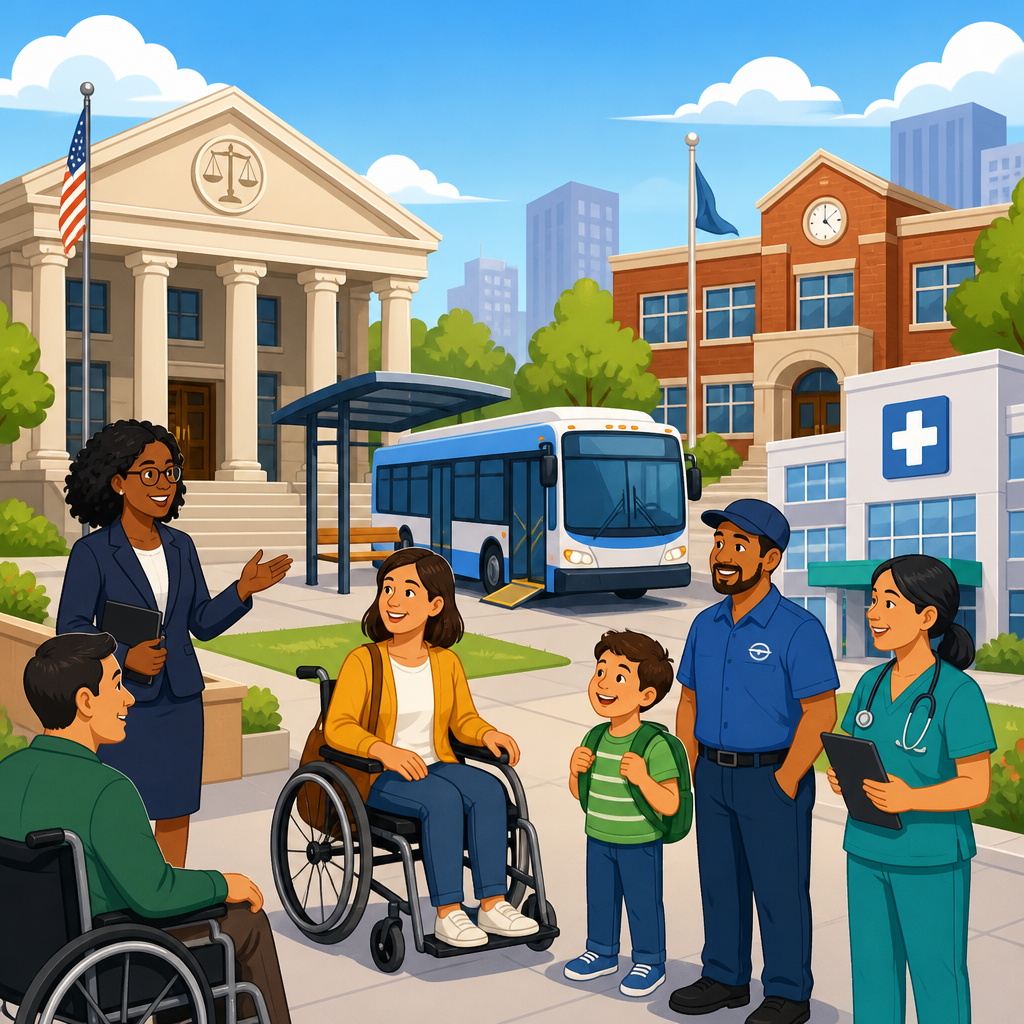
Title II coverage under the Americans with Disabilities Act governs how state and local governments deliver services, programs, and activities to people with disabilities. In practice, that means a county courthouse, a city bus system, a public school district, and a municipal hospital must provide equal access unless doing so would fundamentally alter the program or impose an undue financial and administrative burden. I have worked with public entities on audits, grievance procedures, digital accessibility plans, and facility upgrades, and the same misconception appears repeatedly: many agencies assume Title II is mainly about ramps and parking. It is much broader. Title II reaches policy design, communication access, eligibility criteria, procurement, emergency planning, websites, mobile apps, transportation operations, and the daily decisions frontline staff make.
Understanding Title II starts with three core ideas. First, a public entity includes any state or local government and any department, agency, special purpose district, or instrumentality of those governments. Second, coverage applies to all services, programs, and activities, not only those offered in government buildings. Third, access can require both physical accessibility and effective communication, including auxiliary aids and services such as qualified interpreters, captioning, accessible documents, and screen-reader compatible digital content. The governing regulations are issued primarily by the U.S. Department of Justice at 28 C.F.R. Part 35, with the U.S. Department of Transportation regulating public transportation details. For many facilities, the 2010 ADA Standards for Accessible Design remain the practical construction benchmark.
This topic matters because public entities control essential civic functions. If a person cannot enter a courtroom, understand a school meeting, board a bus, or communicate in an emergency room, the result is not a minor inconvenience; it is exclusion from justice, education, mobility, and healthcare. The risk is legal, operational, and reputational. Complaints can trigger DOJ investigations, Office for Civil Rights reviews, FTA oversight, damages in some cases, and costly retrofits that would have been cheaper if addressed earlier. Just as important, good compliance improves service quality for everyone. Clear wayfinding helps visitors, captioned video helps nonnative speakers, low-floor buses speed boarding, and accessible digital forms reduce staff rework. For courts, transit authorities, school districts, and public hospitals, Title II is not a side obligation. It is a core operating standard.
What Title II requires from every public entity
Title II prohibits disability discrimination in all public services, programs, and activities. The practical rule is simple: a qualified person with a disability must have an equal opportunity to participate in and benefit from what the public entity offers. Public entities must make reasonable modifications to policies, practices, and procedures when necessary to avoid discrimination, unless the modification would fundamentally alter the nature of the service, program, or activity. They also must administer services in the most integrated setting appropriate, communicate effectively with people who have hearing, vision, or speech disabilities, and avoid eligibility criteria that screen out people with disabilities unless those criteria are necessary for the program.
Operationally, agencies should know four recurring duties. First, they need an ADA coordinator if they employ fifty or more people. Second, they need a grievance procedure meeting regulatory requirements. Third, they should complete a self-evaluation of policies and practices, and when structural changes are needed, maintain a transition plan identifying barriers, methods, schedules, and responsible officials. Fourth, they must ensure contractors do not become accessibility weak points. I have seen agencies buy inaccessible kiosks, scheduling platforms, and learning software because procurement teams focused on price and features but skipped accessibility conformance reviews. That creates a predictable compliance problem and often a more expensive replacement cycle later.
Program access is the central concept for existing facilities. Unlike new construction and alterations, which generally must comply with technical design standards, existing buildings are judged by whether the program as a whole is accessible when viewed in its entirety. That gives entities flexibility. A historic city hall without an elevator might relocate permit intake to an accessible floor or nearby accessible site if that delivers equivalent access. However, flexibility is not permission to offload inconvenience onto disabled users. Separate or delayed service often fails when it diminishes privacy, timeliness, dignity, or independence. New construction and alterations, by contrast, carry stricter technical obligations because accessibility must be built in, not improvised later.
Courts: equal access to justice means more than physical entry
Courts have some of the clearest Title II obligations because participation in judicial proceedings is a basic constitutional and civic function. Accessibility must extend to litigants, witnesses, jurors, attorneys, victims, family members, and spectators. In court systems I have reviewed, the biggest risk areas were not always the oldest courtrooms. More often, they were scheduling procedures, remote hearing platforms, and assumptions that a companion could interpret or assist. That approach is risky and usually noncompliant. Courts must furnish appropriate auxiliary aids and services when needed for effective communication, including qualified sign language interpreters, real-time captioning for complex proceedings, assistive listening systems, and accessible electronic filings and notices.
Policy details matter. A deaf juror cannot be excluded based on outdated assumptions about ability to deliberate with an interpreter present. A blind litigant must receive notices and exhibits in an accessible format on a timeframe that supports meaningful participation. A person with a mobility disability should not have to use a service entrance or wait for staff to carry files downstairs for every hearing. Courts also must modify rules when reasonable, such as permitting support persons in some circumstances, adjusting check-in processes, or allowing service animals unless a narrow exception applies. Security screening protocols must also accommodate medical devices and disability-related needs while preserving legitimate safety requirements.
Digital court access now deserves equal attention. E-filing portals, online payment systems, hearing notices, jury summonses, livestreams, and remote testimony platforms all fall within the communication and program access framework. If a portal is incompatible with screen readers, labels are missing, PDFs are image-based, or captions are absent from archived video, the barrier is real even when the courthouse itself is renovated. Public entities should align web and document practices with WCAG 2.1 AA because that benchmark is widely used in settlements, procurement reviews, and remediation plans. It is not a silver bullet, but it provides a practical standard that courts can operationalize through templates, testing, and vendor requirements.
Transit authorities: accessible transportation is a system, not a single vehicle feature
Public transportation under Title II combines ADA nondiscrimination rules with transportation-specific operating requirements enforced by the Department of Transportation. Fixed-route bus and rail systems must provide accessible vehicles, maintain lifts and ramps in operative condition, announce stops, provide adequate route identification, and train personnel to proficiency. Complementary paratransit is required for riders who cannot use the fixed-route system because of disability, and the service must be comparable in response time, fares, geographic area, hours, and trip purpose. In reviews I have conducted, transit agencies often underestimate how quickly maintenance backlogs or call center practices can turn a compliant system on paper into an inaccessible one in reality.
Consider the operational chain. A low-floor bus helps only if the kneeling function works, the stop announcement system is audible, the operator consistently secures mobility devices when requested, and temporary stop relocations are communicated accessibly. Rail stations need elevators that are monitored and repaired quickly, with redundant communication channels when outages occur. Paratransit eligibility must be individualized, not based on diagnosis alone, and no-show policies must account for disability-related circumstances. Transit apps and websites also matter because riders increasingly depend on trip planning, service alerts, and digital fare tools. If those systems are inaccessible, the rider loses practical access even before reaching the curb.
| Public entity | Common Title II risk | Strong compliance practice |
|---|---|---|
| Courts | Inaccessible e-filing, delayed interpreters, unusable jury summons | Accessible documents, interpreter protocols, tested remote hearing tools |
| Transit authorities | Lift outages, poor stop announcements, weak paratransit intake | Preventive maintenance, operator training, individualized eligibility review |
| School districts | Inaccessible parent communications, segregated activities, broken grievance process | Accessible meetings, integrated programs, clear modification procedures |
| Public hospitals | Failure to provide interpreters, inaccessible portals, exam equipment gaps | Interpreter workflows, accessible digital forms, height-adjustable exam tables |
Transit agencies should measure accessibility with the same rigor they apply to on-time performance. Useful metrics include lift failure rates, elevator uptime, complaint closure time, denial rates for paratransit trips, operator retraining frequency, and accessibility defects found in apps after updates. The Federal Transit Administration has repeatedly emphasized maintenance, training, and service equivalency because inaccessible transportation disrupts employment, healthcare, and education immediately. A missed accessible trip is not merely a customer service issue. It can mean a dialysis appointment missed, a shift lost, or a student unable to reach class.
School districts: Title II overlaps with, but does not disappear into, special education law
School districts are public entities, so Title II applies across academics, extracurricular activities, transportation, disciplinary systems, communications with families, facilities, and digital learning tools. Many administrators understandably focus first on the Individuals with Disabilities Education Act and Section 504, but Title II adds a broader nondiscrimination framework. It protects students, parents, guardians, employees interacting with school services, and members of the public attending events. I often tell district teams that if they treat ADA obligations as only an IEP issue, they will miss major exposure points such as inaccessible board meetings, captionless posted videos, after-school clubs that quietly exclude disabled students, or online enrollment forms that parents using assistive technology cannot complete.
Equal access in schools requires attention to both educational and noneducational settings. A student with diabetes may need policy modifications for snack access and field trips. A deaf parent may need an interpreter at an IEP meeting, disciplinary conference, or graduation ceremony. A wheelchair user must be able to reach science labs, performance stages, and athletic viewing areas, not just the main office. Districts also must avoid unnecessary segregation. Separate programming is lawful only in limited circumstances; integrated participation is the default. Athletics, music, assemblies, recess, and school-sponsored travel all require deliberate planning so access is built into the event instead of handled as a last-minute exception.
Technology has become the fastest-moving compliance frontier for districts. Learning management systems, posted assignments, scanned worksheets, parent portals, bus tracking apps, and emergency notification tools all need accessibility review. Procurement language should require conformance testing, VPAT documentation, remediation timelines, and the right to withhold acceptance if critical barriers remain. Districts should also train teachers on document structure, captioning, color contrast, and accessible multimedia because many barriers are created locally after a platform purchase. OCR resolutions regularly show that a district can have a generally sound disability policy and still fail because one essential communication channel remains inaccessible at the point of use.
Public hospitals: healthcare access depends on communication, equipment, and workflow
Public hospitals and health systems operated by counties, cities, or state institutions must provide nondiscriminatory access to medical services under Title II. In healthcare, communication failures are often the most serious and the most avoidable. A qualified interpreter may be necessary in triage, informed consent, discharge planning, mental health assessment, and complex specialist consultations. Relying on family members, especially minors, is usually inappropriate because accuracy, privacy, and impartiality suffer. Video remote interpreting can work well when equipment, bandwidth, camera placement, and staff training are adequate, but it is not a universal substitute. When the patient cannot see the screen clearly, the connection lags, or the clinical encounter is highly sensitive, an on-site interpreter may be required.
Physical and equipment access matter just as much. Accessible parking and routes are basic, but healthcare compliance also includes height-adjustable exam tables, accessible weight scales, transfer supports, mammography positioning access, and policies for safe assistance. I have seen otherwise modern clinics fail patients because intake kiosks lacked nonvisual access or because only one accessible exam room existed and staff used it for storage. Program access means the patient receives substantially equivalent care, not merely entry to the building. If a patient cannot be weighed accurately, transferred safely, or examined on standard equipment, diagnosis and treatment quality can drop. That is both a civil rights issue and a clinical quality issue.
Hospital digital ecosystems require the same scrutiny. Patient portals, pre-registration forms, telehealth platforms, discharge instructions, and billing communications must be usable by patients with vision, hearing, dexterity, cognitive, or speech disabilities. Emergency departments also need reliable auxiliary aid workflows because delays are common during nights and weekends. The strongest systems use centralized interpreter request protocols, on-call escalation trees, tested accessible document templates, and regular drills. They also audit complaint trends and adverse events for disability-related patterns. That approach treats accessibility as patient safety infrastructure rather than a narrow compliance task.
How public entities can build a durable Title II compliance program
The most effective Title II programs are operational, not symbolic. Start with governance: appoint an empowered ADA coordinator, publish a usable grievance procedure, and give leaders clear responsibility for facilities, digital assets, procurement, and training. Then map services from the user perspective. Follow a litigant through filing and a hearing, a rider through trip planning and boarding, a parent through enrollment and meetings, and a patient through intake and discharge. That exercise reveals barriers policy manuals miss. Prioritize fixes by legal risk and service criticality, document decisions, and fund accessibility as a recurring operating need rather than an occasional capital project.
Public entities covered by Title II succeed when accessibility is embedded into design, purchasing, staffing, and accountability. Courts need accessible proceedings and documents, transit authorities need reliable accessible operations, school districts need integrated participation and accessible family communications, and public hospitals need effective communication plus accessible equipment and workflow. Across all four sectors, the pattern is the same: equal access is achieved through planning, training, maintenance, and measurable standards, not promises. Review your policies, digital systems, facilities, and vendor contracts now, then connect this hub to your deeper guidance on courts, transit, schools, and hospitals so every public service remains open to everyone.
Frequently Asked Questions
What does Title II of the ADA require from courts, transit authorities, school districts, and public hospitals?
Title II of the Americans with Disabilities Act requires state and local government entities to ensure that people with disabilities have an equal opportunity to participate in and benefit from their services, programs, and activities. For courts, that can mean providing sign language interpreters, accessible courtrooms, assistive listening systems, accessible websites for filing and case information, and policies that allow meaningful participation by litigants, witnesses, jurors, and members of the public with disabilities. For transit authorities, it often involves accessible buses and rail systems, reliable paratransit service, accessible bus stops and stations where required, clear communication for riders with vision or hearing disabilities, and nondiscriminatory eligibility and complaint procedures. In school districts, Title II applies to everything from enrollment and classroom access to extracurriculars, transportation, discipline processes, digital learning platforms, and parent communications. In public hospitals, the obligation extends to effective communication, accessible medical equipment where appropriate, physical access to facilities, accessible intake and discharge processes, and equal access to treatment and hospital programs.
The core legal standard is broad: public entities must operate their programs so they are accessible when viewed in their entirety. That does not always mean every building or every legacy system must be immediately perfect, but it does mean the entity must take practical, effective steps to remove barriers and avoid excluding people with disabilities. Title II also prohibits policies and practices that screen out or unnecessarily burden individuals with disabilities unless the public entity can show that the requirement is necessary for the program. In day-to-day compliance work, this usually means combining physical accessibility, communication access, policy updates, staff training, grievance procedures, and digital accessibility into one coordinated approach rather than treating disability access as a one-time facilities issue.
How does the “fundamental alteration” or “undue burden” defense work under Title II?
These concepts are important, but they are narrower than many public entities assume. A public entity is not required to take an action that would fundamentally alter the nature of a service, program, or activity, or that would impose an undue financial and administrative burden. A fundamental alteration means the requested change would significantly change the essential character of the program itself, not simply make operations less convenient or require planning. An undue burden means significant difficulty or expense in light of the public entity’s overall resources and operation, not just a department’s preference to avoid cost or disruption. The bar is high, and the analysis must be grounded in facts.
In practice, courts and enforcement agencies expect an individualized, well-documented assessment rather than a reflexive denial. If a requested accommodation cannot be provided as originally requested, the public entity still must look for an alternative that offers access as effectively as possible. For example, if a particular historic courtroom cannot be made accessible for one proceeding on short notice, the court may need to relocate the hearing to an accessible courtroom or provide another effective solution. If a hospital claims a specific auxiliary aid is too difficult to arrange immediately, it still must provide another method of effective communication unless doing so would also fail the legal standard. A transit authority cannot simply cite budget constraints in the abstract; it must evaluate available resources, operational realities, and whether another accommodation or service modification can meet the rider’s needs. In short, these defenses do not excuse inaction. They require a careful decision-making process, documentation by appropriate leadership, and a genuine search for workable alternatives.
What are some common Title II compliance issues for courts and transit authorities?
For courts, recurring issues include inaccessible entrances or courtrooms, failure to provide qualified interpreters in a timely manner, lack of accessible parking or wayfinding, inaccessible online filing or payment systems, and policies that do not account for service animals, medication needs, mobility devices, or cognitive disabilities. Courts can also run into problems when staff are not trained on how to handle accommodation requests from jurors, attorneys, litigants, or members of the public. Because court participation can affect fundamental rights, delays or confusion in the accommodation process can create serious legal exposure very quickly. A strong court access program usually includes a central ADA coordinator, a clear request process, backup procedures for urgent hearings, regular technology testing, and coordination between judges, clerks, security staff, and facilities personnel.
Transit authorities often face a different but equally complex set of compliance challenges. Common issues include broken lifts or ramps, inadequate maintenance practices, operator training problems, failures in stop announcements, inaccessible customer service channels, problems with paratransit eligibility determinations, excessive denials or no-show policies, and inaccessible websites or mobile apps used for route planning and ticketing. Transit entities also have to think carefully about service animals, reasonable modifications to policies, communication for deaf or blind riders, and the accessibility of temporary service changes. Compliance is rarely just about the vehicles themselves. It depends on whether the entire rider experience is meaningfully accessible, from trip planning to boarding, riding, transfers, and complaint resolution. Public transit systems that perform regular audits, track recurring barriers, and train frontline staff consistently are typically in a much stronger position than those reacting only after complaints are filed.
How does Title II apply to public school districts and municipal hospitals beyond physical access?
Title II reaches well beyond ramps, doors, and elevators. In public school districts, it applies to policies, communications, technology, and the full student experience. That includes accessible websites, learning management systems, registration portals, emergency notifications, parent-teacher communications, discipline processes, field trips, athletics, after-school programs, and school board meetings. Districts also need to consider how students, parents, guardians, and community members with disabilities access information and participate in school life. Even when other disability laws may also apply, Title II remains a broad operational standard for the district as a public entity. Digital access is especially important now because so much instruction, scheduling, transportation information, and family communication happens online.
For municipal or other public hospitals, Title II compliance often turns on effective communication and equal access to care. That can involve qualified interpreters for deaf patients, captioning for video content, accessible consent forms, communication support for patients with speech or cognitive disabilities, and policies that do not rely on family members to interpret except in very limited circumstances. Hospitals must also think about accessible check-in systems, patient portals, diagnostic and treatment areas, and the accessibility of policies for companions and support persons. In both schools and hospitals, a common mistake is treating accessibility as an ad hoc customer service issue rather than a systemwide legal obligation. The better approach is to build accessibility into procurement, policy drafting, vendor management, staff training, and routine quality assurance so barriers are identified and corrected before they interfere with education or medical care.
What should a public entity do to improve Title II compliance and reduce legal risk?
The most effective approach is proactive and organization-wide. Public entities should begin with a practical accessibility assessment that reviews facilities, policies, communications, websites, mobile apps, forms, emergency procedures, vendor relationships, and frontline service delivery. From there, they should identify barriers, prioritize high-impact fixes, assign responsibility, and create a realistic implementation plan. A designated ADA coordinator is critical, especially for larger entities such as court systems, transit agencies, school districts, and public hospitals. That person or team should oversee accommodation procedures, track complaints, coordinate corrective action, and help leadership make consistent decisions. A written grievance procedure is also important because it gives individuals a clear path to raise concerns and gives the entity a chance to resolve problems before they escalate into formal enforcement or litigation.
Training is another major piece of risk reduction. Staff need to know not only that the ADA applies, but how it applies in their specific roles. Judges and clerks, bus operators and dispatchers, teachers and administrators, nurses and registration staff all encounter different accessibility issues, and generic training usually is not enough. Public entities should also pay close attention to digital accessibility, since websites, PDFs, apps, portals, and kiosks are now central to service delivery. Procurement language matters too: if a school district buys inaccessible software or a hospital deploys an inaccessible patient check-in system, the accessibility problem becomes embedded in operations. Finally, documentation matters. When entities perform audits, respond promptly to requests, consider alternatives in good faith, and keep records of decisions and corrective measures, they are in a far better position both to serve the public well and to demonstrate compliance if a complaint arises.


