Accessible routes on golf courses connect players and visitors to the core experience of the game: teeing grounds, putting greens, weather shelters, practice areas, and support facilities. In ADA accessibility standards, an accessible route is a continuous, unobstructed path that connects accessible elements within a site or building and can be used safely by people with mobility disabilities, including wheelchair users and golfers who rely on single-rider adaptive golf cars. I have worked on accessibility reviews for outdoor recreation properties, and golf courses are among the most misunderstood settings because they combine highly managed landscapes with natural grades, drainage patterns, and long travel distances. That mix makes compliance more technical than many operators expect.
This topic matters because golf is both a public accommodation issue and a participation issue. A course can have an accessible clubhouse and parking area yet still exclude players if the route to teeing grounds or weather shelters is unusable. The 2010 ADA Standards for Accessible Design, especially the recreation provisions in Chapter 10 and the general route requirements in Chapters 2 and 4, set the baseline. They require certain golf course components to be connected by accessible routes, while also recognizing practical limits tied to terrain and golf course design. For owners, architects, superintendents, and municipal operators, understanding where accessible routes are required and how exceptions work is essential to reducing risk and opening the game to more users.
As a hub for recreation and sports facilities, this article goes beyond golf-specific details and frames the broader compliance pattern. Recreational accessibility usually turns on the same questions: what elements must be connected, what technical standards apply, where can terrain-based exceptions be used, and how should maintenance preserve accessibility over time? Golf courses are a useful case study because they include circulation paths, specialized play surfaces, shelters, restrooms, parking, signage, and policies about vehicle use. If you can understand accessible routes on a golf course, you can better evaluate trails, boating facilities, swimming pools, stadium seating approaches, and other outdoor sports environments governed by the same ADA logic.
At a practical level, the most common questions are direct. Which golf features must be on an accessible route? Do all holes need full pedestrian access? What slope and width rules apply? Can a cart path serve as the accessible route? How do weather shelters fit in? The short answer is that accessible routes must connect course entrances and accessible parking, bag drop areas where provided, teeing grounds, putting greens, weather shelters, and other required amenities, but the standards include targeted allowances that account for the characteristics of a golf course. The details below explain how to apply those rules correctly, avoid expensive redesign mistakes, and create a recreation site that works for both compliance reviewers and real players.
What an accessible route includes on a golf course
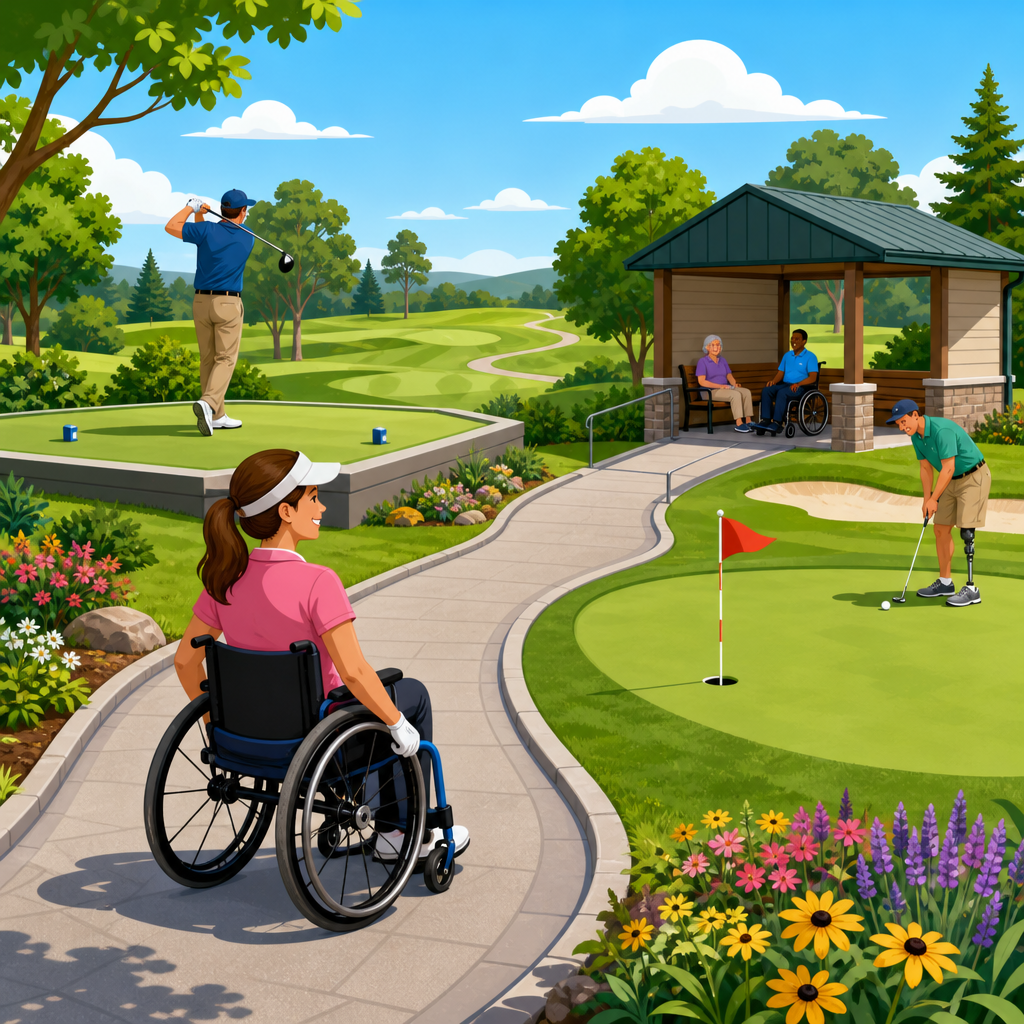
On a golf course, an accessible route is not just a sidewalk. It can be a paved walk, a firm and stable path, or in some cases a golf car passage that satisfies the required connection between accessible elements. The route must connect arrival points such as accessible parking and passenger loading zones to the course entrance and then to the accessible golf features covered by the standards. Those features generally include teeing grounds, putting greens, and weather shelters, along with practice areas, course toilets, sales counters, and other common-use spaces when they are provided. The route must be continuous and usable, not theoretical. If a golfer can reach the clubhouse but cannot get to the first tee or a shelter during a storm, the route network is incomplete.
The golf-specific rules are narrower than many people assume. The ADA does not require every inch of fairway rough or every bunker edge to be independently accessible. It focuses on accessible routes to the functional areas where a person begins play, completes play on a hole, practices, or seeks refuge. In plan review, I look first for route continuity at those decision points. Can a wheelchair user or adaptive golfer move from parking to check-in, from check-in to the practice green, from there to the teeing ground, and later to a weather shelter or restroom? If one of those links fails, the course experience breaks down even if the built features themselves were individually designed well.
Because this page is the hub for recreation and sports facilities, it is useful to note the recurring principle: accessibility in sports settings depends on connecting participation spaces, not merely providing accessible spectator or support areas. That same principle appears in court sports, swimming pools, fishing piers, and boating facilities. Golf makes it especially visible because routes are long, exposed to weather, and often shaped by course architecture. A compliant strategy therefore starts with circulation planning, then aligns grading, surfaces, drainage, and operations with that circulation plan.
Required connections: teeing grounds, putting greens, and weather shelters
Teeing grounds are required destinations because they are the starting point of play. An accessible route must connect to each hole’s teeing ground required by the standards, allowing a golfer with a disability to reach the place where play begins. In practice, many facilities satisfy this with an accessible golf car route rather than a conventional sidewalk, particularly on hilly courses where long pedestrian walks would be intrusive and difficult to maintain. The key is usability. If the route depends on a gate that staff keep locked, crosses a steep lip, or narrows between bollards, it may fail even when the designer intended it to work.
Putting greens are equally important because they are where each hole concludes and where practice often occurs. The route must allow a player to approach and use the putting green area without encountering barriers that stop mobility devices short of the playable edge. Designers often overlook the transition from path to green surrounds. I have seen projects with compliant-width paths ending at loose gravel shoulders or deep turf depressions caused by irrigation and settlement. Those details matter because an accessible route is judged by actual field conditions, not by drawing notes. Smooth transitions, stable surfaces, and manageable cross slopes are what make the route usable.
Weather shelters are not optional extras under the standards when they are provided on the course. They must be connected by an accessible route because their purpose is safety during lightning, heavy rain, high wind, or extreme heat. This is more than a technical compliance point. On a large course, weather shelters may be the only refuge available between holes, and inaccessible shelters create a direct life-safety problem. Operators should verify door clearances, thresholds, turning space, and route approach conditions, especially where shelters sit on raised pads to stay above runoff. A ramp or graded walk may be necessary even when the shelter itself was bought as a prefabricated unit.
| Golf course element | Why the route matters | Typical design approach |
|---|---|---|
| Teeing ground | Starting point for play on each hole | Accessible golf car route or firm, stable walk with clear approach |
| Putting green | Required access to complete play and practice | Smooth path transition to green surround with controlled cross slope |
| Weather shelter | Safety refuge during storms and extreme weather | Accessible path, compliant door maneuvering space, low threshold |
| Practice areas | Equal access to warm-up and instruction | Route from clubhouse or first-tee area to practice tee and green |
| Course restroom | Basic sanitary access during play | Connected route plus interior toilet room compliance |
Technical standards: width, slope, surface, and cross slope
The technical rules for accessible routes on golf courses build from the ADA’s general route criteria, but they must be applied with outdoor realities in mind. Clear width is typically 36 inches minimum, with passing spaces where narrower conditions or longer constrained segments exist, although many golf facilities prudently exceed that width to accommodate adaptive golf cars and side-by-side user movement. Running slope and cross slope are the most sensitive issues. Where a route is treated as a standard accessible route, slope limits generally follow the ADA baseline, and steeper segments function as ramps only when they meet ramp criteria such as rise limits, landings, and handrails where required. On golf courses, careful grading is therefore the difference between a route that works on paper and one that survives review.
Surface quality is just as important as dimensions. Firm, stable, and slip-resistant surfaces are expected, but those words require judgment in outdoor recreation settings. Asphalt and concrete are straightforward choices near clubhouses, shelters, and practice complexes. Stabilized aggregate systems can work in selected low-speed areas if they remain compacted and resist rutting. Loose gravel, uncompacted crusher fines, deep mulch, and turf alone are generally poor choices for primary accessible routes because they shift under wheels and become hazardous after irrigation or rain. I recommend testing route segments after a storm and during peak maintenance season, because some surfaces appear adequate when new but quickly fail under golf car traffic and edge erosion.
Drainage details deserve special attention. Golf landscapes are designed to move water, and accessible routes often fail where sheet flow crosses a path, where trench drains create wheel traps, or where settlement leaves abrupt level changes. The practical standard is simple: the accessible route must still function when the course is operating under ordinary conditions. If a path ponds every morning from over-spray, or if bunker washout repeatedly spills sand across the route to a teeing ground, maintenance costs and user complaints will follow. Durable edging, positive drainage, and realistic maintenance plans are compliance tools, not cosmetic upgrades.
Exceptions, limits, and how golf differs from other recreation sites
Golf courses receive tailored treatment because the game depends on varied terrain and long-distance movement across a landscape. The standards acknowledge that fully urbanizing a course with conventional sidewalks is neither required nor desirable. Instead, they focus on connecting specified elements and permit design flexibility where strict application of ordinary route construction would fundamentally alter the nature of the course or conflict with essential course characteristics. That does not mean broad exemption. It means the operator must understand exactly where flexibility exists and where it does not. The route to a weather shelter, for example, still must work even if the fairway itself is not intended as an accessible pedestrian surface.
Compared with other recreation and sports facilities, golf presents one of the clearest examples of program access through a mix of design and policy. A swimming pool requires accessible means of entry into the water. A stadium requires accessible seating locations and routes. A golf course often relies on both physical routes and operational allowances, such as permitting adaptive golf cars beyond where standard carts may travel. In my experience, operators get into trouble when they treat policy as a substitute for route design. Allowing a player to request help from staff is not equivalent to providing an accessible route. Assistance can complement accessibility, but it cannot replace required independent access to covered elements.
This distinction matters across the entire recreation and sports facilities category. Routes must be planned where people actually use the activity, not where it is easiest to pour concrete. The same thinking applies to miniature golf, amusement rides, shooting facilities, exercise rooms, and team sports venues. Each setting has specialized rules, yet the compliance question is consistent: can a person with a disability participate in the core activity with dignity, safety, and reasonable independence? Golf answers that question through accessible circulation to the playing and shelter points that define a round.
Design, maintenance, and operational practices that make routes usable
The best accessible routes on golf courses come from integrated planning between the golf course architect, civil engineer, landscape architect, accessibility consultant, and superintendent. During design, identify required destinations first, then map the shortest practical accessible connections before finalizing grading and drainage. Cart path alignments can often do double duty if widths, slopes, edges, and approach conditions are addressed early. Where shelters or restrooms are added later, revisit route continuity instead of assuming the nearest service drive is acceptable. Retrofitting after construction is usually more expensive because drainage, irrigation sleeves, retaining edges, and utilities are already fixed.
Maintenance determines whether compliance lasts. Turf overgrowth can narrow routes below minimum clear width. Asphalt heave at tree roots can create abrupt changes in level. Sealcoating can make slopes slick when wet if the wrong finish is used. Even painted stop bars at crossings can become slippery. I advise operators to inspect accessible routes on the same cycle used for cart path safety, then document repairs. That record helps risk management and proves the course treats accessibility as an ongoing operational responsibility. Staff training also matters. Marshals, starters, and grounds crews should know where accessible routes run, where adaptive golf cars may travel, and how to keep gates, mats, hoses, and maintenance equipment from blocking access.
Technology and equipment choices can support good access when they are used correctly. Single-rider adaptive golf cars with swivel seats and stand-assist features expand play for many golfers, but they perform best on routes with stable surfaces and reasonable side slopes. Prefabricated shelters can be compliant if installed on accessible pads with proper door hardware and maneuvering clearance. Digital course maps can flag accessible routes and shelter locations for players before arrival. These are practical improvements, not luxuries. They reduce confusion, improve pace of play for users who need route certainty, and help the facility deliver a consistent recreation experience.
Accessible routes on golf courses are the backbone of inclusion in recreation and sports facilities. When teeing grounds, putting greens, weather shelters, practice areas, and support amenities are connected by usable routes, the course moves from nominal compliance to real participation. The ADA framework is specific but workable: connect the required elements, apply the technical standards carefully, use the permitted flexibility without overreaching, and maintain the routes as part of normal course operations. That combination protects both access and course character.
The larger lesson for ADA accessibility standards in recreation is that circulation is where policy becomes reality. A beautifully designed amenity is not truly accessible if people cannot reach it independently and safely. Golf courses illustrate this with unusual clarity because routes must negotiate distance, weather, slopes, and landscape performance all at once. Owners and designers who address those conditions early produce better outcomes than those who wait for a complaint or renovation trigger. They also create facilities that welcome older players, injured veterans, adaptive athletes, and families with mixed mobility needs.
If you manage, design, or evaluate a golf facility, review every required destination from arrival to shelter and back again. Measure widths and slopes, inspect surfaces after rain, test transitions, and confirm that operations support the physical route. Then apply the same discipline across your other recreation and sports facilities. Accessible routes are not side issues; they are the path to usable access, stronger compliance, and a more inclusive game.
Frequently Asked Questions
What is an accessible route on a golf course, and why does it matter?
An accessible route on a golf course is a continuous, unobstructed path that connects key golf and support elements in a way that can be safely used by people with mobility disabilities. In practical terms, that means players and visitors should be able to travel from arrival points, parking, and passenger loading areas to the clubhouse, practice facilities, teeing grounds, putting greens, weather shelters, and other required amenities without encountering barriers that prevent independent use. The route should be stable, usable, and thoughtfully designed so that a person using a wheelchair, mobility aid, or single-rider adaptive golf car can move through the course experience with dignity and predictability.
This matters because accessibility on a golf course is not limited to getting into the building or reaching a restroom. The game itself happens outdoors, across a large site, and the essential experience includes reaching places where players tee off, practice, putt, pause during bad weather, and interact with course operations. If those areas are not connected by accessible routes, then access is incomplete. From both a compliance and user-experience standpoint, accessible routes help ensure that golfers with disabilities can participate in the core functions of the course rather than being limited to only the portions nearest the clubhouse. Good routing also improves usability for older adults, people with temporary injuries, maintenance staff, and guests pushing strollers or carrying equipment.
Which golf course areas should be connected by accessible routes?
Accessible routes should connect the elements that are part of the golf course’s essential use and any accessible amenities provided to the public. This typically includes arrival points such as accessible parking spaces and passenger loading zones, the route into and through the clubhouse or pro shop, accessible toilet and locker facilities, food service areas if provided, and the paths leading to practice ranges, putting greens, teeing grounds, and weather shelters. When a course includes support spaces such as bag drop areas, starter locations, or instructional areas open to players, those spaces should also be considered in the overall accessible circulation plan.
For the golf-specific portions of the site, it is especially important to focus on the areas that represent the core playing experience. Teeing grounds and putting greens are central to participation in the game, and weather shelters are critical from a safety standpoint. Practice areas should not be overlooked either, since many golfers spend significant time at the driving range, short-game area, or practice green. The goal is not to create isolated accessible islands, but to provide a coherent system of travel so a golfer or visitor can move from one meaningful destination to another without being forced to backtrack, seek assistance, or use staff-only workarounds. A well-planned accessible route network reflects how people actually use the course from arrival through play and departure.
Do accessible routes on golf courses have to reach teeing grounds and putting greens?
Yes, teeing grounds and putting greens are among the most important destinations to consider because they are fundamental to the game of golf. If a course provides these features for general play, they should be connected in a way that allows golfers with mobility disabilities to access the experience alongside other players. In accessibility planning, this is a key distinction: routes should not stop at the edge of the developed site and leave the most important golf functions unreachable. Reaching the teeing area and the putting surface vicinity is part of meaningful access to the sport.
In design terms, that does not mean every inch of turf must be altered or that course character must be compromised. It does mean the route should be intentionally designed so users can get to the teeing ground and putting green area in a practical and safe manner. Designers often need to work carefully with grading, path alignment, edge conditions, and transitions to achieve this while respecting drainage, maintenance needs, and playability. On existing courses, improvements may involve strategic path upgrades and better connections rather than full reconstruction. The best solutions balance accessibility, safety, course operations, and the natural landscape while keeping the golfer’s actual experience at the center of the design.
How do weather shelters fit into golf course accessibility requirements?
Weather shelters are an important part of accessible golf course design because they serve a safety-related function for players and visitors during lightning, heavy rain, high winds, or extreme weather events. If a course provides weather shelters for general use, they should be connected by accessible routes so people with mobility disabilities are not left without the same level of protection available to other golfers. Accessibility here is about more than convenience. In emergency or fast-changing weather conditions, an inaccessible shelter can create serious safety risks for individuals who cannot quickly navigate steep, uneven, or obstructed terrain.
Good accessible design for weather shelters considers the full approach and use sequence. The route should be clear and usable in real conditions, not just in ideal weather. That means paying attention to surfacing, slopes, drainage, turning space, entrance width, and any thresholds or level changes at the shelter itself. Interior clearances should allow a wheelchair user or someone using other mobility equipment to enter and occupy the space without difficulty. From a planning perspective, shelter placement also matters. A shelter that technically exists but is functionally unreachable for some players does not provide equal access. When weather shelters are integrated into the accessible route network from the beginning, courses can better support both safety and inclusion across the full playing environment.
What are the biggest design challenges in creating accessible routes on golf courses?
The biggest challenge is usually the landscape itself. Golf courses often include rolling terrain, drainage swales, long travel distances, bridges, cart paths, and highly maintained turf transitions that were not originally designed with accessibility in mind. Unlike a compact urban site, a course spreads activity across a large outdoor setting where natural features and the strategy of play are part of the design. That can make it difficult to create routes that are usable, continuous, and aligned with accessibility goals without affecting course character, maintenance practices, or stormwater management. Existing courses can be especially challenging because route improvements must work within established grading, irrigation, and circulation systems.
Another major issue is treating accessibility as an afterthought rather than as part of the initial site planning. When routes are not coordinated early, the result is often disconnected path segments, awkward detours, steep approaches, or inaccessible transitions at exactly the places golfers need access most. The strongest projects usually come from a holistic approach that evaluates how people arrive, where they go, how they move between golf features, and what equipment they may use, including wheelchairs and adaptive golf cars. Attention to path width, surface firmness and stability, cross slopes, rest opportunities, and route continuity can make a tremendous difference. In my experience, the most successful golf course accessibility solutions come from practical field observation, close coordination among designers and operators, and a willingness to solve circulation issues in ways that support both compliance and the real-world experience of play.