Swimming pools, spas, and aquatic recreation areas are covered by detailed accessibility rules because water features are public accommodations, not optional amenities. When a pool needs two accessible means of entry is one of the most common questions I have handled for hotel owners, architects, property managers, and recreation directors, and the answer depends on the type of aquatic feature, the size of the pool, and the technical feasibility of each entry method. In plain terms, an accessible means of entry is a way for a person with a disability to get into and out of the water using a compliant feature such as a pool lift, a sloped entry, a transfer wall, a transfer system, or accessible pool stairs. The governing baseline in the United States comes from the 2010 ADA Standards for Accessible Design, especially Section 242 and Section 1009, which specify how many entries are required and how each entry must be built.
This topic matters because mistakes are expensive, visible, and difficult to correct after construction. I have seen projects install a single lift at a large resort pool, only to learn later that a second accessible entry was required. I have also seen operators assume that any set of wide steps counts, when the standards only recognize accessible pool stairs if they meet technical criteria such as uniform risers, handrails, and integration with an accessible route. Beyond legal exposure, accessible entries directly affect whether guests, students, athletes, and community members can use the water independently and safely. A compliant design improves inclusion, reduces staff intervention, and supports consistent operations during inspections, renovations, and program planning.
As the hub for recreation and sports facilities under ADA accessibility standards, this article frames pools within the broader aquatic landscape. Wading pools, spas, therapy pools, lazy rivers, splash play zones, and competition venues can each trigger different requirements. The central rule for standard swimming pools is straightforward: pools with less than 300 linear feet of pool wall need at least one accessible means of entry, while pools with 300 linear feet or more need at least two. However, the details matter. At least one of those required entries usually must be either a pool lift or a sloped entry, and the second, when required, can come from a limited set of approved options. Understanding those distinctions is the difference between a compliant facility and a costly retrofit.
Core rule: when two accessible means of entry are required
The main compliance threshold for swimming pools is the total linear feet of pool wall. Under ADA Section 242.2, a swimming pool with 300 linear feet or more of pool wall must provide at least two accessible means of entry. A swimming pool with less than 300 linear feet of pool wall must provide at least one accessible means of entry. This is the rule most people are trying to find, and it should be stated plainly because it answers the headline question directly.
Linear feet of pool wall means the perimeter measurement of the pool edge, not the square footage of the water surface and not the deck size. In practice, designers usually calculate the entire perimeter of the pool basin. For example, a rectangular pool measuring 50 feet by 20 feet has a perimeter of 140 linear feet, so one accessible means of entry is required. A larger 75-foot by 40-foot hotel pool has a perimeter of 230 linear feet, still one required entry. A 100-foot by 50-foot municipal pool has a perimeter of 300 linear feet, which reaches the threshold and requires two accessible means of entry.
There is another important qualifier. For swimming pools, one of the required accessible means of entry must be either a pool lift or a sloped entry. If the pool is large enough to need two entries, the second accessible means may be a pool lift, sloped entry, transfer wall, transfer system, or accessible pool stairs. In other words, a large pool cannot rely only on two transfer systems or on stairs alone. The standards prioritize entry methods that serve the broadest range of users, especially people who remain in their wheelchairs or need supported transfer options.
This requirement is not limited to newly built public pools in parks. It applies broadly to covered entities and public accommodations, including hotels, apartment leasing facilities open to the public, universities, health clubs, schools, hospitals, waterparks, and municipal recreation centers when the facility falls under ADA coverage. Existing pools may face additional analysis related to barrier removal or program accessibility, but the technical scoping rule is the starting point for any serious review.
What counts as an accessible means of entry
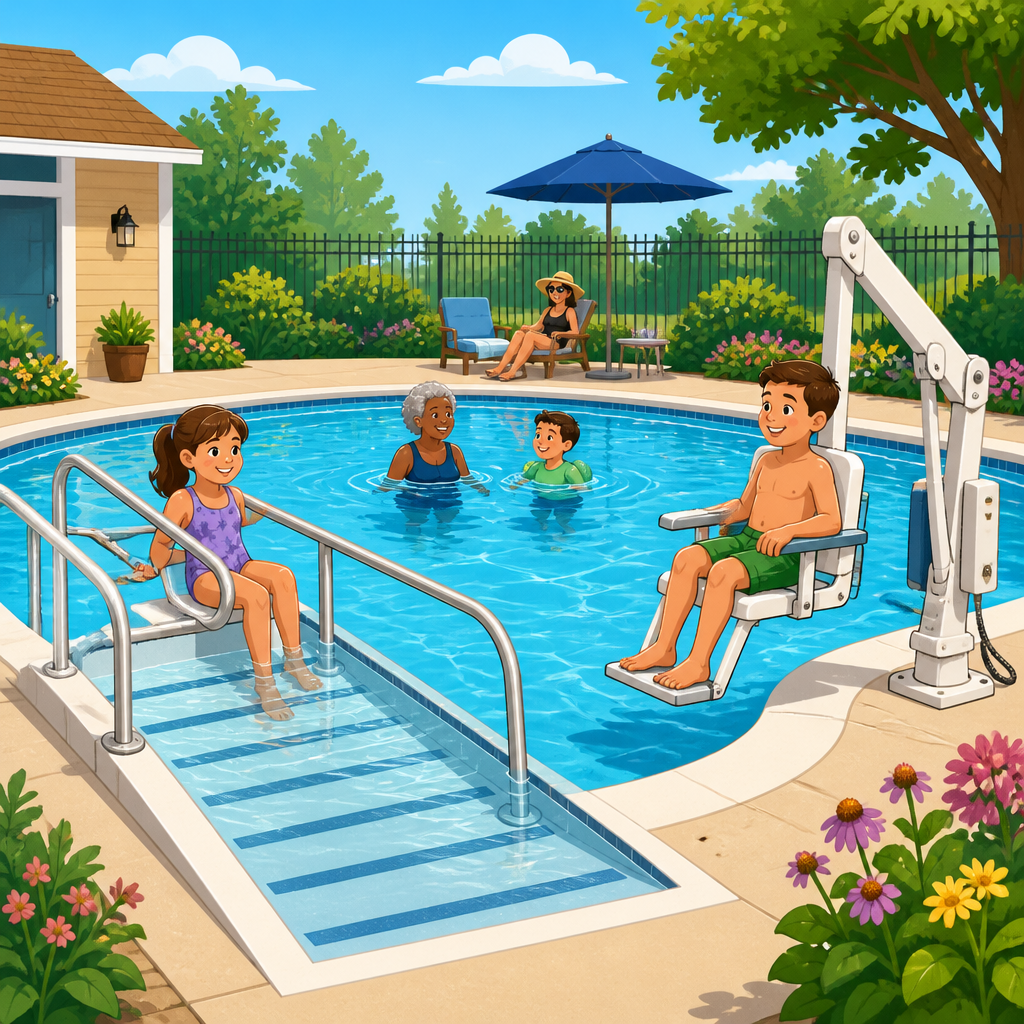
The ADA does not treat every convenient entry feature as compliant. Recognized accessible means of entry for swimming pools are specifically defined. A pool lift is a mechanical seat that lowers and raises a user into the water. A sloped entry is a ramp-like access point into the pool, often called a zero-depth entry, that complies with slope, width, handrail, and submersion requirements. A transfer wall is a wall at deck level designed to support lateral transfers. A transfer system uses transfer steps and grab bars. Accessible pool stairs are built stairs meeting the technical requirements in Section 1009. Wide amphitheater-style steps, sun shelves, tanning ledges, and movable portable stairs do not automatically qualify.
In real projects, pool lifts and sloped entries are the most dependable options because the standards explicitly place them first in the hierarchy. I recommend that teams treat them as the default unless there is a compelling design reason to use another method for the second entry. Lifts work well for many renovation sites because they can be added without reshaping the basin, but they are not maintenance-free. Batteries, anchor systems, clear deck space, seat height, submergence depth, and operating controls all matter. Sloped entries often provide the most intuitive user experience, especially at family resorts and therapeutic facilities, but they require space and precise integration with the deck and circulation route.
The phrase “accessible route” is also critical. An entry feature is not compliant if users cannot reach it from parking, locker rooms, restrooms, and other required points along an accessible route. I have seen technically compliant lifts placed behind planters, furniture, or storage bins, making them effectively unusable. Compliance is measured by use in the real environment, not by checking a catalog specification in isolation.
Pool types with different rules across recreation and sports facilities
Not every aquatic feature follows the same scoping rule as a standard swimming pool. Wading pools, for example, must provide a sloped entry. A lift alone does not satisfy the requirement for a wading pool. Spas must provide at least one accessible means of entry, which may be a lift, transfer wall, or transfer system depending on the design. Catch pools at water slides usually are not required to provide an accessible means of entry, but the route to the slide area and related program access still matter. Wave action pools, leisure rivers, and sand-bottom pools require case-specific evaluation because their geometry and use patterns can alter how the technical standards apply.
That is why this article functions as a hub for recreation and sports facilities. Aquatic accessibility is not one issue; it is a family of related compliance questions. A university natatorium may have a competition pool, a diving well, a therapy pool, and separate spas in one building. A hotel may have one main pool, one children’s splash area, and one elevated spa on a roof deck. Each element should be scoped separately before the design team decides how many accessible entries are needed.
Sports and recreation facilities also raise operational questions that do not appear in static code diagrams. Who deploys the lift each morning? Is the battery charged? Is the sloped entry blocked during event setup? Are lifeguard stations positioned so a user entering by lift remains visible? At public facilities, accessibility is as much about operations and policy as construction details. A compliant installation that is covered, disabled, or treated as “available on request only” can still create serious legal risk.
How to determine the correct number and type of entries
The most reliable review process is methodical. First, identify each distinct aquatic element: swimming pool, wading pool, spa, catch pool, therapy basin, or recreation river. Second, measure the pool wall perimeter for each swimming pool. Third, apply the scoping rule: fewer than 300 linear feet means one accessible means of entry; 300 linear feet or more means two. Fourth, confirm that at least one required entry is a lift or sloped entry. Fifth, verify the technical compliance of the chosen features and their connection to an accessible route.
| Facility element | Typical scoping rule | Common compliant options |
|---|---|---|
| Swimming pool under 300 linear feet | At least 1 accessible means of entry | Pool lift or sloped entry |
| Swimming pool 300 linear feet or more | At least 2 accessible means of entry | One must be lift or sloped entry; second may be lift, sloped entry, transfer wall, transfer system, or pool stairs |
| Wading pool | At least 1 accessible means of entry | Sloped entry |
| Spa | At least 1 accessible means of entry | Lift, transfer wall, or transfer system |
Consider a practical example. A community recreation center renovates a six-lane lap pool measuring 82 by 25 feet, perimeter 214 feet. The pool needs one accessible means of entry, and a fixed lift at the shallow end can satisfy the scoping requirement if all technical details are met. The same center adds a leisure pool measuring 90 by 60 feet with curved edges and a total perimeter above 300 feet. That larger pool needs two accessible means of entry, typically a sloped entry plus either a lift or accessible pool stairs. If the center also has a separate spa, the spa needs its own compliant entry independent of the two required for the leisure pool.
For renovations, teams should also document existing conditions. Older facilities often have edge profiles, gutter systems, or deck slopes that complicate lift installation. In those cases, a detailed survey, manufacturer cut sheets, and field verification prevent change orders. The most effective reviews combine ADA scoping, manufacturer requirements, state or local pool code, and operator input before design development is complete.
Technical and operational issues that cause compliance failures
Most pool accessibility failures are not misunderstandings of the 300-linear-foot rule. They are execution problems. I regularly see lifts installed without the required clear deck space, with seats that do not submerge to the required depth, or in locations where the water is too shallow for safe transfer. Sloped entries fail when handrails stop too early, cross slopes exceed limits, or the submerged edge is not extended far enough. Transfer walls and systems are often built with incorrect heights or grab bar locations. Accessible pool stairs fail when risers vary or handrails do not meet specifications.
Operations create a second layer of risk. The Department of Justice has made clear through guidance and enforcement that accessible features must generally be in place and ready to use. A lift stored in a back room, even if technically available, undermines independent access. Staff training is therefore part of compliance. Employees should know how to inspect the lift, charge batteries, deploy the seat, keep clear deck space open, and respond respectfully when assistance is requested.
Property owners also need to understand the tradeoff between portable and fixed equipment. Some portable lifts can be compliant if they meet technical standards and are available for independent use, but in practice they are easier to misplace, harder to charge consistently, and more likely to be removed during events. Fixed lifts tend to perform better operationally because they signal permanence and reduce daily setup errors. For high-use pools, fixed installations usually produce fewer accessibility complaints.
Another common issue is assuming state building approval ends the analysis. State and local codes may address pool safety, but ADA compliance is a separate civil rights obligation. A permit sign-off does not eliminate federal exposure. The safest approach is to evaluate both building code and accessibility standards together, especially during planning, major alteration, and reopening after renovation.
Best practices for recreation and sports facility planning
The best pool accessibility plans start early and treat aquatic access as a program requirement, not a late correction. During concept design, identify every aquatic element, map the accessible route, and reserve deck space for compliant entries. During design development, coordinate structural, mechanical, and electrical systems with the lift anchors or sloped entry geometry. During construction, inspect dimensions in the field rather than relying solely on shop drawings. Before opening, test every entry the way a user would actually experience it.
For operators managing broader recreation and sports facilities, create an inventory of all accessibility features across the site. That includes parking, routes, locker rooms, spectator seating, team areas, and pool entries. Link this page to more detailed guidance on spas, aquatic lifts, locker rooms, and sports venues so the entire accessibility program works as one system rather than isolated fixes. If you oversee multiple properties, standardized checklists and annual inspections will catch missing batteries, damaged handrails, and blocked routes before a complaint or incident occurs.
The core benefit of getting this right is simple: people can use the facility with dignity and independence. When a pool needs two accessible means of entry, the rule is not arbitrary. Large pools serve more users, support more activities, and need more than one practical way to enter the water. Start with the perimeter measurement, confirm the pool type, choose compliant entry methods, and verify technical details in the field. If you are planning, renovating, or auditing a recreation or sports facility, review each aquatic element now and document what is required before design decisions become expensive to reverse.
Frequently Asked Questions
When does a pool need two accessible means of entry?
A pool generally needs two accessible means of entry when it is a larger swimming pool covered by the ADA Standards for Accessible Design. For most swimming pools with 300 or more linear feet of pool wall, at least two accessible means of entry are required. One of those means must typically be either a pool lift or a sloped entry, and the second can be another lift, another sloped entry, a transfer wall, a transfer system, or pool stairs that meet the applicable technical standards. The reason this comes up so often is that accessibility rules do not treat aquatic access as a nice extra. They treat it as part of the required route into and use of the facility by people with disabilities. In practice, that means owners and designers have to look at the type of water feature, its size, and the available compliant entry options before deciding what is required.
It is also important to understand that the two-entry rule is not universal for every water feature. Wading pools, spas, and certain specialized aquatic recreation elements have their own standards. In addition, existing facilities may have obligations shaped by whether barrier removal is readily achievable or whether alterations are being performed. So while the phrase “two accessible means of entry” is commonly associated with larger pools, the correct answer always depends on the specific feature, whether the facility is new construction or altered, and which ADA provisions apply to that setting.
Does every pool need two accessible entries, or are there exceptions?
No, not every pool needs two accessible entries. The rules vary based on the pool’s size and type. In general, pools with less than 300 linear feet of pool wall are only required to provide one accessible means of entry, and that entry must usually be either a pool lift or a sloped entry. Larger pools, by contrast, generally need two. This distinction is one of the most important thresholds in aquatic accessibility compliance, because owners often assume all pools are treated the same, when they are not.
There are also feature-specific exceptions and alternate requirements. Wading pools typically require a sloped entry rather than a lift. Spas generally require at least one accessible means of entry, which may be a lift, transfer wall, or transfer system depending on the design. Catch pools, wave action pools, leisure rivers, and other aquatic recreation areas can trigger different standards depending on how the feature is used and whether it serves as the accessible route into the activity itself. Existing pools can add another layer of complexity, because the standard is not always whether full compliance is possible in the abstract, but whether modifications are readily achievable or part of a planned alteration. That is why a site-specific review is so important before concluding whether one entry, two entries, or a different accessible solution is required.
What types of accessible means of entry count toward the two-entry requirement?
The ADA recognizes several types of accessible means of entry for swimming pools, but not every option works in every situation. The most common compliant entries include a fixed pool lift, a sloped entry, a transfer wall, a transfer system, and accessible pool stairs. For larger pools that require two means of entry, one of the entries usually must be a pool lift or a sloped entry. That requirement matters because lifts and sloped entries provide a higher level of independent access for many users than some of the secondary options. The second required entry may then come from the broader list of recognized methods, assuming the technical specifications are satisfied.
What counts is not just the category of entry, but whether it meets the detailed dimensional and operational requirements. For example, a pool lift must be properly located, capable of independent operation from the deck and water levels, and provide the required seat and support features. A sloped entry must have compliant slope, width, landings, and handrails. Transfer walls and transfer systems must meet precise height, clear deck space, and transfer step criteria. Pool stairs must include required tread and handrail features. In other words, a feature does not count merely because it seems helpful or resembles an accessible design. It must comply technically and be usable as intended. That is why accessibility reviews often focus as much on specifications and placement as on the mere presence of an entry device.
How do existing pools differ from new pools when applying the two-entry rule?
This is one of the most misunderstood parts of pool accessibility compliance. New construction and altered pools are generally expected to comply with the applicable ADA Standards in full, including the required number and type of accessible means of entry. Existing pools that have not been altered are often evaluated under the barrier removal standard, which asks whether adding accessibility is readily achievable, meaning easily accomplishable and able to be carried out without much difficulty or expense. That analysis depends on the resources of the business, the nature of the facility, structural conditions, and other practical considerations.
For example, in an existing hotel pool, installing a fixed lift may be readily achievable and therefore required even if more extensive reconstruction is not. In another setting, adding a second means of entry might involve major structural changes that are not readily achievable at that time. But that does not mean the owner can ignore accessibility altogether. The obligation is ongoing, and businesses are expected to remove barriers when it becomes readily achievable to do so. If the pool is altered, the compliance obligations become more rigorous. Because of that, owners should be careful not to rely on broad assumptions such as “older pools are grandfathered” or “portable equipment is always enough.” Existing facilities do not get a blanket exemption, and the best compliance strategy usually comes from documenting the condition of the facility, evaluating feasible options, and applying the correct legal standard to that specific pool.
What are the most common compliance mistakes owners and designers make with accessible pool entry?
The most common mistake is assuming that buying a lift automatically solves the problem. It often does not. A lift has to be in a compliant location, connected to an accessible route, supported by the required clear deck space, and available for use when the pool is open. Another frequent error is misunderstanding the 300-linear-foot threshold and failing to determine whether the pool requires one accessible means of entry or two. Owners also commonly overlook the fact that one of the required entries for a larger pool generally must be a lift or sloped entry, not just any accessible feature.
Design teams also run into trouble by treating all aquatic features the same. A spa is not analyzed the same way as a swimming pool, and a wading pool has different entry requirements from a lap pool or resort-style recreation pool. Other recurring problems include selecting a portable lift without addressing storage, staffing, charging, or independent operability; installing sloped entries that do not meet dimensional standards; and assuming that aesthetic or space-planning preferences can override accessibility requirements. From an operations standpoint, a major issue is failing to keep accessible equipment usable and available. A compliant feature that is blocked, removed, uncharged, or difficult for guests to request can still create serious accessibility problems. The best way to avoid these mistakes is to evaluate compliance early, identify the correct feature classification, confirm the technical requirements in detail, and coordinate legal, design, and operational decisions before construction or renovation is complete.