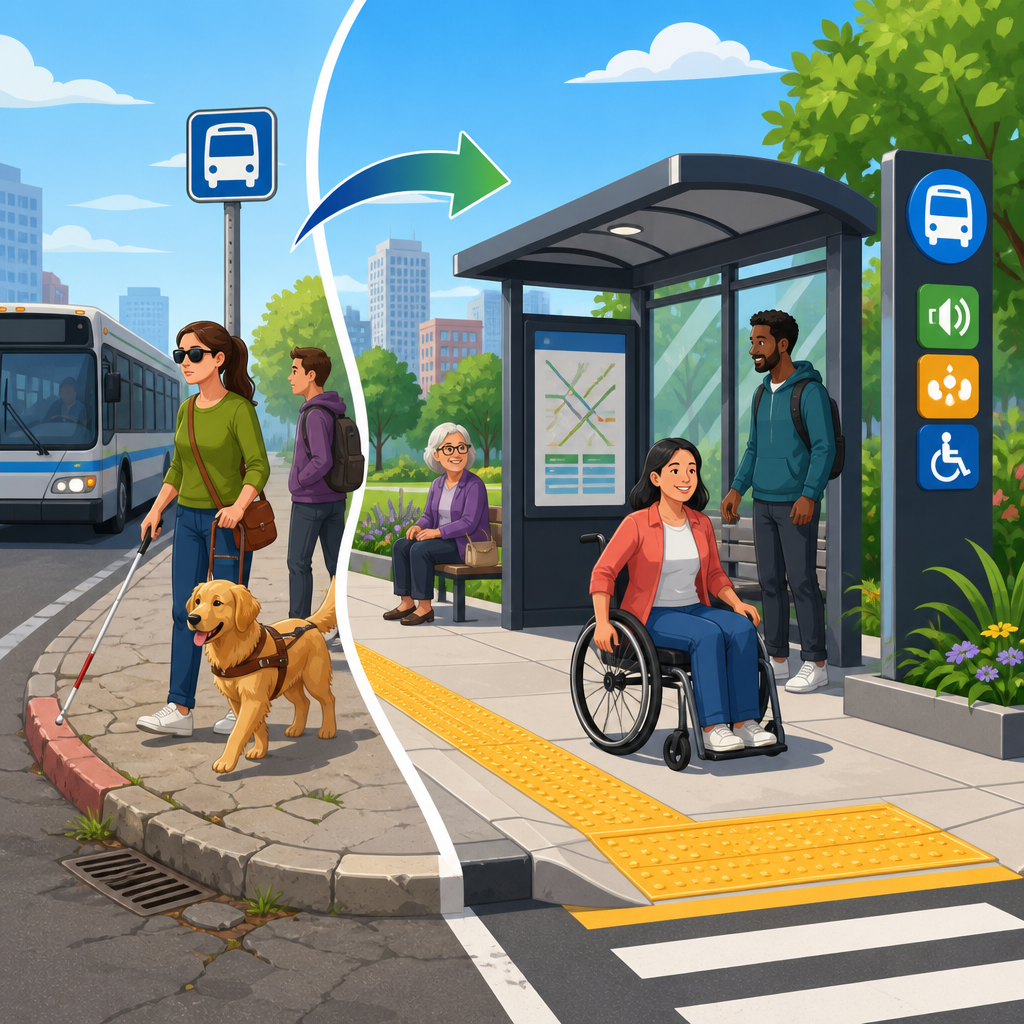
Public agencies, consultants, and accessibility coordinators have been waiting for clarity on the Public Rights-of-Way Accessibility Guidelines, and the latest PROWAG adoption update matters most at the curb line, where transit stops either connect riders safely or leave them negotiating avoidable barriers. PROWAG refers to federal accessibility guidelines for sidewalks, street crossings, on-street parking, pedestrian signals, and transit stop connections in the public right-of-way. For transit stops, the core question is straightforward: what changed, what is now expected in practice, and how should agencies respond under the broader umbrella of recent ADA updates and developments? The answer is important because bus and rail riders with disabilities experience the public right-of-way as a chain of linked decisions, not isolated design details. A compliant vehicle means little if the boarding area is too narrow, the pedestrian access route is broken, or detectable warnings are missing at the adjacent crossing. In my work reviewing stop inventories and capital programs, the biggest implementation gap has rarely been intent; it has been uncertainty about standards, prioritization, and documentation. This article serves as a hub for recent ADA updates and developments affecting transit stops, with a focus on what PROWAG adoption changes operationally, how it aligns with long-standing ADA obligations, and where agencies should concentrate design, maintenance, and funding decisions now.
What PROWAG adoption changes for transit stops
The most important change is that transit stop accessibility expectations are now easier to interpret and apply consistently across planning, design, construction, and maintenance. For years, agencies relied on a patchwork of ADA regulations, Department of Justice and Department of Transportation enforcement positions, ADA Standards references, accessibility case law, and agency design manuals. PROWAG gives the public right-of-way its own tailored framework. For transit stops, that means clearer dimensional and scoping expectations for the boarding and alighting area, the pedestrian access route connecting to the stop, surfaces, cross slope, running slope where applicable, and relationships to curb ramps, blended transitions, and street crossings. The practical effect is not that accessibility suddenly became optional before and mandatory now; ADA obligations already applied. What changed is the level of specificity agencies can use to make defensible decisions.
A transit stop is not just a sign on a pole. It is an accessible boarding location connected to an accessible path of travel. In plain terms, riders need a firm, stable surface where they can wait and board, enough clear space to deploy a ramp or use a lift, and a continuous route from the surrounding sidewalk and crossing network. The design standard also must account for real site constraints, including drainage, utilities, steep terrain, narrow right-of-way, retaining walls, and legacy curb geometry. PROWAG does not erase those constraints, but it provides a clearer baseline for evaluating equivalent facilitation, technical infeasibility, and alteration scope. That clarity helps transit agencies coordinate more effectively with city public works departments, state DOTs, and private developers who build or alter sidewalks and bus pads.
Another key shift is organizational. Agencies now have stronger justification for moving transit stop accessibility out of a reactive complaint-driven model and into asset management, capital planning, and preventive maintenance. A stop inventory can no longer stop at counting shelters and benches. It should document route connectivity, landing dimensions, surface condition, obstructions, drainage issues, and crossing access. The agencies making the fastest progress are tying stop accessibility data to pavement management systems, ADA transition plans, and five-year capital improvement programs. That is how a legal requirement becomes an operational program instead of a stack of unresolved exceptions.
Key technical elements agencies need to review now
Transit stops rise or fall on a few technical elements that repeatedly show up in field reviews. The first is the boarding and alighting area. It must support safe deployment from accessible vehicles and provide usable clear space for wheelchair users and other riders with mobility devices. Agencies should verify length, width, surface condition, and cross slope against current requirements and vehicle operating characteristics. In practice, this means checking whether a low-floor bus can consistently align with the curb, whether a front-door ramp lands fully within the pad, and whether street furniture reduces usable maneuvering room. A shelter placed without preserving clear boarding space can negate an otherwise compliant pad.
The second element is the pedestrian access route. This route must be continuous, stable, and unobstructed from the stop to the surrounding pedestrian network. Common failures include utility poles in the clear width, tree root uplift, heaving panels, drainage grates, driveway cross slopes, and missing sidewalk segments between the stop and the nearest crossing. I have seen agencies rebuild the stop pad but leave a forty-foot gap to the crosswalk, which still leaves riders stranded. Accessibility is judged by the whole trip segment, not by the concrete immediately under the bus door.
The third element is the interface with crossings. Transit riders frequently access stops by crossing the street, so curb ramps, blended transitions, detectable warning surfaces, median refuge areas, and pedestrian signal timing directly affect stop usability. Where a stop sits on the far side of a signalized intersection, the accessible route often depends on the quality of both corners and the crossing itself. Missing detectable warnings, skewed curb ramps that direct users into traffic, or inaccessible pedestrian pushbuttons can all undermine an upgraded stop. That is why transit stop programs should be coordinated with intersection modernization, not handled as isolated bus amenity projects.
The fourth element is maintenance. Snow storage, ponding, broken shelter pads, temporary signs, and overgrown vegetation can turn compliant designs into barriers. ADA compliance is not achieved once at ribbon cutting and preserved automatically. It requires inspection cycles, work orders, and defined responsibility between transit agencies and roadway owners. The best maintenance plans include response times for hazards, photo documentation, and a process for escalating recurring drainage or utility conflicts that need capital fixes.
How transit stop requirements connect to broader ADA updates and developments
PROWAG adoption is best understood as part of a larger shift toward systemwide accessibility accountability. Recent ADA updates and developments have pushed agencies to think beyond single facilities and toward complete, documented accessibility programs. That includes stronger transition planning, more rigorous self-evaluation, digital complaint tracking, and coordination across departments that historically operated in silos. For transit stops, the effect is significant because responsibility is often fragmented. A city may own the sidewalk and curb ramp, a transit agency may own the sign and shelter, a state DOT may control the arterial, and a utility may control poles affecting clear width. Current practice increasingly expects these entities to coordinate rather than point at one another.
Enforcement trends also matter. Federal agencies and private plaintiffs have continued to focus on inaccessible pedestrian infrastructure, maintenance failures, and the lack of meaningful transition plans. Courts and settlement agreements have repeatedly emphasized that accessible routes are required in the public right-of-way when facilities are newly constructed or altered, and that program access obligations remain in force even when full reconstruction has not yet occurred. For transit stops, this means agencies should not assume that limited right-of-way or funding scarcity excuses avoidable barriers. They need documented prioritization, a method for responding to requests, and evidence that accessibility is integrated into routine resurfacing, signal work, sidewalk repair, and stop relocation decisions.
There is also a stronger expectation that agencies use current standards proactively. The U.S. Access Board has long shaped technical guidance, while the Federal Highway Administration, Federal Transit Administration, and Department of Justice influence implementation through funding conditions, guidance, oversight, and enforcement. In practical terms, when agencies update standard drawings, procurement specifications, and design checklists to match adopted public right-of-way accessibility requirements, they reduce field confusion and construction change orders. Waiting for project-by-project interpretation is expensive and risky.
Common transit stop deficiencies and what fixes are most effective
Most inaccessible transit stops fall into a handful of recurring categories, and each has a predictable remedy path. The table below summarizes the issues I see most often during stop audits and the fix that usually produces the best result.
| Deficiency | Why it creates a barrier | Most effective fix |
|---|---|---|
| Undersized or broken boarding pad | Ramp or lift cannot deploy onto a usable surface | Reconstruct a full pad with compliant dimensions, slope, and joint treatment |
| Missing sidewalk connection | Rider reaches the stop but not an accessible route beyond it | Build or close the sidewalk gap to the nearest accessible crossing |
| Obstructions in clear width | Wheelchair users and pedestrians cannot pass safely | Relocate poles, signs, boxes, or redesign furniture layout |
| Poor drainage or ponding | Standing water blocks boarding area and accelerates surface failure | Adjust grades, inlet placement, and gutter design during reconstruction |
| Inaccessible adjacent curb ramps | Stop is reachable only through a noncompliant crossing approach | Bundle stop upgrades with corner ramp and crossing improvements |
These fixes are most successful when agencies resist the temptation to solve only the visible symptom. For example, replacing a shelter pad without addressing gutter flow usually recreates ponding after the next storm. Moving a bench but leaving a utility cabinet in the path still fails clear width. The durable approach is to treat each stop as part of a corridor and evaluate drainage, crossing access, stop operations, and maintenance responsibility together. That is especially important on high-ridership bus corridors where a small design flaw affects thousands of boardings each week.
Real-world examples show why this corridor approach works. A suburban stop on a state highway may need a new concrete pad, but the decisive improvement often comes from adding a short sidewalk segment to a signalized crossing and relocating a drainage inlet that forced the bus to stop away from the curb. In a dense downtown, the issue may not be missing infrastructure but clutter: cafe barriers, newspaper boxes, and improperly placed signs shrinking the route below usable width. In a rural edge condition, the right answer may be stop consolidation combined with a fully accessible pair of upgraded stops at a safer crossing location. Accessibility and operations are not competing goals when the stop network is planned intelligently.
What transit agencies, cities, and consultants should do next
The first step is to update standards and checklists. If design staff, on-call consultants, and contractors are still using inconsistent details, agencies will continue to build avoidable defects into every resurfacing and shelter project. Standard drawings should cover boarding areas, curb ramps, sidewalk transitions, detectable warning placement, shelter layouts, and utility clearances. Specifications should require field verification of slopes and dimensions before sign-off. Construction inspection forms should include accessibility hold points, not treat them as optional punch-list items.
The second step is to build a defensible stop inventory. Good inventories go beyond simple amenity counts and use condition ratings, photos, geospatial IDs, and route connectivity fields. They classify deficiencies by severity and by project type, such as maintenance, minor concrete work, utility coordination, or full capital reconstruction. That allows agencies to package quick wins while programming larger corridor projects. Tools such as ArcGIS Field Maps, Cartegraph, Cityworks, and asset modules inside enterprise transit platforms can support this workflow if the data model is designed carefully. The inventory should also connect to paratransit patterns, rider complaints, and ridership so prioritization reflects both need and impact.
The third step is to align accessibility work with funding cycles. Transit stop improvements are often inexpensive relative to roadway reconstruction, but they still compete for limited capital. Agencies that make progress typically braid funding from local sidewalk programs, FTA formula funds, Complete Streets initiatives, state safety grants, and development conditions. The crucial move is to embed stop accessibility triggers into every adjacent project. If a corridor is being resurfaced, restriped, signalized, or redeveloped, the accessible route to each stop should be part of the scope from day one. Retrofits are always harder once the curb line is poured.
The fourth step is to formalize maintenance ownership. Many stop barriers persist because no one knows who clears snow from the pad, trims vegetation behind the shelter, or repairs settlement at the sidewalk joint. Interagency memoranda, permit conditions, and shelter contracts should assign these tasks clearly. Response standards should distinguish urgent hazards from routine upkeep. Riders notice the difference immediately when agencies treat accessibility as a service reliability issue rather than a legal afterthought.
Why this hub matters for future ADA compliance work
The PROWAG adoption update is not just a technical footnote for designers. It changes how transit stops should be assessed, funded, documented, and maintained across the public right-of-way. The central lesson is simple: a transit stop is accessible only when the boarding area, pedestrian access route, and street crossing work together as one connected system. Agencies that act on this now can reduce legal exposure, improve rider independence, and make every capital dollar work harder by fixing root causes instead of isolated defects. As recent ADA updates and developments continue to reshape expectations, this hub should guide your next steps: review your standards, inventory your stops, coordinate across departments, and tie accessibility upgrades to every corridor project. Then move from compliance uncertainty to a repeatable program that delivers safer, more usable transit access for everyone.
Frequently Asked Questions
What is the latest PROWAG adoption update, and why does it matter specifically for transit stops?
The latest PROWAG adoption update is important because it gives public agencies, transit providers, designers, and accessibility coordinators clearer direction on how accessibility expectations in the public right-of-way should be applied. PROWAG, or the Public Rights-of-Way Accessibility Guidelines, addresses the spaces people use to move through communities: sidewalks, curb ramps, street crossings, pedestrian signals, on-street parking, and the pedestrian connections that serve transit stops. For transit stops, that clarity matters at the exact point where accessibility often succeeds or fails: the curb line and the path leading to the boarding area.
In practical terms, the update matters because a transit stop is not just a sign in the ground. It is part of a connected pedestrian system. Riders need a stable, usable route from the sidewalk or crossing to the stop, and they need a place to wait and board without being forced into grass, broken pavement, drainage depressions, steep cross slopes, or utility conflicts. The PROWAG adoption update reinforces the idea that transit stop accessibility must be evaluated as part of the public right-of-way, not treated as an isolated feature.
For agencies and consultants, this means planning, scoping, and capital programming decisions should place more emphasis on the stop’s connection to the surrounding pedestrian network. For riders, especially those using wheelchairs, walkers, canes, strollers, or traveling with limited vision, the effect is more immediate: safer, more predictable, and more usable access to transit. That is why the update is getting so much attention. It helps shift the conversation from “Do we have a bus stop installed?” to “Can people actually reach and use it independently?”
What changed for transit stops under the PROWAG adoption update?
The biggest change is not that transit stops suddenly became subject to an entirely new concept of accessibility, but that agencies now have firmer, more usable guidance on what accessible stop connections should look like in the public right-of-way. The update sharpens attention on the pedestrian access route serving the stop, the boarding and alighting area, and the relationship between the stop and adjacent features such as curb ramps, sidewalks, crosswalks, and street furniture. In other words, transit stop accessibility is now framed more clearly as a network issue, not simply a pad-at-the-pole issue.
That matters because many older or constrained stops were historically installed in locations where riders had no continuous accessible route to the stop, no level waiting area, or no practical way to board without traversing obstacles. The updated framework puts more focus on eliminating those conditions wherever construction, alteration, or streetscape work occurs. Agencies should expect closer review of whether stops are connected by an accessible route, whether the boarding area is appropriately placed and usable, and whether the stop environment includes barriers such as narrow clear widths, excessive slopes, vertical changes in level, drainage conflicts, or obstructions from signs, cabinets, poles, or landscaping.
Another meaningful shift is that transit stops are increasingly being evaluated in context with adjacent curb-space design. If a stop is next to on-street parking, bike facilities, driveways, curb extensions, or drainage inlets, those features cannot be allowed to compromise the rider’s ability to access the stop. The update encourages better interdisciplinary coordination among roadway engineers, ADA coordinators, transit planners, and construction teams. For many agencies, that will change the workflow as much as the design details themselves.
How should public agencies evaluate whether an existing transit stop is compliant or needs upgrades?
Public agencies should start by looking at the full rider experience, not just whether a bus stop sign exists or whether a concrete pad was poured at some point in the past. A sound evaluation begins with the pedestrian access route leading to the stop. Is there a continuous, stable, and usable path from the surrounding sidewalk network or crossing point? Can a rider using a mobility device reach the stop without traveling through dirt, grass, gravel, gutter flow lines, or uneven pavement? If the answer is no, the stop likely needs attention even before the agency gets to boarding details.
Next, agencies should assess the boarding and waiting area itself. Is there adequate space for riders to position themselves safely and predictably? Is the surface firm, stable, and free from abrupt level changes? Are slopes and cross slopes reasonable for waiting and maneuvering? Are shelters, benches, trash receptacles, poles, and other site furnishings placed so they support rider use rather than reduce maneuvering space? A stop can appear upgraded at first glance but still function poorly if furnishings create pinch points or force wheelchair users into the pedestrian through-zone.
Agencies should also review each stop’s relationship to the curb and roadway edge. For example, a stop may be located where the bus cannot align well for boarding, where drainage creates ponding, or where driveway grades distort the waiting area. Crossings matter too. If riders commonly approach from the opposite side of the street but the crossing is inaccessible or missing curb ramps, the stop’s practical accessibility is weakened. Documenting these issues through field audits, photos, measurements, and rider feedback is essential.
Finally, agencies should sort findings into categories such as maintenance fixes, near-term upgrades, full alteration triggers, and long-range capital improvements. Some barriers can be corrected quickly, such as cracked pavement or misplaced street furniture. Others require more substantial reconstruction or corridor redesign. The key is to apply a consistent evaluation method, coordinate across departments, and prioritize stops based on risk, ridership, transfer importance, and the severity of accessibility barriers.
What are the most common accessibility barriers found at transit stops in the public right-of-way?
The most common barriers are usually basic but consequential. One of the biggest is the absence of a continuous accessible route to the stop. Riders may have to leave the sidewalk and travel across turf, mud, gravel shoulders, or broken pavement just to reach the boarding area. Another frequent problem is insufficient space at the stop itself. Poles, sign posts, utility boxes, shelters, benches, newspaper boxes, or vegetation can narrow the clear space and make it difficult or impossible for a wheelchair user to wait or maneuver safely.
Slope-related issues are also common. Transit stops are often placed where roadway geometry, drainage grading, or driveway transitions create steep cross slopes or warped surfaces. Even when a stop technically exists, an excessively sloped or uneven waiting area can make it hard for a rider to remain stable or position for boarding. Vertical changes in level, heaving panels, cracked asphalt, and ponding water create similar problems. These are not cosmetic defects; they directly affect usability and safety.
Another recurring barrier involves disconnected crossings. A stop may be physically present, but if nearby curb ramps are missing, misaligned, or inaccessible, riders approaching from an intersection cannot use the stop independently. This issue is especially important at transfer locations, near schools, medical centers, civic buildings, and senior housing. On some corridors, the stop is also compromised by conflicts with on-street parking, bike lanes, or curbside loading activity that interrupt access to the bus door zone.
There are also operational barriers that become design barriers over time. If a bus cannot pull to the curb because of utility poles, parked vehicles, or poor stop placement, the gap between the vehicle and boarding area may become less predictable. If a shelter is installed without preserving maneuvering clearances, the amenity can unintentionally reduce accessibility rather than improve it. These are exactly the types of field conditions the PROWAG adoption update puts into sharper focus, because they show that accessibility depends on how all right-of-way elements work together.
What should agencies, consultants, and accessibility coordinators do now in response to the PROWAG adoption update?
The most effective next step is to treat the update as an implementation signal, not just a regulatory headline. Agencies should review current design standards, standard drawings, stop placement criteria, and ADA transition planning documents to make sure transit stop requirements are addressed clearly and consistently. If current details focus mainly on curb ramps and sidewalks but say little about stop connections, boarding areas, or curbside coordination, those documents likely need revision. Internal standards should help project teams make compliant choices early, before inaccessible conditions are designed into resurfacing, utility, or corridor projects.
Consultants should update their field review checklists and quality-control processes so transit stops are examined as part of every roadway, streetscape, and active transportation assignment. Accessibility coordinators should be brought into scoping and concept development, not just asked to review plans at the end. This is especially important for projects involving sidewalk reconstruction, drainage improvements, signal work, curb extensions, parking reconfiguration, or multimodal corridor redesign, because each of those project types can affect stop access directly.
Agencies should also identify high-priority stop locations for targeted assessment. Good candidates include high-ridership stops, transfer points, stops near healthcare and civic destinations, school-area stops, and locations with documented ADA complaints or known barriers. From there, agencies can build phased improvement programs that combine maintenance fixes, mid-term upgrades, and full capital reconstruction where needed. The goal is not only compliance, but also a more durable and equitable transit access strategy.
Just as important, teams should improve documentation. Keeping records of field conditions, design decisions, constraints, alternatives considered, and completed upgrades helps demonstrate a


