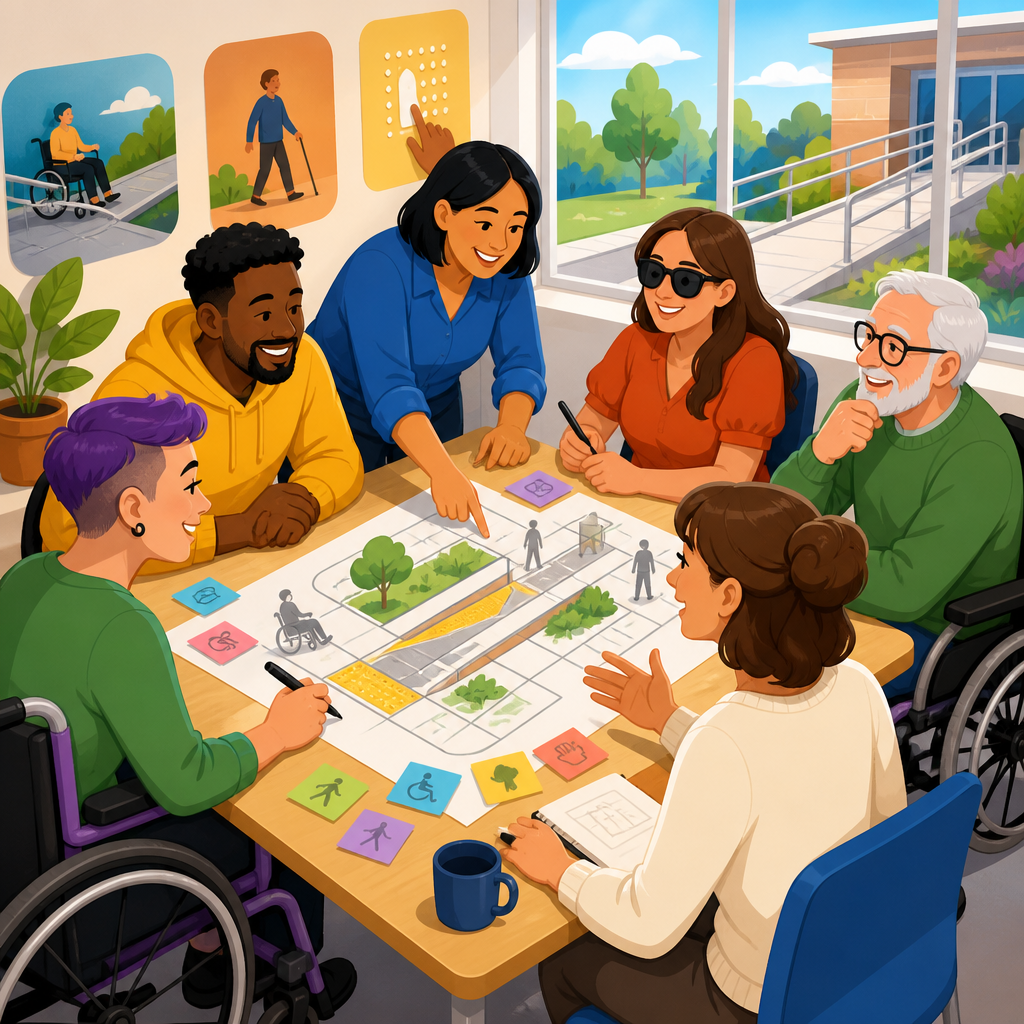
Why co-design improves ADA outcomes becomes obvious the moment disabled people move from being consulted at the end of a project to shaping decisions from the start. In ADA work, co-design means planning spaces, services, policies, and digital experiences with disabled participants as active partners, not passive reviewers. Community engagement is the broader practice of involving the people affected by a decision, while advanced ADA support refers to the specialized methods, audits, remediation planning, training, and governance needed to meet legal duties and deliver usable access in real settings. I have seen projects clear technical compliance reviews yet still fail wheelchair users, Deaf visitors, neurodivergent employees, or screen reader users because the team relied on assumptions instead of lived experience. That gap matters because the Americans with Disabilities Act sets a legal baseline, but outcomes are measured in whether people can enter, navigate, communicate, participate, and return without friction. For organizations building a strong Resources and Support program, this hub topic connects community engagement with advanced ADA support across facilities, events, housing, transportation, public programs, higher education, healthcare, employment, and websites. Done well, co-design reduces avoidable retrofits, strengthens trust, improves procurement choices, and produces access that works under everyday conditions, not just in policy documents.
What Co-Design Means in ADA Practice
Co-design is a structured collaboration model in which disabled residents, employees, students, patients, customers, or advocates help define the problem, test options, and evaluate results. It is not a listening session held after key decisions are made. In ADA practice, the strongest co-design process begins before scope is locked, budget lines are finalized, or architects, developers, and vendors make assumptions about user needs. On building projects, that can include route mapping with wheelchair users, mock-up reviews with people who have low vision, and acoustic testing with Deaf and hard of hearing participants. On digital projects, it can include task testing with screen reader users, keyboard-only navigation reviews, caption quality checks, plain language feedback, and analysis of cognitive load. The practical value is simple: disabled participants reveal barriers that standards alone do not fully predict, including heavy doors, confusing wayfinding, inaccessible queuing, sensory overload, unusable kiosks, and online forms that technically validate but still break assistive technology workflows.
The ADA provides a legal framework, but compliance work often intersects with other standards and guidance. Teams commonly reference the 2010 ADA Standards for Accessible Design, Section 504 obligations for federally funded entities, Fair Housing Act requirements in housing contexts, and the Web Content Accessibility Guidelines for websites, mobile apps, and documents. Co-design improves outcomes because these standards answer many minimum questions, while community engagement exposes situational realities. For example, a ramp can meet slope requirements and still create a poor arrival experience if it routes wheelchair users to a service entrance. A video can include captions yet remain ineffective if speaker identification and sound cues are omitted. A quiet room can exist on paper and still fail if signage is unclear, booking rules are restrictive, or staff do not know how to support users. Co-design turns legal interpretation into operational accessibility.
Why Community Engagement Produces Better ADA Results
Community engagement and advanced ADA support belong together because accessibility failures usually come from process gaps, not just missing technical details. When organizations engage disabled stakeholders early, they learn which barriers most affect participation, what tradeoffs are acceptable, and where resources create the biggest benefit. In my work, the clearest pattern is that community-informed projects solve for complete journeys rather than isolated checkpoints. A clinic improves not only the exam room, but also parking, drop-off, reception, online intake, interpreter scheduling, after-visit summaries, and follow-up calls. A university addresses not only classroom seating, but also housing requests, emergency alerts, lab access, event registration, field placements, and caption turnaround times. This systems view is what advanced ADA support is meant to provide.
Better engagement also lowers organizational risk. Complaints, demand letters, and reputational damage often arise when people feel ignored, forced to repeat the same issue, or offered a workaround that signals second-class treatment. Co-design builds a record of good-faith participation and improves decision quality before conflict escalates. It also sharpens purchasing and governance. If procurement teams hear directly from users, they write stronger accessibility requirements into RFPs, ask for VPATs with meaningful follow-up questions, require remediation timelines, and avoid buying inaccessible software, furniture, kiosks, or communication tools. The result is not perfection. It is a more reliable process for identifying barriers early, correcting them efficiently, and sustaining access over time.
How Co-Design Works Across Facilities, Programs, and Digital Services
Different settings require different engagement methods, but the principles stay consistent: recruit the right participants, define the decision clearly, compensate people for their time, test real tasks, and close the feedback loop. In facilities planning, teams can conduct access walks that follow actual user routes from transit stop or parking space to entrance, reception, restrooms, service counters, meeting rooms, and exits. That reveals issues like cross slopes, door pressure, reach ranges, line-of-sight barriers, and poor contrast on signs. In program design, organizations can map user journeys for enrollment, event attendance, service delivery, and complaint resolution. In digital accessibility, usability testing should include assistive technology combinations such as JAWS with Chrome, NVDA with Firefox, VoiceOver on iPhone, keyboard-only operation, magnification, speech input, and caption review for multimedia. Automated scanners like axe, WAVE, and Lighthouse are useful, but they do not replace human testing because they catch only a fraction of barriers.
Advanced ADA support adds the structure many organizations lack. It includes governance, role clarity, remediation tracking, training, and metrics tied to outcomes. For example, a city may create an ADA steering committee with facilities, procurement, legal, IT, human resources, transit, and communications represented, plus ongoing resident input. A health system may establish standards for accessible PDFs, interpreter workflows, patient portal testing, and equipment purchasing. A housing provider may combine reasonable accommodation procedures with common area audits and maintenance protocols so that access does not degrade after renovation. In each case, co-design informs priorities, while support systems turn priorities into repeatable practice.
Where Co-Design Has the Greatest Impact
Some areas benefit from co-design more than others because user experience is highly contextual. Wayfinding is one example. An architect can specify compliant signage, but only users can show whether the route is intuitive under stress, in low light, during crowding, or when elevators are out of service. Communication access is another. Policies may promise interpreters, captions, and alternative formats, yet actual success depends on booking lead times, front-line staff knowledge, microphone use, platform settings, and backup plans. Emergency planning is especially important. People with mobility, sensory, cognitive, or mental health disabilities often face the highest risk when alarms are confusing, refuge areas are not understood, or evacuation chairs exist without trained operators. Co-design surfaces these failure points before an incident exposes them.
| Area | Common compliance-only approach | Co-design improvement | Practical outcome |
|---|---|---|---|
| Building entrances | Measure slope and clear width | Test arrival routes in rain, crowding, and with mobility devices | Safer, dignified entry for all users |
| Web forms | Run automated accessibility scan | Observe screen reader and keyboard users complete real tasks | Fewer abandoned applications and support calls |
| Public meetings | Offer accommodations on request | Plan captions, interpreters, accessible materials, and hybrid participation by default | Higher attendance and more representative input |
| Housing services | Respond case by case to requests | Map tenant journey from inquiry through maintenance and renewal | Faster resolutions and fewer recurring barriers |
| Emergency procedures | Post general evacuation rules | Run drills with disabled participants and revise roles, routes, and alerts | More realistic life safety readiness |
Building an Effective Community Engagement Process
Strong community engagement is designed, not improvised. Start by identifying which disability groups are affected and whether the decision involves mobility, vision, hearing, speech, cognitive, sensory, mental health, or chronic condition access needs. Then recruit beyond the most visible advocates. Include people who use different assistive technologies, people with intersecting identities, and participants who interact with the service at different stages. Compensation matters because lived expertise is professional input, not free labor. Accessibility for the engagement itself matters just as much: provide plain language agendas, captioning, interpreters, accessible documents, transportation information, remote participation options, fragrance awareness, and enough time for processing and response. If the meeting format excludes people, the project has already learned the wrong lesson.
Next, ask the right questions. Instead of “Is this accessible?” ask “What task were you trying to complete, where did friction occur, and what would have made it work?” Task-based questions produce more actionable findings than general opinions. Document decisions transparently. If the team accepts a recommendation, assign an owner, budget, and deadline. If it rejects a recommendation, explain why and note the alternative mitigation. This transparency builds trust even when constraints are real. Finally, report back. Too many organizations collect stories and never show how input changed outcomes. A simple summary of what was heard, what will change now, what requires future funding, and what remains under review turns engagement into accountability.
Common Mistakes That Undermine ADA Outcomes
The first mistake is tokenism: inviting one disabled person to approve decisions already made. No single participant can represent all disabilities, and late-stage review limits what can be changed. The second mistake is treating accessibility as a checklist instead of an experience. A space can satisfy dimensions and still isolate users socially. A website can pass many success criteria and still contain confusing error messages, poor heading structure, or inaccessible third-party widgets. The third mistake is failing to integrate disability input into procurement, maintenance, and operations. Many access barriers appear after launch because software updates introduce regressions, furniture blocks clearances, caption workflows break, or staff turnover erodes knowledge.
Another common problem is assuming legal minimums equal best practice in every context. Standards are essential, but they are not design strategy. High-impact environments such as hospitals, campuses, transit systems, and civic centers often need more than minimum compliance because users are stressed, unfamiliar with the space, or completing complex tasks. Finally, organizations often underinvest in feedback channels. If people cannot easily report a barrier, or if reports disappear into a generic inbox, the same failure repeats. Effective advanced ADA support includes a visible reporting path, triage rules, escalation for urgent issues, and recurring review of patterns. That is how organizations move from reactive fixes to continuous improvement.
How This Hub Supports Resources and Support Planning
As a sub-pillar hub under Resources and Support, community engagement and advanced ADA support should connect readers to the full accessibility lifecycle. The key takeaway is that co-design improves ADA outcomes because it aligns legal compliance with real use, strengthens trust, and helps organizations invest where barriers actually occur. Facilities teams need guidance on audits, capital planning, and maintenance. Program managers need playbooks for inclusive events, meetings, and service delivery. Digital teams need testing methods, document remediation standards, and vendor management. Human resources, housing, education, healthcare, and public sector leaders need consistent procedures for accommodations, communication access, training, and complaint response. Every one of those topics works better when disabled people help shape the solution from the beginning.
If you are building or refreshing an accessibility program, start with one concrete step: create a repeatable co-design process tied to your highest-impact services. Identify priority journeys, recruit diverse participants, test real tasks, track remediation, and publish what changes. That approach will improve ADA outcomes faster than isolated audits alone, and it will create a stronger foundation for every related article in this hub. Use this page as your starting point for deeper work on accessible facilities, digital accessibility, communication access, inclusive events, procurement, policy design, training, and long-term governance. The goal is not simply to avoid violations. The goal is to deliver access people can trust, use, and recommend.
Frequently Asked Questions
What does co-design mean in the context of ADA work?
In ADA work, co-design means disabled people help shape decisions from the beginning instead of being asked for feedback after major choices have already been made. That distinction matters. Traditional accessibility processes often rely on late-stage review, where a plan, website, policy, or physical environment is mostly complete before disabled users are invited to comment. Co-design changes that model by making disabled participants active partners in defining goals, identifying barriers, testing options, and refining solutions throughout the project.
This approach can apply to physical spaces, digital platforms, customer service processes, public programs, workplace policies, transportation systems, and more. For example, a team designing a new online application form might include screen reader users, people with cognitive disabilities, and people who use voice input at the planning stage, not just in final testing. Their input can influence structure, language, navigation, timing requirements, and error recovery before expensive development decisions are locked in.
Co-design is also broader than simply “asking for opinions.” It requires shared decision-making, intentional facilitation, accessible participation methods, and respect for lived experience as a form of expertise. In strong ADA practice, community engagement brings affected people into the conversation, while co-design gives them real influence over outcomes. Advanced ADA support then adds the technical side, such as audits, remediation strategies, compliance interpretation, usability testing, and implementation planning. Together, these elements create solutions that are not only more compliant, but more usable, equitable, and durable.
Why does co-design usually lead to better ADA outcomes than late-stage accessibility review?
Co-design improves ADA outcomes because it catches barriers when they are easiest to prevent, not after they have already been built into a project. When accessibility is treated as a final checkpoint, teams often discover avoidable problems in layout, workflows, procurement choices, policy assumptions, or service delivery models. Fixing those issues late can be expensive, time-consuming, and incomplete. By contrast, when disabled people are involved early, they help teams make smarter foundational decisions that reduce the likelihood of exclusion from the start.
It also produces better quality solutions because lived experience reveals problems that technical checklists alone may miss. A design may appear compliant on paper yet still be frustrating, confusing, or unusable in practice. For instance, a website might technically include alternative text and keyboard access but still create a burdensome experience through poor heading structure, unclear instructions, or inaccessible document workflows. A building may meet minimum code requirements yet still pose wayfinding, sensory, or service-access challenges. Co-design surfaces these real-world issues earlier and more clearly.
Another reason co-design works is that it shifts accessibility from a narrow compliance task to a broader performance and inclusion strategy. Teams begin asking better questions: Who might be excluded by this process? What assumptions are built into this service? How will someone with different access needs complete this task independently? That mindset tends to improve outcomes across the board. It strengthens legal risk management, supports usability, builds community trust, and often leads to solutions that are more flexible for everyone, including older adults, people with temporary injuries, and users in challenging environments.
How is co-design different from general community engagement?
Community engagement and co-design are closely related, but they are not the same thing. Community engagement is the broader practice of involving people affected by a decision. It may include surveys, public meetings, listening sessions, advisory groups, interviews, workshops, comment periods, or user testing. Its goal is to gather input, understand priorities, and build communication between organizations and the communities they serve.
Co-design goes further by giving community participants a more active role in shaping the solution itself. Instead of only reacting to proposals, participants help define the problem, generate ideas, weigh tradeoffs, and influence final decisions. In ADA projects, that means disabled people are not limited to validating someone else’s work. They contribute directly to the design of environments, policies, tools, and services. The difference is not just about timing, although early involvement is important. It is about power, structure, and decision-making.
In practice, the strongest accessibility initiatives use both. Community engagement helps organizations hear from a wide range of stakeholders and identify broad patterns of need. Co-design then brings representative disabled participants into a deeper working process where their experience informs actual design choices. Advanced ADA support complements both by adding technical expertise, standards interpretation, audits, remediation roadmaps, and quality assurance. When these pieces are combined well, organizations avoid tokenism and move toward accessibility efforts that are informed, credible, and genuinely effective.
What role does advanced ADA support play in a co-design process?
Advanced ADA support provides the specialized structure needed to turn community insight into practical, compliant, and sustainable results. While co-design brings essential lived experience to the table, many ADA projects also require technical knowledge of accessibility standards, legal obligations, remediation methods, documentation practices, procurement requirements, and implementation strategies. Advanced support helps organizations connect those technical demands with the human realities identified through co-design.
For example, a co-design group may identify that a digital service is difficult to navigate, that a policy relies too heavily on phone communication, or that a facility creates barriers for people with mobility, sensory, or cognitive disabilities. Advanced ADA support helps translate those observations into action. That may include digital accessibility audits, content remediation plans, barrier removal priorities, communication access protocols, staff training, accommodation frameworks, accessible design specifications, and phased implementation plans. It can also help teams distinguish between minimum compliance and best-practice usability, which is critical for long-term success.
Just as important, advanced ADA support can improve process quality. It helps organizations build accessible meeting formats, compensation practices for participants, inclusive research methods, and stronger governance for decision-making. In other words, it supports not just accessible outcomes, but accessible participation. When technical experts and disabled participants work together from the start, organizations are far more likely to produce solutions that are legally sound, operationally realistic, and genuinely useful to the people they are meant to serve.
How can an organization start using co-design to improve accessibility and ADA compliance?
The best place to start is by changing when and how disabled people are involved. Instead of waiting until a project is nearly finished, organizations should include disabled participants during planning, discovery, and concept development. That means budgeting for participation, recruiting a diverse group of contributors, providing accessible materials and meeting formats, and compensating people for their time and expertise. If participation is not accessible, the process will not produce strong accessibility outcomes.
Organizations should also define clear roles for co-design participants. Ask them to help identify barriers, set priorities, review prototypes, test workflows, and evaluate whether proposed solutions will work in real life. Build multiple feedback loops rather than relying on a single consultation event. Accessibility needs vary widely, so it is important to include people with different disabilities, communication preferences, and lived experiences. A narrow participant group can lead to partial solutions that unintentionally exclude others.
Finally, pair co-design with strong internal leadership and advanced ADA support. Teams need decision-makers who are willing to act on what they learn, not simply collect feedback. They also need technical expertise to conduct audits, interpret standards, plan remediation, and measure results over time. Co-design is most effective when it becomes part of an ongoing accessibility strategy rather than a one-time exercise. Organizations that do this well typically see better compliance outcomes, fewer costly retrofits, stronger public trust, and services that work more effectively for everyone.


