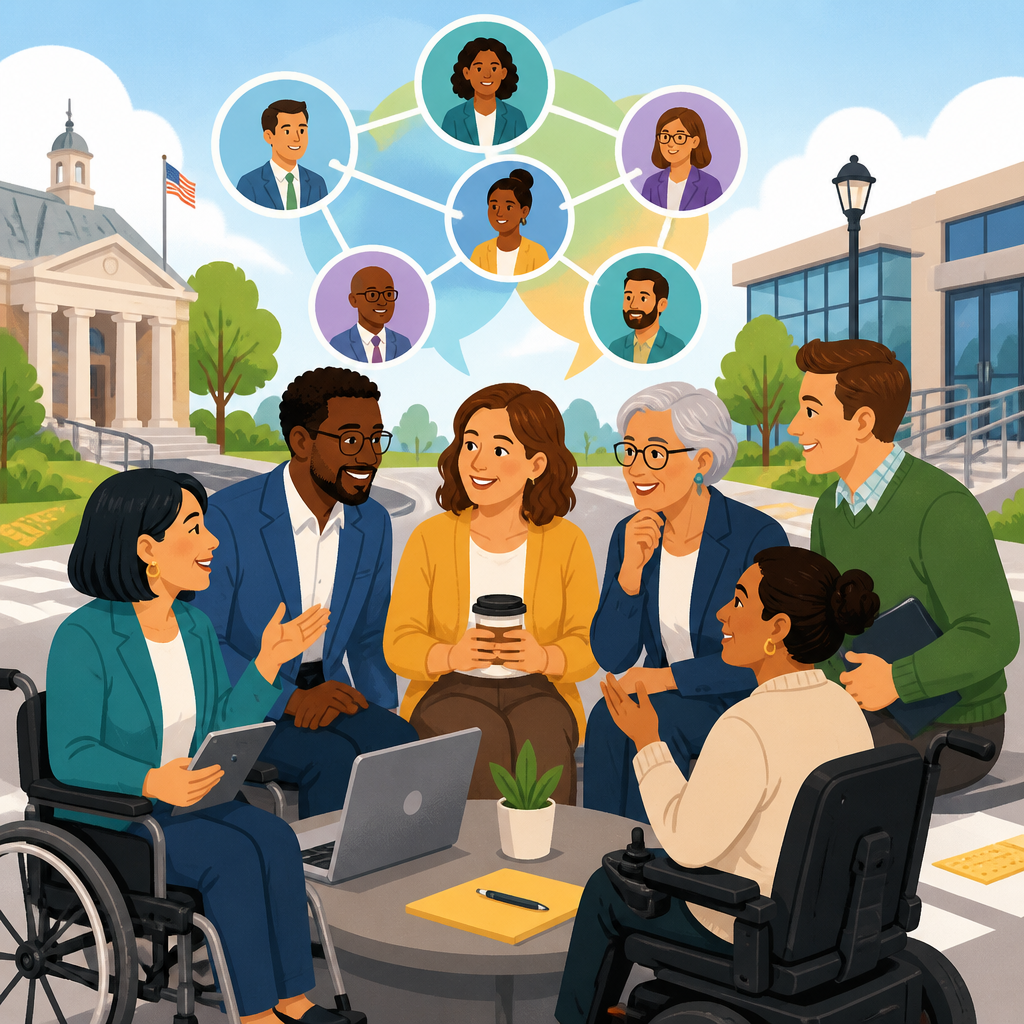
Peer networks for ADA coordinators and public officials are one of the most practical ways to improve compliance, solve recurring accessibility problems, and strengthen public trust across agencies. In this context, a peer network is a structured community of professionals who share policies, review difficult cases, compare procedures, and exchange lessons from real implementation. For ADA coordinators, city managers, HR leaders, transit officials, parks directors, court administrators, school administrators, and procurement staff, these networks convert isolated responsibility into collective capacity. I have seen coordinators make faster and better decisions when they can call a counterpart in another jurisdiction, compare a policy against recognized standards, and test an accommodation approach before a complaint escalates. That matters because ADA administration is rarely simple. It involves Title I employment obligations, Title II program access, effective communication, web accessibility, reasonable modification analysis, grievance procedures, service animal rules, transportation questions, capital planning, and vendor oversight. Public officials often inherit fragmented systems, inconsistent records, and legacy facilities that were never evaluated comprehensively. A well-run peer network helps them move from reactive problem solving to repeatable practice. It also supports continuity when staff change, budgets tighten, or high-visibility complaints attract scrutiny. As a hub within resources and support, advanced ADA support and networking centers on the people, processes, and partnerships that make compliance sustainable rather than episodic.
Strong ADA peer networks matter because public entities face similar legal duties but very different operating environments. A county courthouse, a school district, a transit agency, and a parks department all answer the same core question: how will residents with disabilities obtain equal access in practice, not just on paper? The answer depends on trained staff, current policies, documented decisions, and relationships with people who have already handled comparable issues. When officials share transition plan templates, digital accessibility procurement clauses, captioning workflows, evacuation procedures, and complaint-tracking methods, they reduce avoidable errors and improve consistency. They also gain perspective on emerging expectations, including WCAG-based digital accessibility standards, language access coordination, and the intersection of disability rights with emergency management. In my experience, the best networks do not trade rumors or generic encouragement. They trade usable artifacts: sample notices, intake forms, self-evaluation frameworks, meeting agendas, accessibility checklists, and post-incident reviews. That practical exchange is what makes advanced ADA support valuable to both new and experienced coordinators.
What advanced ADA support and networking includes
Advanced ADA support and networking goes beyond introductory training. It includes peer consultation, subject-matter roundtables, access to technical specialists, shared document libraries, cross-agency benchmarking, and escalation channels for unusual cases. A mature network helps a coordinator answer questions such as: When is a policy modification reasonable? How should a town document an undue financial and administrative burden determination under Title II? What procurement language should be inserted into a software contract to address accessibility conformance and remediation timelines? How should a public meeting platform handle live captioning, screen reader compatibility, and accessible document distribution? These are not abstract questions. They arise in hiring, permitting, elections, recreation programs, police interactions, emergency alerts, and online services every week.
Useful networks typically combine formal and informal layers. Formal layers include state municipal leagues, county associations, school board associations, public transit consortia, and regional disability access coalitions. Informal layers include listservs, quarterly coordinator calls, direct counterpart relationships, and ad hoc working groups. Federal and state resources often anchor the technical baseline. The U.S. Department of Justice ADA guidance, the ADA National Network regional centers, the Job Accommodation Network, the U.S. Access Board, and the Department of Transportation all provide recognized frameworks that local officials can interpret together through a peer network. The value of the network is not replacing authoritative guidance. It is turning guidance into an operational decision inside a specific agency context.
Who should participate and what each role contributes
The strongest peer networks are multidisciplinary because accessibility failures usually cross departmental lines. ADA coordinators should be central participants, but they should not be the only participants. HR directors contribute expertise on interactive processes, medical documentation limits, reassignment, and return-to-work issues. IT and digital services teams bring knowledge of accessibility testing, content workflows, document remediation, mobile app requirements, and vendor management. Facilities and capital planning staff understand path of travel, toilet room upgrades, parking, signage, elevators, assembly areas, and phased remediation. Procurement officers control the language that determines whether inaccessible products can be rejected, remediated, or replaced. Public information officers shape accessible communications, plain language, alternative formats, and crisis messaging. Legal counsel helps interpret risk, but a good network prevents legal review from becoming the first and only response.
External participants also matter. Disability advisory commissions, independent living centers, rehabilitation professionals, interpreters, CART providers, architects, and accessibility consultants can all strengthen problem solving when engaged thoughtfully. Public officials sometimes assume networking should occur only among government peers. In practice, the best results come from networks that combine internal administrators with community expertise. For example, a parks department planning inclusive playground improvements benefits from talking with another city that completed a similar project, but it also benefits from hearing directly from parents of children with disabilities, occupational therapists, and maintenance supervisors who know what surfacing materials fail after winter freeze-thaw cycles.
Common challenges peer networks help solve
Most agencies join ADA networks because they are facing repeat problems. Digital accessibility is a common trigger. A city may have hundreds of legacy PDFs, inaccessible online forms, livestreamed meetings without consistent captioning, and procurement records that say nothing about accessibility testing. Another recurring challenge is program access in older facilities. Public entities often cannot renovate every building immediately, so officials need peer examples of relocation strategies, alternate service methods, and transition-plan prioritization. Employment accommodation consistency is another pain point. Supervisors may treat similar requests differently across departments, creating morale issues and legal exposure. Peer discussion helps normalize standards and documentation.
Emergency management is an area where advanced support is especially important. Officials need practical answers on accessible sheltering, evacuation devices, alert formats, backup power for assistive technology, and registries or support systems that respect privacy while improving preparedness. Elections create another set of high-stakes questions: accessible polling places, ballot marking devices, curbside voting procedures where permitted, poll worker training, and effective communication for voters who are blind, deaf, or have speech disabilities. Transit and public works departments often need advice on stop announcements, paratransit eligibility communication, sidewalk obstruction response, and temporary pedestrian route accessibility during construction. In each case, a peer network shortens the path from uncertainty to a defensible, user-centered solution.
How to build a high-value peer network
Start with a clear charter. The network should define who participates, how often members meet, what topics are in scope, how documents are shared, and when matters are escalated to legal counsel or technical experts. Without a charter, networks drift into unfocused discussion. With one, they become operating infrastructure. I recommend setting a quarterly cadence for full-group meetings, monthly topical calls for active workstreams, and a secure repository for templates, training slides, checklists, and decision logs. Agencies with Microsoft 365 often use Teams and SharePoint effectively. Others use Basecamp, Google Workspace, or a municipal intranet. The platform matters less than disciplined organization and permission management.
Shared norms are equally important. Members should distinguish between legal interpretation, operational practice, and community feedback. They should identify whether a recommendation is based on DOJ guidance, Access Board technical criteria, WCAG success criteria, local ordinance, settlement experience, or field-tested practice. That level of attribution builds confidence and helps officials avoid copying a policy without understanding the assumptions behind it. Confidentiality also needs boundaries. Complaint examples can be discussed in de-identified form, and employment matters require particular care. A network should increase candor without creating records chaos or privacy risk.
| Network Element | Purpose | Practical Example |
|---|---|---|
| Quarterly peer forum | Share cross-agency lessons and recurring issues | City, county, and school ADA coordinators review recent communication access cases |
| Template library | Standardize documents and reduce drafting time | Members upload grievance procedures, accommodation forms, and procurement clauses |
| Topical workgroups | Address technical subjects in depth | Digital team develops a captioning and PDF remediation workflow |
| Community advisory input | Validate solutions against lived experience | Disability commission reviews wayfinding changes at a civic center |
| Metrics dashboard | Track whether the network improves performance | Members monitor complaint closure time and training completion rates |
Best practices for making networks operational, not symbolic
Many accessibility groups meet regularly but produce little change because they lack decision pathways. To avoid that, every meeting should end with assigned actions, owners, deadlines, and a note on whether the output is advisory or mandatory. If the network identifies that public notices are inconsistently offered in alternate formats, one member should draft standard language, another should review vendor turnaround times for Braille and large print, and a communications lead should update publishing procedures. The same discipline applies to digital accessibility. If members agree to require VPAT review during software procurement, procurement must revise boilerplate language and IT must define testing and acceptance criteria. Discussion alone does not improve access.
Training should be layered. New coordinators need core orientation on ADA structure, grievance procedures, self-evaluation, and transition planning. Experienced officials need advanced modules on effective communication, website governance, captioning quality control, temporary event accessibility, and accommodation decision writing. Peer networks are ideal for this because they can pair instruction with local examples. A school district explaining how it handled graduation captioning and accessible seating teaches more than a generic webinar. A county sharing its process for relocating services from an inaccessible annex gives other counties a realistic roadmap. Real cases make principles durable.
Using peer networks to strengthen policy, procurement, and accountability
Peer networks become especially powerful when they influence policy documents and contracts. Accessibility breaks down when agencies rely on goodwill but fail to embed requirements into the systems that purchase technology, plan construction, publish information, or deliver services. Network members should review key policies together: website and digital content standards, public meeting access procedures, service animal guidance, reasonable modification procedures, emergency communications protocols, and complaint intake and resolution workflows. Comparing documents across agencies quickly reveals gaps. One town may have a grievance procedure but no public notice. Another may caption meetings but post inaccessible agendas. A third may have strong facility standards but no process for temporary route closures during sidewalk work.
Procurement deserves special emphasis because inaccessible products create expensive downstream remediation. Strong network resources usually include sample contract clauses requiring accessibility conformance, documentation such as VPATs, user testing where appropriate, remediation obligations, timelines, indemnity language, and a right to withhold acceptance if critical barriers remain. Public entities should not treat vendor claims as proof. They should verify accessibility through manual testing, keyboard review, screen reader checks, caption inspection, and user feedback. Peers can share what language worked, which vendors cooperated, and where common loopholes appeared. That intelligence saves money and prevents agencies from buying barriers they later have to defend.
Accountability measures keep the network credible. At minimum, agencies should track training participation, complaint volume and closure time, accommodation response timelines, progress on transition-plan items, digital remediation backlog, and completion of policy updates. Qualitative measures matter too, especially feedback from residents and employees with disabilities. If a network has been active for a year but members still report inconsistent meeting access or repeated website failures, the problem is not a lack of discussion. It is a lack of governance. Successful networks use metrics to focus effort, not to create decorative dashboards.
How public officials can get immediate value from this hub
As the hub for advanced ADA support and networking, this resource should help officials find the right support channel quickly. If the issue is employment accommodation, connect with HR peers, the Job Accommodation Network, and labor counsel as needed. If the issue is digital access, route it to IT governance, procurement, and content owners with reference to WCAG-based requirements and testing practices. If the issue is facilities or right-of-way access, involve public works, facilities, architects, and transition-plan priorities. If the issue concerns public meetings, combine communications staff, interpreters or CART providers, platform administrators, and clerks who manage agendas and records. The point of a hub is not just to collect articles. It is to direct action.
Public officials should also use this hub to identify where their current support system is thin. Many agencies have a designated ADA coordinator but no deputy coverage, no complaint-tracking standard, no digital accessibility owner, and no routine connection to peers outside the organization. Those are warning signs. Start by mapping the functions that affect access, naming responsible leads, and joining or convening a regional network if none exists. Then build a small operating rhythm: quarterly peer calls, a shared template library, and one annual review of priority policies and transition-plan progress. That modest structure delivers compounding benefits. It improves consistency, accelerates learning, and makes accessibility work less dependent on one overextended person. If you oversee ADA responsibilities in government, use this hub to formalize your network, fill gaps, and turn individual effort into durable institutional support.
Frequently Asked Questions
What is a peer network for ADA coordinators and public officials?
A peer network for ADA coordinators and public officials is a structured group of professionals who regularly share practical knowledge about disability compliance, accessibility operations, policy development, and difficult implementation questions. Unlike a general professional association or a one-time training event, a peer network is built around ongoing problem-solving. Members compare procedures, review recurring accommodation issues, discuss complaint trends, exchange sample forms and policies, and learn from one another’s real-world experience across agencies and departments.
In practice, these networks often include ADA coordinators, city and county administrators, HR leaders, transit officials, parks and recreation directors, court administrators, school leaders, risk managers, facilities staff, and legal or compliance personnel. Their value comes from bringing together people who face similar obligations but may be solving them in different environments. One agency may have strong practices for digital accessibility, while another has better systems for interactive process documentation, effective communication, or public meeting access. A good peer network helps members identify those strengths and adapt proven approaches to their own setting.
For public officials, the main benefit is that accessibility stops being treated as an isolated compliance issue and becomes part of normal governance. Instead of responding to problems only after a complaint or lawsuit, agencies can learn proactively from peers who have already addressed the same challenge. That makes the network not just a place to talk, but a reliable tool for improving consistency, reducing risk, and building more accessible public services.
Why are peer networks so important for improving ADA compliance across agencies?
Peer networks are important because ADA compliance is rarely a one-department issue. Most accessibility problems cut across programs, facilities, employment practices, communications, procurement, and public engagement. A single ADA coordinator may understand the legal framework, but implementation usually depends on cooperation from many offices. Peer networks help public officials see how other agencies organize that cooperation, assign responsibilities, document decisions, and maintain accountability over time.
They are especially useful because many recurring ADA issues are operational, not theoretical. Questions about service animals, meeting accommodations, website barriers, accessible events, transportation procedures, grievance processes, or modifications to standard practices often do not require abstract legal discussion as much as they require practical examples of what works. When peers can say, “Here is the workflow we use,” or “Here is how we trained supervisors,” the conversation becomes immediately actionable.
Another reason these networks matter is consistency. Public trust can be damaged when residents encounter very different accessibility practices from one department or jurisdiction to another. A strong peer network helps reduce that variation by spreading effective procedures and common expectations. It also helps agencies avoid reinventing the wheel. Rather than drafting new forms, policies, and response systems from scratch, officials can adapt tested materials and refine them to fit local needs.
Just as important, peer networks support a more proactive compliance culture. They create regular opportunities to identify trends before they become formal complaints, media issues, or litigation. When agencies share lessons from audits, accommodation requests, dispute resolution, and public feedback, they become better equipped to prevent recurring problems. That prevention-focused approach saves time, improves service, and demonstrates a serious institutional commitment to accessibility.
What kinds of issues can ADA coordinators and public officials solve through a peer network?
Peer networks are most effective when members bring forward the recurring, high-friction issues that create uncertainty inside government operations. These often include public meeting accessibility, effective communication for individuals who are deaf or hard of hearing, website and document accessibility, reasonable modification requests, facility access priorities, program access planning, complaint handling, and employment accommodation procedures. These are the types of issues that arise repeatedly, involve multiple stakeholders, and benefit from comparison across agencies.
For example, an ADA coordinator may need better procedures for handling accommodation requests at public hearings, elections, community events, or court proceedings. A parks director may be working through accessible route questions, inclusive recreation policies, or maintenance practices that affect usability. An HR leader may want to strengthen the interactive process for employees with disabilities, improve supervisor training, or clarify documentation protocols. A transit official may be facing recurring service policy questions involving paratransit eligibility, stop announcements, or communication access. In each case, peer input can help identify practical solutions that have already been tested elsewhere.
These networks are also valuable for case review and policy refinement. Members can discuss challenging scenarios in a way that protects confidentiality while still surfacing the operational lessons. They can compare how grievances are tracked, how deadlines are managed, how contractors are held accountable, and how departments coordinate when more than one office is involved. This helps agencies move from ad hoc decision-making to repeatable procedures.
Beyond solving immediate problems, peer networks can also help with long-term capacity building. Members often exchange training outlines, intake forms, notice language, transition planning methods, self-evaluation practices, and communication strategies for internal leadership. That means the network does more than answer isolated questions. It helps agencies strengthen the systems that prevent the same problems from happening again.
How should a peer network be structured to be genuinely useful?
A useful peer network needs more than a list of contacts or occasional informal conversations. It should have a clear purpose, a defined membership group, and a practical structure that encourages regular exchange. The most effective networks usually meet on a predictable schedule, such as monthly or quarterly, and focus on implementation topics rather than broad, unfocused discussion. Members should know that the network exists to improve accessibility practice, share working tools, and help solve real operational challenges.
Strong structure matters. Meetings are often most productive when they include a short agenda, a defined topic area, time for case-based discussion, and opportunities to exchange templates or follow-up resources. Some networks rotate facilitation among agencies, while others rely on a coordinator or steering group to organize discussions and keep attention on recurring priorities. Either approach can work, as long as the network remains practical, organized, and responsive to member needs.
It is also important to include a cross-functional mix of participants. Accessibility responsibilities do not sit in only one office, so networks are stronger when they include professionals from administration, HR, facilities, IT, legal, transportation, parks, public meetings, courts, and schools or higher education where relevant. This cross-agency and cross-discipline participation helps members understand how accessibility decisions affect different parts of government and why coordination is essential.
Trust is another key element. Members need confidence that they can discuss difficult situations honestly, ask basic questions without embarrassment, and learn from mistakes without turning every conversation into a liability exercise. That does not mean ignoring legal considerations. It means creating a professional environment where people can focus on improvement. Clear expectations about confidentiality, respectful dialogue, and appropriate use of shared materials help make the network both candid and useful. When these elements are in place, the network becomes a dependable resource rather than just another meeting on the calendar.
How do peer networks strengthen public trust and accessibility outcomes over time?
Peer networks strengthen public trust because they help agencies become more consistent, more responsive, and more capable of addressing accessibility issues before they escalate. Members of the public may never see the network itself, but they experience its results. They notice when accommodation requests are handled more smoothly, when meetings are easier to access, when staff know what to do, when websites and documents improve, and when the same barrier does not keep recurring year after year. Those visible improvements matter because trust is built through reliable public service, not just policy statements.
These networks also improve outcomes by reducing institutional isolation. Many ADA coordinators and public officials work in environments where they are one of only a few people handling complex accessibility responsibilities. Without peer support, they may spend unnecessary time researching issues that others have already solved or may hesitate to make improvements without examples from comparable agencies. A peer network shortens that learning curve and gives members practical confidence to act.
Over time, the network can also influence leadership culture. As agencies share benchmarks, success stories, training methods, and corrective strategies, accessibility becomes easier to discuss as a management issue tied to service quality, equity, and risk reduction. That shift is important because long-term progress usually depends on leadership buy-in, budgeting, interdepartmental coordination, and routine review. Peer networks help public officials make the case for those investments with stronger evidence and clearer examples.
Ultimately, the long-term value is that accessibility work becomes less reactive and more institutionalized. Instead of depending on individual memory or emergency fixes, agencies develop stronger policies, clearer procedures, and better-informed staff. That leads to better compliance, fewer preventable disputes, and more confidence among community members that public institutions are serious about access. In that way, peer networks do more than connect professionals. They help create a more trustworthy and inclusive public sector.


