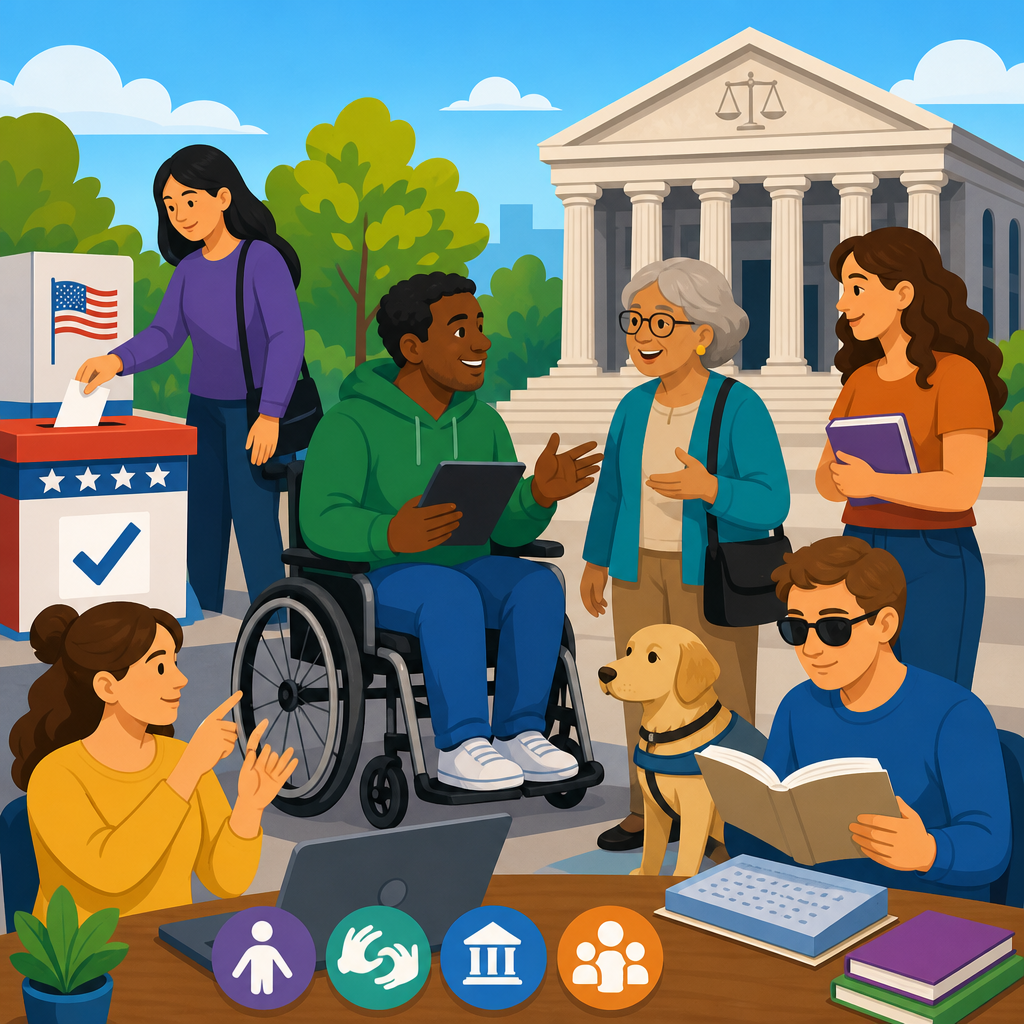
Resources on voting, courts, and civic participation accessibility help people with disabilities take part in public life with dignity, privacy, and equal access. In practice, this means more than adding a ramp to a polling place or offering a large-print form. It includes accessible voter registration, ballot marking devices, plain-language court notices, captioned public meetings, screen-reader-friendly government websites, transportation planning, and staff training that prevents exclusion before it happens. I have worked with accessibility audits and public service content, and the pattern is consistent: when agencies plan accessibility early, participation rises and complaints drop. When they treat it as an afterthought, barriers multiply across every step of the civic process.
As a hub within Resources and Support, this guide brings together the most important specialized ADA resources and support related to elections, courts, jury service, public meetings, and community engagement. “Specialized ADA resources and support” refers to targeted tools, legal guidance, technical assistance, and service providers that address a specific setting where accessibility duties are high stakes and time sensitive. Voting deadlines cannot be moved because a website was inaccessible. A court hearing cannot be fair if a deaf litigant cannot follow testimony. A town hall does not count as meaningful participation if residents with disabilities cannot enter the building, understand the agenda, or submit comments independently.
This topic matters because civic participation is where civil rights become real. The Americans with Disabilities Act, Section 504 of the Rehabilitation Act, the Voting Rights Act, the Help America Vote Act, and state access laws all shape what equal participation looks like. The U.S. Department of Justice has long treated access to state and local government programs as a core obligation under Title II. The U.S. Election Assistance Commission, Disability Rights organizations, protection and advocacy agencies, court administrators, and local ADA coordinators all publish practical guidance, but many people need one place to understand how those resources fit together. This article does that, while pointing to the subtopics every accessible public entity should build into its support system.
Accessible voting resources: registration, polling places, and private ballot access
Accessible voting begins before Election Day. A person must be able to learn eligibility rules, register online or in person, review sample ballots, request accommodations, travel to the correct site, enter the building, navigate check-in, mark a ballot privately, verify selections, and cast that ballot without unnecessary assistance. When any one of those steps fails, equal access fails. The most reliable resources come from state election offices, local boards of elections, the U.S. Election Assistance Commission, and disability rights groups that publish polling place checklists and voter guides in accessible formats.
Key supports include accessible online voter registration, alternative formats for election materials, curbside voting procedures where allowed, and ballot marking devices that let voters with vision, mobility, or dexterity disabilities vote privately and independently. In audits I have reviewed, common breakdowns were not sophisticated technology failures but basic implementation errors: temporary signs placed in the wrong location, inaccessible parking routes, registration portals that trapped keyboard users, and poll workers who did not know how to activate an accessible machine. Good resources solve those issues by combining technical specifications with operational checklists and staff scripts.
| Access area | What good support includes | Example resource source |
|---|---|---|
| Voter registration | Keyboard navigation, labeled form fields, plain language instructions, deadline reminders | State election office accessibility page |
| Polling place access | Route surveys, parking and entrance checklists, door width and signage guidance | Election Assistance Commission and DOJ polling place guidance |
| Ballot privacy | Ballot marking devices, audio ballots, sip-and-puff or switch compatibility where supported | County election equipment manuals |
| Communication access | ASL interpreters on request, TTY or relay contact options, multilingual accessible notices | Local ADA coordinator and election board |
Vote-by-mail and absentee voting also require targeted accessibility resources. An inaccessible absentee ballot portal can exclude voters just as effectively as a staircase at a polling site. Some jurisdictions now offer remote accessible vote-by-mail systems that let voters receive and mark ballots electronically before printing and returning them under state rules. These systems must still be tested for screen reader compatibility, focus order, error identification, and secure workflow. The best voter support pages clearly explain what is available, who qualifies, the deadline to request materials, and who to call if the accessible method fails.
Court accessibility resources: hearings, filings, jury service, and due process
Court accessibility has a different urgency because rights, deadlines, and personal liberty can be affected immediately. Specialized ADA resources and support in this setting cover physical access to courthouses, effective communication during proceedings, accessible electronic filing systems, accommodation request procedures, and equal access to jury service. The strongest court systems publish ADA accommodation forms, contact information for an ADA coordinator, grievance procedures, and plain explanations of how to request interpreters, captioning, assistive listening devices, continuances tied to access needs, or alternative formats for court documents.
For litigants and witnesses who are deaf or hard of hearing, effective communication often means qualified sign language interpreters, real-time captioning, or assistive listening systems, depending on the situation. For blind users, it may mean accessible PDF orders, navigable e-filing notices, and orientation help inside a large courthouse complex. For people with cognitive disabilities, it can mean plain-language notices, extra time to review instructions, or support persons where permitted by court rules. These are not courtesy upgrades. They are conditions for meaningful participation and due process.
Jury service is another area where people are wrongly screened out. Many courts now provide resources explaining that disability alone does not disqualify a person from serving. Reasonable modifications can include accessible jury summonses, mobility accommodations, interpreter services, captioning, or permission to use assistive technology. A well-designed jury information portal should let users respond to summonses online with full keyboard access and screen reader support, and it should explain how confidentiality is handled when a juror requests an accommodation.
Electronic court systems deserve special attention. If an e-filing portal times out too quickly, uses unlabeled buttons, or relies on image-based CAPTCHAs without alternatives, self-represented litigants can miss deadlines. Courts should use recognized accessibility standards, test with assistive technology, and offer staffed alternatives while barriers are corrected. From experience, the most effective court resource centers do not bury ADA information in a policy manual. They put accommodations, contact details, deadlines, and escalation steps directly on the pages users see before a hearing or filing.
Public meetings, local government programs, and community participation support
Civic participation extends beyond elections and courts. Residents need accessible paths into city council meetings, zoning hearings, school board sessions, transit advisory boards, neighborhood planning processes, and online public comment systems. Specialized ADA resources and support here often come from municipal ADA coordinators, clerk offices, public engagement teams, and state municipal leagues. The core obligation is program access: if the government offers a public meeting or participation channel, people with disabilities must be able to use it in an equally effective way.
That requires both physical and digital planning. Meeting notices should state how to request accommodations, by what deadline, and through which contact methods, including relay-friendly phone access and email. Agendas and attachments should be posted in accessible formats, not scanned image PDFs. Live streams should include captions. In-person rooms need accessible seating locations integrated with the audience, clear routes, working microphones, and presentation materials that can be understood by attendees with low vision or cognitive disabilities. When public comment is accepted online, the submission form must work with screen readers, keyboard-only navigation, and mobile devices.
One common mistake is assuming that a webcast alone solves access. It does not. If the stream lacks captions, if the agenda is posted as an unreadable image, or if a resident cannot submit testimony independently, participation is still unequal. Strong support resources therefore include event accessibility checklists, vendor standards for captioning and interpreting, templates for accessible notices, and procurement language requiring digital accessibility from platform providers. Local governments that institutionalize these resources avoid the last-minute scramble that often leads to preventable exclusion.
Where to find reliable specialized ADA resources and support
The most dependable resources usually come from a mix of federal guidance, state administration, and local implementation. For legal interpretation and enforcement trends, the U.S. Department of Justice remains essential, especially for state and local government access obligations. For election-specific operations, the U.S. Election Assistance Commission publishes practical materials on polling place accessibility and voting system usability. For education and training, the ADA National Network provides regional technical assistance that translates legal requirements into everyday action. Protection and Advocacy agencies in each state are especially valuable when a barrier is urgent and an individual needs direct support.
At the state level, look for election boards, administrative office of the courts, statewide independent living councils, vocational rehabilitation agencies, and disability rights nonprofits. These organizations often maintain resource pages on accessible absentee voting, courthouse accommodation contacts, transportation programs, and grievance procedures. At the local level, the city or county ADA coordinator, election administrator, court clerk, transit authority, and library system can be practical entry points because they know how services are actually delivered on the ground.
When evaluating any resource, check five things. First, is it current and tied to the right agency? Second, does it explain the exact process, not just the right in theory? Third, is the resource itself accessible to screen readers, keyboard users, and people who need plain language? Fourth, does it name a human contact for time-sensitive problems? Fifth, does it acknowledge limits honestly, such as accommodation deadlines or state-specific voting rules? Resources that meet those tests are far more likely to help people solve real access problems quickly.
How this hub connects the subtopics under Resources and Support
As a sub-pillar hub for Specialized ADA Resources and Support, this page should guide readers to deeper articles on each civic setting. The natural companion topics include accessible voting guides, courthouse accommodation requests, accessible jury service, digital accessibility for government forms, transportation to civic sites, communication access services, and complaint or grievance options when access fails. Internal linking among these pages matters because users rarely start with a fully defined problem. Someone searching for an accessible polling place may also need paratransit information, an absentee ballot alternative, or help filing a complaint after being turned away.
Building the hub this way also reflects how accessibility works in real life: barriers overlap. A wheelchair user may face an inaccessible entrance at a polling place and an online sample ballot that is not compatible with voice control software. A deaf resident may need both captioning for a council meeting and an interpreter for a later zoning appeal. A blind juror may need an accessible summons, navigable parking instructions, and digital exhibits in readable formats. Organizing support by connected tasks, not isolated legal categories, makes the resource hub far more useful.
The practical benefit is simple. With the right resources on voting, courts, and civic participation accessibility, public agencies reduce risk, residents gain independence, and the civic process becomes more accurate and inclusive. Use this hub to identify the specific support you need, then move to the linked guides for step-by-step help, agency contacts, and implementation details. Equal participation depends on preparation, and the best time to build accessibility into civic life is before the next deadline, hearing, election, or public meeting arrives.
Frequently Asked Questions
What does accessibility in voting, courts, and civic participation really include?
Accessibility in public life goes far beyond basic physical access. In the context of voting, courts, and civic participation, it means designing every step of participation so people with disabilities can use services independently, privately, safely, and with dignity. For voting, that can include accessible voter registration forms, polling places with step-free entrances and clear signage, ballot marking devices, curbside voting where permitted, accessible absentee ballot options, and trained poll workers who know how to assist without taking over. In court systems, accessibility can involve plain-language notices, qualified sign language interpreters, real-time captioning, assistive listening systems, accessible digital filings, screen-reader-compatible websites, flexible scheduling, and policies that allow reasonable modifications.
Civic participation also includes attending town halls, public hearings, school board meetings, and community forums. These settings should offer captioning, accessible livestreams, interpreters when needed, wheelchair-accessible seating, accessible transportation planning, and materials in formats such as large print, Braille, and accessible digital text. Just as important, accessibility includes staff training, communication practices, and planning that prevent exclusion before it happens. In short, true accessibility is not a one-time accommodation or a single piece of equipment. It is a system-wide commitment to equal participation in democracy and public decision-making.
Why is accessible voting important beyond legal compliance?
Accessible voting matters because voting is a fundamental right, and that right is not fully protected if people cannot use it privately and independently. While laws set important standards, the real goal is equal participation. A voter with a disability should not have to rely on another person to read a ballot, navigate a building, interpret confusing instructions, or overcome preventable barriers. When accessible systems are in place, voters can register, receive information, cast ballots, and confirm their choices with the same dignity and confidence as everyone else.
Accessible voting also strengthens the legitimacy of elections. If barriers keep eligible voters from participating, communities lose voices that belong in public decision-making. People with disabilities represent a large and diverse part of the population, and their full participation helps ensure that elected officials and public policies reflect the experiences of the whole community. Better accessibility often improves the process for many others too, including older adults, people with temporary injuries, individuals with limited literacy, and voters who benefit from clearer instructions or better wayfinding. Accessible voting is not a special add-on for a small group. It is a core part of a fair, trustworthy, and inclusive election system.
What accessibility features should people look for in courts and public meetings?
In courts and public meetings, accessibility should be visible in both the physical environment and the communication process. People should look for accessible entrances, elevators when needed, clear pathways, seating options for wheelchair users and companions, accessible restrooms, and signage that is easy to understand. For communication access, important features include qualified interpreters, CART or live captioning, assistive listening devices, microphones that are actually used by speakers, and written materials in accessible formats. If meetings are held online or in hybrid form, the platform should support captions, keyboard navigation, screen readers, and accessible chat or participation tools.
Equally important are the documents and notices people receive before and after proceedings or meetings. Court summonses, hearing notices, agendas, public comment instructions, and policy documents should be written in plain language where possible and offered in formats that work for people with different disabilities. A website that posts meeting details or court information should be compatible with screen readers, readable on mobile devices, and structured so users can find deadlines, locations, and contact information without unnecessary barriers. Accessibility also means there should be a clear, responsive process for requesting accommodations in advance and resolving problems quickly if barriers arise on the day of an event. A truly accessible court or public body makes participation predictable, understandable, and usable from start to finish.
How can government agencies and community organizations improve civic participation accessibility?
Government agencies and community organizations can improve accessibility most effectively by treating it as an ongoing operational responsibility rather than a last-minute fix. A strong approach starts with reviewing the full participation journey: how people find information, request services, travel to locations, enter buildings, understand instructions, communicate with staff, and complete tasks. Agencies should evaluate websites, forms, printed materials, registration systems, meeting platforms, and in-person spaces for usability by people with a wide range of disabilities. Accessibility planning should include procurement standards, so any new software, kiosks, voting tools, or communication systems meet accessibility requirements from the beginning.
Training is another major factor. Staff, election workers, clerks, bailiffs, volunteers, and meeting facilitators should know how to communicate respectfully, provide reasonable modifications, use accessibility equipment properly, and avoid common mistakes that unintentionally exclude participants. Organizations should also build relationships with disability advocates and community members to test systems, identify barriers, and improve services based on real experience. Providing multiple ways to participate is especially important. That may include online and in-person options, telephone support, accessible transportation information, multilingual plain-language materials, and clear accommodation request procedures. When accessibility is built into planning, budgeting, communication, and evaluation, civic participation becomes more reliable and equitable for everyone involved.
Where can people find help if they face accessibility barriers when trying to vote, go to court, or participate in public life?
People who encounter barriers should start by contacting the relevant office directly, such as the local election office, courthouse accessibility coordinator, clerk’s office, public meeting organizer, or government agency responsible for the event or service. Many barriers can be resolved quickly when reported early, especially if the issue involves communication access, alternative formats, room changes, or equipment problems. It is helpful to explain the barrier clearly, describe the accommodation or modification needed, and keep records of emails, forms, dates, and names of staff involved. If the matter is urgent, asking for a supervisor or accessibility contact can speed up the response.
If the problem is not resolved, people can seek support from disability rights organizations, legal aid groups, protection and advocacy agencies, election protection programs, bar association referral services, or civil rights enforcement offices at the local, state, or federal level. Community-based disability organizations can also help individuals understand their options, document barriers, and advocate for better access. In some situations, formal complaints may be appropriate, especially when barriers are systemic or repeatedly ignored. The most useful resources are often those that combine legal information with practical support, such as help lines, accessible guides, accommodation request templates, and voter or court access toolkits. No one should have to navigate exclusion alone, and strong accessibility resources can help turn a barrier into a fix that benefits many others in the future.


