Can a public entity require you to use a separate entrance? Under the Americans with Disabilities Act, the general rule is no: a state or local government cannot force a person with a disability to use a different entrance when the main entrance is accessible or can be made accessible without fundamentally altering the service or causing an undue burden. That question sits at the center of basic rights under the ADA because entrances are not just doors; they control dignity, independence, safety, and equal participation in public life.
In my work reviewing access policies, entrances are often where compliance problems become visible first. A building may advertise inclusion, yet route wheelchair users to a side door near trash bins, require people with mobility impairments to call staff for entry, or direct service users to a loading area because the front steps were never corrected. These practices matter because the ADA is not only about getting someone inside eventually. It is about providing equal opportunity to participate in government programs, services, and activities in the most integrated setting appropriate.
A few key terms help frame the issue. A public entity includes state and local governments, along with their departments, agencies, and instrumentalities. Title II of the ADA governs those entities. Program accessibility means a public entity, when viewed in its entirety, must operate each service, program, or activity so it is readily accessible to and usable by people with disabilities. Effective communication requires governments to communicate with people with disabilities as effectively as with others, including through auxiliary aids and services when needed. Reasonable modification means changing policies, practices, or procedures when necessary to avoid disability discrimination, unless the change would fundamentally alter the program.
The reason this topic deserves a hub article is simple: basic rights under the ADA extend far beyond ramps and elevators. They include equal access to public meetings, courthouses, schools, police services, websites, forms, recreation programs, transit systems, and emergency communications. They also include protection from unnecessary segregation, retaliation, and blanket safety exclusions. If you understand the entrance question clearly, you understand the broader ADA principle: public entities must remove barriers that exclude people with disabilities unless a narrow legal defense applies, and they must choose methods that preserve equality and integration rather than convenience for staff.
What the ADA says about separate entrances
A public entity generally cannot require a separate entrance simply because a person has a disability. The ADA and Department of Justice regulations favor integrated access. If the front entrance is accessible, everyone should be able to use it. If the front entrance is not accessible in an older facility, the entity may sometimes provide access through another entrance as part of overall program accessibility, but that alternative cannot be inferior in a way that denies equal participation, privacy, safety, or timely service. New construction and alterations are held to a stricter standard: accessible routes and entrances must comply with the 2010 ADA Standards for Accessible Design.
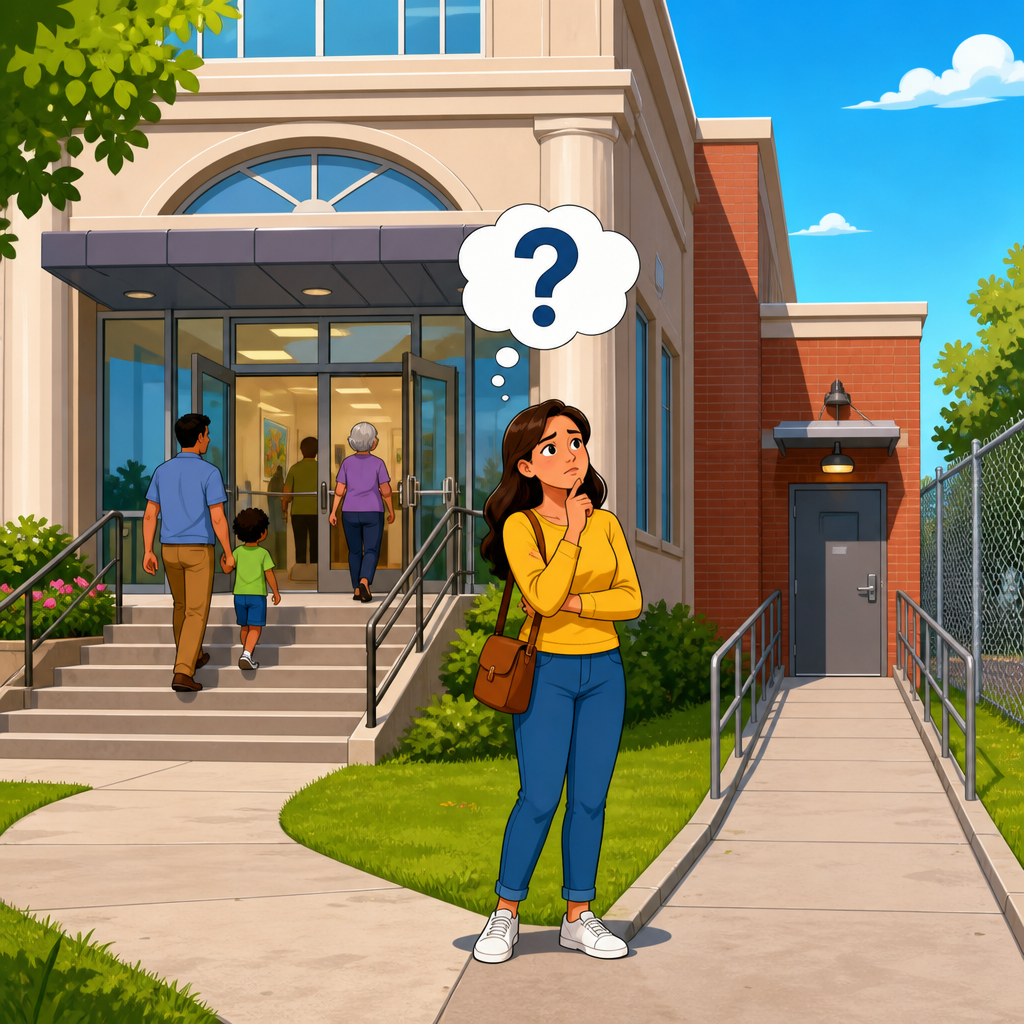
In practical terms, a side entrance might be lawful in limited circumstances, but not as a default method of treating disabled visitors separately. Suppose a historic city hall has front stairs and an accessible side entrance with signage, automatic door hardware, weather protection, equivalent security screening, and the same hours of operation. That may satisfy the law if the program remains readily accessible and structural changes to the front are not required under the applicable standard. By contrast, if visitors must ring a bell, wait ten minutes for staff, enter through a delivery corridor, and miss the beginning of a public meeting, the access provided is not equal in substance.
The Department of Justice has consistently treated segregation as a core concern. Separate routes that mark disabled visitors as different, expose them to embarrassment, or make them dependent on staff assistance are legally risky. The same principle appears across Title II obligations. Access should be independent when possible, predictable, and equivalent to what nondisabled members of the public receive. Public entities often miss this point by focusing only on whether some route exists. The better legal question is whether the route provides meaningful access to the same government service, at the same time, with comparable convenience and dignity.
Basic rights under the ADA in public services
Basic rights under the ADA begin with nondiscrimination in public services. State and local governments cannot exclude qualified individuals with disabilities from participation in, deny them the benefits of, or subject them to discrimination in services, programs, or activities. That applies to city council meetings, parks programs, public schools, licensing offices, voting locations, libraries, jails, court systems, and public health clinics. The right is broad because Title II covers how the program operates, not just what the building looks like.
People with disabilities also have the right to reasonable modifications when standard rules block equal access. A recreation department may need to modify a registration procedure that requires in-person signatures if a participant cannot physically reach the office. A courthouse may need to adjust a policy about where a witness sits so a person using a wheelchair can testify safely and visibly. A transit agency may need to permit paratransit eligibility assessments through alternative formats. These are not special favors. They are required changes unless the entity can show a fundamental alteration, a high bar that must be supported by actual facts.
Effective communication is another foundational right. Public entities must furnish appropriate auxiliary aids and services where necessary, including qualified interpreters, captioning, accessible electronic documents, screen-reader-compatible web content, large print, or assistive listening systems. The standard is equal effectiveness, not token effort. I have seen agencies offer handwritten notes in situations where a qualified sign language interpreter was necessary for accuracy and interaction. That usually fails because communication about legal rights, medical services, policing, or education depends on nuance and speed. The person’s preferred aid must receive primary consideration in many Title II contexts.
Public entities must also avoid eligibility criteria that screen out people with disabilities unless the criteria are necessary for the service. For example, a blanket rule that all program participants must stand in line for extended periods can unlawfully exclude people with mobility impairments if another orderly process would work. Likewise, governments cannot impose surcharges to cover accessibility costs. Charging a wheelchair user extra because staff must unlock an accessible entrance or charging a Deaf resident for interpreting services is prohibited. Equal access is part of the public entity’s legal obligation, not an optional premium service.
When a different entrance may be allowed
The law does not treat every separate entrance as automatically illegal. Context matters. In existing facilities, Title II uses a program accessibility framework. A city is not always required to make every older building fully accessible if the program, viewed in its entirety, is accessible. That means a permit office on an inaccessible upper floor might need to relocate services to an accessible room on the ground floor, rather than rebuild immediately. Similarly, an alternate entrance may sometimes be acceptable if it delivers genuinely equivalent access and the entity has documented why structural changes are not required or are not yet feasible.
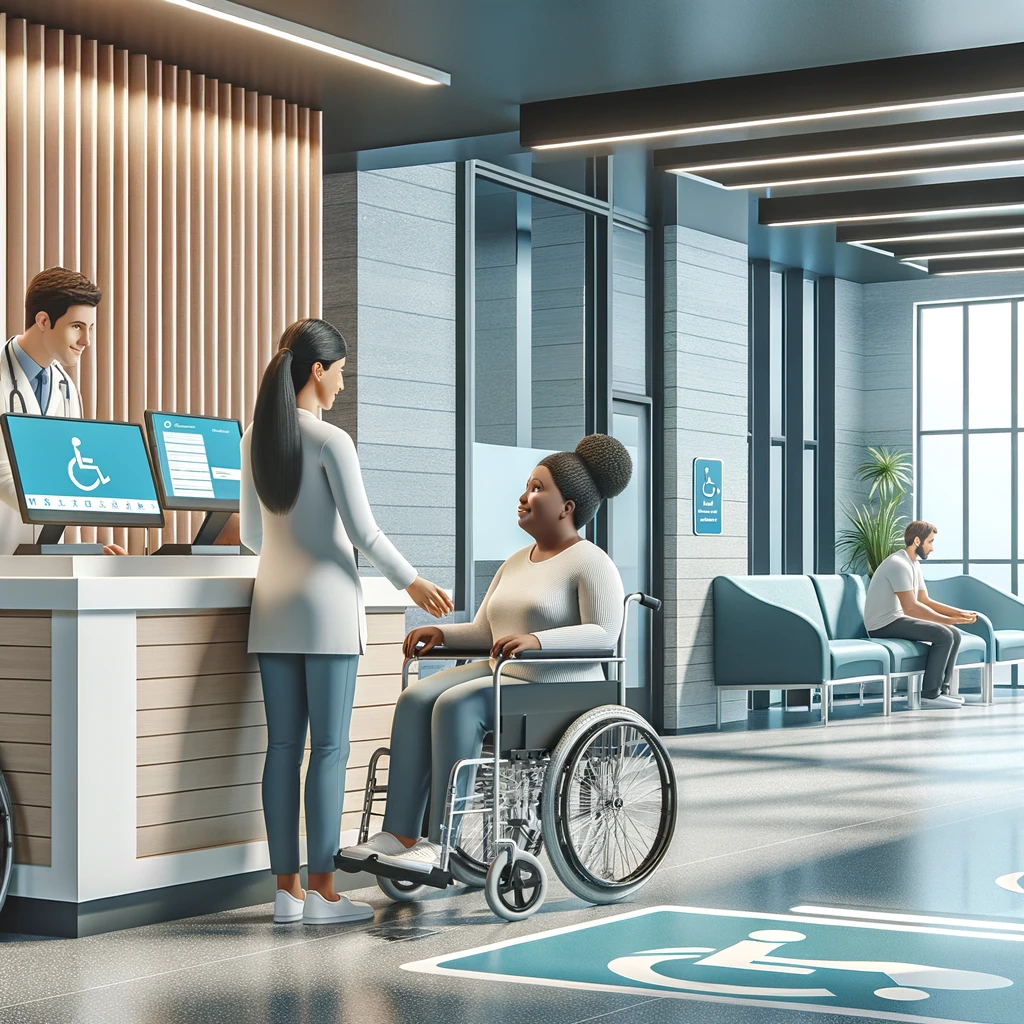
However, equivalent means more than technically open. The entrance should be on an accessible route, available during the same hours, clearly signed, unlocked or independently operable, and connected to the same security, reception, and wayfinding systems. If the front entrance has metal detectors and staffed check-in, the alternative should not leave disabled visitors unprocessed or delayed. If the front door opens into the main lobby, the alternative should not deposit someone in a restricted corridor with no visible assistance. In compliance reviews, these operational details often determine whether an accommodation works in real life.
| Scenario | Likely ADA Result | Reason |
|---|---|---|
| Main entrance is accessible, but staff direct wheelchair users to a side door anyway | Usually unlawful | Unnecessary segregation and unequal treatment |
| Historic building uses signed accessible side entrance with equal hours and independent access | Possibly lawful | May satisfy program accessibility if access is equivalent |
| Separate entrance requires visitors to call staff and wait outside | Often unlawful | Delays, dependence, and indignity undermine equal participation |
| Newly renovated facility keeps only inaccessible front steps and accessible rear route | Likely unlawful | Alterations must meet 2010 ADA Standards where required |
There are also narrow defenses. A requested change need not be made if it would fundamentally alter the nature of the service, program, or activity, or if it would impose undue financial and administrative burdens. But public entities must prove those defenses through a reasoned determination by the head of the entity or designee, considering all resources available for the program. A casual statement like “that would be too expensive” is not enough. In many entrance cases, relatively modest solutions such as power-assisted doors, ramps, signage, access control changes, or relocating services resolve the problem without approaching that threshold.
How this applies to common public settings
Courthouses illustrate the issue well. A disabled litigant, juror, or visitor cannot be treated as an afterthought because hearings run on strict schedules and privacy matters. If the public enters through a monitored front entrance but a wheelchair user is told to use an employee loading dock, the entity must ask whether that route preserves timeliness, security screening, confidentiality, and dignity. The same analysis applies to police stations, where inaccessible public counters or locked accessible doors can interfere with reporting crimes, seeking records, or obtaining immediate assistance.
Schools and universities face similar obligations. Parents attending an Individualized Education Program meeting, students using mobility devices, and community members at public events all have Title II rights in public education settings. A school cannot announce inclusion while directing disabled guests to a gym service door with no signage, no shelter, and no staff support. Public libraries, recreation centers, and city pools also frequently create access issues through poor maintenance. An entrance that was once compliant can become inaccessible if automatic door openers fail, mats bunch up, snow blocks the route, or accessible parking lacks a curb ramp.
Digital access is increasingly tied to physical access. If a public entity tells visitors to use a separate entrance, but the notice appears only on an image-based website unreadable by screen readers, the person may never receive the instruction. Likewise, an online reservation system for courthouse appointments or recreation classes must be usable with keyboard navigation and assistive technology. The ADA increasingly intersects with Web Content Accessibility Guidelines, especially WCAG 2.1 AA as an operational benchmark. Equal access today means the route to the service, physical or digital, cannot break at the point where a disabled person needs information most.
What to do if your rights are violated
If a public entity requires a separate entrance in a way that feels unequal, start by documenting the facts. Note the date, time, location, staff names, exact instructions given, waiting time, and whether the main entrance was available to others. Take photos of signage, steps, door hardware, intercoms, or blocked routes if it is safe to do so. Keep copies of emails, web notices, and forms. In ADA matters, details decide outcomes. A complaint that says “they sent me to the back” is weaker than one that explains you were left outside in rain for twelve minutes, missed check-in, and entered through a trash corridor while nondisabled visitors used the front lobby.
Next, request a correction from the entity’s ADA coordinator or civil rights office. Public entities with fifty or more employees must designate an ADA coordinator and adopt grievance procedures. Ask for a prompt remedy, such as access through the main entrance, repair of the accessible door, relocated services, or a modification to the entry process. If informal efforts fail, you can file an administrative complaint with the U.S. Department of Justice or other relevant agency, depending on the program involved, and in some cases pursue litigation. Deadlines, available remedies, and strategic choices vary, so legal advice can matter.
The broader lesson is that basic rights under the ADA are practical rights. They protect a person’s ability to enter, communicate, participate, and be treated with equal respect in public life. A separate entrance may occasionally be permissible in older facilities, but it cannot become a shortcut for segregation or neglect. Public entities must design access around equality, not inconvenience. If you encounter a barrier, document it, raise it clearly, and ask for a remedy tied to the specific service you need. That approach resolves many disputes early and builds a stronger record when it does not.
Frequently Asked Questions
Can a public entity legally require a person with a disability to use a separate entrance?
In most situations, no. Under the Americans with Disabilities Act, a state or local government generally cannot require a person with a disability to use a separate entrance if the main entrance is accessible or can be made accessible without a fundamental alteration or an undue burden. The ADA is designed to provide equal access to public programs, services, and activities, and that includes how people enter a building. Being directed to a side door, back entrance, service entrance, or another segregated access point can undermine dignity, independence, and equal treatment.
The core principle is integration. Public entities are expected to offer services in the most integrated setting appropriate, which means people with disabilities should not be separated unnecessarily from everyone else. If the main entrance works for the public at large, the goal is for it to work for people with disabilities too. A separate entrance may sometimes be used temporarily or in limited circumstances, but it should not become the default when equal access through the main entrance is readily achievable within the public entity’s obligations under the law.
Are there any situations where a separate entrance might be allowed?
Yes, but those situations are limited and fact-specific. A public entity may sometimes rely on a different accessible entrance if making the main entrance accessible would fundamentally alter the nature of the service, program, or activity, or if doing so would impose an undue financial or administrative burden. These are legal standards, not casual excuses. A government office cannot simply say that using the main entrance is inconvenient, expensive, or operationally difficult without careful analysis and documentation.
Even when a separate accessible entrance is used, the public entity still has a duty to provide meaningful access. That means the alternate entrance must actually be usable, safe, clearly identified, open when needed, and provide a comparable level of convenience and independence. It should not require a person to wait for staff, travel through loading areas, use an unsafe route, or announce their disability in a humiliating way just to enter. In other words, an exception does not erase the broader ADA obligation to avoid discrimination and to provide access that is as equal as possible under the circumstances.
What does it mean if the main entrance is “accessible” under the ADA?
An accessible entrance is one that a person with a disability can use in a real, practical, and independent way. It is not enough for a door to technically exist; the route to it, the door hardware, thresholds, width, maneuvering clearance, ramps, automatic door features, and signage all matter. An entrance may fail to be accessible if there are stairs without an alternative route, heavy doors that cannot be opened by many users, inaccessible buzzers or intercoms, narrow passageways, or inaccessible security features.
Accessibility also involves usability during normal operations. For example, if the main entrance has an accessible ramp but it is routinely blocked, locked, or monitored in a way that prevents independent use, that may not satisfy ADA requirements in practice. Public entities are expected to maintain accessible features in operable working condition. So when asking whether someone can be required to use a separate entrance, the right starting point is whether the main entrance truly provides equal and reliable access, not whether the entity can point to a nominal accommodation on paper.
What should someone do if a public entity tells them to use a side or back entrance?
Start by documenting what happened. Note the date, time, location, names of staff involved, what was said, whether the main entrance appeared accessible, and what barriers existed. Photos or videos can be especially helpful if they show stairs, locked accessible doors, broken automatic openers, missing ramps, or signs directing people with disabilities elsewhere. If the issue happened at a courthouse, city hall, public school, police station, library, or another local or state government building, that information may support a disability discrimination complaint.
It can also help to raise the issue directly with the public entity by asking for the ADA coordinator, facilities manager, or department administrator. Many public entities have grievance procedures for disability access concerns. If the problem is not resolved, a person may file an administrative complaint with the appropriate agency or seek legal advice from an attorney familiar with ADA and disability rights law. The key point is that being told to use a separate entrance is not something a person has to automatically accept as lawful. The facts matter, and the law often protects the right to enter in the same way as everyone else.
Why does the issue of separate entrances matter so much under disability rights law?
It matters because entrances are about much more than physical access. They shape whether a person can participate with dignity, move independently, and be treated as an equal member of the public. A separate entrance can send the message that people with disabilities are an afterthought or do not belong in the same spaces as everyone else. That is exactly the kind of exclusion modern disability rights laws were designed to challenge.
From a legal standpoint, the ADA is not only concerned with whether a person can eventually get inside a building. It is also concerned with equal opportunity, integration, and avoiding unnecessary segregation. From a human standpoint, entering through the front door with everyone else can affect privacy, safety, convenience, and self-respect. That is why the general rule is so important: if the main entrance is accessible or can be made accessible without a fundamental alteration or undue burden, a public entity should not force a person with a disability to use a separate entrance.