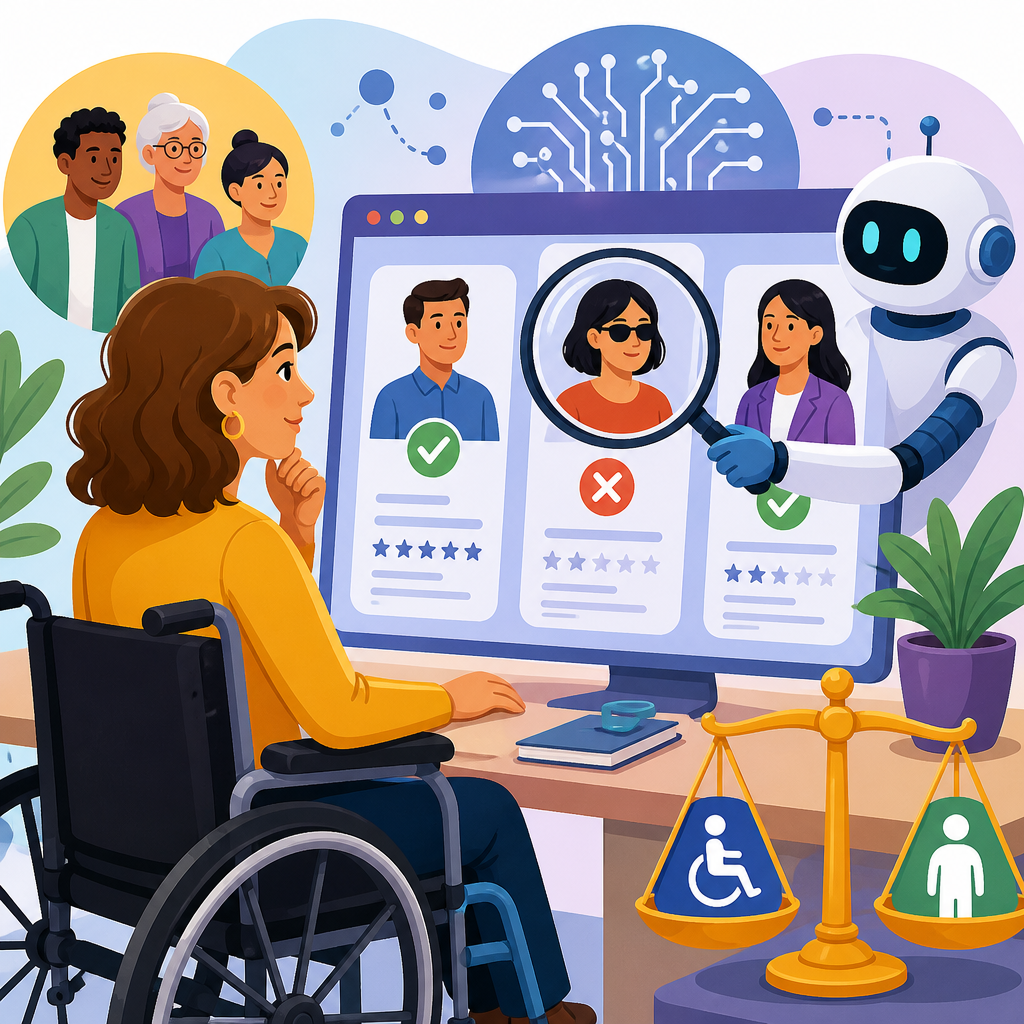
Emerging cases on AI hiring systems and disability bias are reshaping how employers, software vendors, and courts interpret the Americans with Disabilities Act in digital recruiting. AI hiring systems include résumé screening tools, chatbot pre-screeners, automated assessments, video interview analyzers, online games, and ranking models that decide who advances. Disability bias occurs when these systems screen out qualified applicants with physical, sensory, cognitive, mental health, or neurodivergent conditions, whether by design, bad data, inaccessible interfaces, or rigid scoring rules. I have worked with employers reviewing these tools before launch, and the same problem appears repeatedly: teams focus on efficiency and validation metrics, but overlook accommodation workflows, accessibility testing, and the legal significance of adverse impact.
This matters because hiring is now software-mediated at nearly every stage. The Equal Employment Opportunity Commission has warned that algorithmic decision tools can violate the ADA when they fail to provide reasonable accommodations, ask impermissible disability-related questions, or use criteria that disproportionately exclude disabled candidates without being job-related and consistent with business necessity. Courts are still building the case law, so “emerging cases” includes filed lawsuits, settlements, agency guidance, consent decrees, and state enforcement actions that reveal where liability is moving. For employers, this is not a niche compliance issue. It affects talent pipelines, vendor contracts, audit protocols, recordkeeping, and the defensibility of every scored hiring decision.
As a hub article under Legal Cases and Precedents, this page maps the recent ADA litigation landscape and the trends connecting individual disputes. The central questions are straightforward. When does an automated process become an employment test? What counts as a reasonable accommodation in an online assessment? How should employers evaluate vendor claims about fairness? And what facts make judges and regulators more likely to find unlawful screening? The answers increasingly turn on practical details: whether alternative formats were offered, whether the employer could explain what the tool measured, whether the trait being scored was actually necessary for the job, and whether disabled applicants had a realistic way to challenge or bypass automated outcomes.
What recent ADA disputes over AI hiring systems are really about
Recent ADA litigations and emerging trends show that most disputes do not arise from science-fiction style autonomous hiring. They arise from ordinary software decisions that become legal problems at scale. A timed cognitive test may disadvantage candidates with attention-deficit disorders unless extended time is available. A video interview platform may analyze eye contact, speech cadence, or facial movement in ways that penalize autistic applicants, people with speech impairments, or candidates with facial differences. A chatbot may require rapid text responses that are difficult for candidates using assistive technology. An online personality assessment may contain mental-health related inquiries or function as a medical examination if badly designed. In each scenario, the core issue is not that software exists; it is that the software can operate as a gatekeeper without lawful accommodation.
The EEOC’s technical assistance on algorithmic fairness under the ADA has become the baseline reference point. It makes three principles unmistakably clear. First, employers may be responsible for tools built by third parties if the tools are used on their behalf. Second, an applicant who needs an accommodation to be fairly assessed must have a way to request it. Third, employers cannot hide behind vendor assurances that a system is “validated” if they cannot explain how disability-related exclusion was identified and addressed. In practice, that means legal exposure often traces back to procurement and governance failures rather than malicious intent. I have seen employers buy sophisticated assessment platforms with no contract language requiring accessibility conformance, no audit rights, and no documented accommodation process. That is exactly the kind of operational gap that later appears in complaints.
Another pattern in litigation is the tension between speed and individualized review. High-volume employers want standardized workflows that produce comparable scores, but the ADA is built around reasonable modification and individualized consideration. Plaintiffs therefore frame claims around the inability to obtain an exception, a retest, an alternative assessment, or human review. Defendants often answer that uniform administration protects fairness and business efficiency. Courts and agencies generally view that argument skeptically when the employer cannot show that the exact testing condition was essential to the job. If a customer support role requires communication skill, for example, that does not automatically justify a video analysis feature measuring gaze direction or micro-expressions. The legal question is whether the selection criterion maps to actual job performance and whether less exclusionary alternatives were available.
Key case patterns, regulators, and the facts driving liability
The fastest way to understand this area is to track recurring fact patterns rather than wait for a single landmark Supreme Court case. Different forums are contributing pieces of the rule set: private class actions, EEOC investigations, state attorney general scrutiny, city-level automated employment decision rules, and structured settlements. New York City’s Automated Employment Decision Tools law is not an ADA statute, but it has influenced how companies think about notice, bias audits, and vendor documentation. Separate from that law, the Department of Justice has repeatedly emphasized web accessibility under the ADA, and those principles spill directly into hiring portals and assessments. Together, these developments create a compliance expectation that employers test both the decision logic and the user interface.
Several allegations appear again and again in recent disputes: inaccessible application websites, inability to use screen readers, no keyboard navigation, no captioning, no accommodation contact, impossible time limits, opaque rejection messages, and refusal to provide an equivalent alternative. Plaintiffs also focus on unsupported inferences. If a vendor claims to infer conscientiousness, resilience, or communication ability from gameplay, typing speed, or facial analytics, courts and regulators will ask what evidence supports that inference and whether the evidence includes disabled populations. Validation studies based on narrow samples are weak protection. A model tested primarily on non-disabled incumbents can replicate historic exclusion while still producing neat accuracy statistics.
| Pattern | Typical allegation | Why it matters under the ADA |
|---|---|---|
| Timed online tests | No extra time or pause function | May deny reasonable accommodation and screen out qualified applicants |
| Video interview analytics | Scoring eye contact, tone, or facial movement | Can penalize autism, speech impairments, or facial differences without job necessity |
| Inaccessible portals | Screen reader failures or mouse-only design | Blocks equal access to the application process itself |
| Chatbot screening | No alternate channel for assistive technology users | Prevents effective communication and accommodation requests |
| Vendor black box tools | Employer cannot explain criteria or audit results | Undermines business necessity defenses and accountability |
The facts that most often increase liability are surprisingly basic. Did the posting or portal tell applicants how to request an accommodation? Was the contact channel monitored? Was there a documented escalation path when a candidate said the tool was inaccessible? Could the employer substitute another assessment measuring the same skill? Did anyone analyze pass rates for applicants who requested accommodations? If those answers are missing, plaintiffs can present the system as structurally indifferent to disability access. By contrast, employers fare better when they preserve validation reports, accessibility conformance records such as WCAG testing, accommodation logs, and evidence that managers were trained not to treat accommodation requests as a negative signal.
How courts and agencies are applying ADA concepts to automated hiring
The ADA concepts driving these cases are established, but applying them to AI hiring systems requires careful translation. The first concept is reasonable accommodation. In software-mediated hiring, accommodation may mean extended time, compatibility with screen readers, captioning, a human-administered alternative, waiving a nonessential video requirement, or allowing a different input method. The second concept is qualification standards and selection criteria that screen out disabled individuals. A tool violates the ADA if it uses criteria that tend to exclude disabled applicants unless the employer proves the criteria are job-related and consistent with business necessity. The third concept is medical examination and disability-related inquiry. Some assessment questions, biometric inferences, or mental health probes can cross that line, especially before a conditional offer.
Agency guidance has become influential because litigation often settles before appellate courts issue broad opinions. The EEOC has stated that employers using software developed by vendors are still responsible for compliance. That position matters because defendants often try to shift blame to the software provider. Courts are unlikely to accept that move when the employer selected the tool, defined the hiring workflow, and relied on the score. Liability can also be shared. Contract indemnities may allocate costs between employer and vendor, but they do not eliminate obligations to applicants. In practical terms, the employer remains the public-facing decision maker and must be able to explain how a qualified person with a disability can compete fairly.
Business necessity is becoming the decisive battleground. A vague assertion that “the model predicts success” is not enough. Employers need evidence connecting the assessment to essential job functions, and that evidence must survive scrutiny when applied to disabled candidates. For example, if a warehouse role truly requires rapid response to visual cues for safety reasons, some timed visual testing may be defensible. But the employer still needs to examine whether there is an accommodated format that measures the same essential capacity. Courts generally ask whether the same business goal could be achieved through a less exclusionary means. That is why disability bias reviews must go beyond global accuracy and look at which features, thresholds, and administration rules produce exclusion.
Emerging trends in recent ADA litigation and risk management
One clear trend is the decline of facial analysis and affect detection in hiring. Employers and vendors increasingly recognize that claims about reading personality, honesty, or enthusiasm from facial movements are scientifically contested and legally fragile. Illinois’ Artificial Intelligence Video Interview Act pushed notice and consent into the conversation, but disability risk did more to change purchasing behavior. Another trend is broader scrutiny of game-based and psychometric assessments. These tools are not inherently unlawful; some are carefully designed. The problem arises when employers cannot explain what trait is being measured, how the scoring was validated, whether accommodations alter score interpretation, or whether disabled users were included in testing.
A second trend is the migration from individual accessibility complaints to systemic discrimination theories. Early disputes often focused on whether one applicant could use one portal. Newer cases increasingly argue that entire workflows are built to exclude categories of disabled people. That matters for class allegations, injunctive relief, and reputational harm. Once a plaintiff frames the issue as a company-wide practice, the employer must defend design choices across every requisition and location. Plaintiffs’ lawyers also increasingly use public statements, vendor marketing, and procurement records to show what the employer knew or should have known. If a company advertised “fully automated screening” while offering no accommodation path, that language can become powerful evidence.
The best risk management response is governance, not panic. Employers should inventory every hiring technology, identify where it makes or influences decisions, and map disability touchpoints from application through interview scheduling. Procurement teams should require accessibility conformance testing, audit rights, data retention limits, and prompt notice of model changes. Human resources should maintain an accommodation protocol specific to digital assessments, including alternatives that measure the same skill. Legal teams should review validation evidence with unusual skepticism when the claimed predictor is indirect or behaviorally inferred. And managers should be trained that “standardized” does not mean “unalterable.” In my experience, organizations reduce legal exposure fastest when they treat AI hiring tools as employment tests first and technology products second.
What this hub means for employers, vendors, and future case law
This hub article connects the central lesson across recent ADA litigations and emerging trends: disability bias in AI hiring systems is rarely an abstract ethics problem. It is a concrete legal risk created by inaccessible design, unsupported scoring, and weak accommodation practices. Employers should assume that any automated assessment can be challenged as a selection procedure, and they should document why it exists, what it measures, how applicants seek help, and what alternatives are available. Vendors should expect deeper diligence on accessibility, validation, and explainability. Courts and regulators are signaling that efficiency gains do not excuse barriers that keep qualified disabled applicants from fair consideration.
The practical benefit of following these cases is not just avoiding lawsuits. Better disability compliance usually improves hiring quality for everyone. Clear instructions, flexible formats, and defensible job-related criteria reduce false negatives, widen talent pools, and make audits easier when decisions are challenged. As this sub-pillar hub expands, it should guide readers to deeper coverage of EEOC actions, accessibility standards, vendor liability, business necessity defenses, and specific assessment types such as video interviews and cognitive tests. Use this page as your starting point: review your hiring stack, test every candidate touchpoint, and fix accommodation gaps before the next case defines the standard for you.
Frequently Asked Questions
1. What kinds of AI hiring systems are being challenged for disability bias?
Emerging cases and regulatory scrutiny are focusing on a wide range of AI hiring tools, not just one type of software. The systems most often discussed include résumé screening and ranking tools, chatbot pre-screeners, automated skills tests, personality and cognitive assessments, video interview analysis platforms, online games used to measure traits or aptitude, and algorithmic models that score or rank candidates for advancement. In practice, any digital tool that influences who gets screened in, screened out, interviewed, or hired can raise disability bias concerns under the Americans with Disabilities Act.
The legal concern is not simply that a tool uses artificial intelligence. The concern is whether the tool creates barriers for qualified applicants with disabilities. For example, a timed online assessment may disadvantage applicants with certain cognitive, learning, or motor impairments. A video interview analyzer may penalize atypical eye contact, facial movement, speech patterns, or vocal cadence associated with autism, neurological conditions, mental health disabilities, or speech impairments. Chatbots and online forms may be inaccessible to screen readers or difficult for applicants with visual, dexterity, or processing limitations to navigate. Even a ranking model trained on historical hiring data can reproduce past patterns that screened out disabled candidates.
What makes these cases especially important is that liability may extend beyond obvious accessibility failures. Courts and enforcement agencies are increasingly looking at whether the tool itself measures qualities in a way that unfairly excludes people with disabilities, whether reasonable accommodations were available, whether employers understood how the technology worked, and whether vendors made representations about fairness that were not supported in real-world use. In other words, the issue is not only website accessibility; it is the full decision-making pipeline and whether the digital process unlawfully disadvantages qualified individuals with disabilities.
2. How does the Americans with Disabilities Act apply to AI hiring tools?
The ADA applies to employment practices, and that includes technology used in recruiting, screening, testing, interviewing, and selection. Employers cannot use qualification standards, tests, or selection criteria that screen out or tend to screen out qualified individuals with disabilities unless the standard or tool is job-related and consistent with business necessity. That principle becomes highly significant when an employer relies on an algorithmic tool to decide who advances in the hiring process. If the tool disproportionately excludes people with disabilities, the employer may have to justify why the assessment is truly necessary for the job and why there is not a less exclusionary alternative.
The ADA also requires employers to provide reasonable accommodations to applicants with disabilities. In the AI hiring context, that means employers may need to offer an alternative testing format, additional time, a non-video interview option, a human-assisted process, accessible interfaces, or other modifications that allow a qualified applicant to compete fairly. A major issue in current disputes is whether employers gave applicants clear notice that an automated tool would be used and an effective way to request accommodation before being screened out. If the process is opaque, fast-moving, or entirely automated, applicants may never get a meaningful chance to ask for help.
Another key point is that an employer generally cannot avoid ADA responsibility by blaming a software vendor. If an employer adopts an AI tool as part of its hiring process, the employer remains responsible for ensuring that process complies with disability law. Vendors may also face legal exposure under other theories, including contract, consumer protection, or accessibility-related claims, but the employer still has a direct duty not to discriminate. That is why current cases are pushing organizations to evaluate their digital hiring tools more carefully, validate them for real job relevance, test for disability-related exclusion, document accommodations procedures, and maintain human oversight rather than treating vendor technology as legally self-certifying.
3. What does disability bias look like in an AI hiring process?
Disability bias in AI hiring often appears in ways that are easy to miss if an employer focuses only on efficiency or predictive scoring. Sometimes the bias is technical and direct: a platform may not work properly with assistive technology, captions may be missing, screen reader navigation may fail, or an online test may require mouse precision or rapid responses that are unrelated to the actual job. In other situations, the bias is embedded in the design of the assessment itself. A tool may reward speech fluency, eye contact, facial expressiveness, memory speed, reaction time, or pattern-recognition performance in ways that penalize individuals with disabilities even though those traits are not essential to the role.
Bias can also arise from proxy measurements. A model may claim to evaluate professionalism, enthusiasm, attention, resilience, or cultural fit, but the inputs it uses may correlate with disability status or disability-related behavior. For example, an applicant with a mental health condition may communicate differently under pressure, a neurodivergent applicant may respond in a less conventional style, or a person with chronic pain may perform worse on a long, timed online game. If the system treats those differences as negative indicators of employability without proving that they matter to job performance, the result may be unlawful screening out of qualified candidates.
Importantly, disability bias does not require intentional discrimination in the ordinary sense. A company can create legal risk even when it believes the system is neutral and efficient. The problem may stem from training data, inaccessible interfaces, poor validation practices, lack of accommodation procedures, overreliance on vendor claims, or failure to monitor outcomes. That is why emerging cases are expanding the conversation beyond classic bias concepts. They are asking whether the entire digital workflow was designed with disability access in mind, whether the employer knew applicants could be screened out unfairly, and whether there were practical steps available to reduce the harm.
4. What are courts, regulators, and enforcement agencies paying attention to in these emerging cases?
They are paying close attention to transparency, accommodation, validation, and accountability. One recurring issue is whether applicants were told that an AI-driven tool would be used and given enough information to understand what was being measured. If a candidate is evaluated by an automated system without meaningful notice, it becomes harder for that person to request an accommodation or challenge an unfair result. Regulators have signaled that secrecy around algorithmic hiring can amplify discrimination risk, especially for applicants with disabilities who may need adjustments before participating in an assessment.
Another major area of focus is whether the tool is actually job-related and consistent with business necessity. Courts and agencies want to know what traits the system measures, whether those traits matter to successful job performance, how the tool was validated, and whether it was tested on populations that include people with disabilities. A vendor’s generic claim that the model predicts success is usually not enough. Decision-makers are increasingly interested in evidence: validation studies, adverse impact testing, accessibility audits, accommodation protocols, appeal or review mechanisms, and documentation showing the employer did more than simply purchase software and turn it on.
Human oversight is also becoming central. If a system automatically rejects applicants without any meaningful review, the risk grows. Courts and regulators are skeptical of “black box” processes where no one can explain why a candidate was screened out or whether an accommodation would have changed the result. They are also examining the allocation of responsibility between employers and vendors. Even if a vendor designed the system, employers are expected to understand enough about the tool to use it lawfully. As these cases develop, the broader message is becoming clearer: automated hiring does not relax disability law obligations; in many ways, it intensifies the need for careful compliance, testing, and documentation.
5. What should employers and software vendors do now to reduce legal risk related to AI hiring and disability bias?
They should start by treating disability compliance as a core design and governance issue, not as a last-minute legal add-on. For employers, that means identifying every automated or semi-automated tool used in the hiring funnel, including screening, assessments, video interviews, rankings, and recommendation systems. Each tool should be reviewed for accessibility, job relevance, accommodation readiness, and disability-related adverse impact. Employers should ask what the system measures, why those measures matter for the position, whether less exclusionary alternatives exist, and whether applicants can complete the process in multiple accessible ways. Clear notice to applicants and a simple, responsive accommodation request process are essential.
Employers should also build human review into the process. There should be a way to override or revisit automated decisions, especially when an applicant requests accommodation or reports a barrier. Documentation matters as well: maintain records of validation efforts, vendor representations, accessibility testing, accommodation requests, changes made in response to problems, and periodic audits of outcomes. Training recruiters and HR teams is equally important so they understand that AI outputs are not automatically objective and that disability-related concerns may appear in subtle forms.
For vendors, the priority is to design products that can withstand scrutiny. That includes accessibility by design, transparent documentation, testing with diverse disability populations where appropriate, and honest communication about what the system can and cannot measure. Vendors should avoid overstating fairness, accuracy, or predictive value. They should provide clients with practical guidance on accommodations, implementation limits, and monitoring responsibilities. Contract terms should support compliance rather than obscure it. Across the board, the safest approach is proactive: audit early, validate carefully, provide alternatives, keep humans accountable, and assume that if a hiring tool affects who gets a job, it may eventually be examined through the lens of the ADA.


