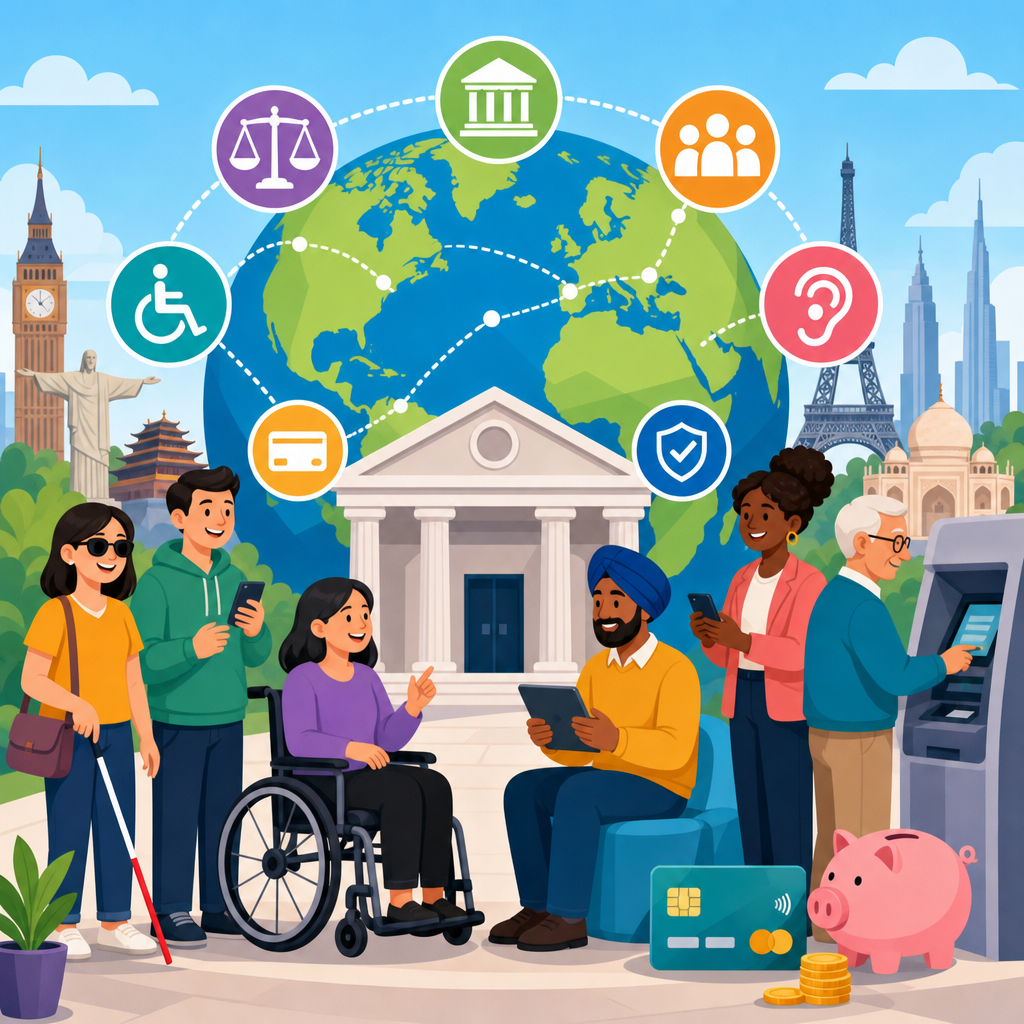
Accessible banking and financial services sit at the intersection of disability rights, consumer protection, digital inclusion, and economic participation. Around the world, regulators increasingly recognize that a current account, payment card, mortgage application, insurance policy, or investment platform is unusable if a customer cannot read disclosures, navigate authentication, sign forms, hear support prompts, or enter a branch independently. In practice, accessible banking means products, channels, communications, and environments designed so people with visual, hearing, mobility, cognitive, speech, neurodivergent, and psychosocial disabilities can use them with dignity, safety, and reasonable independence.
This international perspective matters because banking is now borderless in operation but fragmented in regulation. Global banks run common apps across continents, card networks process transactions internationally, and fintech firms scale quickly, yet accessibility duties still arise from local disability statutes, human rights conventions, technical standards, financial conduct rules, and case law. I have worked on accessibility reviews for digital account opening, ATM estates, and complaints journeys, and the same pattern appears repeatedly: where rules are vague, firms treat accessibility as a retrofit; where obligations are explicit, accessibility becomes part of procurement, design, testing, and governance.
As a hub for global views on disability rights, this article compares the main legal models shaping accessible banking and financial services worldwide. It explains how the United Nations Convention on the Rights of Persons with Disabilities influences national law, why the European Union has moved toward harmonized product and service requirements, how the United States blends civil rights enforcement with technical standards, and where countries in Asia-Pacific, Latin America, Africa, and the Middle East are building stronger frameworks. It also highlights the operational issues banks actually face, from accessible authentication to plain-language disclosures, so readers can connect legal principles to day-to-day financial access.
Global baseline: disability rights principles that shape financial access
The most important global reference point is the United Nations Convention on the Rights of Persons with Disabilities, or CRPD. It does not function like a banking rulebook, but it establishes the rights framework that national regulators and courts increasingly apply to financial services. Core concepts include equality before the law, accessibility, non-discrimination, independent living, access to information, and equal participation in economic life. For banking, those principles support the idea that a disabled customer must be able to open accounts, use payment services, receive statements, understand terms, authenticate securely, and complain effectively without facing avoidable barriers.
Countries that ratified the CRPD generally translate it into domestic disability law, consumer rights rules, or accessibility standards. The exact mechanism varies. Some jurisdictions create broad anti-discrimination duties and let courts interpret them case by case. Others prescribe technical requirements for websites, payment terminals, public buildings, and communications. A practical lesson from cross-border compliance work is that firms should not rely only on narrow banking statutes. Accessibility obligations often come from overlapping sources, including telecom rules, e-commerce law, procurement standards, equality legislation, and data protection requirements governing consent and information delivery.
Another common principle is reasonable accommodation, sometimes paired with universal design. Reasonable accommodation addresses individual needs, such as providing documents in braille, large print, easy read, audio, or accessible PDF, or allowing an alternative signature process for a customer who cannot use a standard touchscreen. Universal design looks upstream and aims to reduce the need for exceptions by building accessible mobile apps, websites, ATMs, call flows, branch layouts, and card readers from the start. The strongest regulatory systems require both: inclusive default design plus responsive support when standard journeys still fail certain users.
European Union and United Kingdom: from equality duties to service accessibility rules
The European Union has moved furthest toward detailed accessibility obligations for financial services. The European Accessibility Act requires certain consumer banking services, e-commerce functions, payment terminals, computers, smartphones, and related digital interfaces to meet accessibility requirements across member states, with implementation applying from 2025 for many services. In banking, this matters for online banking portals, mobile apps, payment authentication journeys, information presentation, support channels, and devices used to access payment services. Firms often map these requirements against EN 301 549, the European standard aligned closely with Web Content Accessibility Guidelines, especially for software and web content.
Alongside the Accessibility Act, the Payment Services Directive, consumer credit rules, and broader equality law shape expectations. If strong customer authentication is mandatory, the authentication method still has to be usable by disabled customers. If a pre-contract disclosure is required, it has to be presented accessibly enough to be understood. This is where operational friction appears. I have seen banks comply formally with disclosure timing while failing functionally because screen readers could not navigate accordion menus, CAPTCHA alternatives were absent, or timeout settings ended sessions before customers using assistive technology could complete actions.
The United Kingdom, outside the EU but closely watched internationally, relies on the Equality Act 2010, Financial Conduct Authority consumer protection expectations, the Public Sector Bodies Accessibility Regulations for relevant public entities, and market practice shaped by WCAG. The Equality Act’s anticipatory duty is especially significant. Service providers must think ahead about barriers rather than wait for a complaint. For banks, that can include accessible debit card design, hearing loop availability, relay services, plain-language vulnerability communications, and alternatives to voice-only security checks. The FCA’s Consumer Duty adds pressure by requiring firms to deliver good outcomes for retail customers, which clearly includes disabled customers.
United States and Canada: civil rights enforcement, digital access, and branch obligations
In the United States, accessible banking rests primarily on the Americans with Disabilities Act, especially Title III for places of public accommodation, plus Section 504 of the Rehabilitation Act for entities receiving federal financial assistance, and specific accessibility rules affecting communications and technology. Although the ADA predates modern mobile banking, courts and settlements increasingly treat websites and apps as part of a bank’s service offering. The Department of Justice has repeatedly supported the principle that inaccessible digital services can exclude disabled people from equal participation, even when the account itself is legally available.
For physical banking, ADA Standards for Accessible Design affect branch entrances, counters, routes, ATMs, and related facilities. ATM accessibility has been a major enforcement area for years, including tactile controls, audio output through standard headphone jacks, privacy considerations, and screen flow usability. The 2010 ADA Standards strengthened requirements, and litigation pushed many institutions to upgrade fleets. Yet physical compliance alone is no longer enough. If a customer can withdraw cash independently but cannot activate a card in an app, complete multifactor authentication, or read fee disclosures online, the broader service remains inaccessible.
Canada combines the Canadian Human Rights Act, the Accessible Canada Act for federally regulated entities, provincial human rights codes, and standards developed by provinces such as Ontario under the Accessibility for Ontarians with Disabilities Act. Banks regulated federally must also consider guidance from the Financial Consumer Agency of Canada and plain-language communication expectations. Canadian practice often emphasizes barrier prevention plans, feedback mechanisms, and progressive improvement. Compared with more litigation-driven environments, this can support stronger governance, though outcomes still depend on testing, executive accountability, and whether procurement contracts require accessible third-party platforms used for onboarding, payments, or investing.
Asia-Pacific, Latin America, Africa, and the Middle East: fast evolution with uneven enforcement
Outside Europe and North America, accessible banking rules are developing rapidly but unevenly. Australia is a leading example. The Disability Discrimination Act 1992, Australian Human Rights Commission processes, and robust use of WCAG in digital policy have influenced banks and insurers for years. Major institutions have published accessibility commitments covering branches, cards, ATMs, websites, apps, captioning, interpreter services, and support for customers experiencing vulnerability. In my experience, Australian firms often treat accessibility as a mainstream risk issue because reputational and legal exposure are both well understood.
India has an increasingly important framework through the Rights of Persons with Disabilities Act 2016, accessibility rules, and digital public infrastructure policies that influence financial inclusion. The scale challenge is enormous: banks must serve customers across many languages, devices, literacy levels, and connectivity conditions. Accessibility therefore overlaps with inclusive design more broadly. For example, a low-bandwidth mobile banking flow with clear language and predictable navigation helps screen reader users and customers with cognitive impairments alike. The Reserve Bank of India has also addressed customer service for persons with disabilities, including account operations and branch treatment.
Brazil, Mexico, South Africa, Singapore, and the Gulf states are also significant. Brazil’s Brazilian Inclusion Law and consumer protection environment support broader accessibility claims, while Pix and digital payments growth make app usability central. South Africa’s equality framework and constitutional rights language create a strong normative basis, though implementation varies. Singapore has advanced digital governance and inclusive design programs, which influence financial interfaces even where sector-specific accessibility provisions are less detailed than in the EU. Across the Middle East, disability strategies and smart government programs are improving public service accessibility, but private financial services may still depend heavily on voluntary adoption and procurement choices.
| Region | Main legal driver | Typical banking impact | Common gap |
|---|---|---|---|
| European Union | Accessibility service rules plus equality law | Apps, web journeys, payment terminals, disclosures | Inconsistent implementation across legacy systems |
| United Kingdom | Anticipatory equality duty and conduct regulation | Reasonable adjustments, communications, branch access | Authentication barriers and fragmented ownership |
| United States | Civil rights law and ADA design standards | ATM access, branch design, web and app claims | Reactive compliance through complaints or litigation |
| Canada | Human rights and barrier prevention laws | Accessible communications, planning, feedback channels | Variable provincial maturity |
| Asia-Pacific and emerging markets | Mixed disability statutes and policy guidance | Mobile-first access, branch service, language inclusion | Enforcement capacity and supplier dependency |
What accessible banking requires in practice
Across jurisdictions, the legal wording differs, but the practical requirements are remarkably consistent. First, digital banking must work with assistive technologies. That means semantic structure, keyboard access, visible focus states, screen reader compatibility, color contrast, scalable text, captions, meaningful error messages, and forms that can be completed without time pressure traps. Second, documents must be available in accessible formats, including tagged PDFs, HTML versions, braille or large print on request, and plain-language summaries for complex products. Third, customer support must offer more than one channel, such as text relay, chat, email, video relay, and trained human escalation.
Authentication is one of the hardest issues globally. Security teams often deploy one-time passcodes, image-based puzzles, gesture controls, or voice biometrics without testing whether blind customers, deaf customers, people with speech differences, or people with dexterity impairments can use them reliably. Good regulation does not require weaker security; it requires equivalent access. In practice, that means offering multiple authentication methods, allowing accessible device pairing, avoiding inaccessible CAPTCHA, and monitoring abandonment data by journey step. When we reviewed failed applications for one multinational bank, the biggest accessibility problem was not form labels but a third-party identity verification SDK that trapped screen reader focus.
Physical access also remains essential, even in digital-first markets. Branches need step-free routes, appropriate counter heights, hearing support, tactile signage where relevant, accessible queuing systems, private consultation spaces, and staff who understand how to assist without patronizing. ATMs and card terminals still matter because cash use, merchant payments, and PIN entry remain foundational. Card design can support access too: tactile notches, clear orientation, high-contrast printing, and non-embossed alternatives when embossing interferes with readability. The core rule is simple: a banking service is accessible only if the whole customer journey works, not just one channel in isolation.
How global financial institutions can build a defensible accessibility program
For multinational banks, the safest approach is to create one enterprise accessibility baseline that meets the highest common denominator, then localize where national law requires more. Start with a policy tied to recognized technical standards such as WCAG 2.2 AA for web and mobile content and EN 301 549 for broader ICT considerations. Then embed accessibility into procurement, design systems, quality assurance, call center scripting, branch standards, document templates, and incident management. If accessibility is not included in vendor contracts and acceptance criteria, institutions inherit defects from core banking platforms, onboarding tools, e-sign vendors, and payment providers.
Governance is where mature programs separate themselves. Effective banks assign executive ownership, maintain an accessibility risk register, test with disabled users, and train frontline staff as well as engineers. Metrics should include not only conformance issues but customer outcomes: successful logins, card activation completion, complaint themes, turnaround times for alternative formats, and branch service availability. Internal audit should review whether accessibility controls operate consistently across countries and business lines. This hub article should also connect readers to deeper topics such as digital banking accessibility, ATM standards, procurement rules, complaints handling, and inclusive fintech design across different legal systems.
Comparing global rules for accessible banking and financial services reveals a clear direction of travel. Disability rights are no longer peripheral to finance; they are becoming a core condition of lawful, fair, and competitive service delivery. The strongest frameworks combine rights-based duties, technical standards, conduct supervision, and practical enforcement. The weakest rely on vague goodwill, which leaves customers to negotiate basic access one complaint at a time. Across every region, the same truth holds: inaccessible banking excludes people from wages, savings, credit, insurance, and independence.
For regulators, the priority is clearer alignment between disability law and financial sector rules, especially for digital identity, authentication, disclosures, and outsourced technology. For firms, the priority is execution. Audit your mobile apps, web journeys, branches, ATMs, statements, and support channels against recognized standards and real customer testing. Fix the barriers that block essential tasks first, then build accessibility into procurement and product governance so they do not return. For readers exploring global views on disability rights, use this hub as the starting point and map each subtopic to the customer journey your organization actually delivers.
Frequently Asked Questions
1. What does “accessible banking and financial services” actually mean in a global regulatory context?
Accessible banking and financial services refers to the practical ability of people with disabilities, older adults, and others with access needs to use financial products and services on equal terms with other customers. Globally, that goes far beyond wheelchair ramps or large-print brochures. It includes whether a customer can independently open an account, review disclosures, complete identity verification, use online and mobile banking, receive fraud alerts, authenticate transactions, sign agreements, communicate with customer support, and access ATMs, branches, payment terminals, and investment platforms.
In regulatory terms, accessibility usually sits at the overlap of several legal frameworks. Disability rights laws often prohibit discrimination and require reasonable accommodations or accessible design. Consumer protection rules may require clear disclosures, fair treatment, and usable complaint channels. Digital accessibility standards increasingly shape website, app, and document requirements. Financial inclusion policies also matter, especially where governments view access to payments and basic accounts as essential for economic participation.
Different countries organize these duties differently. Some rely on broad anti-discrimination statutes that apply to banks and insurers as public-facing service providers. Others impose sector-specific rules through financial regulators, central banks, or payments authorities. In some regions, accessibility expectations are driven by public procurement, telecom rules, e-government standards, or case law rather than a single banking accessibility law. The result is a patchwork: the underlying principle of equal access is widely shared, but the compliance path varies by jurisdiction, product type, and delivery channel.
For financial institutions, the key takeaway is that accessibility is not a niche feature. It is a core usability, compliance, and customer trust issue. A mortgage disclosure that cannot be read by a screen reader, a call center that relies entirely on voice prompts, or a two-factor authentication flow that excludes customers with dexterity or visual impairments can create legal risk and deny meaningful access to essential financial services.
2. How do global rules differ between regions such as North America, Europe, the United Kingdom, and Asia-Pacific?
The biggest difference is not whether accessibility matters, but how it is enforced and where the legal obligations come from. In North America, accessibility duties are often grounded in civil rights and anti-discrimination law, supplemented by consumer protection and digital accessibility expectations. In the United States, institutions may need to consider disability discrimination obligations, fair access issues, and the accessibility of websites, apps, kiosks, and customer communications even where there is no single banking-specific accessibility code covering every channel. In Canada, accessibility obligations can arise through federal and provincial frameworks, human rights law, and standards initiatives, with regulated entities increasingly expected to plan, remove barriers, and report on accessibility measures.
Europe tends to be more structured around harmonized accessibility legislation layered on top of equality law and national implementation rules. The European accessibility framework increasingly affects digital services, e-commerce features, consumer interfaces, self-service terminals, and information formats. Financial firms operating across EU member states must also account for local transposition, enforcement differences, and the interaction between accessibility, consumer law, electronic identification requirements, and data protection. The practical impact is that banks may need more formalized accessibility governance, testing, and documentation across multiple markets.
The United Kingdom has its own combination of equality law, consumer duty concepts, and accessibility expectations tied to digital services and fair treatment. UK regulators have emphasized customer outcomes, vulnerability, and inclusive design in ways that can be highly relevant to disability access, even when not framed exclusively as disability law. That means firms may be judged not only on whether they technically comply with a standard, but also on whether customers can successfully understand, navigate, and use products in real-world conditions.
Across Asia-Pacific, the picture is more varied. Some jurisdictions have strong disability inclusion laws and advanced digital accessibility guidance, while others rely more heavily on industry codes, inclusive finance policies, or broader public service accessibility rules. Markets with rapid digital banking growth may focus on mobile access, digital identity, and electronic payments, but still differ significantly on enforcement intensity. For multinational institutions, this means there is rarely a one-size-fits-all checklist. A global baseline is essential, but local legal mapping remains critical.
3. Which banking and financial activities create the highest accessibility compliance risks?
The highest-risk activities are usually the ones customers cannot avoid and cannot easily complete through another channel. Digital onboarding is a major example. If a bank requires customers to upload identity documents, take live selfies, read CAPTCHA challenges, or complete timed authentication steps without accessible alternatives, it may effectively block access at the front door. Similar issues arise in credit applications, mortgage workflows, insurance claims submissions, investment account setup, and fraud response processes where speed and independent use are essential.
Authentication and security controls are another frequent problem area. Financial institutions understandably prioritize fraud prevention, but poorly designed security measures can exclude customers with visual, hearing, speech, cognitive, or dexterity impairments. Voice-only phone verification, inaccessible one-time passcode interfaces, small touch targets, biometric requirements without alternatives, or card readers that are difficult to manipulate can all create barriers. Regulators increasingly expect firms to balance security with accessibility rather than treating them as competing goals.
Customer communications also carry substantial risk. Required disclosures, terms and conditions, fee notices, privacy notices, arrears letters, investment warnings, and insurance policy documents must often be provided in ways customers can actually perceive and understand. If PDFs are not tagged correctly, videos lack captions, chat support is inaccessible, or phone systems cannot support relay services, institutions may undermine both accessibility and informed consent. This becomes especially sensitive for vulnerable customers making major financial decisions under time pressure.
Physical and hybrid service channels matter too. ATMs, branches, kiosks, payment terminals, signature pads, and queue systems can all present barriers if they are poorly positioned, rely on inaccessible touchscreens, or fail to provide audio, tactile, visual, and staff-assisted options. In many countries, reducing branch networks and pushing customers online has increased regulatory scrutiny of whether alternative channels are genuinely accessible. Firms face the greatest risk where barriers affect essential services such as cash withdrawal, payment authorization, card activation, account recovery, or dispute resolution.
4. How can banks, insurers, and fintech companies build a compliance strategy that works across multiple countries?
The most effective strategy is to create a strong global accessibility baseline and then layer local legal requirements on top. A baseline should cover core principles such as inclusive design, accessible procurement, testing against recognized digital accessibility standards, alternative communication formats, accessible authentication options, staff training, and escalation processes for accommodation requests. That baseline should apply not just to websites and apps, but also to documents, call center scripts, kiosks, account statements, payment flows, and third-party platforms embedded into the customer journey.
From there, firms should map country-specific obligations by channel and product. That means identifying which rules come from disability law, which come from financial regulation, and which arise through consumer law, telecom rules, e-signature requirements, or market conduct expectations. In one jurisdiction the main issue may be anti-discrimination and reasonable accommodation; in another it may be technical digital accessibility requirements; in another it may be the regulator’s expectations around vulnerable customers and fair outcomes. Without this mapping, organizations often overlook important obligations because they assume accessibility belongs only to legal or only to UX teams.
Operational governance is just as important as legal analysis. Leading firms assign clear ownership, set accessibility requirements in product development lifecycles, include accessibility clauses in vendor contracts, and require testing before launch and after updates. They also monitor complaints, abandonment rates, support interactions, and exception requests to identify where barriers still exist. This is especially important in financial services, where inaccessible experiences may not always generate complaints; some customers simply give up, switch providers, or rely on others to complete tasks that should be private and independent.
Finally, firms should involve disabled users directly. Accessibility programs are much stronger when they include user research, assistive technology testing, feedback loops, and review by people with lived experience. That approach helps companies move beyond checkbox compliance toward genuine usability. It also puts them in a better position if regulators, courts, or ombudsman schemes ask whether the firm took reasonable, proactive steps to ensure equal access.
5. Why is accessibility becoming a strategic issue for financial institutions, not just a legal requirement?
Accessibility is increasingly strategic because financial services are foundational to daily life and are rapidly becoming more digital, more automated, and more dependent on self-service. If customers cannot independently manage payments, verify identity, compare products, receive alerts, or contact support, they are effectively excluded from the financial system. Regulators understand this more clearly than ever, particularly as societies age and as governments promote digital-first service delivery. What once may have been treated as a narrow accommodation issue is now seen as central to consumer outcomes, resilience, and trust in the financial sector.
There is also a strong business case. Accessible design tends to improve usability for a far broader group of customers, including people using mobile devices in poor lighting, customers with temporary impairments, non-native speakers, and older adults. Clearer navigation, better document structure, captioned video, flexible authentication, and multi-channel support often reduce errors, improve completion rates, and lower service costs. In competitive markets, firms that make complex financial products easier to understand and use can strengthen acquisition, retention, and brand reputation.
Just