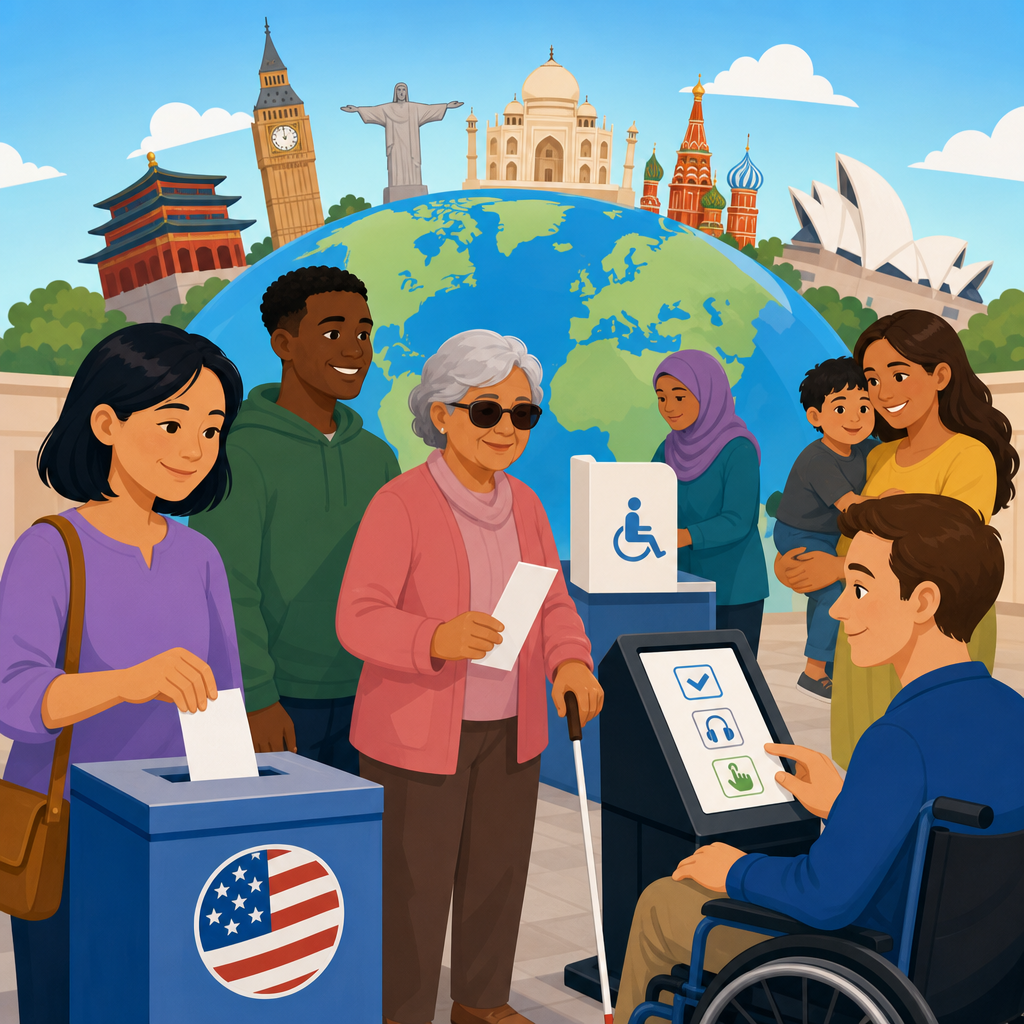
Accessible elections policy determines whether people with disabilities can register, receive information, vote privately, and participate fully in public life. For U.S. readers, looking abroad is not an abstract exercise in comparative politics; it is a practical way to identify tested solutions, avoid repeated mistakes, and understand how disability rights are implemented under different legal systems. In this context, accessible elections policy includes physical access to polling places, accessible ballot design, alternative voting methods, plain-language information, assistive technology, poll worker training, and enforceable legal remedies. It also sits within the broader field of global views on disability rights, where voting is treated not as a special accommodation but as a core civil and human right.
The most important international benchmark is the United Nations Convention on the Rights of Persons with Disabilities, especially Article 29, which requires states to guarantee political participation on an equal basis with others. That commitment reaches beyond ramps and curb cuts. It covers accessible procedures, facilities, and materials; the right to a secret ballot; assistance chosen by the voter where necessary; and active support for public participation. Countries vary widely in how well they meet those obligations, but the global record offers clear lessons. Some nations have built strong election accessibility through centralized standards, universal design, and early disability consultation. Others have adopted progressive laws without delivering consistent implementation. The difference matters because election access fails most often in the details.
I have worked on content and policy analysis touching election administration, disability communications, and public-sector compliance, and one pattern is constant: accessibility improves when officials stop treating disabled voters as edge cases. Systems work best when accessibility is planned from the start, tested by actual users, and monitored with public accountability. U.S. readers can learn from countries that institutionalized tactile ballots, mobile voting, sign-language broadcasts, accessible voter guides, and nationwide polling-place audits. They can also learn from places where overreliance on postal voting, poorly certified machines, or inaccessible party campaigns left major gaps. A global perspective sharpens domestic policy because it shows what equal participation looks like in practice, not only in principle.
Global disability rights frameworks shape election access
Global views on disability rights begin with a shift in model. Older systems often framed disability through charity, guardianship, or medical incapacity. Modern rights-based systems use the social model of disability, which recognizes that exclusion is produced by barriers in law, design, communication, transportation, and attitudes. That distinction is crucial in elections. If the problem is assumed to be the voter’s impairment, policy tends toward substitutes and exceptions. If the problem is inaccessible systems, policy aims at redesign, support, and equal agency.
The CRPD pushed this shift worldwide, and regional human rights instruments reinforced it. The European Union’s accessibility agenda, the Council of Europe’s standards, the Inter-American human rights system, and national constitutional equality guarantees have all influenced election law. In practice, this means that countries increasingly review whether polling stations are step-free, whether websites meet WCAG standards, whether ballots can be read by screen readers, and whether people under guardianship retain voting rights. For U.S. readers, the key lesson is that election accessibility is strongest when grounded in civil rights law rather than administrative discretion alone.
Another global trend is recognition that disability intersects with language, age, rural residence, and poverty. Accessible elections policy therefore cannot stop at one technical fix. A blind voter may need a tactile ballot guide, but also accessible transit and a plain-language voter guide. A Deaf voter may need captioned debates, sign-language interpretation, and text-based hotlines. A voter with an intellectual disability may need easy-read materials and legal protection from disenfranchisement. Countries that plan for these overlapping needs generally outperform those that rely on one device or one accommodation form.
What leading countries do well in accessible elections
Several countries provide useful models. Australia has long combined legal protections with practical voting alternatives, including telephone voting options for blind or low-vision voters in some jurisdictions and strong guidance from the Australian Electoral Commission. New Zealand has invested in Easy Read election information and works with disability organizations to test voter communications before major elections. Sweden and Norway emphasize high baseline accessibility in public buildings and public information, reducing last-minute election fixes. Canada has required election officers to remove barriers, provide transfer certificates when polling places are inaccessible, and publish accessibility reports after elections.
India offers another important case because of scale. The Election Commission of India has developed disability-focused election initiatives that include accessible voter awareness materials, home voting options for certain voters with disabilities and older adults, and the use of mobile apps to identify polling station facilities. While implementation varies across states, the lesson is that accessibility can be systematized even in a massive, diverse democracy. Brazil has expanded accessible polling locations and assistive options through its electoral courts, showing how centralized election management can accelerate nationwide standards.
These examples matter because they show accessibility as an operational discipline. Strong systems map barriers before election day, certify equipment, train temporary staff, and publish complaint channels. They do not assume that a legal right enforces itself. In my experience reviewing public accessibility programs, the biggest gains come from routine practices: checklists, procurement standards, usability testing, and after-action reviews with disability advocates. Countries that normalize those practices create fewer avoidable barriers and more voter confidence.
Lessons from policy tools that deliver real access
Accessible elections policy succeeds when it turns broad rights into specific administrative tools. U.S. readers can evaluate international models by asking a simple question: what tool solved what barrier? The answers are concrete.
| Policy tool | Barrier addressed | Global example | Lesson for U.S. readers |
|---|---|---|---|
| Tactile ballot guide | Private, independent voting for blind voters | India and parts of Latin America | Privacy improves when accessibility is built into the ballot process, not added through assistance alone |
| Easy Read voter materials | Complex instructions for voters with intellectual disabilities | New Zealand and the United Kingdom | Plain language increases comprehension for many voters, not only one group |
| Mobile or home voting | Inaccessible transport or severe mobility limitations | Australia, India, and some European systems | Alternative voting methods should supplement, not replace, accessible polling places |
| National polling-place audits | Uneven local compliance | Canada and Sweden | Public reporting turns accessibility from promise into measurable performance |
| Sign-language and captioned broadcasts | Inaccessible campaign and election information | New Zealand and South Africa | Democratic access includes information access before election day |
Each tool has limits. Tactile guides fail if poll workers do not know how to position them correctly. Easy Read documents fail if they are produced too late or distributed only online. Mobile voting can create security and chain-of-custody concerns unless procedures are tightly controlled. Accessibility audits become symbolic if they lack remediation deadlines. The lesson is not that any one intervention is enough. The lesson is that effective policy bundles legal rights, technical standards, and administrative discipline.
Another useful international practice is co-design. Election agencies in countries with stronger records often consult organizations led by disabled people before procurement, pilot testing, and communications rollout. That process catches practical errors that legal review misses. A website can technically pass accessibility checks while still confusing screen-reader users. A polling site can satisfy minimum entry access while offering no accessible route to the voting booth. Real users find those failures early, when they are cheapest to fix.
Where global systems still fall short
International comparison is valuable partly because it shows persistent failures. Many countries still allow polling places in schools, churches, or municipal buildings with stairs, heavy doors, poor lighting, or inaccessible restrooms. Election information is often translated into multiple spoken languages while remaining unavailable in braille, audio, captioned video, or easy-read formats. In some states, people under plenary guardianship still face formal or informal disenfranchisement despite modern disability rights standards. These are not isolated defects; they reflect a deeper problem of treating electoral participation as secondary to administrative convenience.
Technology introduces a different set of risks. Electronic voting machines can expand independence, but only if they include verified accessibility features, audio interfaces, tactile controls, and privacy safeguards. Several countries have discovered that adopting new equipment without robust testing simply shifts exclusion from the doorway to the interface. Online voter information portals can improve access dramatically for many users, yet inaccessible PDFs, unlabeled forms, and time-out settings can block participation. The global lesson is straightforward: digital government is not automatically accessible government.
There are also tensions between ballot secrecy and assistance. Some systems rely heavily on family members or poll workers to assist disabled voters. While help can be necessary, overreliance on informal assistance undermines privacy and increases the risk of undue influence. Better systems preserve voter choice by offering independent methods wherever possible and clearly regulating assistance when it is requested. U.S. readers should pay attention to this distinction because true accessibility protects autonomy, not just ballot completion.
What U.S. election officials, advocates, and voters can apply now
The United States already has important foundations through the Americans with Disabilities Act, the Rehabilitation Act, the Help America Vote Act, the Voting Rights Act, and state election laws. Yet implementation remains uneven across counties and precincts. International experience suggests five practical priorities. First, standardize polling-place audits nationwide using clear measures for parking, path of travel, entrances, voting area layout, seating, lighting, and signage. Second, require all voter education materials in plain language, large print, tagged PDF, HTML, audio, captioned video, and where relevant, braille on request. Third, improve procurement rules so accessible voting devices and websites are usability-tested with disabled voters before deployment.
Fourth, expand poll worker training beyond etiquette. Staff need scenario-based instruction on setting up accessible equipment, communicating with Deaf voters, supporting voters with cognitive disabilities without patronizing them, and resolving barriers in real time. Fifth, create transparent reporting after each election. Canada’s post-election accessibility reporting offers a strong model because it documents complaints, remediation steps, and future improvements. That kind of public record helps advocates, journalists, and administrators see whether reforms are working.
For readers exploring global views on disability rights, accessible elections are also a gateway issue. They connect to transportation policy, digital accessibility, legal capacity, inclusive education, and media regulation. They also point to related topics worth following across this International Perspective hub: comparative voting rights for people under guardianship, accessible political communication standards, disability-inclusive disaster voting plans, and the role of disabled people’s organizations in democratic reform. When these issues are examined together, the pattern is clear: democracies become more representative when accessibility is treated as infrastructure, not exception.
Global accessible elections policy gives U.S. readers something more useful than inspiration: it provides evidence. Across democracies, the same principles recur. Voting access improves when disability rights are framed as civil rights, when election rules are translated into operational standards, and when disabled people help design the systems meant to serve them. It weakens when governments rely on ad hoc accommodations, inaccessible technology, or local discretion without oversight. The international record is not perfect, but it is rich enough to show what works, what fails, and why.
The clearest takeaway is that election accessibility is not one reform. It is a chain that includes registration, transportation, information, equipment, staffing, complaint resolution, and legal enforcement. Break any link and equal participation becomes conditional. Countries such as Canada, New Zealand, Australia, India, Sweden, and Brazil demonstrate that meaningful progress is possible under very different political and administrative structures. Their examples do not transfer mechanically to the United States, but they do offer tested tools and standards that American jurisdictions can adapt now.
For anyone building a stronger understanding of global views on disability rights, start with elections because they reveal how seriously a society treats equal citizenship. Review how your state or county handles accessible voting, compare it with leading international practices, and push for the fixes that close the gap. Better policy is not speculative. It is already visible around the world.
Frequently Asked Questions
1. Why should U.S. readers pay attention to accessible elections policies in other countries?
U.S. readers should pay attention because international examples turn accessibility from a general principle into a set of real-world policy choices. Looking abroad shows how different democracies address the same core question: how to make sure voters with disabilities can register, receive understandable election information, travel to voting sites, cast a ballot privately and independently, and take part in civic life on equal terms. That comparison is valuable because it reveals which reforms are merely well-intentioned and which ones have actually been implemented at scale.
For American audiences, this is especially useful because many accessibility barriers are familiar and recurring. Polling places may be physically difficult to enter, election instructions may be hard to understand, websites may not work with assistive technology, and voting systems may not adequately protect both privacy and independence. Other countries have tested solutions to these problems through national standards, local administration rules, disability consultation requirements, and alternative voting methods. Studying those systems can help U.S. policymakers, advocates, election officials, and voters identify ideas worth adapting rather than reinventing from scratch.
There is also a legal and civic lesson. Accessible elections policy is not just about convenience; it is about equal citizenship. International practice shows how disability rights can be embedded into election law, public administration, and election-day operations. Some systems emphasize universal design, some focus on enforceable accommodations, and others rely on centralized planning or public oversight. For U.S. readers, these models provide a practical framework for asking better questions: Are accessibility standards clear enough? Is compliance measured? Are disabled voters consulted directly? Are election workers trained to support rights without undermining voter autonomy? Global policy examples help sharpen those questions and make domestic reform more concrete.
2. What parts of accessible elections policy matter most when comparing countries?
The most important areas are the ones that shape the entire voting experience from start to finish. Registration is a key starting point. If voter registration systems are inaccessible online, difficult to navigate in person, or confusing for people with cognitive, sensory, or mobility disabilities, then barriers arise before voting even begins. Countries that do this well typically provide multiple registration methods, accessible digital forms, plain-language guidance, and support that does not force voters to give up independence.
Election information is another major category. Voters need accessible instructions about deadlines, identification requirements, polling locations, ballot options, and complaint procedures. Strong systems often provide information in formats such as screen-reader-compatible webpages, large print, plain language, captioned video, sign language interpretation, Braille where appropriate, and multilingual materials that also account for disability access. The key lesson is that information access is not a side issue. If a voter cannot understand how or where to vote, formal voting rights become much weaker in practice.
Physical access to polling places remains essential as well. This includes ramps, doorway width, accessible parking, seating, lighting, signage, low-height voting surfaces, and routes that are usable from entry to exit. But strong policy goes beyond building access alone. It also addresses transportation, long lines, and emergency procedures, all of which can disproportionately affect disabled voters. Comparisons across countries often show that accessibility succeeds when standards are specific and inspections happen before election day, not after complaints are filed.
Ballot access and voting technology are equally important. The strongest systems aim to preserve secrecy, privacy, and independence. That can include tactile ballot tools, audio ballot interfaces, accessible voting machines, the right to bring a person of choice for assistance, and carefully regulated alternative voting methods such as postal or mobile voting where appropriate. Finally, oversight matters. A country may have excellent rights on paper, but if there is no monitoring, data collection, enforcement, or disability community input, implementation can fall short. For U.S. readers, the most useful comparisons are the ones that examine the full ecosystem rather than a single accommodation.
3. What practical lessons can the United States take from global approaches to accessible voting?
One practical lesson is that accessibility works best when it is built into election administration from the beginning, not added at the last minute. In many countries, the most successful reforms come from planning accessibility as a baseline requirement rather than treating it as an exception. For the United States, that means integrating accessibility into procurement, poll worker training, voter education, website design, polling place selection, and post-election review. A reactive system that waits for individual complaints tends to produce uneven access and repeated failures.
Another lesson is the value of clear national or system-wide standards. Even in countries with local election administration, accessibility improves when local officials work within defined rules for physical access, communication access, assistive voting options, and complaint handling. U.S. readers can see from international examples that inconsistency itself becomes a barrier. If one jurisdiction offers accessible online information and another does not, or if one polling location is well-equipped and another is not, equal voting rights become dependent on geography. Global examples reinforce the importance of minimum standards that are specific, measurable, and consistently enforced.
A third lesson is that technology helps only when it is paired with usability, testing, and trust. Some countries have invested in accessible election websites, remote ballot-marking tools, or assistive devices at polling sites, but the most effective systems usually involve user testing with disabled voters and clear backup procedures when technology fails. That is a crucial point for U.S. discussions, where new tools are often introduced as universal solutions. International experience shows that accessible elections require both innovation and redundancy. A voter should not lose access because a device malfunctions, a website is incompatible with assistive software, or poll workers are unsure how to operate equipment.
Perhaps the most important lesson is that disabled people must be involved in designing, reviewing, and improving election systems. Around the world, policies tend to be stronger when disability organizations are consulted early and often, rather than after implementation problems emerge. For U.S. readers, this means that accessibility policy should be shaped not only by lawyers, administrators, and vendors, but also by voters with lived experience across a range of disabilities. That approach leads to more realistic standards, better training, and greater public confidence in the fairness of the process.
4. How do global policies address the balance between ballot security and accessibility?
Global accessible elections policy often demonstrates that security and accessibility should not be treated as opposing goals. A well-designed election system can protect the integrity of the vote while also ensuring that disabled voters can cast ballots privately and independently. The key is to design safeguards that account for different access needs instead of assuming that a one-size-fits-all process is inherently secure. In many countries, the policy challenge is not whether to choose access or security, but how to structure identification, verification, assistance, and ballot handling rules so that both values are respected.
For example, some systems allow voters to receive assistance from a person they trust while also setting rules that prohibit coercion and preserve voter intent. Others permit alternative voting methods such as absentee, postal, mobile, or supervised remote options for voters who face barriers at polling places. These approaches are typically accompanied by chain-of-custody rules, identity checks, witness procedures, or official oversight mechanisms. The lesson for U.S. readers is that flexibility does not automatically weaken election integrity. In many cases, rigid procedures create exclusion without delivering meaningful security benefits.
Another useful international lesson is that privacy and independence are central security concerns too. If a disabled voter must rely on someone else because no accessible equipment or ballot format is available, that is not just an accessibility problem; it is also a problem of ballot secrecy and equal participation. Strong policies recognize that a secure election must protect the individual voter’s autonomy. That is why accessible ballot-marking devices, tactile guides, audio systems, and trained poll workers matter. They reduce the need for workarounds that can compromise privacy.
U.S. readers can also learn from countries that use layered safeguards instead of singular barriers. Rather than depending on one restrictive rule, strong systems often combine physical security, audit procedures, transparent administration, voter education, and complaint mechanisms. This creates room for accommodation without abandoning accountability. The broader takeaway is that accessible elections policy should be evaluated by asking whether it expands lawful participation while maintaining verifiable procedures. When done well, accessibility strengthens democratic legitimacy because it ensures more eligible citizens can participate on equal terms.
5. What should advocates, journalists, and policymakers in the U.S. look for when evaluating international election accessibility models?
They should start by looking past headlines and asking how a policy actually works in practice. A country may have impressive legal language recognizing the political rights of persons with disabilities, but the real test is implementation. Are polling places inspected for accessibility before elections? Are online voter portals compatible with screen readers and keyboard navigation? Are instructions available in plain language, captioned video, and other accessible formats? Are complaints resolved quickly enough to matter during an active election cycle? These practical details determine whether a model is worth studying or borrowing.
It is also important to ask who was involved in designing the system. The most credible international models are usually those developed with direct participation from disability organizations, election administrators, and technical experts. If disabled voters were not consulted, the policy may overlook common barriers or rely too heavily on assumptions. U.S. evaluators should pay close attention to whether the model addresses a broad range of disabilities, including mobility, visual, auditory, cognitive